
Arkansas Nuclear Voice: A conversation about spent nuclear fuel
Susan Edwards, Program Manager and Worth Wilsey, Program Coordinator, with Arkansas Nuclear Voice, Ed Mayer, a nuclear spent fuel expert from Holtec International, and historian and former Huntington resident, Jerry Moore, met recently to discuss the US Department of Energy’s (DOE) collaboration-based siting approach to identifying a location for the consolidated storage of the nation’s commercial spent nuclear fuel. The following is a recap of that conversation.
What is Arkansas Nuclear Voice?
Arkansas Nuclear Voice is one of twelve groups around the country selected by DOE to gather local perspectives, raise awareness, facilitate discussions and provide information about the need for consolidated, safe storage of spent nuclear fuel.
While open to speaking with “Any Arkansan who’s interested,” the group has been actively meeting with elected officials, community groups, and interested residents as well as participating in public forums, festivals, and fairs.
Edwards noted that at present, DOE has not selected any site in the United States for the storage facility, nor have any communities been identified to host such a facility. “Right now,” she said, “We’re at the information sharing stage.”
DOE’s Collaboration Based-Siting
DOE’s collaboration-based siting involves a three-stage process to identify a suitable location for one or more spent fuel storage facilities. And its foundation is that no site will be selected unless a community willingly volunteers as a host.
The process is currently in Stage 1 – Planning and Capacity Building – in which the consortia, including ANV, build relationships, mutual learning, and develop a common understanding of waste management-related topics.
Stage 2 – Site Screening and Assessment – is expected to begin late 2025/early 2026 – at which time DOE will issue initial site criteria and a national call for expressions of interest. Individuals, communities, counties, groups, etc. that are interested in learning more about hosting a facility can apply for technical assistance to engage with their community and begin preliminary and detailed site assessments.
The third stage – Negotiation and Implementation – would follow and is when DOE would negotiate agreements with willing and informed host communities. Licensing, construction, and operation activities would follow.
Edwards said this collaborative approach relies on local people demonstrating their interest and opting into in these conversations without obligation or binding agreements. She said, “DOE is committed to listening to communities and ensuring that the people most impacted by spent nuclear fuel policy and decisions will have a seat at the table.” She also noted that the Nuclear Regulatory Commission (NRC) would oversee safety at the site, with support from other federal, state, and local agencies.
The Huntington Connection
ANV hosted a community forum in Fort Smith in December 2024 which piqued the interest of Moore who contacted Wilsey to share his insights about Huntington and the region’s rich coal mining history.
Moore detailed the town’s origins and evolving relationship with energy. “The history of Huntington is deeply rooted in coal mining. Back in the early 1800s, our economy revolved around it. People relied on coal for heating and cooking, but they had no idea how it impacted their lungs and health. It was a different world.”
Moore emphasized the importance of preserving local heritage, calling Huntington “an amazing historical place.” He also drew parallels between modern energy conversations and past cultural resistance to innovation.
“As they electrified the country in the early 1900s, people feared electricity. There were anti-electricity ad campaigns warning it was some invisible danger. Same thing happened in the 1980s with microwaves, and even with Wi-Fi just a few years ago — people said it would cause cancer. That kind of resistance is driven by misunderstanding.”
Moore brought along an old political cartoon from that era to illustrate how new technologies have often been met with suspicion — a timeless reminder of the challenge Arkansas Nuclear Voice faces today as they educate communities about spent nuclear fuel storage.
What Is Spent Nuclear Fuel?
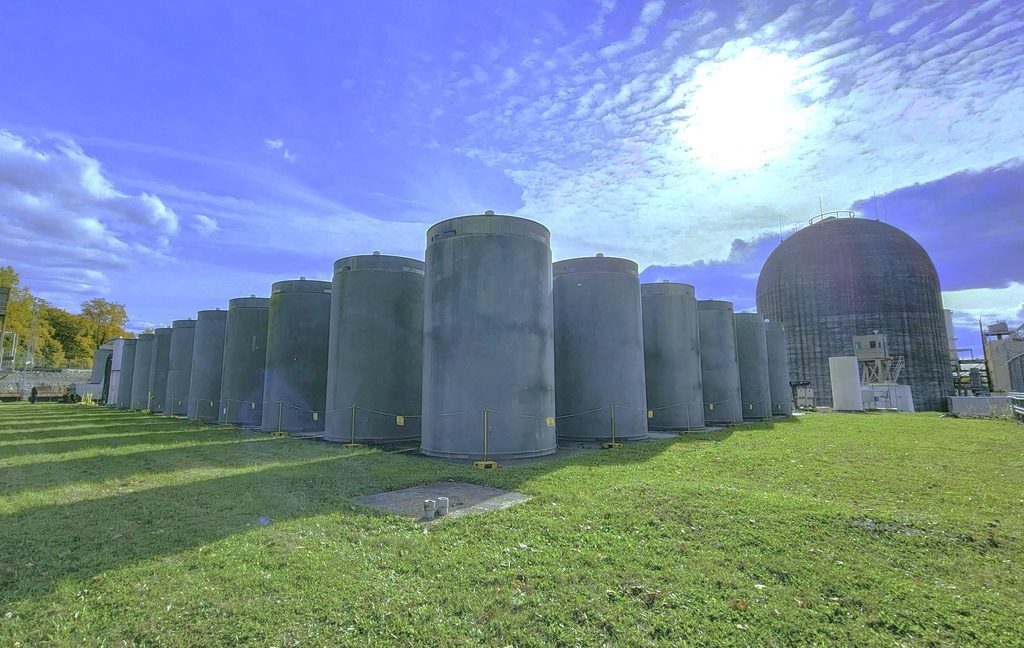
Commercial nuclear reactors, like Arkansas Nuclear One, use fuel that consists of small, solid ceramic pellets, about the size of a fingertip, which are held together in bundles made of multiple metal rods. Once the fuel can no longer sustain a nuclear reaction for power generation, the rods are removed from the reactor and placed in pools for cooling. From there, they are safely stored in dry casks at the site where they were used. Spent nuclear fuel is safely stored in dry casks throughout the U.S.
Storage and Transportation:
Spent fuel casks are steel-welded, leak-tight containers surrounded by concrete. They’ve been rigorously tested to endure extreme conditions like:
- Natural disasters
- Fire and flooding
- Vehicle and missile strikes
Transporting spent fuel is also a well-established and secure process:
- Fuel is moved via railcar from nuclear plants — both active and decommissioned.
- The transportation casks are engineered to withstand over 99% of potential accidents.
- Over the last 55 years, more than 2,500 shipments of commercial spent fuel have been safely transported across the country without radiological releases or harm to the public.
Mayer assured, “These railcars for cask transport are equipped with two locomotives and accompanied by a comprehensive security detail. They’re the most robust transportation package ever made for the railway system.
The National Need
As Wilsey explained, the U.S. faces a dilemma that necessitates the need for national spent fuel storage facilities. The dilemma, he said, is not about safety or security – it’s about economics. “Without national facilities, taxpayers have and will continue to bear the burden of the nation’s spent nuclear inventory. It all comes down to the federal government’s non-compliance with the 1982 Nuclear Waste Policy Act.” That Act requires that the government take possession of and manage commercial spent nuclear fuel.
Instead, the spent fuel is stored at more than 70 sites in 35 states. Consolidating it at one or more sites would reduce the overall economic burden.
From Spent Fuel to New Fuel
According to DOE, spent nuclear fuel can be recycled to make new fuel and byproducts. More than 90% of its potential energy still remains in the fuel, even after five years of operation in a reactor. And while the United States does not currently recycle spent nuclear fuel, other countries, such as France, do.
Reprocessing US spent fuel is a possibility, but as Mayer pointed out, it’s still years down the road. In the meantime, ANV is focusing on community engagement and education – informing the public about the storage of this fuel as well as the economic benefits for interested communities.
The Local Connection
Recalling her initial reaction to the collaboration-based siting project and potential opportunities it could bring to Arkansas, Edwards was immediately intrigued and welcomed the chance to be a part of DOE’s efforts. “Like most people, my nuclear understanding was built off the news, pop-culture, TV and movies. Luckily, we have subject matter experts who can truly explain the details everyday people.”
Edwards, a sixth generation Arkansan with roots in Magazine, Danville, and Russellville, has spent much of her career focused on rural communities, workforce development, and economic development at the federal level throughout the Mississippi River Delta and the Alabama Black Belt. That experience makes her comfortable with meeting all sorts of people including mayors, law enforcement and emergency management personnel.
She emphasized that the purpose of this project is to meet people where they are and “have straightforward conversations.” She added, “We don’t pretend to know what we don’t. We’re not trying to sell anything – we’re here to share honest, fact-based information.”
What’s Next
Stage 2 Screening and Assessment, anticipated to begin late 2025/early 2026, starts with a national call for expressions of interest. DOE is expected to suggest that potential; sites be ~2 square miles (or 1,280 acres), avoid endangered or threatened species and coastal barriers and deviate away from single use lands.
Those interested in participating in this phase will have to agree to ground rules set by DOE, be given access to a GIS tool to map potential sites and must respond to a set of general questions about the local area. Letters of support will also be accepted. Once DOE reviews these expressions of interest, eligible applicants will be awarded technical assistance funds to generate a community assessment report that DOE will use to determine a final set of sites for deeper consideration, negotiations and possible construction.
Even late in the process, communities retain the right to opt out. As Wilsey noted, “You can have the contract in hand and still say no thanks.”
Considerations
Mayer acknowledged there is a perception issue with spent nuclear fuel. “People assume it’s unsafe, but that’s not true. It’s just misunderstood.”
On the upside, a spent fuel facility represents a multi-billion-dollar federal capital investment and the creation of hundreds of jobs and workforce training.
On the environmental side, site assessments will include considerations such as geology, climate, proximity to population centers, and ecological sensitivity to avoid any potential conflicts.
In addressing environmental concerns Mayer stated, “There’s no environmental impact.” He noted that the spent fuel is in stainless steel containers that are seal-welded and placed in thick concrete casks that don’t allow for any emissions. In addition, he said, as an extra measure of safety, the site will be secured and monitored 24/7.
The Bottom Line
“This stage right now is about empowering communities,” Wilsey said. “The government needs interested parties more than they need the government. We tell people – don’t dream small. Dream big. If your town needs a hospital, schools or other infrastructure project, say it. Hosting a spent fuel facility is an opportunity to be part of a national solution, while reaping local benefits.”
To learn more or to ask about your community joining the conversation, go to www.arnuclearvoice.org.
Contributed by Susan Edwards and Worth Wilsey of Arkansas Nuclear Voice.