


By John Lovett
University of Arkansas System Division of Agriculture
Now that protein is taking a more prominent position in federal nutrition guidelines, you may have some questions about how to adjust your diet.
While the dietary guidelines are updated every five years by the U.S. Department of Agriculture and U.S. Department of Health and Human Services, the latest edition released in January is “the most significant reset of federal nutrition policy in decades,” according to the HHS.
Highly processed foods and beverages currently account for about two-thirds of the energy consumed in the United States, according to “The Scientific Foundation for the Dietary Guidelines for Americans,” the full report released by HHS and the USDA. The new guidelines emphasize “real food” and prioritize high-quality, nutrient-dense protein, fruits, vegetables, healthy fats and whole grains, while avoiding highly processed foods, added sugars and refined carbohydrates.
The Center for Human Nutrition, a part of the University of Arkansas System Division of Agriculture’s research arm, the Arkansas Agricultural Experiment Station, has developed a series of visual guidelines to help people better understand daily protein recommendations and other changes in the new Dietary Guidelines for Americans.
The Center for Human Nutrition’s Facebook page and the experiment station’s Instagram page have the graphics posted for public use.
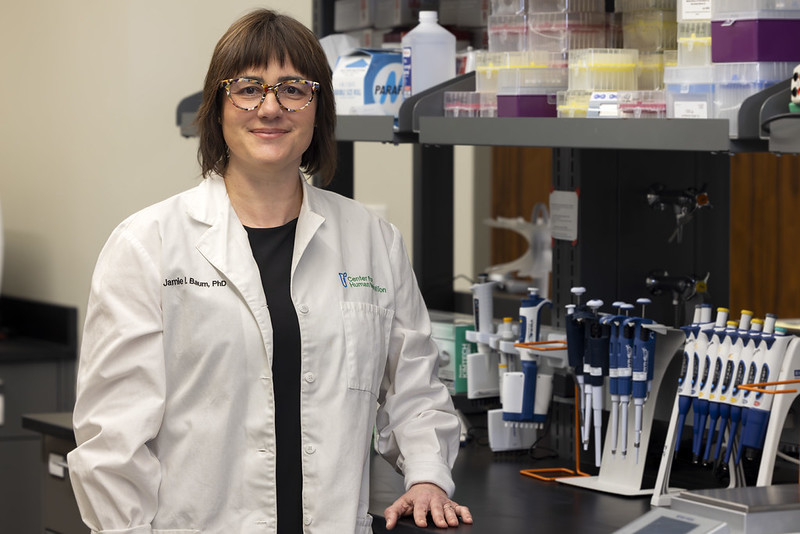
Jamie Baum, associate professor of nutrition and director of the Center for Human Nutrition, said that while most Americans already eat enough protein, the new guidelines support further increasing protein intake for additional health benefits, such as greater muscle mass and less fat, decreased hunger, improved bone health and decreased risk of chronic diseases such as type 2 diabetes and cardiovascular disease.
The emphasis on protein called for doubling the amount of daily intake from 0.8 grams per kilogram of body weight — the amount needed to prevent the body from breaking down its own proteins and to prevent protein deficiency — to 1.2-1.6 grams per kilogram of body weight.
That translates to 82-109 grams per day for a 150-pound person. Another way to understand it is one palm-sized portion of high-protein food at every meal, plus one or two high-protein snacks like Greek yogurt or a hard-boiled egg, if desired.
Grams to ounces
Converting these recommendations to ounces can get a little tricky, since 1 ounce of a protein source isn’t purely protein, says Sydney Boudrey, a registered dietitian and program associate with the Center for Human Nutrition. In general, she says, 1 ounce of a protein food has about 7 grams of protein, along with other nutrients like vitamins and minerals.
The new daily recommendations equate to the following:
- 150-pound person: 11.5 to 15.5 ounces throughout the day, or 4 to 5 ounces per meal.
- 200-pound person: 15.5 to 21 ounces throughout the day, or 5 to 7 ounces per meal.
- 250-pound person: 19.5 to 26 ounces throughout the day, or 6.5 to 8.5 ounces per meal.
More-protein tradeoff
While increasing protein intake can improve health benefits, Baum cautions that it comes with a tradeoff.
“You can’t just take in all this protein on top of what you’re already eating. You’ll have to reduce caloric intake and/or increase your activity levels,” Baum said.
A balanced, 2,000-calorie diet is still the daily benchmark, but calorie intake varies with age and activity levels, Baum noted. For those who are physically active, Baum recommended aiming for an upper limit of 1.4–1.6 grams of protein per kilogram of body weight.
The 2025-2030 Dietary Guidelines for Americans reaffirms that protein should make up 10 to 35 percent of a person’s total energy. Historically, the guidelines emphasized protein intake on the lower end of this range. On average, Americans consume 15 percent of their calories from dietary protein, Baum said.
Protein studies
In addition to a nutrition-focused program on KUAF radio called “Balance,” with Erin Howie, associate professor of exercise science in the University of Arkansas department of human health, performance and recreation, Baum and her team at the Center for Human Nutrition have conducted many studies that focus on higher protein intake across ages, genders and activity levels, as well as the affordability of nutrition and health.
“Protein scientists, and I think most healthcare professionals, recognize that as we age, we need more protein because our bodies slowly lose muscle,” Baum said of the overarching findings in their studies.
“The Benefits of 30 Grams of Protein at Breakfast,” a fact sheet developed by Baum for the Division of Agriculture, noted that it takes 30 grams of protein to refuel the body at breakfast. After not eating for eight to 10 hours, the body is in a breakdown mode, or catabolic state. Unfortunately, the fact sheet adds, most Americans eat too little protein at breakfast and a lot of protein at dinner. The protein at dinner, however, isn’t stored for muscle use like it would be when consumed at breakfast.
Research by protein specialists like Baum shows the ideal protein intake is 30 grams per meal compared with the typical American diet of about 10 grams at breakfast, 20 grams at lunch and 60 grams at dinner.
The Center for Human Nutrition has developed several other fact sheets with recipes and research-based information on protein intake, including:
- “Protein and Weight Management,” FSFC89
- “The Power of Protein at Breakfast for School-Aged Children,” FSFC86
- “The Power of Protein,” FSFC85
Protein economics
Both animal- and plant-source protein foods provide essential nutrients when consumed in minimally processed forms as part of a healthy diet. Although animal protein is favored in the new food pyramid because it provides all the essential amino acids our body needs, it also costs more money than plant-based protein.
“Especially in the state of Arkansas, we have a lot of food insecurity, and for a lot of people who receive SNAP benefits, meat is not necessarily the most affordable option of protein,” Baum said, referencing the USDA’s Supplemental Nutrition Assistance Program.
Baum currently has a study funded by the USDA Pulse Crop Health Initiative to examine the nutritional properties of dried beans and lentils as sources of protein in a higher-protein diet.
The idea, Baum said, is to “mix lentils or beans with less meat to deliver protein amounts aligned with the new dietary guidelines.”
While most plant sources are not complete proteins, combining plant sources like beans and rice in one meal can provide all the essential amino acids the body needs and enhance the meal’s nutrient profile, Boudrey said.
To learn more about ag and food research in Arkansas, visit aaes.uada.edu. Follow the Arkansas Agricultural Experiment Station on LinkedIn and sign up for our monthly newsletter, the Arkansas Agricultural Research Report. To learn more about the Division of Agriculture, visit uada.edu. To learn about extension programs in Arkansas, contact your local Cooperative Extension Service agent or visit uaex.uada.edu.
About the Division of Agriculture
The University of Arkansas System Division of Agriculture’s mission is to strengthen agriculture, communities, and families by connecting trusted research to the adoption of best practices. Through the Agricultural Experiment Station and the Cooperative Extension Service, the Division of Agriculture conducts research and extension work within the nation’s historic land grant education system.
The Division of Agriculture is one of 20 entities within the University of Arkansas System. It has offices in all 75 counties in Arkansas and faculty on three system campuses.
Pursuant to 7 CFR § 15.3, the University of Arkansas System Division of Agriculture offers all its Extension and Research programs and services (including employment) without regard to race, color, sex, national origin, religion, age, disability, marital or veteran status, genetic information, sexual preference, pregnancy or any other legally protected status, and is an equal opportunity institution.