



By Sarah Cato
University of Arkansas System Division of Agriculture
Cooperative Extension Service
While the cooler temperatures have many Arkansans gearing up for fall, melonworm has found its way into the state’s pumpkin patches and extension horticulture specialist Aaron Cato is urging growers to scout early and often.
Melonworm is a pest of cucurbit crops — a family that includes pumpkins, squash and watermelons — that feeds on plant foliage and fruit, usually etching pumpkin rinds just under the stems, causing handles to pop off, or where the fruit contacts the ground. Often confused with pickleworm, melonworm is a different, tropical moth species that migrates to Arkansas from coastal regions. Because melonworm doesn’t overwinter in Arkansas, its arrival varies year to year, typically beginning in early to mid-September, but sometimes as early as August.
“Melonworm was found infesting pumpkin plants on August 19 in Hope and on August 26 and 27 in Fort Smith, Conway and Newport,” said Cato, who specializes in horticulture integrated pest management for the Division of Agriculture. “These reports indicate melonworm have moved across the entire area and there is a high risk of infestations in all pumpkins, winter squash and other cucurbit crops.”
Cato said this early arrival could put the pest on a similar trajectory as last year , where many growers observed significant infestations and incurred losses. However, with frequent scouting, melonworm infestations can be controlled.
Scouting and control methods
Cato said growers should be scouting pumpkins for melonworms one to two times a week, even if they haven’t seen signs of infestations.
“Focus early scouting efforts on the first signs of melonworm, which include feeding on the underside of leaves and in new growth,” Cato said. “It’s also important to keep an eye out for moths and rolled leaves. Fruit injury can occur very quickly after melonworm arrive, so fruit should be scouted for injury even when melonworm haven’t been observed.”
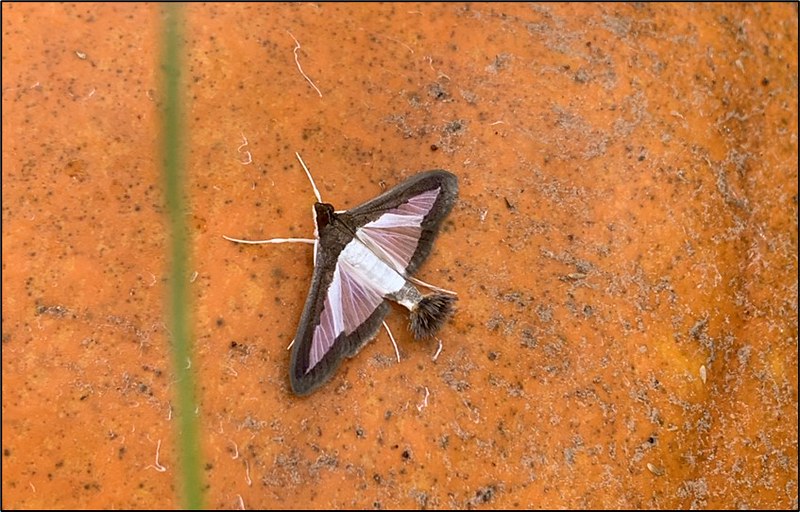
Melonworm moths have white, almost translucent, wings with a brown outline. Larvae are green caterpillars with two longitudinal, white stripes down their back and four sets of prolegs.
Cato recommends an insecticide application as soon as melonworm larvae or moths are observed in pumpkins, winter squash, or other cucrbits.
“We recommend growers have a diamide insecticide like Coragen eVo or Beseige on hand and apply as soon as you find any melonworm larvae or moths,” he said. “If growers are already spraying a weekly pyrethroid for control of other pests they can expect melonworm to be suppressed as well. Our data indicate that weekly applications of insecticides with short residuals, such as pyrethroids or even Bt, will suppress melonworm as well as the diamide insecticides, however, diamides offer 21 days of residual activity and most consistent suppression of fruit injury in previous trials.” More information on melonworm and control options can be found in Cato’s blog.
Mention of product names does not imply endorsement by the University of Arkansas System Division of Agriculture.
To learn more about Division of Agriculture research, visit the Arkansas Agricultural Experiment Station website: https://aaes.uada.edu. Follow on Twitter at @ArkAgResearch. To learn more about the Division of Agriculture, visit https://uada.edu/. Follow us on Twitter at @AgInArk. To learn about extension programs in Arkansas, contact your local Cooperative Extension Service agent or visit www.uaex.uada.edu.