



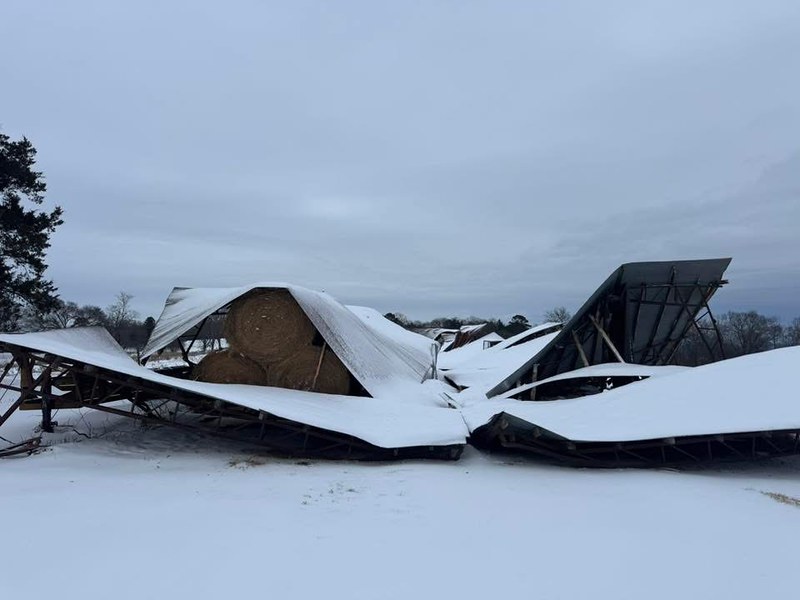
The winter storm that hit Arkansas in late January caused an estimated $200 million in damage to the state’s poultry industry, according to a preliminary report from the University of Arkansas System Division of Agriculture.
The March 3 report, “Preliminary Assessment of Statewide Poultry Industry Damage in Arkansas from the January Winter Storm, 2026,” was authored by Frank Seo, James Mitchell and Ryan Loy, all economists for the Division of Agriculture.
The weather event, which brought as much as 12 inches of snow and 2 inches of sleet in some areas, was especially damaging to poultry houses and other structures. The authors gathered data from eight poultry integrators operating across the state, who reported total bird mortality losses valued at approximately $12.08 million and structural damage estimates ranging from $172.33 million to $202.06 million.
According to statewide survey data collected by Cooperative Extension Service agents, 241 poultry houses were destroyed during the storm, and an additional 91 poultry houses were damaged.
The report estimated $26.83 million in foregone farmer income from the lost birds and $21.74 million in lost economic output under a one-year disruption scenario. Of that amount, about $5.83 million represents value added, meaning income that would have gone to farmers, workers, businesses, and governments in Arkansas, Seo said.
The estimated statewide economic impact of the lost poultry production capacity was $48.26 million, representing the combined effects of “reduced poultry production capacity and associated disruptions across supply chains and household spending,” the report stated.
The loss of production is estimated to reduce economic activity enough to support about 44 fewer full-time-equivalent jobs across the Arkansas economy, Seo said.
“The biggest statewide hit is lost household income, especially grower pay and related wages, because that is what ripples into local spending,” Seo said.
Between bird mortality and loss of production capacity, the report estimated a loss of $3.83 million in lost tax revenue to city, county, state and federal governments.
Because the poultry industry is deeply enmeshed with other associated industries, the actual economic impacts will be felt across a broad swath of the economy. The report lists 20 industries likely to experience economic losses from the storm damage fallout, including transportation, grain farming, veterinary services and more.
Seo said that any effects on consumers would likely be limited to regionally sourced products.
“While the report does not model prices directly, any effects are more likely to be localized and uneven rather than a uniform statewide spike, since integrator supply chains can shift production across regions,” Seo said.
On a positive note, the reconstruction and repair of damaged facilities is estimated to generate between $292.92 million and $343.45 million in economic activity, in turn generating between $29.76 million and $34.90 million in estimated tax revenue. Associated industries are also likely to benefit from reconstruction efforts, including transportation, wholesale machinery sales, restaurants and more.
Seo said that the report’s findings highlight an infrastructure resilience issue for the poultry industry.
“Commercial poultry production depends on continuous power and environmental control systems, including heating, ventilation and automated feeding,” Seo said. “The prolonged cold temperatures, snow and ice loads, and widespread power outages associated with the winter storm demonstrate how quickly infrastructure failures can cascade into production losses, reduced household income, job impacts and broader economic effects across the state economy.”
This poultry industry analysis follows an earlier report that estimated the economic impact of the January storm on other aspects of the Arkansas agricultural industry, including an estimated $24 million loss to the state’s cattle industry.
To learn about extension programs in Arkansas, contact your local Cooperative Extension Service agent or visit uaex.uada.edu. Follow us on Facebook and Instagram. To learn more about the Division of Agriculture, visit uada.edu. To learn more about ag and food research in Arkansas, visit the Arkansas Agricultural Experiment Station at aaes.uada.edu.
About the Division of Agriculture
The University of Arkansas System Division of Agriculture’s mission is to strengthen agriculture, communities, and families by connecting trusted research to the adoption of best practices. Through the Agricultural Experiment Station and the Cooperative Extension Service, the Division of Agriculture conducts research and extension work within the nation’s historic land grant education system.
The Division of Agriculture is one of 20 entities within the University of Arkansas System. It has offices in all 75 counties in Arkansas and faculty on three campuses.
Pursuant to 7 CFR § 15.3, the University of Arkansas System Division of Agriculture offers all its Extension and Research programs and services (including employment) without regard to race, color, sex, national origin, religion, age, disability, marital or veteran status, genetic information, sexual preference, pregnancy or any other legally protected status, and is an equal opportunity institution.