



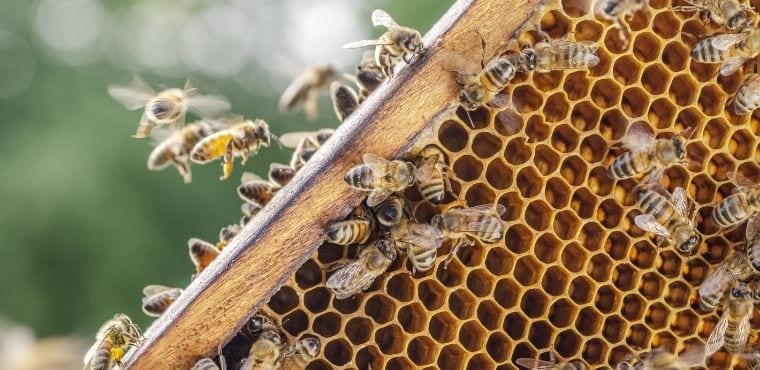
By Rebekah Hall University of Arkansas Division of Agriculture
LITTLE ROCK — As spring blooms in Arkansas, honey bee populations are swarming, but there’s nothing to be afraid of — most swarms are harmless, and the colony will soon fly away to establish its new home.
“A honey bee swarm is an incredibly complicated, amazing and majestic process,” said Jon Zawislak, extension assistant professor of apiculture and urban entomology for the University of Arkansas Division of Agriculture. “Swarming is the honey bees’ response to crowded conditions in the springtime when there is an abundance of food — nectar or pollen. When spring comes, the population of the beehive starts to increase exponentially.”
“As a result, the bees will begin raising a new queen bee, and then the old queen leaves the hive,” he said. “She takes anywhere from one-half to two-thirds of the worker bees with her and they fly away. Their goal is to establish a new colony.”
The swarm will land nearby and settle on a tree limb or a fence post, or sometimes on the wall of a building.
“I’ve seen them on picnic tables, mailboxes and stop signs,” Zawislak said. “But usually, they’re up in trees. When people see a giant mass of bees hanging off a limb, inside of that is the queen and thousands of worker bees, along with a few male bees that we call drones. It could be anywhere from a few thousand bees to 50,000 bees.”
These bees are in a temporary resting location, which is sometimes called a bivouac. While the appearance of so many honey bees can be frightening, a new swarm is usually gentle in temperament and they rarely sting, Zawislak said.
If you come across a swarm, Zawislak said the most important practice is to do no harm.
“Leave it alone — don’t throw rocks at it or squirt it with a garden hose or spray it with an insecticide,” he said. “If you wait and don’t do anything, chances are those honey bees will just disappear and find another home.”
However, in an urban environment, “we don’t want to risk that the bees will move into the wall of a home or building because it becomes much more difficult to relocate them when they’re inside of a wall,” Zawislak said. Zawislak recommends contacting your local county extension office, as many counties maintain a list of local beekeepers who can quickly come and collect the bees.
The Arkansas Beekeepers Association is also a helpful resource, Zawislak said. The organization has a county-by-county list of beekeepers who will collect swarms, including those who will collect bees from inside of a wall.
House hunting for a new hive
Honey bees have been swarming in different parts of Arkansas for almost a month, Zawislak said.
“They reach their peak around mid-April to mid-May. That’s when we see most of them,” he said. “But especially in the southern part of the state, where spring comes a bit earlier, you may see it sooner, and you’ll see it later in the northern part of the state. It just depends on how many flowers are in bloom around the hives of individual colonies.”
Once the bees have swarmed and are resting in their temporary location, several hundred become scout bees who then “travel in all directions looking for a new place to live,” Zawislak said.
“This could be a hollow tree or a cavity that’s the right size and easily defensible,” he said. “If it looks like a place where they think their family would be happy, the scout bees go back to the swarm and do a dance on the backs of the other bees as they are all piled on top of each other.
“They do a figure-8 dance that we call a waggle dance,” Zawislak said. “It conveys information about which direction the potential new home is, how far away it is and the quality of the new site.”
Over the next few hours to a few days, the bees “reach a quorum decision, where enough of the bees have checked the new place out and decided it will be the best home for them,” Zawislak said.
To travel to their new destination, the scout bees guide the rest of the group using a pheromone, or chemical odor, that they emit as they fly through the crowd of bees.
“One minute you have this big cluster of bees hanging on a limb, then it looks like utter chaos, then they will suddenly all take off in one direction, and they’re gone within a few minutes,” Zawislak said. “The first thing they must do there is build honeycomb because they can’t do anything else if the queen doesn’t have space to lay eggs and they can store food. They start building it right away, and they’ll often have built a comb the size of your hand in 12 hours.”
Zawislak said he encourages beekeepers to be vigilant and try to manage swarms by keeping a close eye on bees in the springtime and collecting swarms right away. Watch the Division of Agriculture’s “Why Do Honey Bees Swarm?” video on YouTube or visit the Beekeeping in Arkansas page on the Cooperative Extension Service website to learn more about swarms, honey bees and beekeeping.
The extension service is the educational outreach arm of the Division of Agriculture.
To learn about extension programs in Arkansas, contact your local Cooperative Extension Service agent or visit uaex.uada.edu. Follow us on Facebook and Instagram. To learn more about the Division of Agriculture, visit uada.edu. To learn more about ag and food research in Arkansas, visit the Arkansas Agricultural Experiment Station at aaes.uada.edu.
About the Division of Agriculture
The University of Arkansas Division of Agriculture’s mission is to strengthen agriculture, communities, and families by connecting trusted research to the adoption of best practices. Through the Agricultural Experiment Station and the Cooperative Extension Service, the Division of Agriculture conducts research and extension work within the nation’s historic land grant education system.
The Division of Agriculture is one of 20 entities within the University of Arkansas System. It has offices in all 75 counties in Arkansas and faculty on three campuses.
Pursuant to 7 CFR § 15.3, the University of Arkansas Division of Agriculture offers all its Extension and Research programs and services (including employment) without regard to race, color, sex, national origin, religion, age, disability, marital or veteran status, genetic information, sexual preference, pregnancy or any other legally protected status, and is an equal opportunity institution.