


by Dr. Curtis Varnell
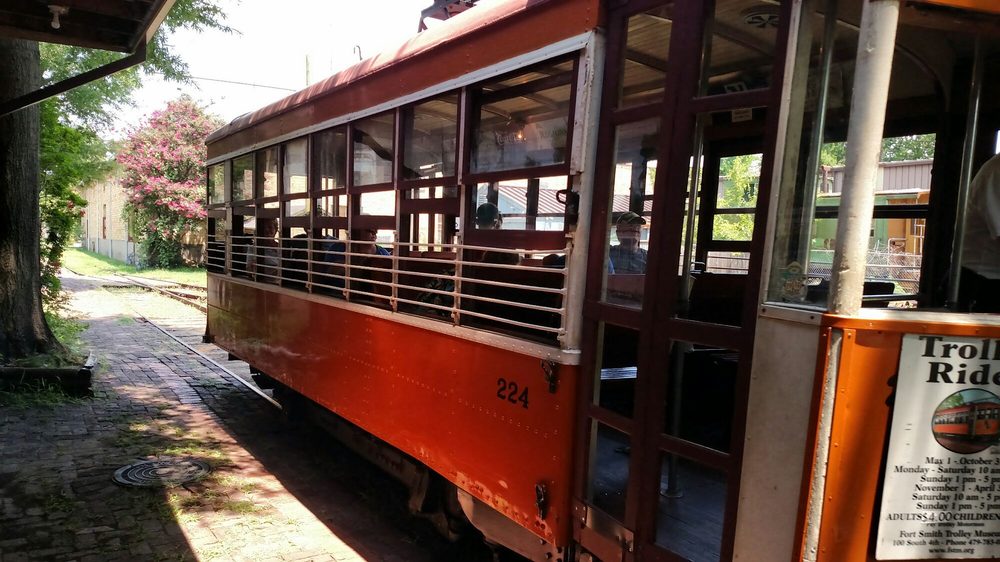
A long line of students snaked around the museum, eagerly awaiting their turn to ride the historic Fort Smith Trolley. On an outing from Paris schools, the group had already toured the grounds of the historic Fort Smith National Park and Judge Parkers courtroom. The trolley ride and then a trip to the Marshalls museum would round out the day for students and provide an historical background for much of the early history of Western Arkansas.
The historical trolley, restored and in operation since 19991, features electric powered streetcars that travel a route through downtown Fort Smith while the conductor provides historical narrative. The trolley looks much like it did in the late 18000’s and passes through the downtown area, stops at the Bass Reeves monument and the then reverses to travel past the Trolley Museum, the National Cemetery, and journeys a short distance into the downtown area. It often stops at the museum, allowing the students to clamber over old trains and streetcars that the association has collected over the years.
The Fort Smith trolley serves to remind of an era long gone, the period of time before the automobile when travel through town and into the suburbs was accomplished by a light rail system that carried passengers to and from outlying areas.
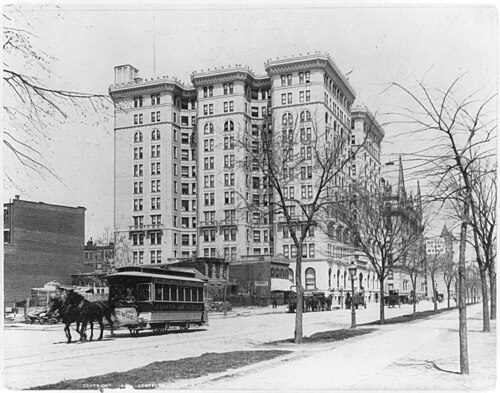
In the early 1800’s, engineers determined that horse-drawn vehicles set on rails would allow animals to carry many more passengers at a much more rapid rate than simple horse-drawn carriages. Rail systems developed throughout America, beginning in New York and spreading to Philadelphia, Detroit, and south to Memphis and New Orleans. After the Civil War, several of the lines switched to steam to power the trolleys and lines extended out greater distances into the countryside. Not only were the steam engines more efficient, they also eliminated the constant street cleaning associated with horse and mule power.
By the late 1800’s, electric power became the chosen source of power and electric lines were strung along the track with extensions running from car to electric wire powering the vehicles. Fort Smith had mule-drawn trolleys as early as 1883 but transitioned to electric in 1899. Other lines operated in Hot Springs. Little Rock, and other towns in the state. Especially in the larger towns, the lines allowed residents to move out of the downtown area and into the suburbs. The trolleys ran regular service to city attractions, amusement parks, and to the ever-popular baseball games.
The introduction of the automobile changed America. By the 1920’s, the road system opened up America to fast and easy transportation from business right back to your own personal driveway. Rail travel declined to a point it was no longer economical and the trolley system died; Fort Smith shutting down by 1933. Only a few trolleys systems survived, those being two of my favorites, New Orleans and San Francisco.
By the late 1900’s, many cities realized the benefit of restoring the history and ambiance of the downtown area and began efforts to attract customers and visitors back to the city. What better way than to provide an historic tour in an historic vehicle that had not been on the streets in over one-hundred years. Little Rock, Memphis, Eureka Springs, Hot Springs, and Fort Smith purchased an restored a part of our historical past and street cars again travel the rails through town.
The students disembark from the trolley, excited about the experience of actually touching history. Heading to the museum, the kids enjoy an ice cream float in the turn of the century drug store and soda shop. Nothing can substitute real-life experience or provide memories that last a life-time like school field-trips.
The Fort Smith Trolley Museum is open daily, and trips can be arranged by phone. They are always happy to see new and happy faces as they share with us our heritage.