



By Traci Rushing
University of Arkansas Division of Agriculture
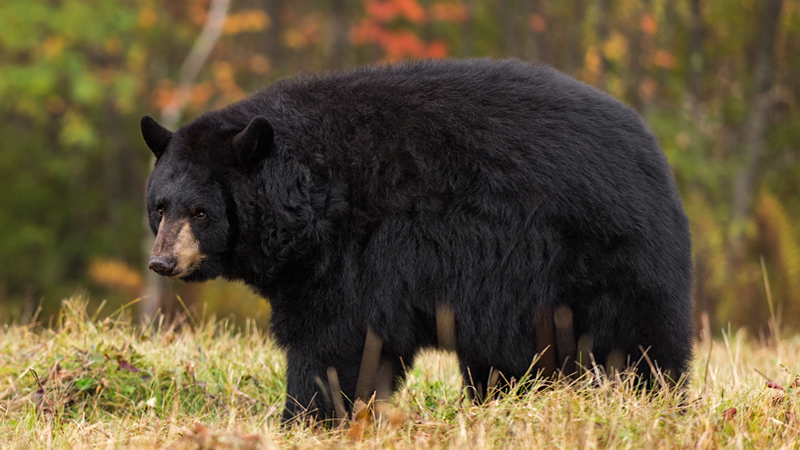
As Arkansans spend more time outdoors during the summer months, wildlife experts say residents may notice an increase in black bear sightings, but they emphasize that bears are generally wary of people and rarely pose a threat.
Although Arkansas experienced two tragic black bear attacks last fall — the first fatal attacks in more than a century — Don White, wildlife ecologist and bear expert with the Arkansas Forest Resources Center based at the University of Arkansas at Monticello, said such incidents are exceptionally uncommon for our state.
“Most bears are naturally afraid of people and will leave an area when they know a human is nearby,” said White, who is also the James White Endowed Professor of Wildlife Ecology at UAM. “Their sense of smell is incredibly acute, allowing them to detect us long before we know they are nearby. In most cases, bears quietly move away without ever being seen.”
White said that the lowest likelihood of encountering a bear occurs during winter when bears are typically denning. Sightings are more likely in the spring and fall simply because more people are recreating outdoors in bear territory.
“When you plot the times of the year when black bear-human encounters take place, spring and fall come out on top,” White said. “These are also the times when people are most active in bear country. Whenever people and black bears occur in the same place at the same time, conflicts can occur, although those conflicts are remarkably rare in our state.”
Spring encounters are sometimes associated with female bears protecting young cubs, while fall conflicts are more often tied to food availability.
This time of year, residents may be more likely to spot young male bears moving through new areas. According to Spencer Daniels with the Arkansas Game and Fish Commission, yearling males are often dispersing from their mother’s territory in search of a home range of their own.
“These young bears stayed the winter with their mother but were kicked out of her territory to start their lives on their own,” Daniels said. “They can travel very long distances in search of a new place to call home. This uptick in bear activity makes seeing a bear walking on the side of the road or through a wooded area near a home fairly common in Arkansas.”
Understanding black bear diets
Black bears are highly adaptable omnivores, with approximately 75 to 90 percent of their diet consisting of plant material, White said. In spring, they feed heavily on green vegetation, tender shoots, roots and insects. As summer arrives and moves into fall, they shift to berries and fruits such as blackberries, blueberries, pawpaws, persimmons and muscadines. Fall is their most important feeding season as they consume acorns and hickory nuts, often gaining 20 to 30 pounds per week in preparation for winter denning.
Approximately 10 to 25 percent of a black bear’s diet consists of animal matter. As opportunistic feeders, black bears will readily scavenge carrion, including animals found dead in forests or along roadsides, and may occasionally consume fish, bird eggs and small rodents.
While bears primarily rely on natural food sources, they can be attracted to unsecured human food sources.
“Wildlife feeders, unsecured trash with food scraps, and pet and livestock foods left outside are major attractants for bears trying to stock up after a long winter,” Daniels said. “Young male bears are even more likely to take advantage of these foods as they travel to new locations and determine whether an area holds adequate resources.”
The Arkansas Game and Fish Commission encourages residents living in bear country, particularly in the Ozark and Ouachita regions, to remove these attractants to help keep bears wild.
Being bear aware
“The best way to avoid conflicts with black bears is to be BearWise,” Daniels said. “Especially never intentionally feed bears.”
Intentionally feeding bears not only increases the likelihood of property damage and nuisance behavior but can also create dangerous situations by causing bears to lose their natural fear of people, White said.
Although summer bear sightings may become more common as both people and bears remain active across the landscape, White emphasized that Arkansas’ black bear population continues to pose very little risk to people.
“Bears are simply going about the business of being bears,” White said. “Seeing one can be an exciting reminder that Arkansas still has healthy wildlife populations. With a little awareness and by removing attractants, people and bears can continue to coexist successfully.”
For more information about living responsibly in bear country, visit BearWise.org.
About the College of Forestry, Agriculture and Natural Resources and the Arkansas Forest Resources Center
The College of Forestry, Agriculture and Natural Resources, and the Arkansas Forest Resources Center, a University of Arkansas System Center of Excellence, brings together interdisciplinary expertise through a partnership between the University of Arkansas at Monticello and the University of Arkansas Division of Agriculture. The College and Center are headquartered at the University of Arkansas at Monticello campus, but their programs range statewide with the mission of developing and delivering teaching, research, and extension programs that enhance and ensure the sustainability and productivity of forest-based natural resources and agricultural systems. Academic programs are delivered by the College of Forestry, Agriculture, and Natural Resources through the University of Arkansas at Monticello. Through the University of Arkansas Division of Agriculture, research is administered by the Arkansas Agricultural Experiment Station, and extension and outreach activities are coordinated by the Arkansas Cooperative Extension Service.
About the Division of Agriculture
The University of Arkansas Division of Agriculture’s mission is to strengthen agriculture, communities, and families by connecting trusted research to the adoption of best practices. Through the Agricultural Experiment Station and the Cooperative Extension Service, the Division of Agriculture conducts research and extension work within the nation’s historic land grant education system.
The Division of Agriculture is one of 22 entities within the University of Arkansas System. It has offices in all 75 counties in Arkansas and faculty on three university campuses.
Pursuant to 7 CFR § 15.3, the University of Arkansas Division of Agriculture offers all its Extension and Research programs and services (including employment) without regard to race, color, sex, national origin, religion, age, disability, marital or veteran status, genetic information, sexual preference, pregnancy or any other legally protected status, and is an equal opportunity institution.