



By Mary Hightower
University of Arkansas Division of Agriculture
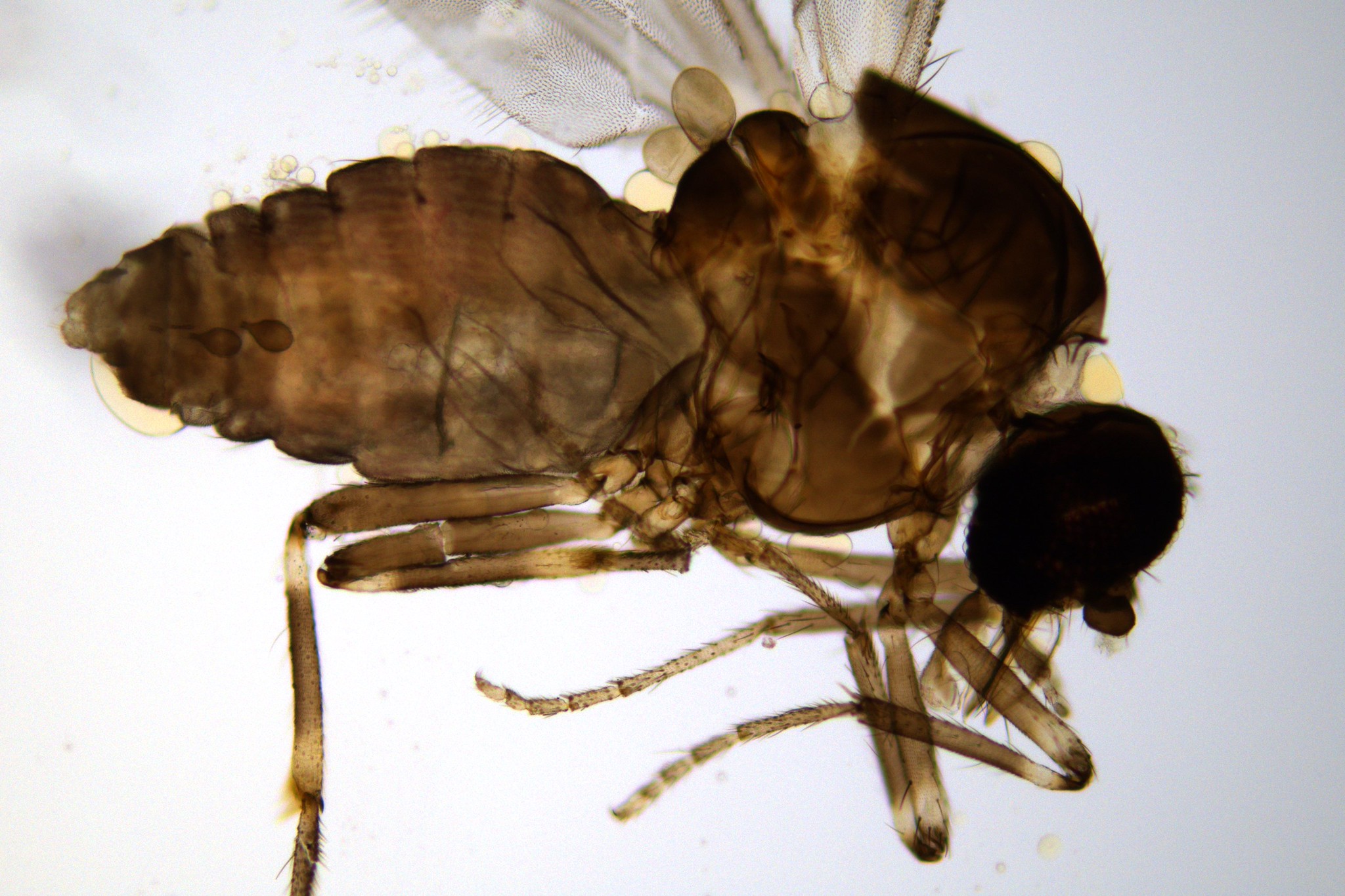
Arkansas researchers are taking a close look at a tiny midge weighing less than a single strand of hair that can have a large impact on sheep and deer populations.
Arkansas has about 20 species of the Culicoides midge popularly known as “no-see-ums” or “punkies,” depending on where you live.
The midges are part of Emily McDermott’s research, which focuses on insect-borne diseases. McDermott is an entomologist for the Arkansas Agricultural Experiment Station, the research arm of the University of Arkansas Division of Agriculture.
Entomology Ph.D. student Cassandra Steele is collaborating with McDermott on this research evaluating the diversity and habits of midges.
No-see-ums have many advantages that lend themselves to stealth attacks. They’re small — 1 to 3 millimeters in length. They’re light, weighing about 0.9 milligrams. They’re quick too.
“It takes about 30 to 60 seconds to take a full blood meal,” McDermott said. “They’ll sit there and get as much blood as they possibly can, and then they kind of waddle off because now they’re big and round with only their teeny, tiny little wings.”
How do I protect against no-see-ums?
McDermott said DEET can be effective in repelling midges for humans. For horses and other livestock, permethrin sprays can help keep the midges at bay.
“In some areas where they kind of all emerge at once and you have huge swarms of them, no amount of bug spray is really going to help you,” she said. “Luckily, you know, here in Arkansas, we don’t have that level of problem.”
What is a midge’s life cycle?
No-see-ums are most active from spring to fall, with different species populations peaking at different times.
The insects generally start their life in some type of moist environment.
“They can develop in standing water, just like mosquitoes can, but they don’t necessarily need standing water,” McDermott said. “Some species will develop in tree holes, some of them are developing in ponds associated with livestock. There are some species that develop in animal manure.
“There are some species that develop in rotting fruit, she said. “Anything that has a high water content can potentially support at least one species of Culicoides.”
Once the larvae develop, pupate and hit adulthood, they’ll start searching for food.
How do no-see-ums find food?
McDermott said the carbon dioxide people and animals exhale is a beacon for biting insects, include no-see-ums.
“Just like mosquitoes or even ticks, they are basically using your breath to locate something that is alive,” she said. “This is kind of a universal cue.
“Once they get closer to you, then they start picking up on other types of host cues,” McDermott said. “They can feel the heat coming off of your body — in warm-blooded animals anyway.
“Once they land, they can actually taste your skin or your feathers or fur,” she said. Midges then use these signals to determine if the person or animal will make for a good meal.
New twist to feeding
McDermott said Steele’s research is revealing some twists about how no-see-ums feed.
“Another chapter of her dissertation is looking at blood meal analysis to see what animals they’ve fed on,” McDermott said.
“Some species will feed on anything. They’ll feed on deer and cows and people and raccoons and all sorts of things,” she said. “Other species are more host-specific. They’ll feed on birds, or they’ll only feed on mammals.”
However, Steele turned up something unexpected.
“She found a lot of reptile blood meals in her analysis,” McDermott said.
“There was a lot of feeding on turtles in particular, and this is brand new,” she said. “We didn’t know that these species would be feeding on some of these reptile species as much as they feed on mammals.”
Disease vector
Some species of Culicoides are more than just an itchy, warm-weather annoyance. They can have a significant economic impact for livestock farmers by transmitting the viruses that cause bluetongue in sheep and epizootic hemorrhagic disease — EHD — in deer. The diseases can be fatal to their host species, but not to humans.
The two diseases don’t make much of an impact in Arkansas, but “in the Northeastern U.S., both bluetongue and EHD are emerging,” McDermott said. “We have these massive die-offs of deer every September, October, which grab headlines.
“Sheep will typically die from bluetongue, so in Europe, where they’ve got a lot more sheep, it’s a lot more economically important than it is in the U.S.,” McDermott said.
A 2015 journal article put the global cost of bluetongue at $3 billion.
While cattle can get bluetongue, it isn’t as harmful to them as it is to sheep and goats.
“Since there aren’t very many people studying midges, we don’t have a good handle on the epidemiology of either virus in the U.S., outside of California.”
Steele’s next chapter of research involves tracking midges and their feeding patterns, using stable isotopes of carbon and nitrogen. As part of the research setup, Steele and McDermott used mud and water to create ideal environments for midge development.
“Then we added stable isotope compounds, so that anything developing in those environments would have higher levels of these elements in their bodies,” McDermott said. “Theoretically, you can collect midges in the pasture and test them for that isotope and be able to pinpoint exactly where they came from in the woods.”
“This has been done for mosquitoes but had never been done for Culicoides in the wild,” she said.
Are your livestock at risk?
McDermott said that while the economic impact of Culicoides in Arkansas is limited, the proximity of livestock pastures and woodlands is interesting from a “disease ecology standpoint.”
“You’ve got this livestock habitat, and then you’ve got this wild habitat, and so there are a lot of opportunities then for spillover if you’ve got deer with EHD in the woods,” she said. “Are your livestock in the pasture going to be at risk from that?
“We did find midges that had been enriched with the elements that we used, and so we could say for sure that these midges developed in the woods and then moved out into the pastures,” McDermott said. “There is direct movement between these two habitats that’s potentially putting livestock at risk for pathogens like bluetongue and EHD.
“While moving from woods to open pasture doesn’t seem like much to us, if you’re 1 millimeter long, that’s a massive change in your environment. Not all insects are willing to do that,” McDermott said.
To gauge the movement, Steele and McDermott set up two types of traps: ones that had a light, which is generally attractive to insects, and ones that gave off carbon dioxide.
The two found that one species, Culicoides stelifer, a suspected vector of bluetongue and EHD in the Southeastern U.S., were attracted to light traps set up in the woods and carbon dioxide traps that were set in the pastures.
“That suggested that these midges were actively leaving the woods to look for something to eat in the pasture and then going back into the woods,” McDermott said. “This then suggests that if you have livestock on pasture and there’s woods next to it, that that’s potentially a risk for bluetongue virus for those animals in the pasture.”
Do no-see-ums have predators?
No-see-ums aren’t without predators.
“I’ve done some work looking at interactions between mosquitoes and midges,” McDermott said. “Sometimes mosquito larvae will eat midge larvae, but they’re probably not making up a huge part of any one animal’s diet since they’re so teeny tiny.
“As far as natural enemies go, there are some nematodes and other things that can infect larvae in aquatic environments, but nothing that can be used as a widespread control,” she said.
To learn more about ag and food research in Arkansas, visit aaes.uada.edu. Follow the Arkansas Agricultural Experiment Station on LinkedIn and sign up for our monthly newsletter, the Arkansas Agricultural Research Report. To learn more about the Division of Agriculture, visit uada.edu. To learn about extension programs in Arkansas, contact your local Cooperative Extension Service agent or visit uaex.uada.edu.
About the Division of Agriculture
The University of Arkansas Division of Agriculture’s mission is to strengthen agriculture, communities, and families by connecting trusted research to the adoption of best practices. Through the Agricultural Experiment Station and the Cooperative Extension Service, the Division of Agriculture conducts research and extension work within the nation’s historic land grant education system.
The Division of Agriculture is one of 20 entities within the University of Arkansas System. It has offices in all 75 counties in Arkansas and faculty on three system campuses.
Pursuant to 7 CFR § 15.3, the University of Arkansas Division of Agriculture offers all its Extension and Research programs and services (including employment) without regard to race, color, sex, national origin, religion, age, disability, marital or veteran status, genetic information, sexual preference, pregnancy or any other legally protected status, and is an equal opportunity institution.