



By Rebekah Hall
University of Arkansas Division of Agriculture
Though it can be tempting to buy inexpensive clothes from fast fashion retailers during the back-to-school shopping season, an extension expert suggests visiting thrift stores and preserving your existing wardrobe instead.
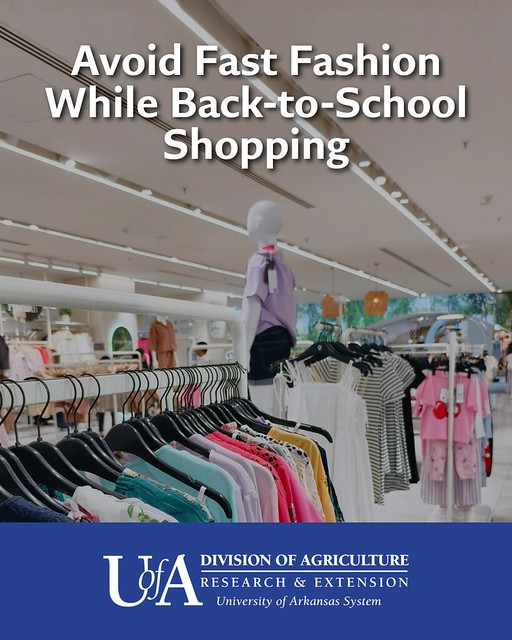
“Fast fashion is a business model where clothing brands quickly mass-produce inexpensive, trendy clothes that copy the latest styles seen on social media or runways,” said Keith Statham-Cleek, extension family and consumer sciences educator for the University of Arkansas Division of Agriculture. “The goal is to get styles into stores or online shopping apps as fast as possible so shoppers can buy them while they are still popular.”
Though swift and convenient, fast fashion has a negative impact on the environment and the workers who produce the garments, Statham-Cleek said. According to the U.S. Government Accountability Office, the decomposition of textile waste in landfills releases greenhouse gases and leaches contaminants into soil and water.
The U.S. Environmental Protection Agency estimates that between 2000 and 2018, textile waste increased by nearly 80 percent.
The quality of fast fashion clothing is also lacking, Statham-Cleek said.
“Utilizing poor quality fabrics, construction techniques and hardware typically leads to a short lifespan of the garment, which then needs to be replaced, leading to more demand,” he said.
Thrifty alternatives
Statham-Cleek said that when back-to-school shopping this year, families can take advantage of deals at local thrift stores, which can help their budgets and keep clothing out of landfills.
“We have seen a rise in the popularity of thrifting,” Statham-Cleek said. “In the United States and here in the central Arkansas area, we have seen several new very large thrift stores open recently. These stores tag their merchandise with colored tags and will run half-price and even $1 specials to help move merchandise.”
Statham-Cleek suggested getting to know the store’s markdown schedule and shopping it when in need of new items.
For parents of children whose schools require uniforms, Statham-Cleek said it can be helpful to check whether the school has a clothing swap scheduled. If not, consider proposing it as a PTA initiative.
“Make friends with other parents, as kids outgrow things quickly,” Statham-Cleek said. “You could also organize a clothing swap within your community, where parents come together and offer up items that no longer fit.”
There are also several social media platforms you can use to shop for used items at reduced prices, Statham-Cleek said.
“This can save you time and money and reduces the need for new items to enter the cycle of fast fashion,” he said. “Today, thrifting is trendy. When I visited a store recently, it was full of families shopping for shoes, clothing, toys and household items. I’ve noticed families have gotten more resourceful.”
When buying secondhand, Statham-Cleek said it’s critical to always inspect garments before purchase.
“Look for stains, missing buttons or any loose stitches that might need to be fixed,” Statham-Cleek said. “Ask yourself, ‘Is this something I can do?’”
Shop your closet, mend what you have
Statham-Cleek said starting at home by shopping your own closet can help you determine what you already own and what you may need.
“We tend to get in a rut and pull from the same section of the closet, those tried-and-true outfits that you know work and fit well,” Statham-Cleek said. “But by sorting through your closet, you may find new items you forgot about or discover new combinations for pairing items together.”
A thorough look through your closet can also help you determine which clothes may be mended through simple repairs, Statham-Cleek added. Properly laundering your clothes can also improve the longevity of your wardrobe.
“Always read your garment labels and follow the instructions on the garment, as well as the instructions of your laundry detergent, spot treatments and laundry sanitizers,” Statham-Cleek said. “Using the proper amount of these products, and not overloading the machine is very important. These practices will not only extend the life of your clothes, but your washer and dryer, too.”
And before you toss something in the laundry basket, ask yourself if it’s really in need of a wash, Statham-Cleek said.
“Is this still fresh, or might it have a bit more wear to it before it needs to be laundered?” Statham-Cleek said. “Out of habit, we typically take garments off and toss them in the hamper before they may actually be considered ‘dirty.’”
For more information about mending clothing, check out the Cooperative Extension Service fact sheets for sewing on a button, hemming pants and sewing up a ripped seam.
To learn about extension programs in Arkansas, contact your local Cooperative Extension Service agent or visit uaex.uada.edu. Follow us on Facebook and Instagram. To learn more about the Division of Agriculture, visit uada.edu. To learn more about ag and food research in Arkansas, visit the Arkansas Agricultural Experiment Station at aaes.uada.edu.