


By Dr. Curtis Varnell
It was just another one of those drills-similar to those ran for fires, tornado, or other disasters-except this drill carried a stringent note of futility and desperation. All students were rushed into the interior hallways and were to sit firmly against the wall with our eyes closed and heads firmly locked between our knees. We were never told exactly what would happen afterward if an actual nuclear bomb was exploded but the schools, communities, and state had a well-developed, even if impractical plan, that was supposed to save a part of humanity if nuclear war occurred. The 1950’s and 60’s were the Cold War years and the antagonism between the western free world and communism was in evidence in divided Germany, Korea, and Vietnam. The ultimate weapon, the use of a nuclear bomb, was a real and present threat and the USSR and the U.S. had enough weapons on hand to destroy a huge portion, if not all, of mankind.
Developed during WWII by the U.S. and used on Japan, the A-Bomb could destroy large cities and wipe out populations with just one explosion. As soon as the war was over, other countries rushed to develop their own version of the weapon and to make it even larger and more powerful. By the 1960’s, a half-dozen countries were practicing blowing up atolls, desert sands, and remote areas with increasingly more powerful H-bombs, neutron bombs, and others.
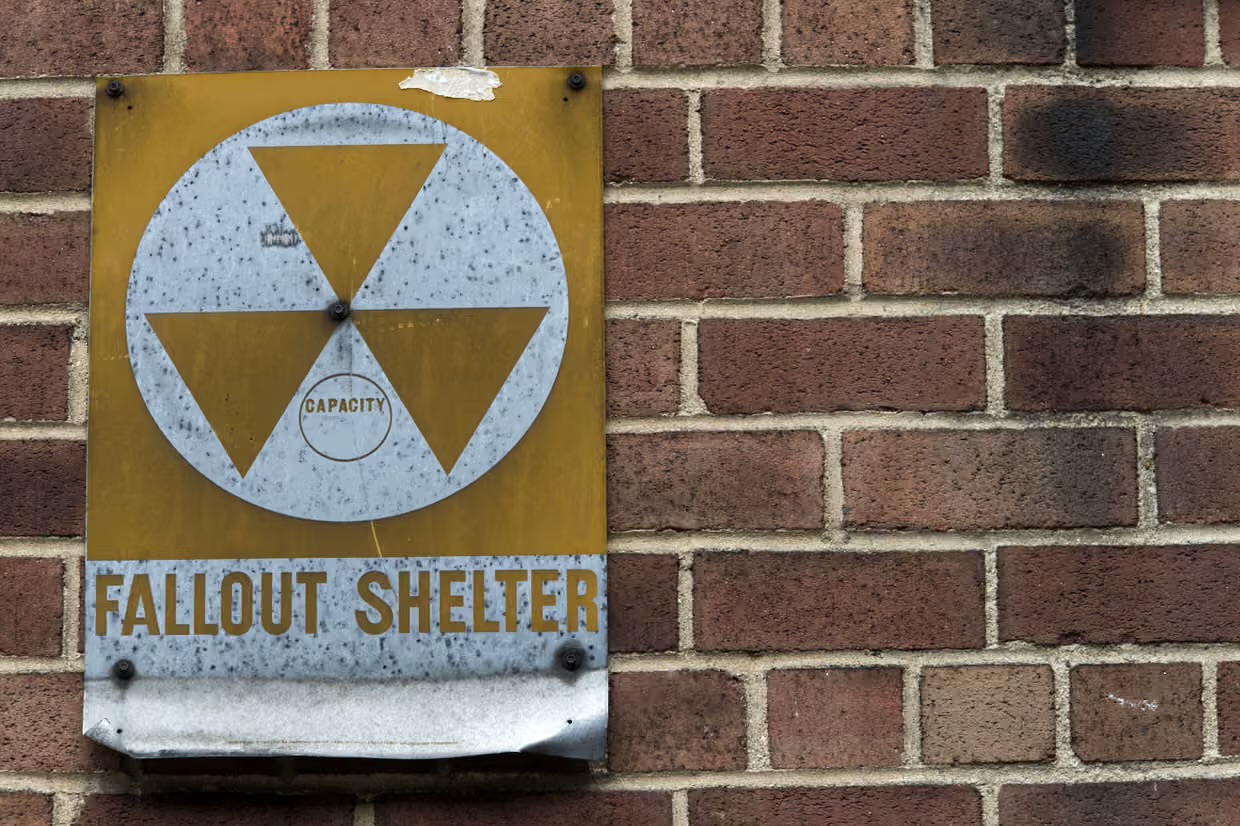
The U.S. developed a desperate strategy to protect citizens from weapons for which there is little protection. The Federal Civil Defense administration developed a series of nationwide exercises that would provide help in case of attack. Public drills, like that at schools, were conducted on a regular basis and public shelters were designated at safe fallout shelters and were stocked with food and water. In rural areas of Arkansas, courthouses were generally considered safe houses and stocked Geiger counters, food, and water. People were encouraged to stockpile food supplies and to construct underground fallout shelters where families could remain for several days. Construction of the shelters became common place and tops of the buried box-like concrete buildings, emerged from many backyards, even in rural areas.
Much of the effort was just to make one feel secure. The primary targets would have been nuclear sites, SAC air bases, and major cities. In Arkansas, that would have included the nuclear sites near Conway, Jacksonville Air base, and perhaps Pine Bluff arsenal. The initial blast would completely wipe out an area at ground zero for about a half-mile, moderate damage for two miles, and window breakage for 10-12 miles. The radioactive fallout would be for about 20 miles downwind. The real danger is the long-range radioactive fallout that affects human health for a generation or more. The government was assuring the population that survival was likely and possible if one could follow protective steps for the first couple of weeks after a nuclear attack. The danger, as we’ve discovered from Chernobyl and Japan, is more insidious and terrible than just initial survival.
In 1956, Howard Hughes decided to film a monumental film about the life of Genghis Khan entitled The Conqueror with the filming site to be located in the Utah Desert. The site chosenwas some hundred miles from where the U.S. had previously detonated nuclear bombs. Not a popular movie (who could envision a John Wayne speaking cowboy slang as Genghis) it nevertheless featured several famous actors including Susan Hayward, John Wayne, and Agnes Morehead. The group rode around constantly on horses, kicking up dust which strangely sparkled on film, and breathed in the debris from wind storms. Nearly half of the 221 crew members, including all three of those mentioned, died of lung cancer. Even though Wayne was a heavy smoker, the per-cent of those affected is astronomical and occurred years after the tests.
The fall-out shelters remained unused except during tornadoes, the drills were discontinued, and the Geiger counters rusted away. No food or water is stocked, and our fear of the nuclear bomb, other than keeping Iran from obtaining one, has dissipated to a remote memory. Unfortunately, the danger is still there and even more so with modern delivery and weapon systems. As we turn the world over to a new generation, we hope they remember the key acronym from our youth. Use of nuclear weapons guarantees MAD- mutual assured destruction.