



By Ryan McGeeney
University of Arkansas Division of Agriculture
University of Arkansas Division of Agriculture experts are urging the state’s pasture managers to gear up for winter by planting cool-season grasses in the fall.
Jonathan Kubesch, extension forage specialist for the Division of Agriculture, said that Arkansas offers some unique challenges to farmers, being in a geographical transition zone between North and South.
“If we were further south, we’d only be growing warm-season grasses and using annuals to complement them,” Kubesch said. “If we were further north, we’d just have cool-season perennial grasses. Here in the middle, we really have to use any and all tools we can to extend the grazing period.”
Kubesch and Flint Harrelson, director of the Livestock and Forestry Research Station and associate professor of animal science for the Division of Agriculture, recently revamped the widely used fact sheet, “Using Cool-Season Annual Grasses for Grazing Livestock.”
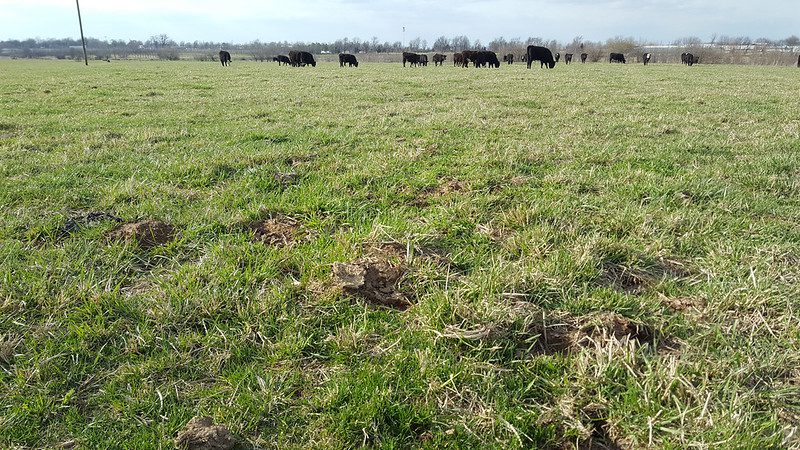
The fact sheet focuses on winter annual grasses, such as small grains and ryegrass, which are typically planted in early fall. With a 60-day growth cycle, the grasses provide an option for farmers with bermudagrass or bahiagrass to extend their grazing season through the winter and into the spring, Kubesch said.
With a ready supply of ryegrass and other winter annual seeds, the lower cost offers an attractive avenue to farmers looking to introduce something new to their grazing systems.
“Annual ryegrass is a great species with which to learn how to manage forage well,” he said. “If nothing else, throwing some annual ryegrass out in the field can get people started down this path.”
The addition of winter annuals, including ryegrass, to a grazing program ties in nicely with the Division of Agriculture’s 300 Days of Grazing program. Established in 2008, the program encourages Arkansas farmers to extend their grazing program for cattle and other livestock as long as possible, relying less on hay and other forages, which are both more expensive and less nutrient-dense than grazing live grass. Kubesch, who joined the Division of Agriculture in 2024, also helps support that program.
Additionally, cool-season grasses help support the overall soil health of a farming operation, Kubesch said.
“Having something actively growing in the winter is good for keeping the ground in place,” he said. Ryegrass can also help bolster “sacrifice areas,” where cattle managers might normally allow herds to graze grasses down to stubble, and help absorb excess nutrients from agricultural runoff, when more fertilizer is present than can be absorbed by the soil alone.
While Kubesch said that adopting cool-season grasses is a good plan for Arkansas farmers in any year, weather conditions in 2026 are trending in a good direction for planting ryegrass and more. According to the U.S. Drought Monitor, the band of exceptional to extreme drought that has plagued several counties in central Arkansas appears to be shrinking, and the El Niño weather pattern in the Pacific Ocean could provide elevated moisture through the fall, Kubesch said.
“We have a really good seasonal outlook that tells us we’re probably going to have enough moisture to plant these grasses,” he said. “If you’re not planting these annuals, this would also be a good year to consider planting fescue or orchardgrass, because those are also in the same planting window.”
Too much of a good thing?
Kubesch said that farmers new to planting winter annuals are sometimes unsure about how much acreage to lend to the new grass. It depends on one’s goals, he said.
“If you’re doing soil conservation, cover the whole darn thing if you don’t have fescue or orchardgrass,” he said. “If you’re just trying to grow this specifically for grazing, we advise growing it on about a quarter of the farm’s acreage, so you don’t end up with too much, and it doesn’t get ahead of you. Concentrate your efforts on just a portion of your acreage and try to do the best job possible.”
Kubesch also encourages farmers to ease their herds into a diet of ryegrass and other cool-season grasses, which tend to be more nutrient dense than bermudagrass, bahiagrass and other common warm-season grasses.
“Allow the cow to build up a tolerance to this level of nutrition by limiting their access,” he said. “They can become bloated, and there’s an actual risk of the cow dying. Their rumen fills with gas, and they can’t get it out.”
Kubesch said cattle farmers can let the grass become “stemmier,” or more mature, to allow it to lose some nutrient density before giving their herds grazing access. Supplements are also available to help the animals break down the nutrients more efficiently.
To learn about extension programs in Arkansas, contact your local Cooperative Extension Service agent or visit uaex.uada.edu. Follow us on Facebook and Instagram. To learn more about the Division of Agriculture, visit uada.edu. To learn more about ag and food research in Arkansas, visit the Arkansas Agricultural Experiment Station at aaes.uada.edu.