


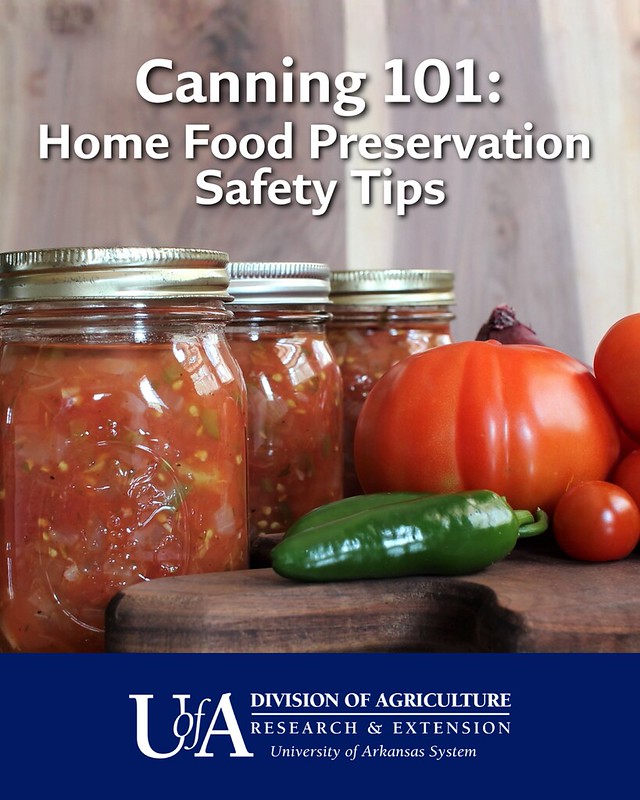
For Arkansans interested in preserving fresh produce, extension experts encourage home canners to follow research-based guidelines to ensure the results are safe.
Quad Whitson, extension culinary nutrition and food safety program associate for the University of Arkansas Division of Agriculture, said that for home food preservation, “canning” is an umbrella term that includes making jams and jellies or pickling foods.
“Canning is just the processing step,” Whitson said. “It is the method of sealing food inside jars and applying heat to make it shelf-stable. Pickling involves preserving foods in something acidic, like vinegar, and jams and jellies rely on sugar and the fruit’s natural acidity to preserve the fruit.”
Whitson said he has noticed a recent increased interest in preserving food at home for long-term storage, especially after the COVID-19 pandemic.
“During that period and continuing today, many people have expressed concerns about the issue of food availability within the supply chain and wanting to have greater control over what ingredients are present in their foods,” Whitson said.
While some people may view canning as an old-fashioned practice, Whitson said the traditional nature of food preservation may be driving its popularity.
“I think people do still have a perspective about canning as something our grandparents or great-grandparents did,” Whitson said. “But what was then viewed as a necessity-driven activity has now become a fun activity for people to do in their free time and connect with traditional knowledge in a modern context.
“I believe canning and other home food preservation methods are becoming less of an outdated practice and more of a way for people to be empowered, more self-reliant and feel more connected to their food,” Whitson said. “Additionally, individuals are turning these skills into small businesses where they sell their value-added products like jams, jellies and pickles.”
Canning safety basics
Whitson said safe canning practices depend on the type of fruit and vegetable being canned, as well as the intended end use of the product. According to the National Center for Home Food Preservation, proper canning practices include:
· Carefully selecting and washing fresh food
· Peeling some fresh foods
· Hot packing many foods
· Adding acids, such as lemon juice and vinegar, to some food
· Using acceptable jars and self-sealing lids
· Processing jars in boiling water or a pressure canner for the correct amount of time
Improper canning can pose serious health risks. The most concerning of these is botulism, a rare but potentially fatal illness caused by a toxin produced in low-oxygen environments such as sealed jars, Whitson said.
“This can happen when low-acid foods, such as vegetables, are not processed in a pressure canner, or when incorrect processing times and temperatures are used, allowing harmful bacteria to survive,” Whitson said.
Other risks include spoilage from mold, yeast or bacteria due to improper sealing, unclean jars and improper headspace, which is the space in the jar between the inside of the lid and the top of the food or its liquid.
“Storage issues, like keeping jars in warm or fluctuating temperatures, can also pose a risk,” Whitson said. “Following tested, research-based methods and using the correct equipment and processing times are essential to ensure food is safe to eat.”
Frequently asked canning questions
· Why didn’t my jars seal? “Jars may not seal for several reasons, including using old or damaged lids, not properly cleaning the jar rims, or over- or under-tightening the bands,” Whitson said. “Incorrect headspace, air bubbles left in the jar, or not following recommended processing times can also prevent a good seal. Always check that you’re using proper equipment and tested methods to ensure successful sealing.”
· How long is it safe to store home-canned foods? “For the best quality, you want to use your food within one year,” Whitson said. “After one year, the quality will deteriorate, but food should still be safe as long as it was processed correctly, the seal remains intact and there are no signs of spoilage.”
According to the National Center for Home Food Preservation, signs of spoilage can include unnatural odors when opening the jar and spurting liquid and cotton-like mold growth — white, blue, black or green mold — on the top surface of the food and the underside of the lid. Visit the canning page on the National Center for Home Food Preservation website to learn more about identifying and handling spoiled canned food.
Avoid outdated practices
Whitson said he often gets asked whether it is safe to use an old canning recipe from a family member of an older generation.
“It’s important to make sure that the recipe follows current, research-based food guidelines,” Whitson said. “Your grandmother’s recipe may have been created before today’s standards, so
the processing time, acidity levels or methods needed to safely preserve the food may not be accurate.”
Whitson recommended comparing an older recipe with a tested recipe from a reputable source, such as the U.S. Department of Agriculture or the National Center for Home Food Preservation.
Whitson also said some canning methods practiced by previous generations have since been debunked and should not be followed today.
“Methods like open-kettle canning — pouring hot food into jars without processing — oven canning or sealing jars by turning them upside down are no longer recommended because they do not reliably destroy harmful bacteria,” Whitson said.
Another outdated practice is using paraffin wax to seal jams and jellies, which can allow mold growth.
“Today, we know that proper processing, either in a boiling water bath or pressure canner, is essential to prevent foodborne illness,” Whitson said.
Getting started with the right tools
For those new to canning, Whitson said water bath canning, which can be used to preserve high-acid foods — such as strawberries, blueberries, apples and peaches or salsas and chutneys — is an easy place to start.
“Generally, you will just need a water bath canner or a large deep pot with a lid that is tall enough to fully submerge jars in water, as well as canning jars designed to withstand high heats, new lids and screw bands,” Whitson said.
Additional helpful tools include a jar lifter for safely removing hot jars, a rack or trivet to keep jars off the bottom of the pot, a funnel for cleanly filling jars and a non-metal utensil to remove air bubbles.
“You will also need basic kitchen items like measuring cups and clean cloths for wiping jar rims,” Whitson said.
These supplies can be found at grocery stores, hardware stores, big box retailers and farm supply stores. For more information about home food preservation, check out extension’s Preserving For You video series on YouTube or the Food Preservation Resources page on the Cooperative Extension Service website. The National Center for Home Food Preservation and the USDA are also helpful resources.
To learn about extension programs in Arkansas, contact your local Cooperative Extension Service agent or visit uaex.uada.edu. Follow us on Facebook and Instagram. To learn more about the Division of Agriculture, visit uada.edu. To learn more about ag and food research in Arkansas, visit the Arkansas Agricultural Experiment Station at aaes.uada.edu.
About the Division of Agriculture
The University of Arkansas Division of Agriculture’s mission is to strengthen agriculture, communities, and families by connecting trusted research to the adoption of best practices. Through the Agricultural Experiment Station and the Cooperative Extension Service, the
Division of Agriculture conducts research and extension work within the nation’s historic land grant education system.
The Division of Agriculture is one of 22 entities within the University of Arkansas System. It has offices in all 75 counties in Arkansas and faculty on three campuses.
Pursuant to 7 CFR § 15.3, the University of Arkansas Division of Agriculture offers all its Extension and Research programs and services (including employment) without regard to race, color, sex, national origin, religion, age, disability, marital or veteran status, genetic information, sexual preference, pregnancy or any other legally protected status, and is an equal opportunity institution.