



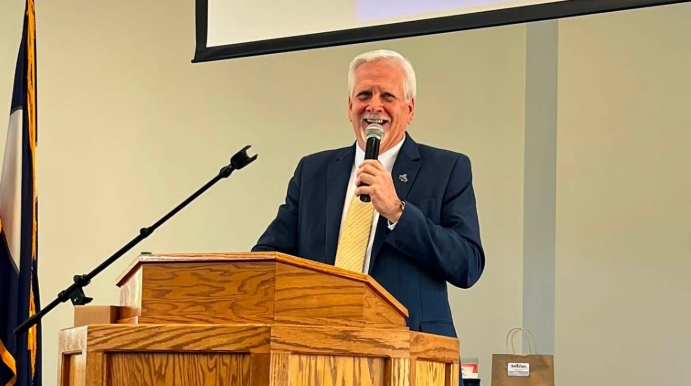
Resident News extended an invitation to Greenwood’s incumbent mayor, Doug Kinslow, to respond to the same constituent-submitted questions posed to challenger Ralph Meeker, Jr., during an in-person interview on Tuesday.
Kinslow provided the following responses:
Q: The city now handles permits and inspections through the TEKConnectGov online portal. What has worked well, and what would you improve for builders and homeowners? Has this enabled permits to be approved faster? Does this lower the financial burden accrued by builders/homeowners?
A: In January 2026, Greenwood transitioned to TekConnectGov, an online system for permits, inspections, and development-related services.
One of the primary reasons for the change was cost. The previous system had become increasingly expensive to maintain, and TekConnectGov provides these services at a lower cost to the city.
The new system allows contractors, developers, and residents to submit applications, monitor project status, schedule inspections, and communicate with city staff online. It also reduces the need to make unnecessary trips to City Hall.
As with any new system, there are opportunities for improvement. We’re continuing to work on clearer instructions for first-time users, more consistent inspection checklists, and better guidance for contractors.
Our goal is to make the process easier to navigate while maintaining the standards necessary to protect public safety.
Q: Our wastewater system includes about 34 miles of sewer line, 12 lift stations, and a treatment plant that handles roughly 907,000 gallons a day. The city has also updated its water & sewer rates since 2020 and may increase them again. How will you make sure future rate decisions are fair to residents? What are the planned capacity improvements and maintenance needs as the city grows?
A: One of my priorities for Greenwood’s future is ensuring we have reliable water and wastewater systems that can support our growing community while keeping utility rates as affordable as possible.
Currently, Greenwood relies on two water sources: our own water production and water purchased from James Fork. I believe we need to explore a third source to strengthen our long-term water supply and reduce our dependence on any single provider.
Affordability remains a challenge. We recently had to increase water rates because the system was operating at a loss, and James Fork subsequently increased the rates it charges us. We must continue looking for ways to control costs while maintaining reliable service.
Our wastewater system also faces challenges involving treatment capacity, aging sewer lines, and lift stations. However, we’ve made significant improvements.
Recent projects include upgrading the treatment plant’s aeration system, improving chemical feed equipment, replacing critical valves, upgrading lift station pumps, adding remote monitoring and control technology, and cleaning and inspecting approximately 12,000 feet of sewer lines.
Additional work is planned, including rehabilitation of treatment plant equipment, replacement of aging sewer lines and manholes in the Indian Hills area, continued lift station improvements, and an engineering study to evaluate treatment capacity.
We’ve also completed a wastewater system model that will help us evaluate infrastructure needs as new development is proposed.
Financial planning is an important part of maintaining these systems. The Water and Wastewater Commission maintains a capital improvement plan, and state law requires regular rate studies and funding set aside for infrastructure replacement. We also continue pursuing grants and other outside funding opportunities to help reduce the burden on our customers.
Our next wastewater rate study is planned for 2028. Any future rate decisions should be based on the actual costs of operating, maintaining, and improving the system.
As mayor, I want to continue working with the Water and Wastewater Commission and city staff to plan ahead, maintain our infrastructure, and keep these essential services affordable for Greenwood residents.
Q: The Economic and Community Development Committee was formed in 2014 to create jobs and expand the tax base. What has it accomplished, and what should it focus on next?
A: Economic development is important to Greenwood’s future, and I believe the committee has opportunities to become more effective.
One project currently being explored is the possibility of bringing a hotel to Greenwood. I support examining that opportunity, beginning with a feasibility study to determine whether the market can support it.
At the same time, economic development isn’t just about attracting new businesses. We need to make sure the businesses already investing in Greenwood remain successful.
As our city grows and changes, I’d like the committee to focus on supporting existing businesses, identifying market needs, and finding practical opportunities to increase commercial activity and sales tax revenue.
We have a strong foundation, but I believe there’s room for improvement in how we approach economic development.
Q: How would you work with the Chamber of Commerce and the Advertising & Promotion Commission to bring visitors and spending into the city?
A: Greenwood’s Advertising and Promotion Commission has been very successful in supporting events that bring visitors to our community and benefit local businesses.
These include Freedom Fest, the Fall Festival, Sebastian County Fair, Greenwood Rodeo, the Chamber’s Fourth of July 5K, the Historical Society’s annual quilt show, the annual car show, the Bell Park disc golf tournament, Christmas lights at the fairgrounds, and the Chamber’s Christmas parade, just to name a few.
We also have live performances, plays, and concerts at our Performing Arts Center.
These events bring people together, attract visitors, and encourage spending at Greenwood businesses. The more successful our local businesses are, the stronger our community becomes.
We’ve also continued investing in recreational opportunities, including the splash pad and our new inclusive playground, which is expected to open in late October or early November.
I want to continue supporting these partnerships because they improve our quality of life while helping grow Greenwood’s economy.
Q: lf revenue fell 5%, what would you protect and what would you cut first?
A: My first priority would be protecting essential services, particularly police, fire, emergency response, and critical infrastructure.
We would need to carefully review departmental budgets and identify discretionary spending that could be reduced or delayed without compromising public safety or necessary services.
I would also look at postponing nonessential purchases or projects when appropriate.
At the same time, we need to be careful about deferring necessary maintenance because doing so can create much larger expenses in the future.
The goal would be to manage the reduction responsibly while minimizing its impact on our citizens.
Q: If revenue grew by 5%, what would you invest in?
A: I would prioritize investments that provide long-term benefits to Greenwood rather than immediately creating new recurring expenses.
Infrastructure and public safety would be at the top of that list, including improvements to our water system and planning for future growth.
One of the most important projects we’ve undertaken is the Trey Burgess Memorial Highway. By committing Greenwood’s original $5 million contribution in 2019, we avoided substantially higher costs as the project progressed.
That kind of long-term planning is important.
I also want to see continued economic development that helps increase our sales tax revenue by supporting existing businesses and attracting new opportunities.
Additional revenue should be invested carefully, with an emphasis on projects that improve services and strengthen Greenwood’s financial position.
Q: Would you support any new taxes or fees? lf so, which ones, and what specific projects would they fund?
A: I’m not proposing any new taxes or fees at this time.
I supported the renewal of Greenwood’s existing three-quarter-cent sales tax because of the important services and improvements it funds.
One area we may need to consider additional funding for in the future is public safety, particularly the transition to a full-time fire department and potentially additional support for our police department.
I believe those discussions should begin with a clear explanation of the need, the total costs, and the available funding options.
If additional tax revenue is necessary for a major public safety investment, I believe Greenwood’s citizens should have the opportunity to vote on that proposal.
We should continue pursuing grants and other funding opportunities before asking taxpayers to take on additional costs.
Q: Our community is one of the more expensive in the County to reside, how would you support seniors and residents on fixed incomes as utility and living costs rise
A: Our seniors have helped build the community we enjoy today, and I believe we have a responsibility to make sure Greenwood remains a place where they can continue to live comfortably.
The new Senior Activity Center is one of the accomplishments I’m especially proud of. It provides a permanent gathering place that our seniors can call their own.
I also recognize that rising utility costs and other expenses can be especially difficult for residents living on fixed incomes.
While we don’t currently have a specific city assistance program for seniors, I would support exploring utility assistance and other programs that could help those who need it most.
We should look for practical ways to help while remaining responsible with taxpayer dollars.
Q: Beyond the legal minimum, what would you do to keep residents informed about council meetings, budgets, and major decisions? Do you have plans to improve community outreach and involvement in city government activities?
A: Transparency is important to me because residents deserve to know how their city government is operating and how their tax dollars are being spent.
We currently provide project updates and financial reports at our monthly City Council meetings. Those public meetings are an important opportunity for residents to hear directly from city officials and ask questions.
I also believe we can do better at getting information out to the public more frequently.
I’d like to explore regular updates through the city’s website, perhaps monthly or every two weeks, to keep residents informed about projects, upcoming meetings, and decisions being considered.
That should include information from our commissions, such as Water and Wastewater, Planning, and Parks, not just the City Council.
The more information we make available, the easier it is for residents to stay involved and understand what’s happening in Greenwood.
Q: A third fire station has been discussed, potentially funded by bond financing. Do you support its construction? Do you feel Zion Rd is an appropriate location though it is outside of the city limits? How would you pay for it?
A: I support the construction of a third fire station in the future, but I believe our immediate priority should be establishing a full-time fire department.
Right now, our firefighters have other jobs and responsibilities, which can make staffing and coverage challenging. As Greenwood continues to grow, we need to ensure we have the personnel available to respond when emergencies occur.
Our fire chief is working on options for transitioning toward full-time coverage through a shift-based staffing model. Before moving forward with another building, we need to determine the staffing requirements, operational costs, and how we would pay for them.
Regarding the Zion Road location, the property was purchased and annexed into the city. I support that location for a future station. An informal evaluation of the site has been conducted, and an architect has begun looking at the property, but the project remains in its earliest stages.
I believe we should address the staffing issue first. Once we have a sustainable plan for providing full-time fire coverage, we can evaluate the timing and financing of the third station.
Public safety is too important to approach these decisions out of order.
Q: lf you could have the council take up one measure in your first 90 days, what would it be and which council members need to be convinced?
A: One of my priorities would be to work with the City Council on developing a financially sustainable plan to transition Greenwood toward a full-time fire department.
As Greenwood continues to grow, so does the demand for emergency services. Our firefighters do an outstanding job, but many have other employment obligations, which can make consistent coverage challenging.
Our fire chief is exploring a shift-based staffing model. The biggest question is how to fund the additional personnel and ongoing operating expenses.
I don’t have a final funding solution today, and I don’t believe it would be responsible to make that commitment without understanding the long-term costs. I want to work with our fire chief, finance director, and City Council to evaluate the options.
If additional tax revenue is ultimately necessary, I believe the citizens of Greenwood should have the opportunity to vote on that proposal.
I believe the council shares the goal of protecting our residents. Our challenge is finding a responsible way to make it happen.
Q: How can we enhance employee efficiency in each department?
A: We already conduct annual performance reviews for city employees, which provide an opportunity to evaluate performance, establish expectations, and identify areas for improvement.
Some department employees report through city commissions, and their evaluations are conducted through those commissions.
Efficiency also means making sure our employees have the right tools and procedures to do their jobs effectively.
Our transition to TekConnectGov is an example of improving services while reducing the city’s operating costs. We’re also continuing to improve internal procedures and communication to eliminate unnecessary work.
I believe we have dedicated employees who care about Greenwood. My responsibility is to help make sure they have the resources, direction, and accountability necessary to serve our residents effectively.
Q: How would you assess spending waste within the City?
A: I believe responsible spending starts with carefully evaluating departmental budgets, recurring expenses, contracts, and the long-term value of our decisions.
One example is the Trey Burgess Memorial Highway. Greenwood committed its $5 million contribution in 2019, which helped protect the city from substantial cost increases as the project moved forward.
Another example is our Senior Activity Center. We worked through multiple rounds of bidding and secured outside funding for the purchase and renovation rather than using Greenwood tax dollars for those costs.
Sometimes saving money means finding a less expensive way to accomplish something. Other times, it means making an investment today that prevents much larger expenses later.
I want to continue evaluating spending decisions with those principles in mind.
Q: Should each department head undergo an annual performance review?
A: Annual performance reviews are already part of Greenwood’s employee evaluation process.
These reviews help establish expectations, evaluate performance, and identify opportunities for improvement.
It’s important to recognize that some department heads and employees report to independent city commissions. In those cases, the commissions are responsible for conducting their evaluations.
I support continuing this process and making sure reviews are meaningful, consistent, and focused on accountability and providing quality service to our residents.
Q: What’s your stance on the flock cameras in Greenwood
A: I believe license plate reader technology is an important tool for law enforcement, particularly for protecting our children and improving public safety around schools.
At the same time, I understand the privacy concerns residents have raised about how information is collected, stored, and shared.
The city remains under contract with Flock, but we are exploring Axon as an alternative. The City Council authorized our city attorney to pursue a proposed agreement for comparison.
Our attorney has requested changes to address privacy concerns, including a seven-day retention period for routine license plate reader data. Information associated with an investigation could be retained longer when necessary.
Axon has agreed to the changes requested so far, although a final agreement has not been approved.
My preference is to move away from Flock while maintaining a system that provides law enforcement with valuable information and establishes stronger privacy protections.
I believe we can support public safety while respecting the privacy of our residents.
Q: Senior Activity Center support
A: I stand behind the decision to purchase and renovate the property for our new Senior Activity Center.
It has proven to be exactly what our community needed. Our seniors love the facility, they’re proud of it, and most importantly, they have a place they can truly call their own.
We now own our facility rather than continuing to invest in property the city doesn’t own.
One important point that sometimes gets overlooked is that the grant funding we received could not have been used to remodel the former leased building. The funding required an eligible city-owned facility.
Through federal COVID relief funds and a $500,000 grant from the Arkansas Economic Development Commission, we were able to purchase and renovate the new center without using Greenwood tax dollars for those costs.
I believe the results speak for themselves. Our seniors have a beautiful, permanent home for their activities, and Greenwood has an asset that will serve our community for many years.
I’m proud of what we accomplished, and I would make that same decision again.