


Message from the author, James Parks: The views and opinions expressed in this article are mine alone, and do not necessarily reflect the views and opinions of Resident News Network.
Can you imagine a world where some of the greatest works of art the world has ever seen, such as Da Vinci’s “Mona Lisa” or Van Gogh’s “The Starry Night” were thrown aside for something computer-generated with no human creativity?
What if we deleted records of Jimi Hendrix and the Beatles, and just computer-generated new recordings simulating the sounds of both?
Okay, admittedly this may be a little far-fetched, but the problem still remains. Artificial Intelligence is getting out of hand, and it shows absolutely no sign of slowing down. Only through pushback, and the practice of responsible use, can we get things back on track.
For most Americans, their first introduction to modern-day AI assistance started harmlessly. We were introduced to the app ChatGPT. Funny conversations were had, a couple of funny pictures were generated, and even a couple viral memes were created. 80s throwback anyone? For the most part, it was all done in just good, harmless fun.
But what about when AI begins to blur the lines between what is real, and what is computer-generated? What about when someone takes just a normal, everyday picture of someone, and a computer generates them into a compromising situation? And, what if someone naïve to the nuisances of artificial intelligence actually believes these alterations are real?
There are multiple examples of AI generation even causing legal problems. There is a report from 2026 of a woman spending two days in jail because her ex-boyfriend created fake AI-generated texts that put her behind bars. No one verified if the evidence was real. It took eight months until prosecutors dropped the charges.
AI is also used by some police departments in the way of facial recognition technology. There are more than a dozen wrongful arrests due to the technology providing false identification. In 2021, Kimberlee Williams, a grandmother living in Oklahoma, was arrested when AI technology wrongfully identified her as having several warrants out of Maryland. She lost her job and spent six months in jail before finally being released.
It is becoming a problem, and the sooner that those aware of this situation can admit that, the better. Altered photos and videos are being shared at will on social media, with zero repercussions from the social media platforms that allow it.
I’ve been in and out of the journalism field, both as a hobby and as a profession, for more than twenty years. You can call me old-fashioned, which I am to a degree. But I still firmly believe in journalistic integrity. Unfortunately, there are countless pages all over social media that do not share this viewpoint.
I won’t name them all because, to put it quite bluntly, they have done nothing to earn publicity or a shout-out. But chances are, if you follow any kind of local high school athletics on social media, you have come across these pages I’m talking about. “Sebastian County Sports” or “River Valley Football News” are the two examples I’ll give.
Immediately upon visiting these pages, you’ll see the unmistakable cringe of AI graphics and flyers. They’re everywhere. And there are multiple instances of them clearly stealing the work of real journalists and photographers, putting it into AI, and attempting to make it their own. With no credit whatsoever. Now, one particular page is taking it to the next level, and are actually trying to charge real money to parents/athletes for a call-out on their page. Want to see an athlete on their page, with a picture and a couple of highlights? That’ll be $45 please. And they’ll use AI to generate it. So, what exactly are they doing to warrant this money?
There are many more examples of these fake news/AI-generated pages. You can look up “Inside Razorback Hoops,” on Facebook. They have over 5,800 followers on the page, and they post multiple times a day. It is nearly all AI-generated images, and 100% completely fabricated and unfounded news stories.
One such story claims Bobby Petrino is returning to the Razorbacks, “in a landmark agreement” worth over $500 million. There is absolutely no truth whatsoever, but they’re allowed to post whatever they want and Facebook does nothing. They even claim legendary Hogs basketball coach Nolan Richardson has died about 10 different times, but he is still alive and well.
The scariest part though, is that on nearly every fabricated post, there is someone in the comments who believe it’s true. And this example is just from one page, about sports. There are similar pages everywhere, for every team, for every subject. And nothing and no one to stop them.
This is just the beginning.
Artistic creativity is being thrown to the side for ChatGPT (or other apps) AI-generated content. Go to the “River Valley Foodies” Facebook page, and you will be bombarded with AI-generated flyers, menus, and logos. Endangered are the days of finding a local graphic designer, and commissioning their time, skill, and efforts. Today, the norm is “Hey ChatGPT, create me a logo showing a chicken with flames around it,” and then seconds later there is a completely generic, unoriginal logo.
To get the perspective of someone in the field locally, I reached out to Dustin Faber – a local graphic designer who does page design for Gannett Media. I questioned him on his thoughts on AI usage by small businesses.
“I think that it cheapens their product,” he said. “If I see your restaurant using AI photos of food instead of your own food, it makes me wonder what you’re hiding”.
Just recently, Jordan Evans – the founder of the River Valley Foodies page – had to place a ban on images of AI-generated food.
“The deception was a real problem,” Evans said. “These exaggerated images were nothing like the actual product.”
Dustin Faber also added, “If you’re a small business owner, you should want to help out other small-time entrepreneurs and hire somebody to make your menus instead of relying on a computer.”
We’ve all seen the AI flyers, and they all look the same. They have unmistakable fonts, formats, and layouts. And in 2026, you can’t look up local businesses online without running into multiple examples of this. And it’s concerning.
I want you to consider this for a moment: Local businesses beg and plead for you to buy local, stay local, except when it comes to graphic design.
And to all the local business owners out there, I don’t want anyone to think I’m picking on them or trying to belittle their business. Just because AI images are used, doesn’t mean your business is bad. This article is here to simply persuade you to at least explore the fact that there are other options out there.
A poll was conducted, with permission from Jordan Evans, on consumer preference when it comes to graphics displayed from businesses. The question was “Are you bothered by AI-generated menus, logos, and flyers?” The options were 1. I prefer AI generated designs. 2. I prefer non-AI-generated designs and content. 3. Indifferent, it doesn’t matter to me.
The response was overwhelming in favor of option 2, that consumers prefer non-AI generated content. This garnered 448 total votes, a total of 75%. The third option, indifference, had 64 votes for 10%. A user manually entered a fourth option, “When I see an AI menu, I won’t go eat there.” This option had almost as many votes as indifferent with 62. The first option, I prefer AI images, had 5 votes for 0%.
Scott Faldon, a marketing manager for a local outdoors company (and local food enthusiast just like myself), shared his opinion on the matter.
“The biggest problem with the AI content from restaurants is it all looks the same,” he said. “The BBQ joint, the taco place, and the coffee shop are all practically identical. Either work on your prompts so that you stand out or just snap a photo of your best dishes with your phone and post those.”
I spoke to a local business owner, Kylie Percifield, who operates the “D&J Bait and Grub” restaurant in Wister, Oklahoma. In addition to a menu of cafe-style foods, her store also sells fishing supplies and bait. On social media, she uses a mixture of live photos and AI generation.
“The biggest factor (in using AI) is not having the knowledge to edit/crop/create the necessary information that I was wanting to visually show people,” she said, referring to her AI flyer which highlights what items are produced in-house at her cafe. “I didn’t love the idea, but it beat typing out 100 times what we make in-house and people prefer to see pictures instead of a bunch of words.”
When asked if she had looked into, sought out, or considered the work of a local graphic designer, she admitted that she had not.
I reached out to other local businesses that use AI generation much more heavily, looking to gain insight into why they chose to use it so much. They declined to comment.
With more and more businesses turning to AI, the graphic design field as a whole could be in trouble. In fact, with the new STATS (Student Tuition and Transparency System) rule, federal student loan funding could be cut. Under the rule, undergraduate programs will be required to demonstrate that their graduates earn more than the typical high school diploma holder. This means that, if things don’t improve, high school students looking to study and major in graphic design might not be able to do so with the assistance of federal scholarships (FAFSA).
I also spoke with fellow class of 2004 Van Buren High School graduate, Eddie Vansell. Vansell is an adjunct graphic design professor at UA Fort Smith. He has 18 years of professional experience in graphic design and creative work. Alongside his teaching duties, he is currently the Creative Director at Harvest Time Church in Fort Smith.
Eddie has some concerns about AI, but he is still optimistic about the future of the industry.
“I’m concerned about certain parts of the industry, but I’m not necessarily worried about the future of design itself,” he said. “If you’ve been in almost any industry long enough, you’ve watched technology change the way work is done. You either learn to adapt to those changes, or, at some point, you risk being left behind.”
Vansell doesn’t dismiss the concerns surrounding AI, either.
“AI is obviously a significant version of that for graphic design, and I don’t always like the way it’s being used,” he said. “But ultimately, I view it as another tool in the toolbox.
This distinction is important. AI may be capable of producing a logo, a flyer, or an advertisement in seconds. But Vansell believes the value of a professional designer goes beyond simply producing an image.
“Do I think AI can replace certain tasks? Absolutely,” he said. “I think some of the more production-oriented work that designers have traditionally been paid to do will become automated, faster, and cheaper. That will affect jobs.”
But graphic design, as he explains, is ultimately much more than simply making something look good.
“Graphic design at its core is visual communication. It’s identifying a problem, understanding an audience, and determining the best way to communicate something to them,” he said.
So, to summarize, the question may not be whether or not AI can make the graphic. It clearly can. The question is, why that graphic should exist in the first place.
“So I think AI changes where the value of a designer is,” Vansell said. “Knowing how to make something is becoming less of a differentiator. Knowing what should be made, why it should exist, who it is for, and whether it actually solves the problem becomes increasingly important.
For students considering graphic design as a career, Vansell believes that the prospective students should seek the answers within themselves.
“I’d ask them two questions: ‘Why?’ and ‘Where?'” he said. “Why are you investing in an education in graphic design, beyond simply enjoying making things? And where do you see yourselves creating value? What kind of problems do you want to solve?”
His advice isn’t for aspiring designers to completely ignore AI. His advice is actually quite the opposite.
“I don’t think students should ignore AI or be afraid of it,” he said. “But they also need to develop the things that are much harder to automate: critical thinking, conceptual development, communication, taste, curiosity, empathy, and the ability to understand why a design solution works.”
Powerful words indeed. Like it or not, AI is here to stay. It’s not going anywhere. But, in this writer’s humble opinion, we need to recognize that it is a tool. No different than a new pen, a new keyboard, or a new laptop. Or, if you’re not a nerd like myself, a new hammer, a new screwdriver, or a new power drill. You can get the job done with a screwdriver, but it would be a heck of a lot easier with a drill, right?
But my challenge to local business owners is this: at least take some time to reconsider your stance on AI-generated images. Is this what your customer wants? Is this the best way to convince someone to spend their hard-earned money at my place of business? I feel the following statement is very important to consider. Remember, for many of your potential customers, the advertisement or flyers they see posted on social media are the first impression they have of your business. How many potential customers are being lost, because they saw an AI-generated flyer, and immediately just keep scrolling?
The consumers have spoken. A vast majority of us have serious AI fatigue. We don’t want to see the same AI flyers over, and over, and over again. We want something different. We want to reward that something different by spending our money at that establishment. We applaud creativity, and we applaud innovation. Seek out the work of a local graphic design professional. Let them make you something personal, and let them showcase your business and what makes it stand out and makes it unique.
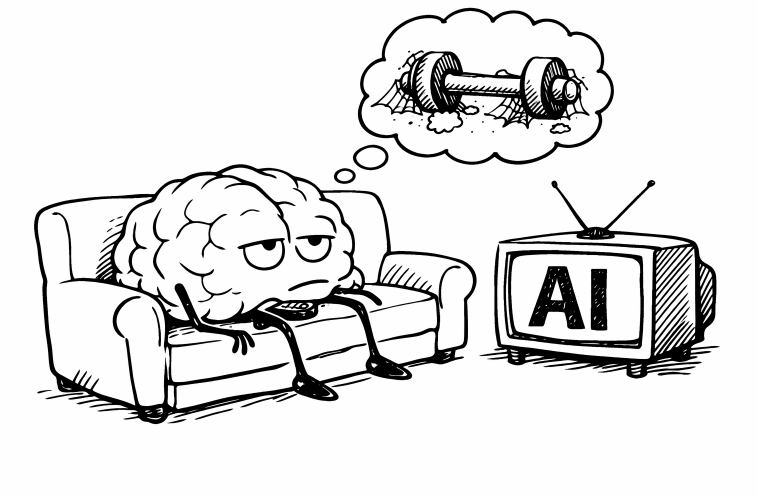
Illustration credit to Siddhant Khare. Siddhant is a software engineer who is also outspoken on AI fatigue. You can read his articles from a software engineering professional’s point of view on his website.