


Arvest Million Meals Campaign Raises $616,000 Bankwide, Hits 3 Million Meals Goal

Arvest announced last week that the bank’s 15th annual Million Meals campaign raised $616,100 to benefit more than 80 food partners in the bank’s footprint of Arkansas, Oklahoma, Kansas and Missouri. With one dollar able to provide up to five meals for someone in need, the funds will help food partners distribute more than 3.08 million meals for hungry families and individuals.
Arvest announced the totals during an event on Thursday, June 12, at the bank’s Fort Smith branch at 5000 Rogers Ave. As part of the campaign’s efforts, Fort Smith Arvest associates presented a total of $50,320 to six local food partners in the River Valley: Community Services Clearinghouse, United Way of Fort Smith Area, First Assembly of God Church in Mena, River Valley Food 4 Kids, Second Baptist Church in Clarksville and Antioch for Youth and Family in Fort Smith.
The Million Meals campaign, which runs from April to May each year, raises awareness and money to fight hunger in the bank’s four-state footprint. Money collected goes directly to the bank’s food partners to help them meet an increase in demand during the summer months, especially for families with children who don’t have the benefit of free or reduced lunches at school.
To celebrate the initiative’s 15th year, the bank set a goal to increase bankwide donations by 15%, equating to more than 3 million meals. The Million Meals campaign originally began with a goal of raising 1 million meals. Now in its 15th year, the bank has more than tripled its original annual goal.
“We’re very proud of the success of this year’s Million Meals campaign,” said Mike Jacimore, president of Arvest Bank – Fort Smith Region. “To hit our 3 million meals goal bankwide is a testament to the strength and compassion of the communities we serve. Through the generosity of our community members and associates, these funds will help our local organizations continue to combat hunger and provide essential support to our neighbors.”
Last year, the Million Meals campaign raised 2.6 million meals for local food partners. Since 2011, the initiative has helped provide more than 28 million meals and collected more than $5.1 million in donations.
Thursday’s announcement also included remarks by Fort Smith Mayor George McGill and a special presentation of the bank’s inaugural Million Meals Hunger Hero Award, given to food partner Antioch for Youth & Family in honor of the nonprofit’s late founder Charolette Tidwell, who passed away in November 2024. Arvest created the Hunger Hero Award to recognize the crucial work that community food pantries and their volunteers undertake daily to provide resources to those in need. Antioch received an additional $1,000 donation from Arvest to go along with the award.
“When we decided to introduce the Hunger Hero Award this year, Charolette immediately came to mind,” said Jacimore. “Her legacy of compassion and service has profoundly impacted countless lives, and this award reflects our deep respect for her tireless work and the vital role Antioch continues to play in our community.”
For more information about Million Meals and local food partners, visit arvest.com/millionmeals.


‘What’s wrong with my lawn?’ Research points toward possible answer
By Maddie Johnson
University of Arkansas System Division of Agriculture
Arkansas Agricultural Experiment Station
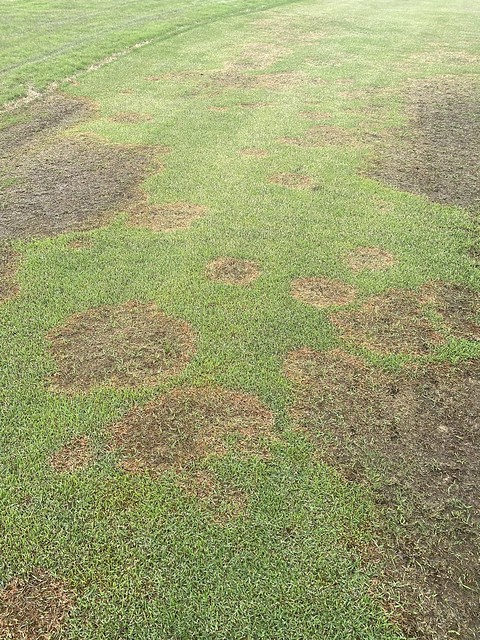
With spring rains, warm-season turfgrasses such as bermudagrass and zoysiagrass are at risk of a fungal disease called large patch that can leave a lawn marked with large brown areas of dead and dying grass.
Large patch is caused by a fungus and affects warm-season turfgrasses, which go dormant in cooler months. This disease begins with small, round patches that can grow in diameter and are characterized by a yellow, orange or brown color as the affected grass dies.
A new article, “Review of the biology and management of large patch of warm-season turfgrasses,” was published in the Crop Science journal and provides critical knowledge about the disease that can compromise the health, aesthetics and usability of turfgrass.
It provides readers with comprehensive information covering the disease’s pathology, progression and management, and it highlights areas in turfgrass science research that require further attention, such as the environmental and soil elements that contribute to the spread of the fungus behind the disease. These could include soil salinity, pH and fertility.
The article identifies breeding for improved large patch resistance as another opportunity for further research.
The article’s first author, Samuel Kreinberg, is a University of Arkansas graduate student specializing in turfgrass science. He plans to defend his master’s thesis this month and present the paper at the 15thInternational Turfgrass Research Conference in Karuizawa, Japan, this summer.
Diagnosing turf
Wendell Hutchens, who is Kreinberg’s adviser and co-author, said he is often asked the question: “What’s wrong with my lawn this spring?”
Hutchens is an assistant professor of turfgrass science in the Horticulture Department with the Arkansas Agricultural Experiment Station and the Cooperative Extension Service — the University of Arkansas System Division of Agriculture’s research and outreach arms — and the Dale Bumpers College of Agricultural, Food and Life Sciences.
Because the article includes information on the disease cycle and management strategies for large patch, Hutchens said it is useful as both a research and outreach resource to answer such a question.
“The paper is a helpful resource to send to a golf course superintendent, sod grower, sports field manager, or anybody that struggles with the disease large patch,” he said.
Hutchens noted that rainy climates and moderate temperatures can lead to a greater prevalence of large patch. As temperatures rise in the summer and the weather becomes drier, the disease will typically go away.
When it comes to managing large patch, Hutchens said many people often make the mistake of watering their grass too much. He said that mowing properly, fertilizing correctly and not overwatering grass will “alleviate the vast majority of the issues” with the disease.
Kreinberg said that large patch is one of the primary issues of zoysiagrass lawns in Arkansas, and he conducted a research trial in both Fayetteville and Alma, Arkansas, to analyze the spread of the disease in zoysiagrass.
Those who suspect that large patch has affected their lawns can submit samples to the Arkansas Plant Health Clinic through county extension offices, and by walk-in at the clinic in Fayetteville, located at 2601 N. Young Ave.
Inspiration behind the work
As for the motivation behind the research, Hutchens said he and Kreinberg “wanted to identify what had not been studied about the disease.”
Hutchens also credited Kreinberg for the accomplishment of serving as the first author of a piece that was published in Crop Science, the flagship journal of Crop Science Society of America.
“Sam is just a rock star student who is an exceptional writer and researcher,” Hutchens said.
The article also featured Division of Agriculture and Bumpers College faculty members Mike Richardson, professor of horticulture, and Terry Spurlock, associate professor and extension plant pathologist, as co-authors.
Jim Kerns, professor and extension specialist of turfgrass pathology with North Carolina State University, and Lee Miller, assistant professor of botany and plant pathology with Purdue University, were also co-authors.
The Arkansas Agricultural Experiment Station and North Carolina State University are part of a system of agricultural research centers at land-grant universities in the southern United States where scientists collaborate to conduct research and outreach focused on conserving the region’s natural resources and sustainably feeding a growing global population.
To learn more about the Division of Agriculture research, visit the Arkansas Agricultural Experiment Station website. Follow us on X at @ArkAgResearch, subscribe to the Food, Farms and Forests podcast and sign up for our monthly newsletter, the Arkansas Agricultural Research Report. To learn more about the Division of Agriculture, visit uada.edu. Follow us on X at @AgInArk. To learn about extension programs in Arkansas, contact your local Cooperative Extension Service agent or visit uaex.uada.edu.
About the Division of Agriculture
The University of Arkansas System Division of Agriculture’s mission is to strengthen agriculture, communities, and families by connecting trusted research to the adoption of best practices. Through the Agricultural Experiment Station and the Cooperative Extension Service, the Division of Agriculture conducts research and extension work within the nation’s historic land grant education system.
The Division of Agriculture is one of 20 entities within the University of Arkansas System. It has offices in all 75 counties in Arkansas and faculty on three system campuses.
Pursuant to 7 CFR § 15.3, the University of Arkansas System Division of Agriculture offers all its Extension and Research programs and services (including employment) without regard to race, color, sex, national origin, religion, age, disability, marital or veteran status, genetic information, sexual preference, pregnancy or any other legally protected status, and is an equal opportunity institution.
Partnership restores local lizards with sooner ‘boomers’
By Randy Zellers
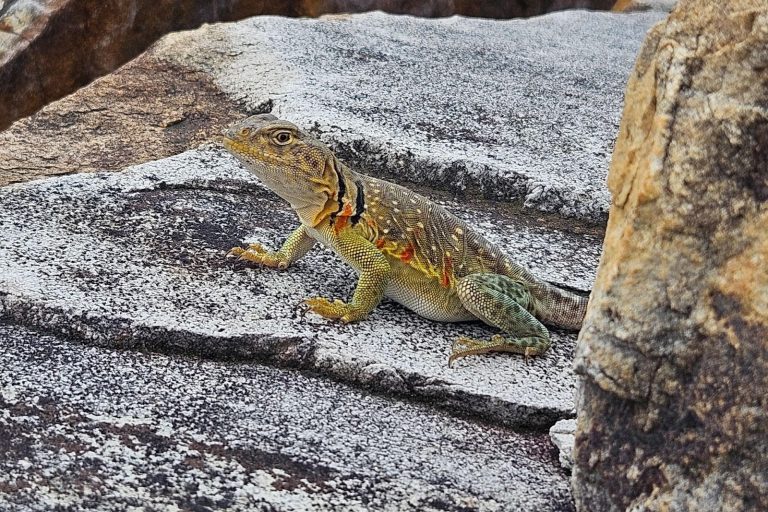
A dozen Oklahoma-born eastern collared lizards now call The Natural State home thanks to a partnership between the Arkansas Game and Fish Commission, the Oklahoma Department of Wildlife, the Little Rock Zoo, Tulsa Zoo and the Collared Lizard Conservation Team. With a little luck, these transplants may be able to replenish a pocket of prime habitat in west-central Arkansas.
Eastern collared lizards, affectionately called “mountain boomers” by many wildlife enthusiasts, are one of Arkansas’s species of greatest conservation need. They are some of the largest lizards found in Arkansas, sometimes reaching 14 inches in length. Males possess vibrant yellow, green and teal markings, while females tend to be more muted, with reddish-orange accents. These lizards have seen dramatic declines throughout much of their range in Arkansas as their preferred fire-tolerant habitats have been swallowed by cedars and other woody plants. Thanks to multi-agency partnerships and work funded through the State Wildlife Grant Program, aggressive habitat restoration in many key locations using prescribed fire and cedar removals have restored some of this habitat. Additional SWG projects have helped to establish captive breeding programs in coordination with the Little Rock Zoo have been used to re-establish these charismatic reptiles in newly recovered sites.
According to AGFC Herpetologist Amanda Bryant, the lizards were transplanted to a portion of private land that had historically housed one of the largest monitored populations of the species but saw a population crash last year.
“We want to reestablish a population at that site because it has so much quality habitat for the species,” Bryant said. “We do not know the cause of the crash, so we are starting with a modest number and monitoring closely in the next few weeks for any disease or environmental issue. Four of the females we released had eggs, so we’ll go back later in the summer to see if we can find any new hatchlings at the site.”
Bryant said the lizards were captured with the help of Casey Brewster of the Collared Lizard Conservation Team under access and permits granted through Mark Howery at ODWC. Kay Backues at the Tulsa Zoo and staff at the Little Rock Zoo screened the reptiles to ensure they were free of diseases and parasites before relocating them.
“It’s been really great to see the team come together and make this project a success,” Bryant added. “I also want to especially thank Matt Gifford and Casey Brewster of the Collared Lizard Conservation Team for being key members of the reintroduction of this fascinating reptile species in a portion of Arkansas where they once thrived.”