
72.2 F
Fort Smith
Friday, June 19, 2026
Home Blog Page 1051

A $20K House? No Joke!

Previously published by Fast Company | Editor | 03 Feb 2016 | LINK

All Photos: Jessica Ashley Photography

This House Costs Just $20,000—But It’s Nicer Than Yours.

The Rural Studio’s 20K House is so cheap and has such innovative design that it’s changing the entire housing system—from mortgages to zoning laws.

For over a decade, architecture students at Rural Studio, Auburn University’s design-build program in a tiny town in West Alabama, have worked on a nearly impossible problem. How do you design a home that someone living below the poverty line can afford, but that anyone would want—while also providing a living wage for the local construction team that builds it?

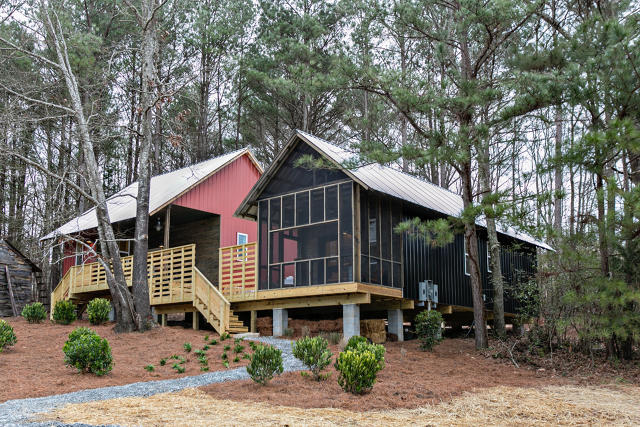
In January, after years of building prototypes, the team finished their first pilot project in the real world. Partnering with a commercial developer outside Atlanta, in a tiny community called Serenbe, they built two one-bedroom houses, with materials that cost just $14,000 each.
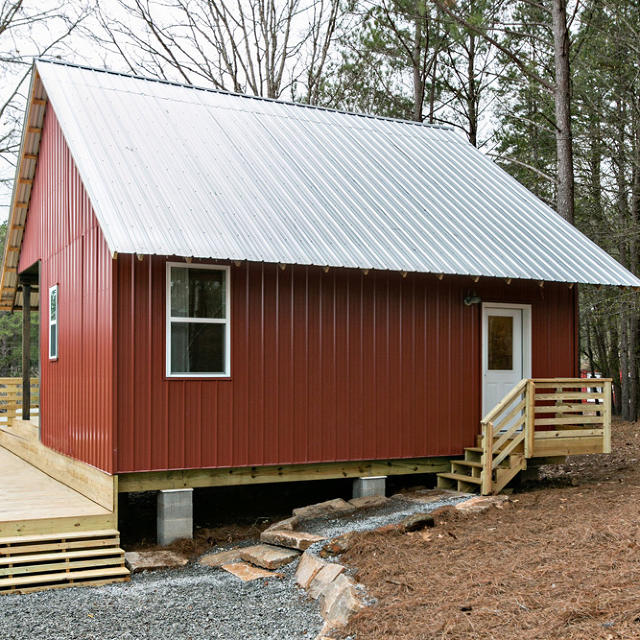
The goal: To figure out how to bring the ultra-low-cost homes, called the 20K Home, to the broader market. “We’re in a kind of experimental stage of the program, where we’re really trying to find out the best practice of getting this house out into the public’s hands,” says Rusty Smith, associate director of Rural Studio. “Really this first field test was to find out all the things that we didn’t know, and to find out all of the kind of wrong assumptions that we had made, and really find out how we had screwed up, honestly.”

Years of architecture students, and their advisors, have spent more than a hundred thousand hours tweaking each detail of the house to optimize both the function and the price. But the bigger challenge is fitting a house that’s completely different than normal into the existing system of zoning, and codes, how contractors do their jobs, and even mortgages.

“The houses are designed to appear to be sort of normative, but they’re really high-performance little machines in every way,” says Smith. “They’re built more like airplanes than houses, which allows us to have them far exceed structural requirements. … We’re using material much more efficiently. But the problem is your local code official doesn’t understand that. They look at the documents, and the house is immediately denied a permit simply because the code officials didn’t understand it.”

The foundation of the house, for example, uses cantilevers, seesaw-like joists that help save wood and concrete and actually make the house stronger than a typical foundation would. But the design isn’t in the usual guides that code officials consult, so the architects had to go back and explain how it worked.

“There’s a thousand and one things in the houses that are like that,” he says. “You’d never see them, the construction techniques, but the house is filled with them. Construction techniques that make the house not just less expensive, but actually makes it perform better than they normally would.”

To bring the house to everyone else who wants to build it, the team realized they would have to create a detailed guide that explained everything from how to build each piece—with Ikea-like instructions—to how to educate local officials.
“A traditional construction set basically tells a builder what to build,” says Smith. “And what we learned that we really need is what we’ve come to refer to as not a construction set, really an instruction set. That not just tells what to build, but specifically how to build it and even more important, why it should be built that way.”

In Serenbe, their first problem was a zoning issue: The houses were too small. (It’s a common problem for anyone trying to build a tiny home.) But they also realized there were numerous other issues, from dealing with insurance, to the bank. In the pilot project, the homes will be owned by the community and shared with artists as part of a residency program. But in a typical case, when someone is buying the house on a limited income and can’t afford the $20,000, banks won’t finance a mortgage for such a small amount of money.

Regions Bank, which works with Rural Studio, told Smith that a mortgage for a $100,000 house costs the bank about $2,300. But a mortgage for a $20,000 house also costs $2,300. “There’s a lack of scalability,” Smith says. “There are these structural things you can only scale down so far.” Now the bank has worked on their own design problem: a new mortgage product made for the poorest people to afford.

The team is trying to address all of the issues the house faces at once. “The most daunting problems aren’t brick and mortar problems, they’re these network and system problems that are threaded together and all intersect in the built environment,” he says. “We’re able to attack all these problems simultaneously—when we see a lever over here and wiggle it, we can very clearly see the implication it has on other systems down the road.”
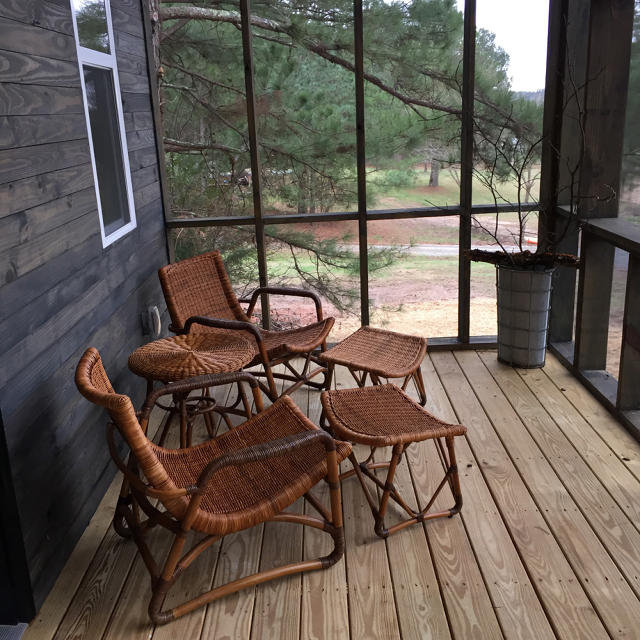
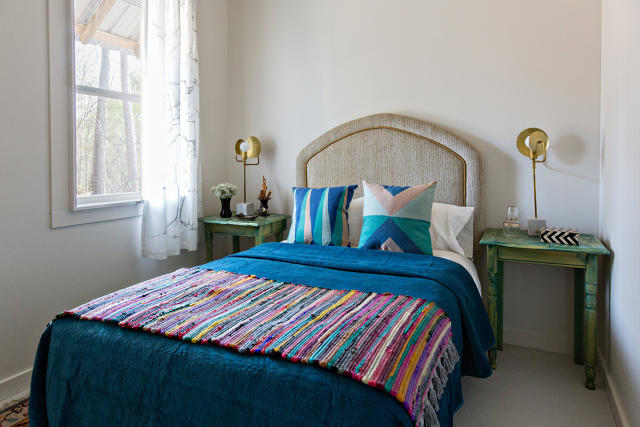
The houses also had to look good, despite the tiny budget. The development near Atlanta might at first seem like an unlikely place to build the pilot homes—it’s a lush planned community that includes million-dollar houses. The architects partnered with the developer for several reasons, including their ability to keep going through seemingly impossible problems. But they also liked the idea of showcasing the homes in such a desirable area.

“When was the last time you were driving down the street by an affordable housing project and you thought, ‘Boy, I really wish I lived in one of those for myself,'” Smith says. “The goal of 20K House is really to design a house that’s affordable, that anybody could have—and that anybody would want.”
Once they have the full “instruction set” ready, the team wants to share it with anyone who wants to use it “The ultimate goal of the project is to give it away,” he says.

Originally, the project aimed for a house that would cost $20,000 in total, including construction, though they now believe that more money may be needed to provide a living wage for builders. They’ve rejected the idea of using factory-made prefab parts (something that a related project in the area does), because one of the main goals is to also provide jobs. Still, whatever the final cost, it will be cheap. And if someone wants to put it together themselves, it would cost less than $20,000.

“We provide the information to you, so that if you wanted to sort of self-service the house yourself, it is a house that with the right set of instructions, anybody who wanted to could build it,” Smith says.

He’s impatient to share the plans with the world. “We’re behind schedule, quite honestly,” he says. “So many people need it now.”

Mansfield/Huntington Chamber Focuses on Pharmacy for Thursday

The Mansfield Chamber of Commerce will meet tomorrow for their monthly meeting. The focus of this meeting will be the two pharmacies coming into Mansfield, and the questions that surround the businesses, their location, opening dates, as well as a “Q&A” with the pharmacists.
Alllsion Clem, representing Cornerstone is familiar face with both Don’s Drug, and Walmart, and Richard Parks, who some have known from his pharmacies in Greenwood, and Lavaca.
Meeting starts 12:00pm (noon) at the City Hall in Mansfield.

MPIC Donates Greenhouse to MSD 7th/8th Grade

Mansfield Parent Involvement Committee (MPIC) was formed to support the teachers, and students of the Mansfield School District. Headed by Amanda Wilson, they’ve been able to supply many needs for the district, including some of those which involved the relationship between parents, and the school district itself.

Recently, MPIC donated a greenhouse for Mrs. Bullard’s 7th/8th grade class where it will be used internally for education purposes. Mrs. Bullard said, “I just wanted to thank the MPIC for purchasing the greenhouse for my classroom!  We are getting good use out of it!!  We really appreciate their support!”

Wilson added, “It’s always rewarding to see the enthusiasm from the staff, and students, when we are able to do something like this. That’s exactly why MPIC was formed. Thank you parents!”

greenhouse
The greenhouse is already at work in Mrs. Bullard’s classroom.

DIY Self-Watering Tomato Buckets

Originally published by Homestead & Prepper | January 28, 2016


grow tomatoes in bucketsMy Italian grandmother always had good advice. One of them being, “You can never have too many tomato plants, but what happens when you run out of room in the garden. Tomatoes are probably the most versatile plant you can grow; They are used in everything from Tomato Sauce to Ketchup,  Espagnole Sauce to Bloody Marys’ (Yum!).

Growing tomato plants in 5 gallon buckets is nothing new, my relatives would grow them on their front porches for decades. What is kinda new and unique is having self watering tomato buckets that are practically maintenance free. Imagine growing beautiful, full tomato plants and only having to refill a reservoir may once a week. I don’t know about you, but my wife hates when we go away for a week and all I can say is “I wonder how my plants are doing”.

Here on the homestead, we try to maximize as much space as we can. About a year ago I was just fiddling around when I came across an obscure website call Alaska Grow Buckets. What they offered was an ingenious and SIMPLE way to make your own self watering buckets from stuff you probably have hanging around the house or garage. The concept so straightforward, it borders on genius.

How It Works

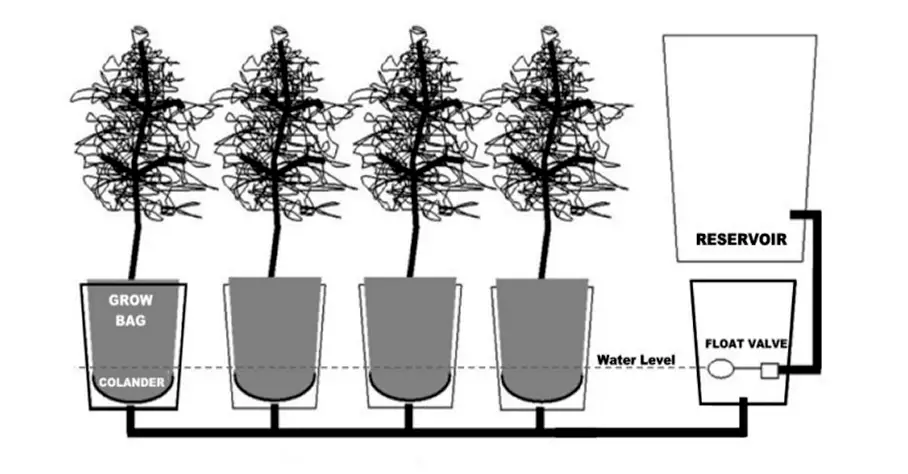
The process is quite simple. The tomatoes are planted in a wicking medium that draws water from below and sends it to the roots of the plant. The water is drawn from another drum or garbage can and is released by a float valve. When the water level drops, it activates the valve instantly irrigating your plants.

You can build this system as small or as large as you wish. Another nice thing is that you are not only limited to tomatoes. You can grow peppers, okra, cucumbers and more. Think of the possibilities.

self-watering-tomato-bucketsbagThe second key to this design is the fabric grow bag. The bags I use can be found at most supermarkets and are very inexpensive or free. The bags are made from spun polypropylene and should last for several years. Similar grow bags are available from nursery and garden suppliers. Canvas or burlap bags may also work – but they will eventually rot and fall apart. The porous fabric allows excess water drainage and aeration of the root zone which is necessary for optimal growing conditions.

The system is also based on the principle of “air root pruning”. As roots grow out to the porous fabric they become exposed to air, dry out and die. This causes the plant to produce dense fine feeder roots and prevents root circling. The increase in fine feeder roots leads to better nutrient and water absorption and promotes accelerated plant growth.


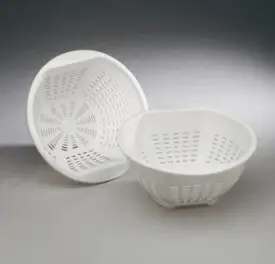
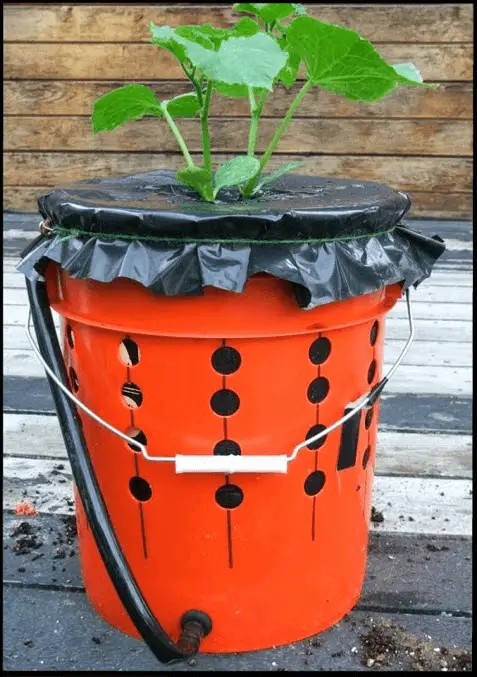
colanderThe third key to this system is a plastic kitchen colander, that will hold the fabric shopping bag off of the bottom of the bucket and create a shallow water reservoir in each grow bucket. Almost any large plastic colander can be trimmed to fit inside a 5 gallon bucket with a strong pair of shears. The colander included in all Alaska Grow Buckets kits fit perfectly without trimming.


grow tomatoes in bucketsThe fourth key to this system is the 5 gallon support bucket with plenty of ventilation holes around the sides. The bucket helps support the fabric bag and the ventilation holes allow adequate air movement. This allows oxygen to reach the root zone which is essential for optimal plant growth. The bucket also acts as a water reservoir below the bag providing a water source for the wicking grow medium. By maintaining the proper water level with the float valve regulator the medium will never dry out and will continuously wick moisture up to the root-zone.


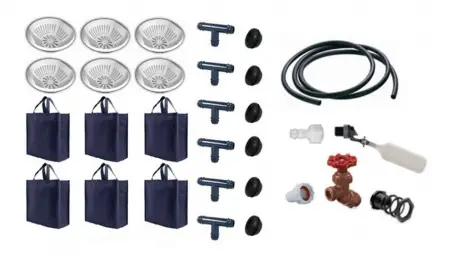
Materials List

1. 5 gallon Plastic Bucket
2. 1⁄2” rubber grommet
3. 10” plastic Colander
4. Fabric shopping bag

I strongly encourage that gardeners find and re-purpose used buckets whenever possible and help us to keep plastic containers out of our landfills. Look for the Type 2 HDPE symbol on the bottom to indicate the plastic is safe to use for growing vegetables.

Many bakeries and restaurants have free or very low cost buckets available. Free used buckets are a great way to save. I get new 5 Gallon buckets from Home Depot at a very low price. You can find the rubber grommets, barbed fittings, vinyl tubing, and other parts from many online or local garden suppliers. The fabric grow bags that I use are available at many supermarkets.

buy-materialsMaterial Kit Includes Most large plastic colanders can be trimmed to fit in a bucket. All Alaska Grow Buckets kits come with special colanders that fit inside a 5 Gallon bucket without trimming. Complete Alaska Grow Bucket material kits are available here.


Tools

1. 3⁄4” Step Drill bit
2. Electric drill
3. Heavy shears or snips if you need to trim a plastic colander.


Bucket-StepsConstruction

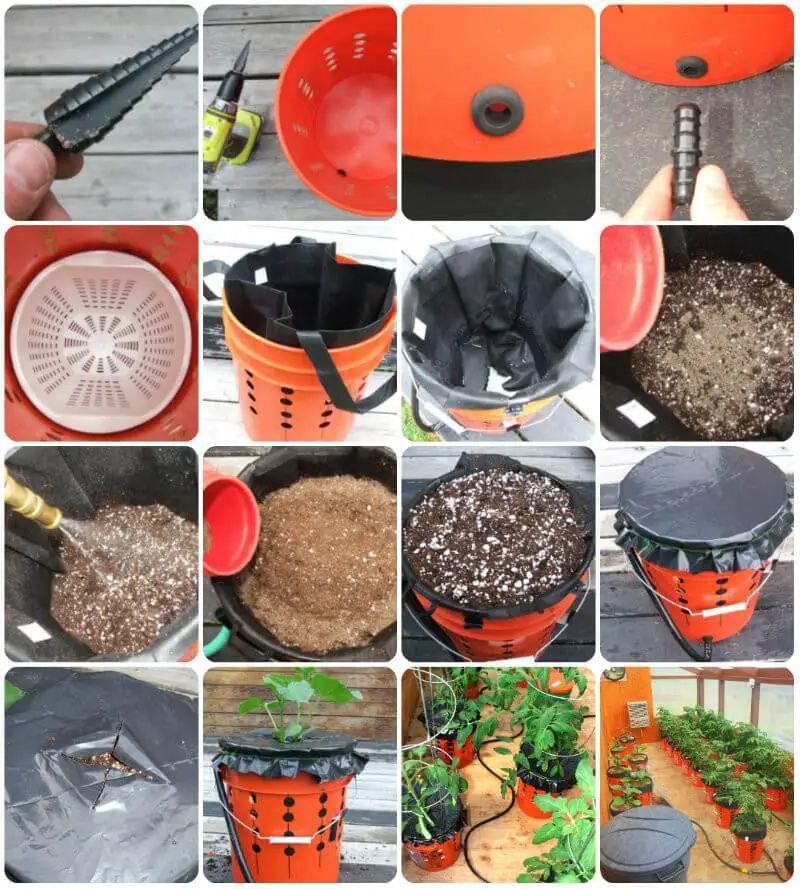
1. Drill a series of 3/4 inch holes in the bucket as illustrated. Drill as many holes as you like starting 6 inches from the bottom of the bucket. These holes along with the porous fabric bag provide air to the root system and that is the key to this design.

2. The lower portion of the bucket has only one opening. This is the water reservoir. You will drill one hole at the very bottom, with your step drill bit for your fill hose fitting.

3. Add a 1⁄2 inch barbed hose fitting to the grommet. This should provide a snug watertight fitting. Your fitting may differ depending on how you connect your buckets – 1⁄2 inch barbed fittings are available from hydroponic suppliers.

4. Place the special Alaska Grow Buckets plastic colander inside your bucket or trim other colanders to fit.

5. Place the fabric bag inside the bucket. I trimmed off the shopping bag handles.

6. Plug the fill hole and add water to the bottom of your bucket and begin adding your growing mix.

7. Fill the bucket in layers and soak each layer well to activate the wicking property of your soilless mix. Dry mix will not work.

8. Add a layer of slow release natural fertilizer to the bottom layer of grow mix.

9. An additional ring of fertilizer should be added near the top.

10. Continue adding layers of grow mix and wetting down with water.

11.A plastic sheet is added to reduce water loss through evaporation.

12. Cut slits in the plastic for planting.

13. I chose a nice looking Alaska grown cucumber that I purchased from a local garden center to test my design.

14. The bucket was attached to my greenhouse auto-fill reservoir system.
The key to setting up an Alaska Grow Bucket multi container system depends on a simple float valve regulator and a bulk reservoir for automatic watering.

Float system

You can add as many Grow Buckets in your system as space allows, but remember to leave enough space for the plants to grow with adequate air movement for ventilation and to remove excess humidity. Overcrowding impedes ventilation and promotes the spread of fungal disease and blocks light transmission within the plants.

Nutrients can be added in the form of a dry natural slow release fertilizer added to the growing mix or as a water soluble nutrient added to the water reservoir. Any hydroponic reference guide will give nutrient requirements for specific plants.

https://youtu.be/7RH0jh5-tmE

MMS FBLA Students Work Towards MAP Project

(Pictured above, Serenity Brunson reads to Mrs. Brewers, Kindergarten class)
The Middle Level Achievement Program (MAP) is an individual member program that is designed to reward those FBLA Middle Level members who excel in their participation in a variety of activities in the areas of service, education and leadership.
Level 1 is the Entrepreneur Level.  This level focuses on basic business skills, introduction to community service, and FBLA-Middle Level involvement at the local level; entries are certified by the local chapter adviser.  ​
MAP is helping students learn basic business skills to help prepare them to pursue future career opportunities and allow them access to professionals who can help them reach their long term goals. Since this competition is a self paced self study competition,  it takes a self motivated student to complete this competition
Mrs. Renea Bryan, the MMS FBLA sponsor stated, “These kids have taken hold of what FBLA stands for, and are all working really hard on making achievements, both personally, and within the community. I am really proud of them.”

FBLA3
With a captive audience, Natalie Allison, MMS 5th grader, reads to Mrs. Brewers, Kindergarten class

FBLA1
MMS 5th grader, Greyson Baggett, reads a fan favorite to Mrs. Barton’s Kindergarten class.

Now What?!?!?

With Walmart closing their doors on the Mansfield location today, we beg to answer the question, Now What?
When Walmart announced the opening of multiple “Express” style locations in several small towns, local businesses went into panic mode. Wondering how they could compete with the giant retailer, some gave up, closed shop, where others stood their ground, and hoped for the best.
While the vacancy now leaves a bad taste in some mouths, don’t forget that this loss, heavily impacts a small towns economics, not to mention the loss of jobs, and the possibility of job creation. On the flip side, it creates a resurgence to longstanding businesses that stayed open.
Will these buildings be utilized by other businesses, possibly donated for the towns civic use, or will it be an eyesore that collects dust, and trash? We’ll wait patiently, and see.

Health-Wise Pharmacy Sets March Opening for Mansfield

Lavaca Based Health-Wise Pharmacy has announced opening a second location in Mansfield for March. The business will take residence in the historic Don’s Drug building on Main Street in Mansfield.
Health-Wise Owner/Pharmacist, Richard Parks, has set a standard in years past with a previous pharmacy in Greenwood, and expanded into Lavaca in late 2014. The Mansfield location will operate Monday thru Saturday, with operating hours from 8:00am – 7pm.
With their plans on opening in March, Parks stated, “We will make the prescription transfer process easy, and seamless, as well as deliver at no charge. We currently deliver anywhere in Sebastian, Scott, and Logan every day, at no charge. ”
Mansfield Health-Wise Pharmacy will be employed by pharmacists, Richard Parks, Kristin Ahlert, and Marietta Parks.
To transfer your scripts to Health-Wise, call (479) 674-2222, or after hours (479) 252-2670.

Cornerstone Pharmacy Announces Mansfield Location

Eric Wright, Cornerstone Pharmacy group, has announced their plans to open a pharmacy in Mansfield at 607 US-Hwy 71 South, next door to Subway.
Wright, who has strong family ties to the area stated, “Cornerstone is about convenience, and customer satisfaction. The communities of Mansfield will be able to utilize a drive-thru, and the same level of care, and professionalism they’re accustomed to.”
Cornerstone Pharmacy is a multiple location Pharmacy group, spread across Arkansas, with headquarters in Fayetteville. “With the family ties we have in the Mansfield area, it’s a place where we feel at home. Our number one priority is to take care of our customers, and we’re looking forward to being part of the community.”
In addition to the opening, Wright also announced that Allison Clem, will be employed as a Cornerstone Pharmacist for the Mansfield location. Clem, who Mansfield residents, and surrounding communities will remember as the Pharmacist in Charge at Don’s Drug, later went on to Walmart.
Cornerstone Pharmacy will bring the Mansfield area an Independent pharmacy with local, familiar, friendly faces, a customer service focus, utilizing all major insurances, Medicare, and Medicaid for prescription medications, offering free delivery, vaccinations, and compounding.
With this announcement, patients can transfer prescriptions to their Fayetteville location, in which they will mail their medicine, with FREE SHIPPING, until the Mansfield location opens. You can contact that location to start the process at (479) 444-7200.
The Mansfield location is planned to open within 4-8 weeks.
For more information on Cornerstone Pharmacy Group, you can visit their website, http://www.cornerstonepharmacy.com/ .

MSD Students “SHINE” Through Artwork

By Kandis Howard, RP Contributor

The City of Mansfield recently created several new committees to help promote some positive changes around town. One of the committees formed was the Mansfield Shine Committee. Its main goals are to promote cleanliness and beautification of the city.
At the end of 2015, the committee partnered together with the Mansfield School District in an effort to get the word out to the public in the form of an art competition. The art teachers, Kelli Thomas and David Love, worked with their students from kindergarten to 12th grade to make posters with the theme “Help Mansfield Shine.”
One overall winner was chosen to be the cover for a calendar and will soon have her poster displayed in the heart of the city near the Mansfield sign on the gazebo square.
The overall winner was Whitney Clark (11th). Four winners were chosen from each campus to have their posters included in the calendar for 2016. They include Colton Silvey (7th), Gavin Holland (6th), Megan Plymale (10th), Trinity Triska (3rd), Jessica George (8th), Mylee Strozier (2nd), Haylie Reese (11th), Scotland Brennan (11th), Haden Henson (7th), Dalton Smedley (12th), Chloe Hattabaugh (1st), and Carter Whiley (3rd). You may buy one of these nice calendars from either art teacher, the City Hall, or at several of the local banks and businesses. The cost is $5 with half of the proceeds going back to the Mansfield Art Dept.
Shine2

Mansfield Walmart Location Closes end of january

In a whirlwind of activity this morning, we have learned through phone calls that the Walmart Neighborhood Market will CLOSE at the end of this month. We will post more information as it becomes available.
For more information, please read the original article posted on KFSM 5 HERE
Walmart issued a press release which can be read HERE