

By John Lovett
University of Arkansas System Division of Agriculture
Arkansas Agricultural Experiment Station
As owners humanize their pets and prove more willing to pay a premium for foods labeled to address pet health, a new study explores which pet health concerns bring the highest prices.
The study recently published in the Journal of Agricultural and Applied Economics examines numerous health attributes for dog food to determine which are associated with higher prices. The study may offer guidance for not just pet food companies, but for pet food buyers as well.
“Trends like premiumization and humanization have made pet owners more aware of the health and safety of their pets’ food in an attempt to keep their pets healthy and happy,” the study said. “Premiumization refers to customers demanding more premium and super-premium products, while humanization involves owners perceiving and treating pets as human family members.”
“Pets have gone from being in the doghouse to being a member of the family, so when it comes to the diet of the pet, that’s a big way in which that bond manifests,” said Andrew Anderson, co-author of the study and an assistant professor in the agricultural economics and agribusiness department for the Dale Bumpers College of Agricultural, Food and Life Sciences at the University of Arkansas and for the Arkansas Agricultural Experiment Station, the research arm of the University of Arkansas System Division of Agriculture.
Amid these trends, the pet food industry grew from $65.9 billion in 2012 to $123.6 billion in 2022, the study said, quoting figures from Statista. The United States’ pet food market is the largest global pet food market and contributor to the global sales total, generating $53.04 billion in revenue in 2022.
In response, the pet food industry is supplying foods that have claims that sound a lot like what we see in specialty foods for humans, he added.
Anderson teamed up with Lonnie Hobbs Jr., an assistant professor in the agricultural economics department at Kansas State University, to investigate the effects of health and wellness attributes on product pricing, and the amount that owners are willing to pay for those attributes. Hobbs and Anderson earned their doctorates at Kansas State in 2023, bouncing study ideas off each other between pickup basketball games. Anderson had data on dog food. Hobbs had delved into the market space. They saw a gap in existing literature on potential value of health and wellness attributes.
Starting with information on 1,268 dry dog food products listed at Chewy.com in January 2023, the researchers used a pricing model that allowed them to analyze prices by attributes only, so factors such as the pet food brand could be omitted to deter bias.
Anderson and Hobbs analyzed more than 60 brands of dry dog food, which they chose to study because dry food has the highest market share among all other pet food markets globally.
Allergies and digestion
From the data gathered, the three most common health-related features marketed on dry dog food included “digestive health,” “skin coat health” and “immune support.” The three least common were “allergy relief,” “itch redness remedy” and “appetite stimulation.”
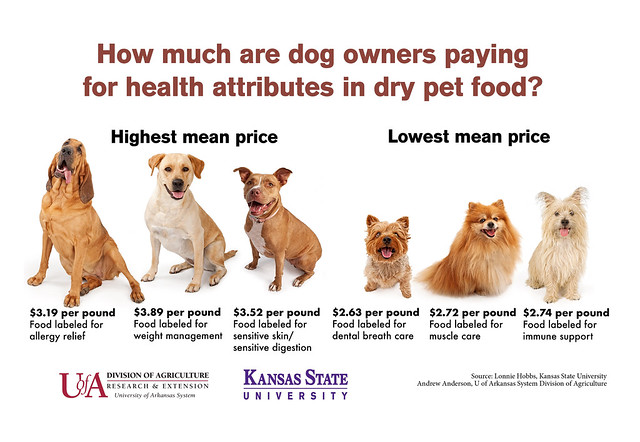
Products labeled “allergy relief,” had the highest average price per pound — $3.89 — which Anderson said could be due to the addition of an antihistamine to support the health-attribute claim.
Foods labeled for “weight management,” were next at $3.52 per pound. Food labeled for “sensitive skin” and “sensitive digestion” were both $3.19 per pound.
The authors noted that except for “weight management,” the attributes with the highest average price per pound have a relatively low number of observations — 6 percent or less of the products — which may warrant cautious interpretation, Anderson said, since the sample size for those products is small.
Highs and lows
The group fetching the highest mean price per pound included the following attributes: “allergy relief,” “appetite stimulation,” “digestive health,” “heart care,” “sensitive digestion,” “sensitive skin” and “weight management.”
On the other hand, the lowest mean per pound price were for these products: “dental breath care” at $2.63 per pound, “muscle care” at $2.72 per pound and “immune support” at $2.74 per pound.
While the study doesn’t specifically show whether the premiums and discounts are related to supply or demand side factors, there are some threads the researchers can tease out from the data that provide clues.
“The sensitive digestion attribute, for example, is in 24 percent of the products but it also commands a 3.7 percent premium,” Anderson said. “When you think about demand, that’s kind of a proxy for that high quantity and price, so to me that sounds a lot like a demand-driven attribute, whereas allergy relief is only in 2 percent of the products, and it commands a very large 17 percent premium. So, it’s not definitive, but it is likely more of a supply side factor in that case.”
When you see a high quantity and high price, as opposed to a low quantity and high price, you start thinking “demand,” Anderson explained.
Pet health and buyer behavior
In the pet food market, health and wellness products are becoming increasingly important in shaping customer purchasing behaviors. Anderson and Hobbs pointed to recent studies in the United States and the United Kingdom showing dogs are overweight or have at least one health disorder including dental, skin or intestinal issues.
Citing the Association for Pet Obesity Prevention’s 2022 study, 59 percent of dogs in the United States were classified as overweight or obese. It was a 3 percent jump from 2018. The UK study took a random sample of more than 22,000 dogs from 784 veterinary clinics and found that nearly 66 percent of dogs had at least one health disorder.
Marketing info
For a marketer, Hobbs said the results could be used to see how frequently a health attribute is included, and what its price point is, to gauge the product’s demand. Manufacturers might also evaluate product development strategies that combine multiple premium-associated attributes, Hobbs said. For instance, the significant premiums associated with both “allergy relief” and “sensitive digestion” suggest potential opportunities in specialized formulations addressing multiple health concerns.
However, the price discounts associated with certain health claims like “dental care” suggest these features may be better positioned as complementary attributes rather than primary product attributes, Anderson added.
Customer benefits
The findings may benefit pet food buyers as well, Anderson said, by offering detailed information on pricing and health attributes. For example, while “allergy relief” products command higher prices, pet food buyers can evaluate whether these specialized formulations address their pet’s specific needs. Conversely, products with “dental care” features may offer high-value opportunities despite being only marketed as such.
Using filters available with online shopping platforms, Hobbs said pet food buyers can make faster comparisons between products by identifying which product attributes they want at the price point desired and read customer reviews.
To learn more about the Division of Agriculture research, visit the Arkansas Agricultural Experiment Station website. Follow us on X at @ArkAgResearch, subscribe to the Food, Farms and Forests podcast and sign up for our monthly newsletter, the Arkansas Agricultural Research Report. To learn more about the Division of Agriculture, visit uada.edu. Follow us on X at @AgInArk. To learn about extension programs in Arkansas, contact your local Cooperative Extension Service agent or visit uaex.uada.edu.
About the Division of Agriculture
The University of Arkansas System Division of Agriculture’s mission is to strengthen agriculture, communities, and families by connecting trusted research to the adoption of best practices. Through the Agricultural Experiment Station and the Cooperative Extension Service, the Division of Agriculture conducts research and extension work within the nation’s historic land grant education system.
The Division of Agriculture is one of 20 entities within the University of Arkansas System. It has offices in all 75 counties in Arkansas and faculty on three system campuses.
Pursuant to 7 CFR § 15.3, the University of Arkansas System Division of Agriculture offers all its Extension and Research programs and services (including employment) without regard to race, color, sex, national origin, religion, age, disability, marital or veteran status, genetic information, sexual preference, pregnancy or any other legally protected status, and is an equal opportunity institution.