Old maps of Arkansas indicate many communities which are no more. No longer does Golden City, Zinc, Monte Ne, Forrester, or Napoleon exist. Once vibrant towns, all that stands today is stones from the foundations or, in some cases a few rural homes forming a small community. One of the more unusual disappearing cities is Lewisburg, once the county seat of Conway County. Its story and disappearance reflect what occurred in many of these small towns – being located at the wrong place at the wrong time in history.
Lewisburg established by settler Stephen Lewis in 1925, was a one of the most important towns along the Arkansas River from Little Rock to Fort Smith. Originally formed as a trading post with local natives, it became an important steamboat stop and refueling station. Located just a few miles south of present-day Morrilton, it had a reputation of being one of the central commerce sites for the region. Cotton and farm products were shipped to market from the steamboat landing and a ferry provided transportation back and forth across the river.
With a sizable population and a growing community, in 1831 it became the county seat. Lewisburg was incorporated in 1844. By mid-century, the town contained a cotton gin, two sawmills, two gristmills, a flour mill and many more businesses. Visitors could find entertainment in the local hotels, saloons, and even an opera house. It became an important stop along the trail of tears and later the Butterfield stage and other stage lines passed through its streets.
Its location as a significant river port lead to its occupation by Union forces during the civil war. Occupied in September of 1863, it remained occupied until August of 1865. During that time, it was used as a Union refugee camp. Families poured into the town from the surrounding area, leading to poor sanitation, food shortages and the dreaded small pox. Untold numbers of the refugees perished from the severe conditions.
Like much of the River Valley, Conway County was divided over the issues surrounding the Civil war and bitterness and hatred existed between neighbors.
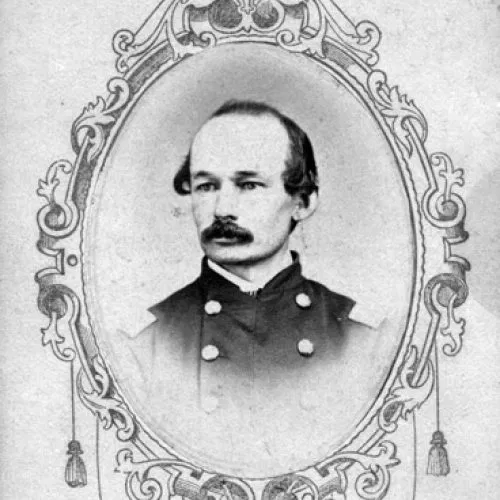
Colonel Abraham Ryan commanded the Third Arkansas Cavalry and was assisted by a group of Union supporters called the William’s Raiders. Opposing them was an assortment of soldiers lead by another local, Colonel Allen Witt and the Quitman Rifles. The greatest conflict between the two groups occurred on Feb. 12, 1865, on the Lewisburg to Dover Road. The Union troops prevailed but about thirty members of the guerilla force escaped to Center ridge in north Conway County. The group traveled to the residence of Captain Williams, called him out, and shot him as he stood in the doorway. The episode set off a series of retaliatory events, some of which transcended the ending of the war. The Williams group eventually killed more than half-of the Witt family and their associates. The breakdown of law and order resulted in thievery, killings, and theft that continued throughout reconstruction. Governor Powell Clayton eventually declared martial law in the county and tried to restore civility.
The railroad had surveyed Conway county prior to the war and it was assumed that the rail would be laid through the county seat. In 1875, the Little Rock and Fort Smith railroad began laying track. They railroad asked the city to donate two-thousand dollars to lay the rail through the town. Feeling the railroad was bluffing, town leaders refused to pay. Two businessmen from the county, Edward Morrill and James Moose offered to donate the land to build the railroad if they would route the train about a mile and a half further north. Lewisburg was bypassed and people began moving businesses closer to the new rail station. By 1879, the new community contained over 800 residents and deemed it time to incorporated. The first station agent, Captain J.W. Boot is said to have flipped a coin to determine whether to name the town after Morrill or Moose. Fortunately, Morrill became the winner of the toss and the town became Morrilton. Mooseton just doesn’t sound like a name to attract new residents or businesses!
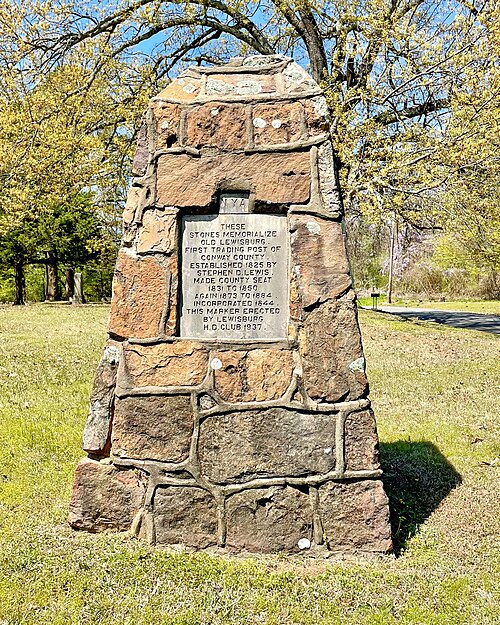
Eventually a bridge was built across the river, the ferry closed, and the residents scattered throughout the county. Today, the only item to remind of the past town is an historical plaque. The town, once a county seat, is no more.
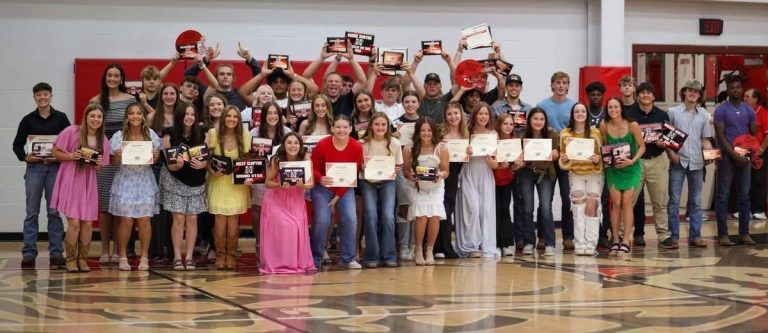
As another Mansfield athletic calendar year reached its collective finish line, Tiger athletes from all sports were recognized at the annual Booster Club Awards Banquet on May 13.
Headlining the honors, which covered all things athletic from basketball to weightlifting, were a set of coveted specialty distinctions such as the ‘M.A.P.Y.’ and the ‘Rising Star’ awards. Notably, the traditional T. Franklin Boyd Tiger of the Year award for one male and one female was left unannounced. The presentation of that long storied Mansfield athletic designation was moved to May 19 in conjunction with the 2025 MHS graduation ceremony.
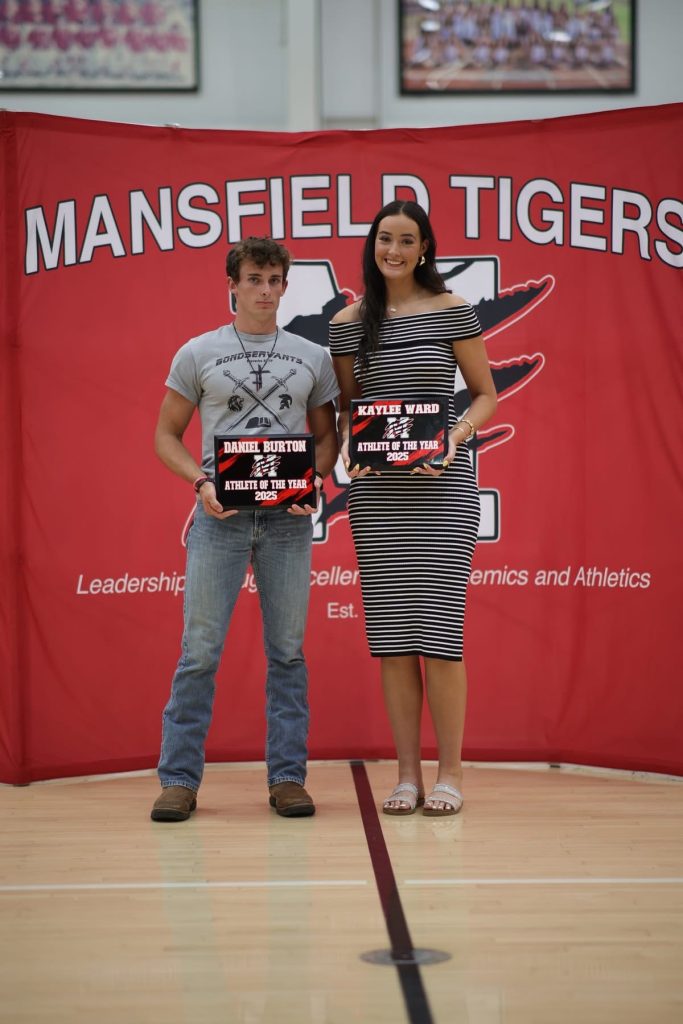
Daniel Burton and Kaylee Ward pose with their Mansfield Athletics Player of the Year (MAPY) awards at the Booster Club Banquet on May 13.
Multi-sport athletes Kaylee Ward and Daniel Burton distinguished themselves among the many in attendance. Respectively, the junior and senior compiled such extensive state wide achievements, they were quite frankly the most celebrated talents walking the ‘red carpet’.
Ward earned All-State awards in three different sports throughout the 2024-2025 school year. She was renowned for reaching the 1,000 kill mark in volleyball, 1,000 scored points in basketball, and the 100 foot club throwing the discus for track and field. All were snippets that illustrated a diverse set of skills across a wide range of sports.
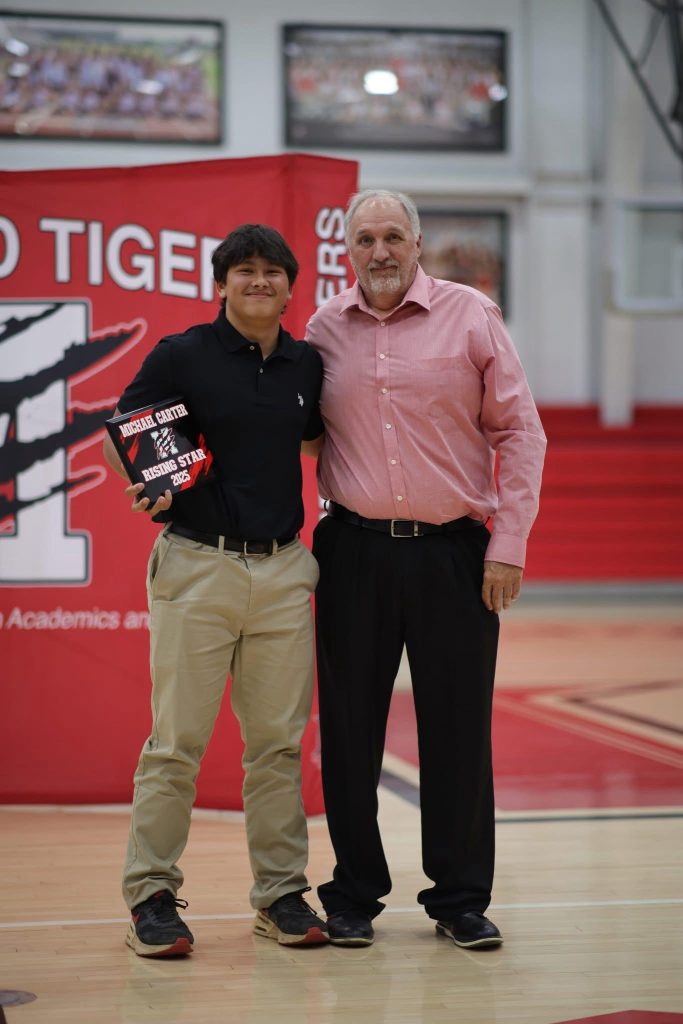
Michael Carter is presented the male Freshman Rising Star award from Coach Keith Stovall as part of Mansfield’s athletic awards presentation.
What was read to the attending assembly, among other items, was an intentionally condensed version of Ward’s most elevated athletic achievements for the year. Had a full length presentation of the 6’ 4” superstar’s highly documented accolades been revealed, the night’s presentation may have extended well past midnight. For all reasons offered and for all time wouldn’t allow, Ward was presented with the M.A.P.Y. plaque, Mansfield Athletics Player of the Year.
An equally flamboyant account of Daniel Burton’s athletic expertise widened the eyes of the Tiger crowd. A high end description of his on the field heroism highlighted the physical prowess of this senior football, basketball, track, and weight lifting athlete.
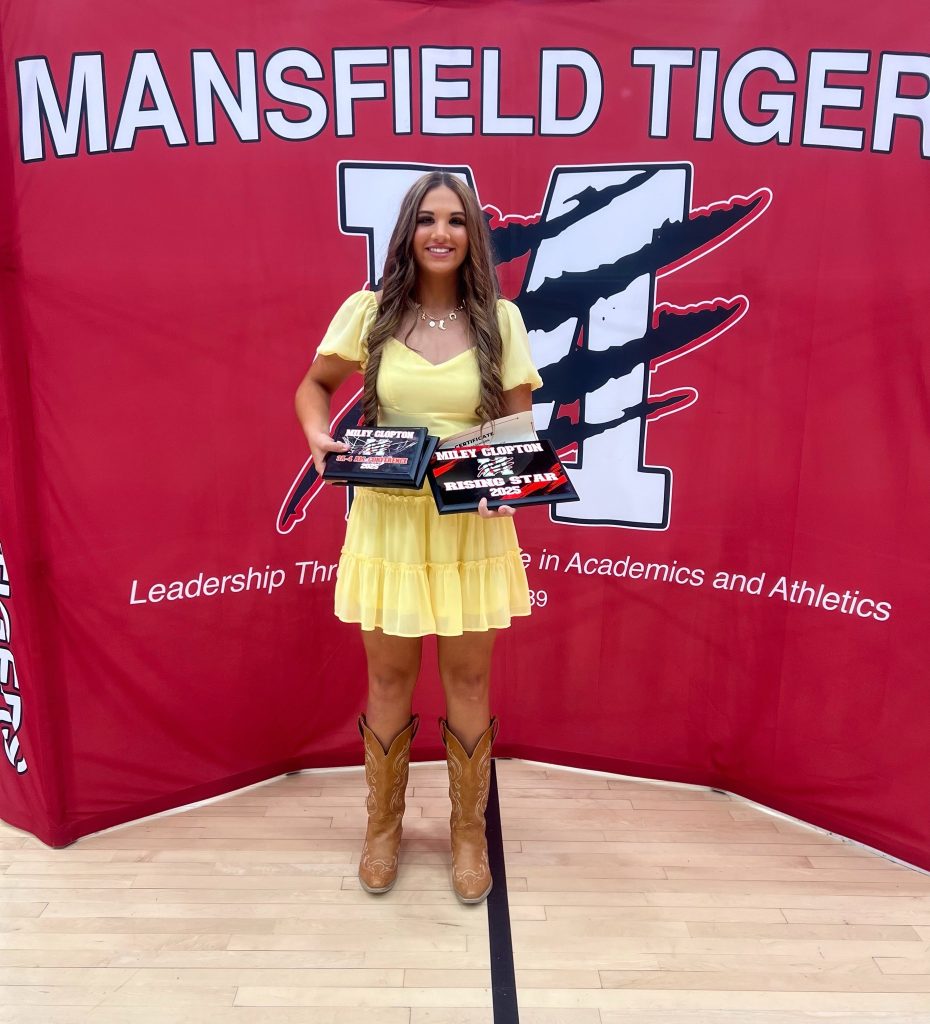
Miley Clopton, a six sport participant for the Mansfield Lady Tigers, is pictured with the female Freshman Rising Star award.
Among the mentionables was Burton’s notable merits playing football and basketball, and lifting weights. He finished his high school football career as the school’s all-time leading rusher with 3,313 yards and with the most touchdowns at 55. He moved into sixth place on the all-time basketball scoring list. He powered cleaned 300 pounds and bench pressed 265 pounds for a combined total of 565 pounds to win the class 3A individual state weightlifting championship in the 165-pound category.
Burton earned All-State honors in all three sports. It was also emphasized that this human highlight reel was the school’s first two time All-State player in both football and basketball. For all this, the award winning athlete was voted the male Mansfield Athletics Player of the Year. It was the senior’s third consecutive year for the award and the only male to ever win the prestigious award since its inception in 2023.
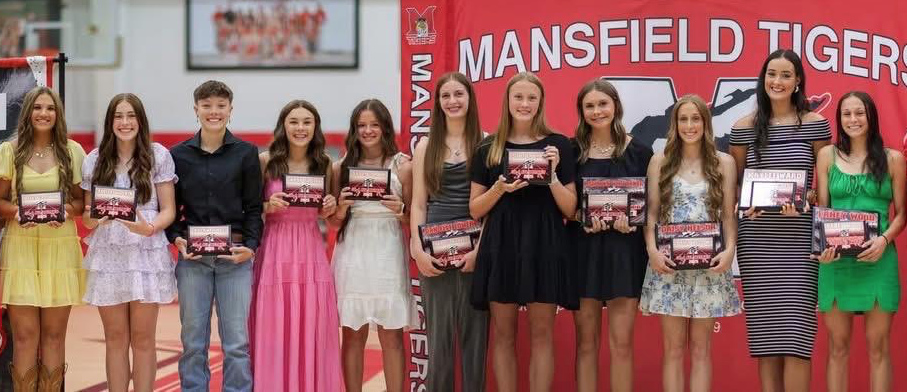
Lady Tigers Miley Clopton, Adeline Godwin, Rylan Jones, Abby Smith, Bailey London, Danielle Lowery, Summer Lyon, Ashlynn Whittaker, Daisy Nelson, Kaylee Ward, and Laney Wood represent some of Mansfield’s best at the 2025 MHS athletic awards ceremony.
Miley Clopton and Michael Carter were selected as Mansfield’s Rising Stars. The awards specifically identify one female and one male freshman that demonstrated throughout the year outstanding qualities related to athletic ability, leadership, and character.
Clopton, the female recipient, participated at a high level in six different sports. She helped the cheer squad to a fourth place finish at the 3A GameDay state cheerleading championships. She excelled on both the junior high and senior high district volleyball tournament titles and was recognized by Prep Dig, an online volleyball ranking outlet, as one of the Highway 71 Rising Stars.
The versatile athlete moved up to the high school basketball team part way through the season to help it finish as the 3A-4 conference and district runner-up. As an undersized power forward on the senior girls basketball team, she garnered All-Conference honors as a hard nosed defender and active rebounder.
In the spring, Clopton split time running track and playing softball. Around the 8-lane oval, she scored in abundance as one of the league’s fastest sprinters. It was in the 100m dash and 4x100m relay that she collected All-District honors and qualified to state for the top rated Tigers. On the softball field, the middle infielder batted .400 on offense and had a fielding percentage of .929 for the defense.
Carter, Mansfield’s male Rising Star, was a four sport standout playing football, basketball, baseball, and track. It was in the field events for the junior and senior high track teams that this self-motivated award winner shined as bright as anywhere.
Carter won the class 3A individual state championship in the indoor shot put for the high school track team. He placed third in the outdoor state shot put throwing the 12 pound ball 45’ 7.5”. He also broke a long standing Mansfield junior high discus record with a 145’ 6” mark at the TIger Relays.
The all purpose freshman was one of the junior high football team’s most effective linemen playing strong tackle for the run oriented Tigers. He moved up to the high school football team at the conclusion of the junior high campaign to provide depth for the playoff semi-finalists. He also made contributions to the freshman basketball team and the senior high baseball squad.
Over the entirety of the awards banquet, sponsored by the Mansfield Booster Club and emceed by Travis Pettus, a plethora of plaques and certificates were distributed. Beginning with the fall sports, proceeding through the winter events, and concluding with the spring teams; it was a night of celebration for another successful year of Tiger athletics.
Cross country saw All-District awards given to Lillianna Porter, Hadley Shores, Laney Wood, Bailey London, and Gunner Williams. Wood, London, and Williams along with Rylan Jones and Trinity Triska also collected River Valley All-Star plaques.
Golf had a single player make All-Conference status. Bryson Elmore, off the men’s team, took such distinction as one of the league’s top golfers and state qualifiers.
Cheerleading honored senior Aidan Fildes as their lone All-State recipient. Fildes was noted for laying a positive foundation for a team that placed first at two invitational competitions, top four at state, and claimed a bid to nationals.
Sophomore cheerleader Emilee Parsons accepted a plaque recognizing her outstanding spirit and leadership. Described as a ‘natural leader among the team’, Parsons was obviously proud to receive the ‘Role of a Cheerleader Award’.
Volleyball recognized eight different athletes and two managers. Whitley Boyd, Danielle Lowery, Kamryn Infalt, Daisy Nelson, Azlynn Stover, Kaylee Ward, and Presley Curry all received All-Conference plaques. Clopton carried home the Prep Dig star award. Ellie Welch and Aubree Helms were thanked for filming and keeping books among other duties as managers.
Ward took a wealth of additional volleyball awards. Count among them citations for Democrat Gazette Volleyball Team, All-State Tournament Team, Prep Dig Rising Star, and Offensive Player of the Year.
Curry made the All-State Honorable Mention Team. She was the leader in assists and received a trophy for reaching the 1,000 assists club. Her two year total as the primary setter was 1,150.
Nelson was the Defensive Player of the Year for volleyball. Her total in-season digs reached a team high 200.
Football, rightfully so, basked in the glory of a long list of team accomplishments and individual honors. As a group, led by 3A-1 Coach of the Year Whit Overton, it was the 2024 gridiron gang that could statistically be considered among the greatest football Tigers.
Mansfield’s senior football team went to the state semifinals for the second consecutive season. They won the outright district championship for only the second time in school history. They posted a 11-3 record for the second consecutive season tying the 2023 team for most wins. They scored more points with 534 than any other MHS team, registered four home playoff games, and beat Booneville for the first time in 44 years.
All-State credentials were lauded upon Daniel Burton, Jeremy Strozier, Dakota Deer, Zander Walters, Andrew Burton, and Ethan Martin. All-conference trophies found Trey Powell, Leland Powell, Samuel Burton, Matthew Burton, Caiden Ore, Logan Ore, James Bausley, Cooper Edwards, and Jeramiah Burton.
Daniel Burton was the River Valley’s Most Valuable Player and secured a position on the Arkansas Activities Association West All-Star Team. Dakota Deer was the River Valley’s Defensive Lineman of the Year.
Basketball honored both the girls and boys. All-Conference plaques were given to Trinity Triska, Abby Smith, Adeline Godwin, Miley Clopton, and Winston Allison. Ward and Daniel Burton were All-State players for class 3A.
Godwin, just a ninth grader playing up on the senior high Lady Tiger squad, received distinction as the River Valley Democrat Gazette Freshman of the Year. Daniel Burton, the senior leading scorer for the Mansfield men, made the Arkansas River Valley Democrat Gazette Men’s Team.
Several Mansfield players appeared on the 3A-4 All-District track team. By virtue of placing first or second at the conference track meet, they were automatically included on the athletic honor roll. Freshmen Miley Clopton, Adeline Godwin, Addison Howard, Rylan Jones, and Abby Smith all made the junior high All-District team. Clopton, Godwin, Jones, and Smith also made the senior high All-District team and qualified to the outdoor state finals.
Freshman Michael Carter, sophomore Chandler Whisman, and senior Trey Powell were on the men’s All-District track team and qualified to state as well.
Payton Meyers was the lone freshman that reaped All-State honors. The young sprinter, who was injured before the outdoor track postseason, ran the first leg on the award winning indoor track 4x400m relay team for the senior high. That specific group included upperclassmen Danielle Lowery, Ashlynn Whittaker, and Laney Wood. Each of the four received All-State Indoor Track medallions. Likewise Daisy Nelson made the All-State Indoor Track team for her outstanding marks in the 60m dash and long jump.
Ward was the single Mansfield track athlete to receive All-State Outdoor Track honors. She also led a long list of All-District Lady Tiger teammates joining the aforementioned freshmen list. Sophomores Bailey London, Danielle Lowery, Summer Lyon, and Ashlynn Whittaker made the postseason All-District register. Junior Daisy Nelson, who qualified to outdoor state in five different events, made the All-District catalog along with seniors Trinity Triska and Laney Wood.
Wood was the track team’s Most Valuable Player. As an All-State and All-District participant for the last four years, Wood was the team captain and this year’s leading scorer. She accumulated 232.17 total points for the 2025 season, and was the conference’s high point winner with 42.5 points at the district finals.
Lyon was surprised with the Most Improved Track Runner Award. The up and coming long sprinter improved her 400m time by seven seconds over the course of the season. The advanced development prompted MHS track coaches to insert the lengthy sophomore onto the district and outdoor state 4x400m relay team.
The Lady Tiger’s junior high track team was heavily supported by an athletic group of underclassmen. Eighth graders Abbigail Adams, Bentley Hoover, Natalee Moore, Bethany Mounts, Mayce Phillips, Lillianna Porter, and Hadley Shores finished top shelf for the Tigers to make the junior high 3A-4 All-District team. Seventh graders Kamryn Bolin, Paris Cervantes, and Allie Hattabaugh were announced as making the junior All-District team as well.
The weightlifting team honored Daniel Burton (165) and Andrew Burton (198) with plaques for winning their respective divisions at the state weight meet. Matthew Burton (220) was credited for finishing third in his weight class.
The evening’s accolades continued with baseball and softball awards. Because there are teams from the 3A-4 conference still competing in the state tournament, conference and state awards associated with this district, although announced, were prohibited from being published at this time. Local awards such as Mansfield Player of the Year, MVP, and newcomer recognitions were available for release.
As for softball, Mansfield was recognized as finishing in a three way tie for third in the conference. It was also noted that eight of the team’s 14 players were freshmen. A competitive, yet inexperienced team patrolled the base paths as Trinity Triska and Ambria Whittaker were the lone two seniors in the lineup.
Several from the softball team met All-Conference or All-State criteria. As for this broadcast, only the Mansfield player of the year will be revealed. That player was freshman Bailey Quick, who was tagged as both the Offensive and Defensive Player of the Year.
On offense, Quick led the team with a .426 batting average. She accumulated 26 hits, 14 RBI’s and 1 homerun. For defense, the infielder, who could play either corner, had a fielding percentage of .973. She put out 64 runners off 74 chances with only 2 errors.
As for baseball, it too was a season draped in inexperience. Only three seniors, Winston Allison, Boston Elmore, and Eli Garne dressed out for the Tiger diamond squad. Upwards to four freshmen drew starting roles on a team that finished the last 13 games with a 7 – 6 record.
Again, Mansfield warranted their share of All-Conference award winners based upon their league record. Those names will be released in due time. As far as school recognition, three players stood tall with season ending accolades in baseball.
The Offensive MVP trophy went to Ethan Martin. Defensive MVP and Pitching Ace honors went to Cooper Edwards. Newcomer of the Year acknowledgement went to Hunter Whittaker.
The Mansfield Booster Club was represented by President Angie Byers, Vice-President Dustin Krigbaum, and Secretary Bill Jones.
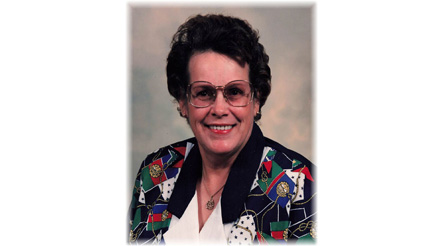
Geanetta Nevills of Waldron, Arkansas went peacefully to be with her Lord and Savior, Thursday, May 15, 2025 in Waldron, Arkansas surrounded by loving family members. Geanetta was born May 6, 1941 to Luke and Alma (Vines) Rose in Boles, Arkansas. She was 84 years old.
Geanetta attended Boles school in her early years and graduated in 1959 from Waldron High School where she was a standout basketball player. She married her high school sweetheart, Kenneth Nevills. They were married for 63 years and together raised three children, Troy, Travis and Marlene.
Geanetta was hard working and devoted to her occupation. She spent many years running a poultry farm, and was awarded several times as Producer of the Year by Tyson Foods Inc.
Geanetta was a fun loving, selfless, and devoted wife, mother and grandmother and she loved her extended family and friends dearly. She was also a kind person but it was wise not to mistake her kindness for weakness. She would do her best to win in any type of sport, cards or board game no matter if you were young or old.
Geanetta was happiest watching her children participate in sports. She never missed a ball game and was her children’s biggest supporter and loudest cheerleader. Geanetta also loved having her children’s friends in her home and enjoyed cooking for them all.
Geanetta leaves behind to cherish her memory, one daughter Marlene Summerhill and husband Brian of Van Buren, Arkansas, and one special sister in law, Patricia Rose of Waldron, Arkansas. Memaw will forever remain in the hearts of her grandchildren: Hunter Nevills and wife Mariah, Darby Summerhill, Bryson Summerhill and Brett Summerhill and three great grandchildren, Ashton, Macie and Haston Nevills. Geanetta will be missed by all that knew her and the many whose lives she impacted including a host of nieces, nephews and friends.
Geanetta was preceded in death by her parents, Luke and Alma Rose, her husband Kenneth Nevills, a son, Travis Nevills, two sisters, Betty Oliver and Treva Davis and two brothers, Herbert Rose and Fredie Rose.
Geanetta’s visitation will be Wednesday, March 21, 2025 from 4:00 p.m. until 6:00 p.m. at the Heritage Memorial Funeral Home Chapel in Waldron, Arkansas. Arrangements and cremation are being entrusted to Heritage Memorial Funeral Home & Crematory.
The family will hold a private celebration of life at a later date.