







Extension researchers studying new disease impacting Arkansas strawberries
By Ryan McGeeney
U of A System Division of Agriculture
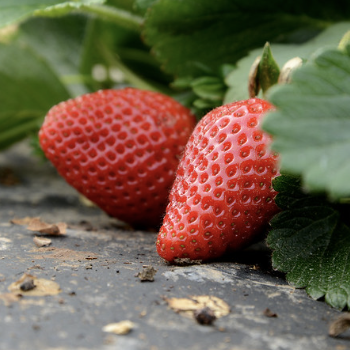
Researchers with the Cooperative Extension Service are studying an emerging disease impacting strawberries in an increasing number of locations across Arkansas in recent months.
Aaron Cato, extension horticulture integrated pest management specialist for the University of Arkansas System Division of Agriculture, said the disease was initially detected in Arkansas in 2020 but has kept a low profile until this year.
“It’s not completely new to Arkansas,” Cato said “We first saw this neopestalotiopsis several years ago — it killed a bunch of plants at one farm and in some of our trials. It’s not new to specialty crops per se, but this aggressive disease is new to the strawberry landscape in the United States.”
Neopestalotiopsis is a genus of plant pathogens belonging to the family Sporocadaceae. While the fungus is pathogenic in strawberries, it does not pose a health risk to humans.
Cato said growers in Florida were first confronted with the disease in large numbers in 2018. In 2020, the fungus “blew up in the nurseries that produce strawberry plant starters, and seemed to be related to excessive rainfall.
“It’s ‘new’ in the sense that we don’t fully understand it,” he said. “But we’ve been on the lookout for it for the last five years.”
Cato said researchers have not yet clearly identified the various causal strains of the fungus, or which species they belong to.
“This happens sometimes when we get new crop pests,” he said. “This fungus is something we might have seen randomly in the past. You might find it on a plant here and there, but it’s never been aggressive or widespread enough to cause problems for most growers.
“The ‘newness’ of it is that it’s either a shift in strain, or even a new species of this neopestalotiopsis,” Cato said. “We know it’s not just one species — there’s two or more aggressive strains, or some kind of species complex, because we see differences in how plants react, how damage occurs, and so on.”
Cato said that depending on the causal pathogen, strawberries may suffer from “crown rot,” which will cause the plant to collapse and die in plug trays or when they begin to produce fruit if not sooner, or “fruit rot” and “leaf rot,” which tends to attack plant leaves and is more visually identifiable. The crown is where the plant’s leaves and roots originate.
“There’s just a lot to nail down before we can definitively say, ‘yes, this is what you’re dealing with, this is what you can expect and here’s how to deal with it,’” he said. “We’re just not there yet. Growers are really trying to do everything they can with an integrated approach to prevent losses in a high-risk year.”
Managing the fungus
Cato said several fungicides commonly used in Arkansas strawberries are not necessarily effective in controlling the new fungus. Many growers are relying on cultural practices, such as destroying any plant that looks as though it may succumb to the disease and trying to reduce transmission between plants through touching.
“I think growers have just buttoned up their operations, in addition to using fungicides we know are effective from work in Florida and Georgia,” he said. “I’ve been to a lot of farms where they’re doing a good job keeping the pathogen at bay and are now producing bumper crops.”
Cato said researchers expect increased fungal activity in strawberries as temperatures rise in May, especially if rainfall is pervasive.
To learn about extension programs in Arkansas, contact your local Cooperative Extension Service agent or visit www.uaex.uada.edu. Follow us on X and Instagram at @AR_Extension. To learn more about Division of Agriculture research, visit the Arkansas Agricultural Experiment Station website: https://aaes.uada.edu/. Follow on X at @ArkAgResearch. To learn more about the Division of Agriculture, visit https://uada.edu/. Follow us on X at @AgInArk.
Boys & Girls Club of South Logan County Awarded Nita M. Lowey 21st Century Community Learning Center Grant

Booneville, AR — The Boys & Girls Club of South Logan County is proud to announce that its Booneville sites have been awarded the prestigious Nita M. Lowey 21st Century Community Learning Center (21st CCLC) grant. This significant achievement will provide critical funding to support expanded academic and enrichment programming for local youth, beginning with the 2025-2026 school year.
The 21st CCLC grant will directly fund services at our Booneville site, which serves children ages 6 through 6th grade. In addition, thanks to a special waiver approval, we are thrilled to announce that programming at our Teen Center will also be included. This allows us to extend high-quality academic support and engaging enrichment opportunities to a broader age range of students in our community, reaching young people from early elementary through high school.
Through this funding, the Boys & Girls Club of South Logan County will work closely with Booneville Schools to deliver targeted academic support, homework assistance, and dynamic enrichment activities that enhance learning, build life skills, and promote positive youth development. By deepening this vital partnership, we aim to help students succeed both in and out of the classroom, preparing them for bright futures.
“We are honored to receive the 21st CCLC grant and excited for the opportunities it brings to the young people of Booneville and the surrounding communities,” said Amber Mikles, CEO of the Boys & Girls Club of South Logan County. “This grant not only helps us expand our reach but also strengthens the collaborative efforts between our Club and local schools. Together, we are building a stronger foundation for our community’s future.”
Enrollment information, program details, and hiring opportunities will be announced later this year as preparations begin for the launch of the 2025-2026 program year.
Arkansas 4-H Poultry Chain Project delivers the chicks
By Tracy Courage
U of A System Division of Agriculture
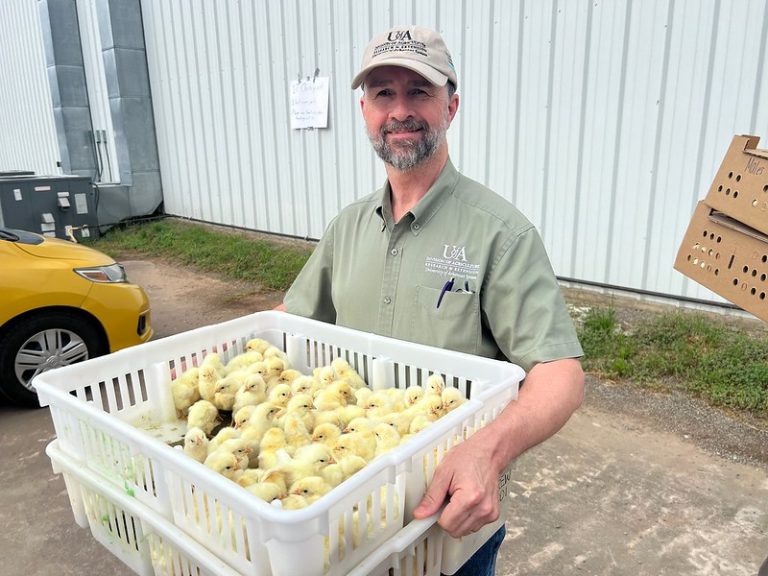
Though fair season is still months away, the poultry competition officially began April 24 when more than 2,000 Arkansas 4-H members from 68 counties in Arkansas received their chicks as part of the 4-H Poultry Chain project.
The program teaches youth about poultry management and animal husbandry. Each participant received a set of 17 pullets — each the same age and breed from the same hatchery. Over the next few months, the youth will put the knowledge they have gained into practice in raising the birds.
Most will take their best birds to county fairs, some will advance to the state fair, and many will use their flocks to start egg-selling businesses.
All in a day’s work
In just over 24 hours, some 36,000 chicks were transported overnight from a Texas-based hatchery to the Lonoke County Fair Grounds, where Cooperative Extension Service personnel unloaded and sorted the birds.
Extension agents from across Arkansas picked up their county’s birds and distributed them to 4-H members in their respective counties. By late afternoon, the birds were settling into their new homes.
4-H members began preparing long before the birds’ arrival — setting up brooders, stocking up on feed and shavings, and purchasing brooder plates, which keep the young birds warm and are preferred over heating lamps, which pose fire risks.
They’ve also learned about biosecurity measures to protect their flocks from disease, especially avian flu.
“My favorite part of this project is that everyone starts on the same day, with birds of the same genetics,” Logan County 4-H agent Sarah Enoch said. “By fair time, their husbandry, what they’ve done to feed and care for the chicks, really shows. It’s a more level playing field than other livestock projects.”
Gateway to 4-H
The Poultry Chain project is one of the most popular programs for Arkansas 4-H, the youth leadership program operated by the Cooperative Extension Service.
Enoch has about 50 4-H members raising chickens this year.
“Poultry Chain is our most popular 4-H program in Logan County,” she said. “It’s the gateway to 4-H. From chickens, some kids will become interested in showing a pig or a goat or want to try other projects.”
4-H offers more than 50 project areas that focus on healthy living, citizenship, leadership and the STEM fields of science, technology, engineering and math.
Logan County’s 4-H Foundation buys the chicken for its county 4-Hers, who raise the birds and take their best three to the county fair. The rest of their flock is theirs to keep.
The birds are judged and awarded blue, red or white ribbons. Blue-ribbon chickens are the cream of the crop and often sell for higher prices in the public auction. The proceeds go back to the Foundation to pay for the next year’s chickens and to support 4-H programs, Enoch said.
Similar scenarios play out in other counties, though not all counties have foundations to pay for the birds, and not all fairs have auctions.
Burgeoning business
With current egg prices, many 4-H members are doing a swift business and often have wait lists of folks wanting to buy fresh eggs. While some buyers may be hoping to beat supermarket prices, many people are willing to pay competitive prices for fresh eggs raised by local youth.
“Everyone is excited to get 4-H eggs,” Prairie County 4-H program assistant Amanda Sinkey said. Half of the county’s 40 4-H members participate in Poultry Chain, and many of them are looking forward to selling eggs.
“One of our members has repeat customers from year to year, and she sells eggs for $3 a dozen.”
Twelve-year-old Adam Hammond who lives near Hope, has had a poultry project for four years. He currently has 18 layers and typically collects 16-18 eggs a day. While Adam is responsible for caring for the flock, his mother, Brittney, helps with marketing and delivery. She posts egg availability on Facebook and she and her son deliver the eggs to customers.
Adam sells the eggs in flats of 30 for $10.
“We feel that’s a good deal,” Brittney Hammond said. “We usually sell between two to five flats a week, depending on if it’s a good week or not.”
The experience has been a valuable lesson in money management as youth learn that not all egg revenue is free money — after costs of feed, supplies and tax are taken out.
Buyers’ preference
This year, Poultry Chain participants received Lohmann whites, a breed known to be good layers though a bit flighty and less friendly than other breeds. Many kids prefer to raise breeds that lay brown eggs to suit their customers.
“When people see white eggs, they think store-bought,” When they see brown eggs, they think farm fresh,” Brittney Hammond said.
Andrew Bolton, extension’s poultry instructor for youth programs, initially worried that participation in Poultry Chain might dip this year, based on breed preference and because of avian flu concerns.
Instead, participation increased slightly with a total of 2,108 recipients. The program is open to 4-H and Future Farmers of America members.
Bolton attributes the increased participation to egg demand and higher egg prices. Increased interest is good news in Arkansas, where poultry production accounts for 1 in 4 agriculture jobs in Arkansas, he said.
“The poultry industry is one of the largest industries in our state, and we always need people to work, whether that’s working in a plant, supervising feed mills, equipment operations, or in research and development,” Bolton said. “There are lots of options, and we hope this sparks an interest.”
To learn more about 4-H, visit 4h.uada.edu, contact your local Cooperative Extension Service agent, or visit www.uaex.uada.edu. Follow us on X and Instagram at @AR_Extension. To learn more about Division of Agriculture research, visit the Arkansas Agricultural Experiment Station website: https://aaes.uada.edu. Follow on X at @ArkAgResearch. To learn more about the Division of Agriculture, visit https://uada.edu/. Follow us on X at @AgInArk.