
75.2 F
Fort Smith
Friday, July 3, 2026
Home Blog Page 116

Arkansas 4-H Poultry Chain Project delivers the chicks


By Tracy Courage
U of A System Division of Agriculture 

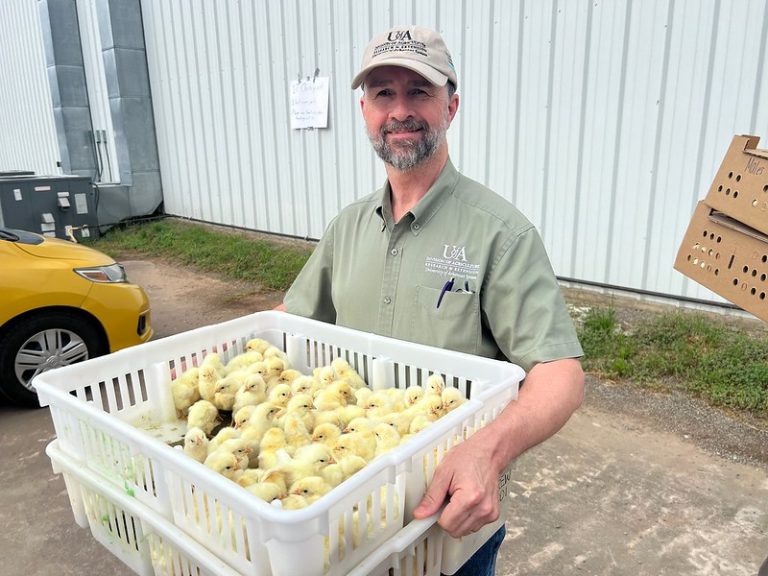
Though fair season is still months away, the poultry competition officially began April 24 when more than 2,000 Arkansas 4-H members from 68 counties in Arkansas received their chicks as part of the 4-H Poultry Chain project. 

The program teaches youth about poultry management and animal husbandry. Each participant received a set of 17 pullets — each the same age and breed from the same hatchery. Over the next few months, the youth will put the knowledge they have gained into practice in raising the birds. 

Most will take their best birds to county fairs, some will advance to the state fair, and many will use their flocks to start egg-selling businesses.

All in a day’s work

In just over 24 hours, some 36,000 chicks were transported overnight from a Texas-based hatchery to the Lonoke County Fair Grounds, where Cooperative Extension Service personnel unloaded and sorted the birds. 

Extension agents from across Arkansas picked up their county’s birds and distributed them to 4-H members in their respective counties. By late afternoon, the birds were settling into their new homes.

4-H members began preparing long before the birds’ arrival — setting up brooders, stocking up on feed and shavings, and purchasing brooder plates, which keep the young birds warm and are preferred over heating lamps, which pose fire risks. 

They’ve also learned about biosecurity measures to protect their flocks from disease, especially avian flu.

“My favorite part of this project is that everyone starts on the same day, with birds of the same genetics,” Logan County 4-H agent Sarah Enoch said. “By fair time, their husbandry, what they’ve done to feed and care for the chicks, really shows. It’s a more level playing field than other livestock projects.”

Gateway to 4-H

The Poultry Chain project is one of the most popular programs for Arkansas 4-H, the youth leadership program operated by the Cooperative Extension Service.

Enoch has about 50 4-H members raising chickens this year.

“Poultry Chain is our most popular 4-H program in Logan County,” she said. “It’s the gateway to 4-H. From chickens, some kids will become interested in showing a pig or a goat or want to try other projects.”

4-H offers more than 50 project areas that focus on healthy living, citizenship, leadership and the STEM fields of science, technology, engineering and math.

Logan County’s 4-H Foundation buys the chicken for its county 4-Hers, who raise the birds and take their best three to the county fair. The rest of their flock is theirs to keep. 

The birds are judged and awarded blue, red or white ribbons. Blue-ribbon chickens are the cream of the crop and often sell for higher prices in the public auction. The proceeds go back to the Foundation to pay for the next year’s chickens and to support 4-H programs, Enoch said.

Similar scenarios play out in other counties, though not all counties have foundations to pay for the birds, and not all fairs have auctions.

Burgeoning business

With current egg prices, many 4-H members are doing a swift business and often have wait lists of folks wanting to buy fresh eggs. While some buyers may be hoping to beat supermarket prices, many people are willing to pay competitive prices for fresh eggs raised by local youth.

“Everyone is excited to get 4-H eggs,” Prairie County 4-H program assistant Amanda Sinkey said.  Half of the county’s 40 4-H members participate in Poultry Chain, and many of them are looking forward to selling eggs.

“One of our members has repeat customers from year to year, and she sells eggs for $3 a dozen.”

Twelve-year-old Adam Hammond who lives near Hope, has had a poultry project for four years. He currently has 18 layers and typically collects 16-18 eggs a day.  While Adam is responsible for caring for the flock, his mother, Brittney, helps with marketing and delivery. She posts egg availability on Facebook and she and her son deliver the eggs to customers.

Adam sells the eggs in flats of 30 for $10.

“We feel that’s a good deal,” Brittney Hammond said. “We usually sell between two to five flats a week, depending on if it’s a good week or not.”

The experience has been a valuable lesson in money management as youth learn that not all egg revenue is free money — after costs of feed, supplies and tax are taken out.

Buyers’ preference

This year, Poultry Chain participants received Lohmann whites, a breed known to be good layers though a bit flighty and less friendly than other breeds. Many kids prefer to raise breeds that lay brown eggs to suit their customers.

“When people see white eggs, they think store-bought,” When they see brown eggs, they think farm fresh,” Brittney Hammond said.

Andrew Bolton, extension’s poultry instructor for youth programs, initially worried that participation in Poultry Chain might dip this year, based on breed preference and because of avian flu concerns.

Instead, participation increased slightly with a total of 2,108 recipients. The program is open to 4-H and Future Farmers of America members.

Bolton attributes the increased participation to egg demand and higher egg prices. Increased interest is good news in Arkansas, where poultry production accounts for 1 in 4 agriculture jobs in Arkansas, he said.

“The poultry industry is one of the largest industries in our state, and we always need people to work, whether that’s working in a plant, supervising feed mills, equipment operations, or in research and development,” Bolton said. “There are lots of options, and we hope this sparks an interest.”

To learn more about 4-H, visit 4h.uada.edu, contact your local Cooperative Extension Service agent, or visit www.uaex.uada.edu. Follow us on X and Instagram at @AR_Extension. To learn more about Division of Agriculture research, visit the Arkansas Agricultural Experiment Station website: https://aaes.uada.edu. Follow on X at @ArkAgResearch. To learn more about the Division of Agriculture, visit https://uada.edu/. Follow us on X at @AgInArk. 

State Capitol Week in Review From Senator Terry Rice

LITTLE ROCK – The Arkansas Medicaid expansion program known as ARHOME must be renewed every five years, and earlier this year the Department of Human Services submitted a renewal application to federal authorities that includes a revised work requirement for recipients.

Also this year the legislature approved Act 774 to achieve more than $260 million in potential savings for taxpayers in the ARHOME program.

ARHOME is an acronym for Arkansas Health and Opportunity for ME. It provides government-subsidized health coverage for about 225,000 Arkansans at an annual cost of between $2 billion and $2.5 billion a year. The years in which it was most costly were during the height of the COVID pandemic.

The federal government pays for 90 percent of the costs of ARHOME and has authority to accept or deny proposed changes in eligibility and range of services.

Most of the cost savings from Act 774 would be through a more transparent rebate process. One of the significant cost categories in Medicaid is prescription drugs. Some public health systems in other states have filed suit, or conducted investigations, and learned that they did not receive all the rebates to which they were entitled.

Also, the state will achieve an unknown amount of savings due to a new work requirement. Arkansas previously had a work requirement, but it was stricken after a legal challenge. The language in Act 774 is meant to comply with federal court orders in the previous lawsuit.

Getting or looking for a job will not be a requirement for eligibility, as it was before. Instead, people who receive ARHOME services will have individual development plans, which include work or continuing education. People who do not cooperate and refuse to follow their plan will have benefits suspended.

The national Affordable Care Act was enacted in 2010, making people between 19 and 64 years old eligible for Medicaid expansion services if their annual income was below 138 percent of the poverty level.

Each state enacted its own version of Medicaid expansion, and in 2013 Arkansas became the first state to gain federal approval for a Medicaid expansion program that relied on private health insurance. Arkansas Medicaid pays private insurers to cover the eligible population.

It was first known as the private option and it lowered the rate of uninsured significantly. Arkansas hospitals reported that the number of unnecessary visits to emergency rooms went down.     Beginning in 2017 the name was changed to Arkansas Works, and the state began imposing the work requirements that were later stricken by a federal court.

Under Act 774, companies that provide coverage under the ARHOME program must maintain a medical loss ratio of 85 percent. Previously it was 80 percent. The ratio refers to the amount that insurance companies must pay to physicians, hospitals, pharmacies and other providers for medical care, and which cannot be spent on administration or salaries.

Federal public health officials estimate that 92.3 percent of the United States population is covered by health insurance of some type. There are about 26.1 million Americans with no insurance.

Lady Tigers Fall To Lavaca’s Ice Cold Pitching In 3A-4 Semifinals

0

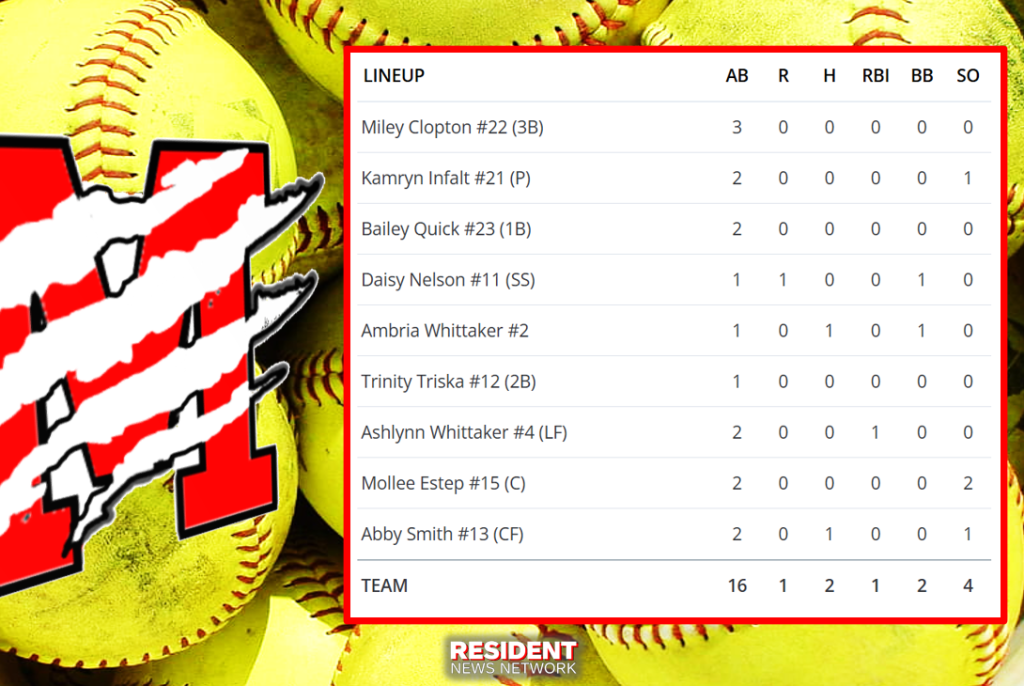
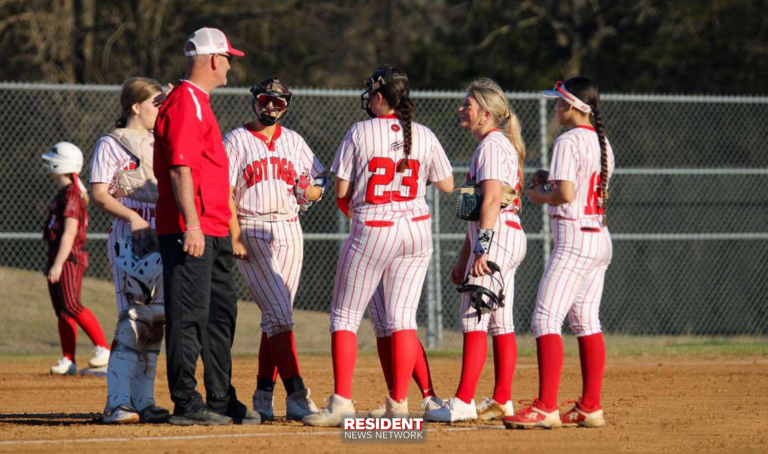
When you’re hot, you’re hot. The Mansfield Lady Tigers were more than hot leading up to their District Semifinal game against the Lavaca Lady Golden Arrows. Mansfield had scored 43 points in their first two games, defeating Cossatot 20-2 and Charleston 23-13. With fire shooting out of the batters box like that, it’d be hard to think they could be slowed down. But there’s a flip side to the saying “when you’re hot, you’re hot” and that’s “when you’re not, you’re not”. The Mansfield Lady Tigers were on the not side when they took on top-seeded Lavaca as the Lady Golden Arrows doused Mansfield’s bats with some fire hose pitching as Mansfield was left smoldering with an 11-1 loss.

Lavaca shut down the Lady Tigers’ previous scoring spree right off the bat by starting with a three-up three-down to send Mansfield back into the dugout. The Lady Golden Arrows then flexed their batting muscles by bringing in a pair of runs against Mansfield to set the score at 2-0 Lavaca to close the opening inning. Daisy Nelson started the second inning with a walk to get Mansfield on base and was followed up by Ambria Whittaker who drilled a line drive into center field to put runners on first and second base. Trinity Triska was snagged out by Lavaca, but the hit allowed Nelson to steal third. Ashlynn Whittaker popped an infield hit to shortstop that was caught for an out but gave Nelson an opening for the score. The Lady Tigers were bumped off the field by a strikeout to end the top of the second inning with Mansfield down by a 2-1 score. Mansfield then took a card out of Lavaca’s book with a fast out by Daisy Nelson to first baseman Bailey Quick. Then Kamryn Infalt struck a Lady Golden Arrow out, then a strikeout to set the Lady Tigers up with two defensive outs against Lavaca. Infalt allowed two Lavaca players to reach bases before earning the third and final out of the inning with a three count of strikes.

The top of the third inning saw Abby Smith up first to bat and she didn’t disappoint as Smith took one ball then smashed a pop fly over first base to get on base. That was as good as the Lady Tigers would get though as Lavaca chopped down the next three at bats for Mansfield. The Lady Tigers defense dropped the first Lady Golden Arrow at bat, but Lavaca popped a bombing home run on the next at bat to push the Lady Golden Arrows’ lead to 3-1. Mansfield was down but still held on to their two outs in the bottom of the third inning and none other than senior, Trinity Triska, caught the next sky hit to end the third inning. The Lady Tigers started the fourth inning by striking out, then being walked to first base by Lavaca’s pitcher. Trinity Triska hit a grounder to second and made it to first base, but the hit was snagged by Lavaca’s second baseman who tagged out Ambria Whittaker. Lavaca again snatched a Lady Tigers hit to chalk up a third out for Mansfield and sent Lavaca back up to bat with a 3-1 lead going into the top of the fourth. The Lady Tigers couldn’t hold Lavaca’s bats at bay though as the Lady Golden Arrows went on a five run streak in the fourth inning to set the tone for the remainder of the game. Mansfield couldn’t keep pace with the top-seeded Lady Golden Arrows in the fifth inning as the Lady Tigers fell 11-1 in the five-inning semifinal game.

The Lady Tigers’ loss put Mansfield at a 13-7 overall record for the season thus far, but did not end their 2025 season. The Lady Tigers will enter the 3A Regional Tournament on May 8th in Lincoln. Once the 3A-4 District Tournament is complete, the Lady Tigers will find out their seeding for Regionals along with their first-round opponent. If Mansfield can get their bats lined up again, they could wind up being a tough out for any team in the Regional Tournament.

Obituary: Arlo Blankenship (April 19, 2025 — April 25, 2025)

Arlo Otis Blankenship of Waldron, Arkansas was welcomed into the gates of glory, Friday, April 25, 2025 in Little Rock, Arkansas surrounded by his loving family. Arlo was born April 19, 2025 in Mena, Arkansas to his parents, Sklya Moore and Seth Blankenship. He was 6 days old.

Arlo leaves behind to cherish his memory, his beloved parents, Skyla and Seth, grandparents: Brad and Charie Whitus, Megan Hubbard and great grandparents: Gloria Mendes, Brad Haslam, Shelby Scott and Cheryl Scott. Arlo is also survived by aunts and uncles: Crystal Ilagan, Karley Hunt, Nick Hayden, Nate Hunt, Trever Whitus, Stryker Blankenship, Kevin Blankenship, Selina Lavack (Kevin), Michel Frayer (Sean). Arlo will forever remain in the hearts of many extended family, friends and loved ones.

Arlo’s family will host a private celebration of life at a later date.

Lady Tigers Dance The Charleston After Victory Against Charleston

This content is reserved for RESIDENT INSIDER members.

Please or subscribe to view.

Kane Archer Commits To UCF

This content is reserved for RESIDENT INSIDER members.

Please or subscribe to view.

Arvest Bank Names Stiles Community Development Mortgage Lender

This content is reserved for RESIDENT INSIDER members.

Please or subscribe to view.

Arrest Reports 4/20

This content is reserved for RESIDENT INSIDER members.

Please or subscribe to view.

Lady Tigers Kickoff 3A-4 Districts With 20-2 Thumping Of Cossatot

This content is reserved for RESIDENT INSIDER members.

Please or subscribe to view.

Resident Press (Lavaca, Charleston, Paris edition) 4/30/25 Vol. 4 No. 18

This content is reserved for RESIDENT INSIDER members.

Please or subscribe to view.