


Junior Lady Tigers Roar At Home Practice Meet

Mansfield hosted a small junior high track meet on Tuesday, March 18 with four other schools. Booneville, Charleston, Magazine, and Mena all made the trip for the specially designed format that allowed unlimited entries for its contestants.
“There wasn’t a close meet for our kids to attend just before spring break,” announced Mansfield coach John Mackey. “We made a couple of calls to schools in the same situation and decided to host the event. It was a good opportunity to get a lot of kids into action without having to be restricted by the two entry limit most meets install.”
Although no official results were kept, many of the Mansfield Lady Tigers showed superiority in their respective events as well as recognizable grit in others. It was in several different areas that Mansfield’s team production showed significant measures. Those marks will certainly help with roster evaluations moving forward through the remaining month of the schedule and the upcoming 3A-4 district track meet.
Among the bright lights for Mansfield was its distance core, relay races, and throws. The strengths in those areas provided value for the junior squad that on this night also included its seventh grade players.
Lillian Porter made a huge splash in the 1600m run. Running alongside the men milers, it was the diminutive eighth grader that stood tall by out-racing several of the boys. Porter rounded the four lap race in a career best 6:28 to take top honors against the women and many of the men.
Porter also clocked in with the second fastest split (3:05) in the 4x800m relay for the winning Tiger team. Hadley Shores, another eighth grader, ran the fastest split (2:50) as the opening leg of the race that also included the boys for the brevity of time. Once again Mansfield’s girls bettered the entire field of girls as well as some of the boy groupings.
Abbigail Adams and Rylan Jones completed the distance relay for the Lady Tigers with Porter and Shores.
It was Jones that also found the winning ways as the best shot and discus thrower in those women’s events. The freshman hurler sent the 6 pound shot 33’ 4” and the 1kg discus 81’ 1” for the two victories.
Mansfield was more than solid in the relays winning three of the four contested cooperatives. Payton Meyers, Bethany Mounts, Bentley Hoover, and Natlee Moore took the 4x100m turn in 56.62 for the win. Porter, Hoover, Jones, and Mounts took the concluding 4x400m series in 4 minutes exactly. Mansfield’s second unit also did well in the 4x400m relay with a 4:14 clocking. That lineup included Meyers, Adams, Mayce Phillips, and Shores.
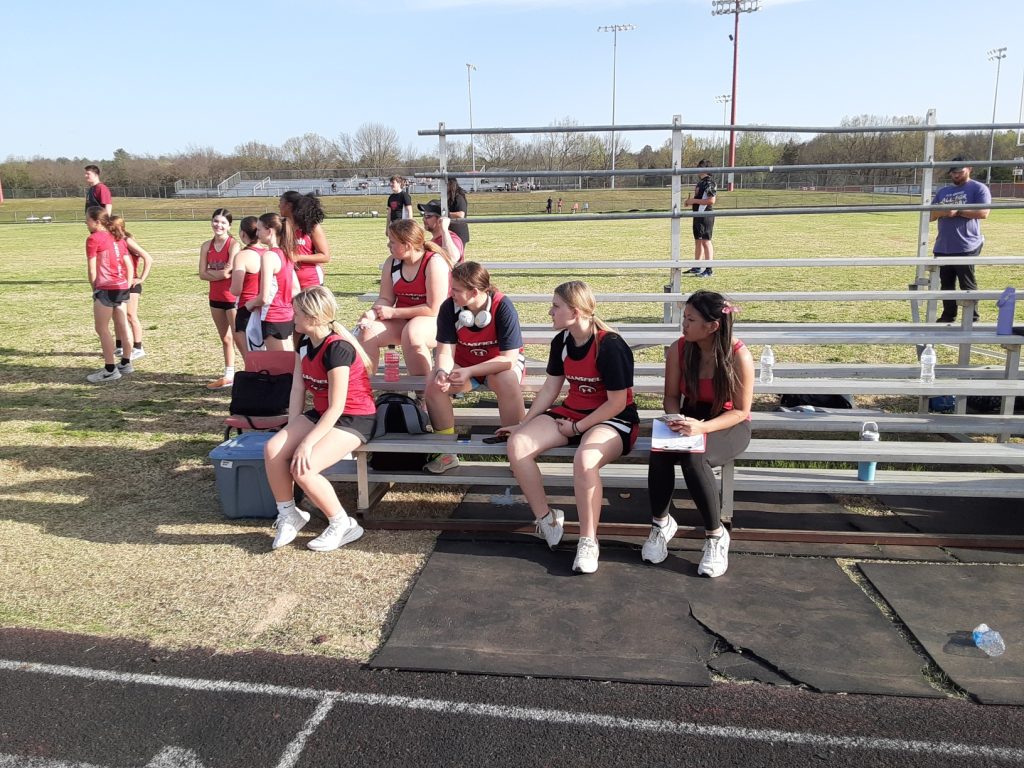
Phillips, Ellah Heydenreich, Adams, and Moore took second in the 4x200m relay. Autumn Staton, Rylie Moore, Eva Buchanan, and Vivi Sylva came in fourth as an extra Mansfield relay option.
Phillips, Shores, and Mounts each made their debut in the 300m hurdles. It was Phillips that was near the front with a first time measure of 58.09. Mounts and Shores came across in near identical times of 1:00.
Kamryn Bolin, a seventh grader, continued to build her case for a spot on the district team as a thrower. Her mark of 32’ 7” in the shot put was just five inches shy of second place. Kaylynn Piyapho, Abbi Neal, and Jalee Edwards also had strong showings as their respective shot put throws landed them in fourth and tied for seventh among 20 registered throwers.

Mansfield newcomers Allie Hattabaugh and Paris Cervantes made noise in the women’s high jump. Both first time jumpers cleared 4’ 2”. That marked landed them just under three leapers from Mena and a Charleston competitor.
Mansfield will host its junior high ribbon meet on March 31. The seventh grade will host their ribbon run the following night on April 1. All Mansfield regular season meets will begin field events at 3:30 with races to begin approximately at 5:15.
MHS Confidence Grows As Ward State Qualifies
Mansfield’s senior girls seem to be growing in confidence as they enter the qualifying portion of their 2025 track schedule. After steady team outcomes in two early season non-qualifying meets, the team turned their attention towards reaching state standards at Alma’s certified track meet on March 20.
Prior to the Alma showcase, Mansfield recently took a second place team finish against 14 scoring schools at the Booneville Bearcat Relays on March 17. Although falling short of Pottsville in the final team rankings for a second consecutive week, it was the Lady Tigers that still saw relevant marks worthy of state criteria. The Bearcat meet was not a state certified event. However, MHS spirits remained on the upswing as faster times, longer distances, and state designated markers were decidedly approached.

Headliners Kaylee Ward, Laney Wood, and Danielle Lowery, all from Mansfield, saw satisfying results at Booneville as well as a previously contested Ozark meet one week earlier. The non-certified results elevated expectations for Mansfield as a select few Lady Tiger athletes continued an assault at Alma’s Leonard Daniel Memorial Airedale Relays three days later.
Three sport Tiger star Kaylee Ward became the first Mansfield track athlete this season to gain early entrance into May’s state meet because of her individual effort at Alma’s certified meet. After a pair of monster 36 feet throws in the shot put at both Booneville and Ozark, the Mansfield junior offered up a modest but gratifying 34’ 1.5” shot put throw that eclipsed the AAA determinant by two and a half inches.
Ward’s productivity at Alma not only qualified her to the 3A state championships, it also gave her the win at the Airedale event. Her mark, on a day that most of the competitors were throwing short of their entry rankings, out-distanced the next closest measure by an astonishing two feet and seven inches.

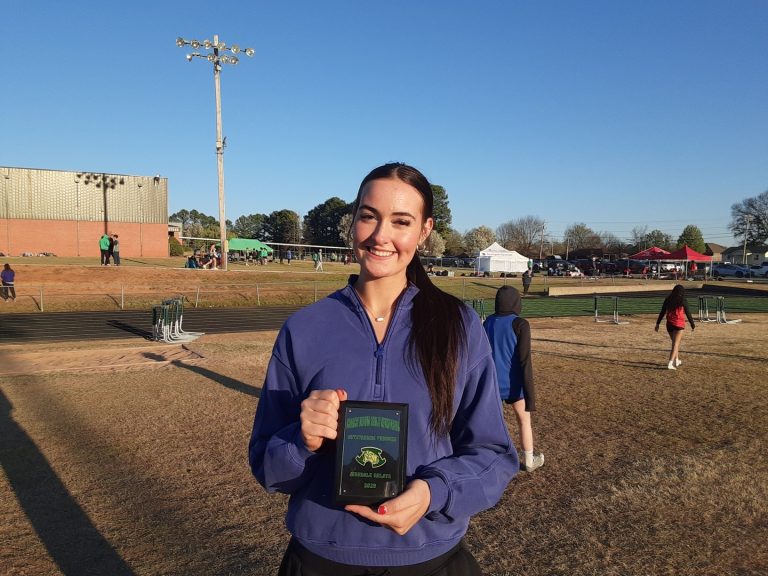
The overwhelming shot put win coupled with a third place toss in the discus prompted Alma officials to recognize Ward as the night’s outstanding female thrower. In fact, the races were halted for a special presentation gifting Ward with the ‘Coach David Hale Memorial’ award, a plaque named in honor of Alma’s longtime, recently deceased throws coach.
Wood was hoping to follow Ward’s walk into the postseason with a state standard of her own. The senior pole vaulter surpassed the 8’ 8” standard at Ozark’s non-qualifier and followed that up with an 8’ 6” measure in Booneville. For clarity, Wood declined the opportunity to move the Booneville crossbar up any higher. It was a decision based upon the meet being non-certified and the fact she had already won the event. Instead, Wood conserved energy for the triple jump, an event that she also won moments later.
The newly installed pole vault pit at Alma, however, gave Wood trouble. The senior Tiger was unable to adjust to the unfamiliar surroundings and missed moving beyond 8 feet for the first time this season. Instead of a qualifying mark, Mansfield’s leading scorer had to settle for a third place medal behind the night’s top two vaulters from Russellville and Farmington respectively.
Lowery also left Alma slightly disappointed although she had a good night too. The sophomore had come off her best performance of the season in the high jump clearing 4’ 10” on Monday night in Booneville. Should she clear that same measurement at the Leonard Daniel meet in Alma, it would have given her the early admission ticket into the 3A postseason.
Lowery had a solid performance. She pushed a pack of equally talented jumpers for podium bragging rights but not at a state height standard. Mansfield’s top high jumper cleared 4’ 8” to finish in second place among the crowded field. Her lower back, a heel or hand rolled the crossbar off at 4’ 10” on each of her three attempts keeping her from first place and the state merit.
The Tiger trio were the only Alma entries targeting the qualifying standards. A pair of teammates, Summer Lyon and Eva Trinh, that have been rapidly improving in their individual events did not make the trip after gusty performances in Booneville.
Lyon, who’s been making the transition to a long sprinter, ran her best 400m split as the starting leg in the 4x400m relay team. The sophomore who also offered a pair of 200m races via the 4x200m relay and the open 200m, clocked in with a 1:12 split in the longer 4x400m coop.
Trinh has been learning the pole vault and has become a welcome addition in the mid-distance events. She moved down to the 400m distance to help the Tigers form a 4x400m relay. Her effort was significant and helped the squad reach a fifth place time for the Booneville mile relay. Wood, Lowery, and Lyon joined Trinh for the relay run.
Thursday night, after a home softball game, Mansfield brought over dual sport athletes Trinity Triska and Ashlynn Whittaker to join Wood and Lowery in the Alma 4x400m relay. The softball pair made it just in time for the one race and a second place medal.
Triska was terrific. She established the early Tiger lead with a 1:06 opening lap. Whittaker, Wood, and Lowery ran slightly slower in the final three passes to keep Mansfield in contention. Russellville, the Airedale Meet team champions, hit a burst in the final relay race to edge Mansfield for the win.
Bailey London, a sophomore softball player and distance runner, also made the trip to Alma. She narrowly made her event coming into the stadium just moments before the start of the 3200m run.
Remarkably, the cross country All-Star battled to a personal record in the two mile equivalent with little warm up. Her recorded time of 13:59.42 placed her sixth among a full field of distance specialists.
Next, Mansfield will take a week off for spring break. They look to capitalize on their return to action with a home state qualifying meet on April 3. It is expected that upwards to twenty something schools will attend the Tiger Relays.
“Just Roll with It” Serving up Recipes and Humor

By Sheri Hopkins, Lifestyle Contributor
Hello everyone! Welcome to the state with all four seasons in one month. I have had the heat on and I have had to turn the air on. Plus size gals don’t want to be hot.
Some of y’all know this story and some don’t. I went to the doctor and was walking across the waiting area and a dryer sheet fell out of my skirt. Was I embarrassed? Well, not really. I just kept walking like I didn’t know it happened. My friend Curtis Feimster will not let me live it down. Every once in a while, I get a dryer sheet in the mail from him. By the way, he’s crazy.
I am telling y’all this to tell you about a good friend of mine, she is like a sister. She had got a new coat, and that particular day had worn it to the doctor’s office. While in the waiting room, a man kept staring at her. It made her a little uncomfortable, so she started doing a check of her wardrobe to make sure she was all covered and buttoned up. As she is feeling, she reaches to her side and feels something. There it was, a big ole tag, hanging form under her armpit. She was proud as Minnie Pearl, wanting folks to know she had a new coat. For you Young Whipper Snappers, Minnie Peal was a Nashville sensation, and she wore a hat with a tag on it. She was proud of that hat. My friend tries to pop that tag off without the whole waiting room hearing it. That didn’t happen. Tammy, I mean my friend, I just had to tell this story!
I have been with my husband, Charles Hopkins, all over Fort Smith with my big 2 XL tag hanging out of the back of my shirt. I never understood that. He had to have seen it. Men don’t pay attention to us very good. One time I was talking to him, and I could tell he was ignoring me, so I yelled, “you are not listening to one word I say!” In his calm as always voice, he replied, “there is no way I could take in everything that comes out of your mouth.” There ya have it. I am sure that was one of the truest statements he ever made.
Y’all have a great week and enjoy spring break. Y’all know I love lemon and this week’s cake recipe is for a is lemon one!
LEMMON ICEBOX PIE
2 packages instant lemon pudding mix (3.5 oz.)
8 oz. Cool Whip
3 cups milk
16 oz. package of graham crackers
LEMON FROSTING
1/2 cup butter
1 1/2 cups powdered sugar
2 tablespoons lemon juice
In a large bowl mix together the pudding mixes and milk. Stir in the Cool Whip. In a 9×13 inch pan, place a single layer of graham crackers on the bottom of the pan. You may have to break a few to cover the bottom good. Spread half the pudding mixture evenly over the graham crackers. Place another layer of the graham crackers on top of that. Put the rest of the pudding mixture on top of those crackers. Place one more layer of graham crackers on top of that. Mix all the ingredients for the frosting and spread on the top of the last layer of graham crackers. Cover and keep in the fridge. Let it chill for about an hour before serving. Enjoy! Have a wonderful week!

State Capitol Week in Review From Senator Terry Rice

LITTLE ROCK – The legislature has approved and sent to the governor a bill that clarifies the meaning of a medical emergency when the life of a pregnant woman and her unborn children are threatened.
House Bill 1610 defines a medical emergency as a condition which complicates the medical condition of a pregnant woman to the extent that termination of her pregnancy is necessary to save her life, according to “reasonable medical judgment.” The standard of “reasonable medical judgment” is longstanding and is used not only in medical care of pregnant women but also in all other medical contexts, according to HB 1610. Throughout the many years of its use, it has never proven to be unworkable or vague. The bill’s sponsors said they wanted to clarify that physicians who act in good faith to save a woman’s life would not be prosecuted under Arkansas anti-abortion laws if the unborn child unintentionally dies. Arkansas has one of the strictest abortion bans in the country. It is only allowed to save the life of the mother.
In other news both the Senate and House of Representatives has approved HB 1258 to establish standards for certifying community health workers. The bill outlines how much training is required and what health services they can perform. The bill is part of a broader effort this year to improve maternal health care in Arkansas. Many counties lack obstetricians and gynecologists, and pregnant women are more likely to go without adequate prenatal and postnatal care. An important provision in HB 1258 allows community health workers to be reimbursed by the state Medicaid program, which will make maternal care more accessible in areas that are now under-served medically.
The Senate passed legislation that removes a costly financial burden from families with a child in the juvenile justice system. Under SB 340, they would no longer have to pay fines and fees. They would no longer have to pay diversion fees, which go for counseling and services ordered by the juvenile court. The family would not have to pay for physical or psychiatric evaluations. However, the juvenile court could still order the juvenile or his or her parents and guardians to pay restitution.
SB 340 will be considered next by the House Committee on Aging, Children and Youth and Legislative Affairs. The House has approved two bills intended to protect children from potentially harmful online technologies. Both are in the Senate Judiciary Committee.
HB 1717 restricts the ability of web site operators to collect and distribute information from minors. HB 1726 requires online operators to take reasonable measures to avoid content that would worsen a child’s anxiety, depression, eating disorders, substance abuse, suicidal behavior, bullying or sexual abuse.
The House passed HB1713 to prohibit ballot issues if their title is written in English above the eighth-grade level. When a group submits a proposed ballot title to the state attorney general for approval, the attorney general would have to reject it if it were written at too high a level. Under the bill, the attorney general would use a national standard, known as the Flesch–Kincaid Grade Level test, to determine how much education is required to read it.