81.1 F
Fort Smith
Sunday, June 21, 2026
Home Blog Page 15

State Capitol Week in Review from Senator Terry Rice

The fiscal session in the Arkansas General Assembly continued this week. This was a busy week in which legislators really dug into budget details.

Some highlights:

The Joint Budget Committee directed the legislative staff to draft a reappropriation measure that would bar the Department of Corrections from spending any of the $73.7 million in state funds for construction of a prison in Franklin County. The funds were left over from a previous prison expansion in Calico Rock.

The committee also approved a $1 million appropriations bill for the Department of Corrections for a pilot program designed to detect, identify, and terminate illegal cell phones used by inmates in state prisons. It is estimated that one out of every four inmates have access to an illegal cell phone. Prisoners are using these phones for a wide range of criminal activity.

Over the last several years, Arkansas prison officials have recovered over 6,500 illegal phones from inmates, but not all of them can be found because prisoners hide them in many places. This system will find any phone as soon as it connects with cell service for calls, messaging, or other apps. A similar program in Georgia eliminated 10,000 contraband phones from its prison system. The pilot project will take place at the Cummins and Varner units.

The Senate convened Tuesday afternoon to honor the late Senator Gary Stubblefield with a memorial resolution recognizing his many contributions to the state and to his community.

After serving one term in the Arkansas House, Sen. Stubblefield represented his district in the Senate from 2013 until his passing in September 2025.

Senators also joined together to commission a portrait of Sen. Stubblefield by artist Barry Thomas. The painting will hang in the Senate through the remainder of what would have been his term, after which it will be presented to the Stubblefield family.

Following adjournment, senators lined up to visit with and embrace members of the Stubblefield family, reflecting the deep respect and affection felt throughout the chamber.

On Wednesday, Senator Mark Johnson presented the Senate Memorial Resolution honoring former Senator Luther Boyd “Lu” Hardin, who passed away in August 2025. He was elected to the Arkansas Senate in 1983, where he served for 14 years. After his legislative career, he served on Governor Mike Huckabee’s cabinet as the Director of the State Department of Higher Education. He later served as the President of the University of Central Arkansas. His son Scott Hardin delivered thanks to the chamber.

The legislature’s sessions are open to the public. You can attend in person at the State Capitol complex in the committee rooms or in the public galleries of the Senate and House chambers. You can also watch meetings live and on demand at https://senate.arkansas.gov.

You can read and download PDFs of the bills that have been filed for the session at https://arkleg.state.ar.us/. Click on “Bills” in the menu, where you can search by keyword or filing date.

Greenwood Athletics News and Notes

Spring has arrived in Greenwood, and along with it, coaching changes and other news and notes.

Girls Basketball

Head Girls Basketball Coach Ryan Casalman stepped down as the Head Coach and will return as the Junior High Boys Basketball Coach. It did not take long to find the next candidate. Roland Girls Head Coach Scott Nelke takes over the program, which is just two seasons removed from completing a Three-Peat under then Head Coach Clay Reeves.

Coach Nelke recently had stops in Sallisaw, Pocola, and Northside. While at Northside, he was an assistant under then-Head Coach Eric Burnett, when current Oklahoma City Thunder players Jaylin Williams and Isaiah Joe were there.

“We reached out to Coach Nelke a couple years ago when this job came open, and heard great things about him. He’s been around the area; he’s been a head coach. He had success at Pocola and had success in Roland.” Athletic Director Chris Young said after signing day activities. “They [Greenwood] tried to hire him for the head [coach] job when it came open with the boys. Everybody we talked to had great things to say about him. Not only as a coach, but him as a person.”

In his most recent stop in Roland, he posted a 59-20 record with trips to the Class 3A State Tournament. Trips to the State Tournament have become a tradition for the Lady Bulldogs, who make it an annual trip. The Lady Bulldogs have eight State Championships on nine State Championship game appearances.

Signing Day

Greenwood had its fourth signing day of the 25-26 school year. Lexi Gordon (Cross Country), Luke Brandt (Cheer), Jordin Jackson (Dance), and Wyatt Edwards (Football) signed on the line to continue their athletic careers.

“It’s awesome to see our kids being able to continue doing what they do. And whether it’s dance, cheer, or cross country, or football. Number one, it’s just a reflection of all the programs we have available at Greenwood.” Athletic Director Chris Young said. “I think it’s something special about Greenwood, is the success of our kids in various programs. But also a reflection of our coaches.”

School Record setters Kylah Pearcy (Basketball -UAFS) and Kane Archer (Football – Utah) signed last year, with Cody Taylor and Champ Davis signing with Charlotte and Southern University in December. February Football signing day saw Cody Johnson and Akira Fujibayashi sign with Central Oklahoma and Henderson State, respectively.

Scholarships

It is getting to be that time when Greenwood High School awards scholarships to students, and there are a few athletics-based scholarships.

Ken Hamilton Memorial Tennis Scholarship winners were Wesley Jerrell and Kylah Pearcy.

Volleyball Booster Club Scholarship went to Raylee Wagoner.

Isaiah Arrington Memorial Scholarship was awarded to Akira Fujibayashi.

More will be announced on the Greenwood High School Facebook page.

Thirsty Arkansas strawberry crop gets off to early start 

By Mary Hightower 
University of Arkansas Division of Agriculture 

Arkansas’ strawberry crop is not only looking good, but is also running a little early this year, said Amanda McWhirt, extension fruit and vegetable specialist for the University of Arkansas Division of Agriculture.  


Good thing too. Berries are flying off the shelves at the Ferndale Market, which noted on its Facebook page last week that it twice sold out of the fruit.

“Many growers across the state have been picking for seven days or more now,” McWhirt said on Monday. 

“Generally, there has only been minor damage from the mid-March freeze,” she said. “Some blooms were killed in that event which will delay the start of the season for some growers in northwest Arkansas.” 

On the plus side, there’s been little disease, likely due to the very dry conditions statewide. 

“Growers are irrigating more this year than what has been typical in years past because of how dry it is,” she said.  

“Despite the freeze, I think we are still running a tad early, so there will be fruit for Mother’s Day!” she said. “Hopefully temperatures stay cool and we can have a nice long season. If it gets too warm too early — with temps in the upper 80s-90s — things will start shutting down.” 

 To learn about extension programs in Arkansas, contact your local Cooperative Extension Service agent or visit uaex.uada.edu. Follow us on Facebook and Instagram. To learn more about the Division of Agriculture, visit uada.edu. To learn more about ag and food research in Arkansas, visit the Arkansas Agricultural Experiment Station at aaes.uada.edu.  

About the Division of Agriculture  

The University of Arkansas Division of Agriculture’s mission is to strengthen agriculture, communities, and families by connecting trusted research to the adoption of best practices. Through the Agricultural Experiment Station and the Cooperative Extension Service, the Division of Agriculture conducts research and extension work within the nation’s historic land-grant education system.  

 The Division of Agriculture is one of 20 entities within the University of Arkansas System. It has offices in all 75 counties in Arkansas and faculty on three campuses.  

 Pursuant to 7 CFR § 15.3, the University of Arkansas Division of Agriculture offers all its Extension and Research programs and services (including employment) without regard to race, color, sex, national origin, religion, age, disability, marital or veteran status, genetic information, sexual preference, pregnancy or any other legally protected status, and is an equal opportunity institution.  

Freeze, drought effects on pastures have some ranchers reaching into hay reserves 

By Mary Hightower 
University of Arkansas Division of Agriculture 

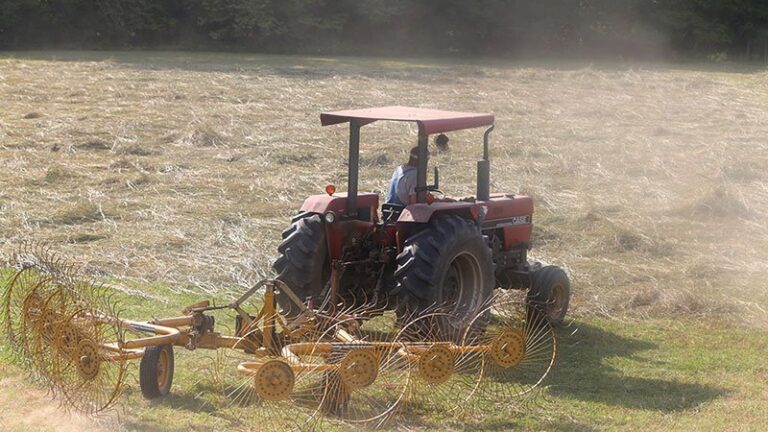
Some Arkansas ranchers are reaching into their reserve hay as drought intensifies across the state.  

The April 9 map from the U.S. Drought Monitor shows 99.96 percent of Arkansas has some form of drought. Areas with the highest intensity of drought — exceptional drought — increased to 8.36 percent of the state from 3.86 percent two weeks before. Most of the exceptional drought is in northeast and north-central Arkansas, with a growing area concentrated in Perry County. 

In its April 12 data, the National Agricultural Statistics Service reported that 74 percent of Arkansas’ pastures were in fair, poor or very poor condition, while 22 percent were good and 4 percent excellent. Hay was about the same, with 50 percent rated in fair condition, 26 percent poor or very poor, 23 percent good and 1 percent excellent.

“The forage situation in White County is pretty rough,” Brian Haller, White County extension staff chair for the University of Arkansas Division of Agriculture, said on Monday. “Most have been feeding hay since October and are getting into their reserves. I have heard of several producers buying hay in fear that this year’s hay season won’t be good.”  

In Arkansas, ranchers grow both winter and summer annual forages. Haller said, “our winter annuals are hurting from the drought. They are green but just not growing.  

“The freeze on March 16 burned back ryegrass and oats pretty bad,” he said. “They are starting to green back up, but the lack of moisture is hampering the grow back. 

“In White County, most farms averaged three-quarters of an inch of rain Saturday,” Haller said. “Some parts of the county got almost an inch. It was much needed and welcomed, but we need more.” 

Kevin Lawson, Faulkner County extension agent, said the drought situation in his county was similar to White County.  

Pointing to two producers who cut and baled ryegrass in his county, Lawson said, “It dried in about three days, which never happens with ryegrass cut this time of year. I know each year is always unique, but for it to just be early April, this is the oddest year I have ever seen.” 

Flint Harrelson, director of the Livestock and Forestry Station for the Arkansas Agricultural Experiment Station near Batesville, said, “We have had some delay in growth of grass in the pastures, and we definitely saw some reduction in grazing days for our wheat pastures this fall and into the spring.  

“We have, thankfully, gotten a few rains lately which have helped us, but we certainly need more rain for our hayfields or we will not get the amount or quality of hay we typically produce,” he said.  

The experiment station is the research arm of the Division of Agriculture. 

Michelle Mobley, Independence County extension staff chair, said the drought has put pressure on another resource: water. 

 “Ponds are low or even dry in places,” she said. “With cattle prices being strong right now, early weaning could be an option for some producers to reduce pressure on cows and forage resources.” 

It’s an option Mobley is considering for her own operation, but “every situation is different, and it really depends on each operation.” 

Jonathan Kubesch, extension forage specialist for the Division of Agriculture, said, “Unfortunately, that rain doesn’t correct a deficit that has carried into the early months of the growing season. 

“South Arkansas fell into drought later than north central Arkansas, and so the response is going to vary,” he said.  

“A lot of wetter ground has been firm enough to support early grazing, and there is some baleage being made in southwest Arkansas,” Kubesch said. “In contrast it looks like a number of pastures have been lost in north central Arkansas to drought and its complicating factors.” 

Those complicating factors can include poor soil fertility, weak grazing management or overstocking.  

“Drought rarely kills pastures and hayfields outright, but it’s often the final straw when the fields aren’t getting needed inputs and being asked to produce a lot of outputs,” Kubesch said. “A prolonged fall drought that has continued into spring also precludes a lot of winter annual plantings that could offset missing growth.”  

Making a grazing plan 

Amy Heck, Cleburne County extension staff chair, said that persistent drought means “management-intensive grazing will be critical this year.”  

“Producers will be forced to manage their forage stands and not overgraze them to make sure cattle are obtaining the greatest utilization rate possible,” she said. 

Kubesch said that “delaying turn out to pastures until the pastures are 8-10 inches tall and pulling animals when the pasture gets down to 3-4 inches will help to start pastures off with sufficient reserves to grow into drought. 

“Plan to feed hay on the weakest pastures if pasture growth stops and have a cull list ready to reduce animal demand,” Kubesch said.  

The Cooperative Extension Service has MP530, Drought Management and Recovery for Livestock Systems, available for download.  

Kubesch is asking the state’s farmers and ranchers to document local conditions and submit information to the U.S. Drought Monitor. 

“That will help us fine tune recommendations in the counties,” he said. “Having an inventory of pastures and hayfields — how much growth and on which species — will help to create a spring grazing plan.”  

To learn about extension programs in Arkansas, contact your local Cooperative Extension Service agent or visit uaex.uada.edu. Follow us on Facebook and Instagram. To learn more about the Division of Agriculture, visit uada.edu. To learn more about ag and food research in Arkansas, visit the Arkansas Agricultural Experiment Station at aaes.uada.edu.  

About the Division of Agriculture  

The University of Arkansas Division of Agriculture’s mission is to strengthen agriculture, communities, and families by connecting trusted research to the adoption of best practices. Through the Agricultural Experiment Station and the Cooperative Extension Service, the Division of Agriculture conducts research and extension work within the nation’s historic land-grant education system.  

The Division of Agriculture is one of 20 entities within the University of Arkansas System. It has offices in all 75 counties in Arkansas and faculty on three campuses.  

 Pursuant to 7 CFR § 15.3, the University of Arkansas Division of Agriculture offers all its Extension and Research programs and services (including employment) without regard to race, color, sex, national origin, religion, age, disability, marital or veteran status, genetic information, sexual preference, pregnancy or any other legally protected status, and is an equal opportunity institution.  

March freeze event likely eliminated 2026 Arkansas peach crop

By Ryan McGeeney
University of Arkansas Division of Agriculture 

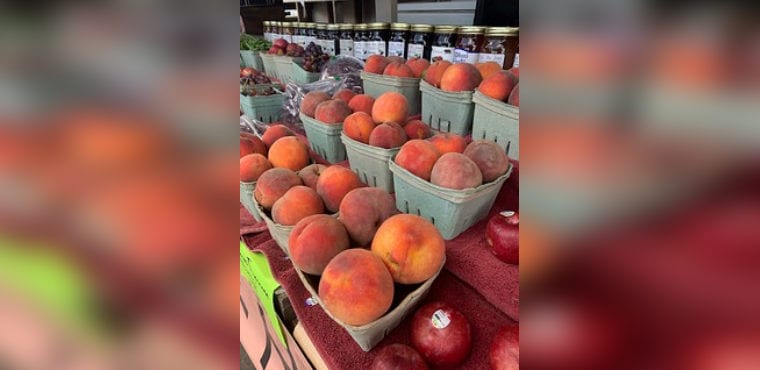
The 2026 Arkansas peach crop was likely eliminated during a mid-March weather event that saw freezing temperatures in the low 20s across the state.

Amanda McWhirt, extension fruit horticulture specialist for the University of Arkansas Division of Agriculture, said the preceding weeks of warm weather earlier in March had left most of the statewide crop particularly vulnerable.

“Unfortunately, peaches in many parts of the state had broken bud and were in full bloom,” McWhirt said.

Peach flowers in open bloom are typically damaged somewhere around 27 degrees Fahrenheit, she said.

Arkansas farmers grow between 100 and 200 acres of peaches across the state, typically as one part of a larger operation, McWhirt said. Most Arkansas growers tend to prioritize early ripening peaches, which were easy prey for the low temperatures struck in March.

Although peaches are an annually blooming crop with no “second chances” during a given season, McWhirt is encouraging farmers to continue to irrigate and care for their trees to lay the groundwork for a healthy crop next year.

“But because peach trees don’t have a crop on them, we have to be careful about not over-fertilizing them,” McWhirt cautioned. “They’ll wind up growing very aggressively, creating the need for a lot more pruning next winter.”

The reduction or elimination of an Arkansas peach crop is not unusual, she said, noting that the state typically only sees a full harvest about one out of every three to four years. The routine impact on crops has, in fact, led to a decline in peach growing efforts over the past decade, McWhirt said.

Some varieties of blueberries were also damaged during the March cold snap.

“They were in a similar situation, having broken bud and were in peak bloom, particularly for southern highbush and some rabbiteye blueberries,” McWhirt said. “In particular the southern highbush type is very early to bloom, and they’re in a similar boat to peaches, where the majority of the crop was lost.”

“If people had northern highbush types, they were still dormant,” she said. “They’ve just now, in the past week or so, begun to flower. I think we’ll have a fine crop with those types. But a lot of people have southern highbush because, again, they like the earlier fruit, particularly in central and southern Arkansas.”

Arkansas farmers grow between 200 and 300 acres of blueberries each year, McWhirt said.

To learn about extension programs in Arkansas, contact your local Cooperative Extension Service agent or visit uaex.uada.edu. Follow us on Facebook and Instagram. To learn more about the Division of Agriculture, visit uada.edu. To learn more about ag and food research in Arkansas, visit the Arkansas Agricultural Experiment Station at aaes.uada.edu

Waldron School Board Approves Contracts, Personnel Changes During April Meeting

WALDRON — The Waldron School Board met for its regular monthly session on April 13, 2026, approving contracts, reviewing campus updates, and addressing personnel matters.

Board President Clay Woodall called the meeting to order at 6:32 p.m. at the Central Office Building. Board members present included Woodall, Angela Hunsucker, Toni VanDeWiele, John Keener and Konnor McKay, along with Superintendent Daniel Fielding and district staff.

During public comments, David Carter addressed the board regarding the potential use of school buses by the West Arkansas Emergency Responders organization in the event of a mass evacuation.

The board unanimously approved the consent agenda, which included prior meeting minutes, financial reports and expenditures, as well as agreements for speech, occupational and physical therapy services for the 2026–27 school year. Members also approved the district’s audit report.

In organizational business, the board approved its leadership structure, naming Clay Woodall as president, Konnor McKay as vice president and Angela Hunsucker as secretary.

School principals reported on campus activities and upcoming events, including state ATLAS testing scheduled in the coming weeks. ABC campus principal Kim Solomon reported a successful Easter egg hunt and announced a Better Beginnings rating of 5 out of 7. Elementary principal Cheyenne Smith highlighted recent events including a chess tournament, parent-teacher conferences and kindergarten registration, along with an upcoming track and field day.

Middle and high school updates included upcoming choir and band performances, awards ceremonies and continued improvement in student reading fluency. Additional highlights included FBLA state participation, a championship performance by the district chess team, and strong ratings for the band at regional assessment.

Assistant Superintendent Chris Lipham reported that Waldron will host the junior high district track meet on April 20, with signing day scheduled for April 28. He also noted transportation updates, including the disposal of six buses and the purchase of three certified used buses now in service.

Superintendent Fielding informed the board that the closing on the Harrison House property has been completed and that roofing projects at ALA and the middle school have been finished. Board members were also provided a publication recognizing Athletic Director Chris Lipham as a 4A Athletic Director of the Year.

Following an executive session, the board approved several personnel actions. Retirements included Christine Davis from food service and Patrick Millard as a bus driver and high school teacher. Resignations were accepted from Caleb Smith (maintenance), Bethelene Davenport (First Step), Ariana Gonzalez Uribe (elementary teacher), Tonya Cluck (assistant high school principal) and Tina Watts (middle school/SpEd secretary).

The board also approved personnel transfers, naming Tanesha Tull as cafeteria manager and Sarah Garrison as assistant child nutrition director for the 2026–27 school year. Classified employees were re-hired as presented.

The meeting adjourned at 7:44 p.m.

Judge Brian Jones Provides Updates on County Projects

SCOTT COUNTY — Scott County Judge Brian Jones has released a series of updates detailing ongoing infrastructure projects, completed improvements, and future plans aimed at enhancing roads, bridges, and public facilities across the county.

Jones announced that staff from U.S. Congressman Bruce Westerman’s office will be in Scott County for an open meeting on April 30 from 1–3 p.m. in the Scott County Courthouse courtroom. The meeting will provide residents an opportunity to speak directly with congressional staff regarding federal services and concerns.

Among current infrastructure projects, Jones highlighted work on Sweet Gum Lane, where a new bridge is under construction. In addition, the state is expected to open bids in May for a repaving project that will extend from the highway to the city limits before connecting with U.S. Highway 71.

Jones also noted the completion of improvements on Foxy Lane, which were finalized last year. Meanwhile, progress on Tate Road remains pending, as the county awaits approval for an addition to the bridge end and related improvements.

Looking ahead, Jones outlined potential projects contingent upon his re-election. These include plans to chip and seal roadways from Highway 71B to 240 East, including areas near City Lake.

In addition to roadwork, the county is investing in park and facility upgrades. Jones reported that crews are currently working to install new lighting and replace roofs on park buildings. The project includes approximately 150 new lights, with an estimated cost of $130,000, with about 50 lights being installed per section.

Jones said the projects reflect an ongoing commitment to improving infrastructure, safety, and quality of life for Scott County residents.

Greenwood Football Has Sixth Player Sign As Wyatt Edwards Inks With Hendrix

Brothers playing college ball from Greenwood have become almost expected. In the late 90’s, Travis and Trent McDaniel laid the foundation for Drew and Grant Morgan, Peyton and Connor Noland, Morgan and Jordan Hanna, Cash and Kane Archer, and now. Jack and Wyatt Edwards. The younger Edwards brother signed with Hendrix College in Conway.

Wyatt Edwards becomes the sixth player from the 2026 class to sign from Greenwood. Kane Archer (Utah), Cody Taylor (Charlotte), and Champ Davis (Southern) signed in December. Akira Fujibayashi (Henderson State) and Cody Johnson (Central Oklahoma).

Hendrix College brought football back in 2013 and hired Head Coach Buck Buchanan to lead the program, and he has been there ever since. In 2025, the Warriors went 6-4 and are currently on the upswing since the pandemic halted their success. Hendrix has an in-state rival in Lyon College in Batesville.

A Longsnapper by trade, Wyatt doesn’t grab the headlines unless something goes wrong. Wyatt’s brother, Jack, is with the NCAA Division II reigning National Champion Runner-Up Harding Bisons.

“For me, it’s just close. I have an uncle (Dr. Keith Pachlhofer – Greenwood ‘98) that’s a math professor at UCA (Central Arkansas). I wouldn’t be too far from him. It was the culture when I went there for a game day visit.” Wyatt Edwards said about choosing Hendrix. “I really fell in love with the place. I love their campus. Their Coaches are awesome.”

As a part of the Greenwood Football team, Wyatt was a back-to-back State Champion and State Runner-Up. But Longsnapper isn’t his only talent, as he is a percussionist for the Greenwood Band. The Winter Winds team placed as State Runner-Up last month in Lake Hamilton.

“To me, what makes Greenwood so special is not just the wins. I think it’s the culture as well.” Wyatt said about his time as a Bulldog. “Not saying we are entitled, but we have a winning culture. We’re always there to win no matter what.”

“He’s a great example of a guy that worked in this specific thing with deep snapping. Just perfected it. He spent countless hours outside of practice deep snapping and it paid off.” Head Coach Chris Young said. “He’s going to continue doing what he loves. He earned it. Deep snapping’s a different position than most.”

“He knows more about deep snapping than his coaches do!” Coach Young said with a laugh. “He self-taught a lot. His dad was a huge part of his progression. Just very fortunate that we had him in our program for three years. Two years as a starter, and we’re certainly going to miss him.”

UAFS adds another Greenwood Bulldog to the Dance roster with Jordin Jackson

The theme of the day was back-to-back State Champions signing to further their athletic careers, and for Senior Jordin Jackson, that next stop for Dance was the University of Arkansas-Fort Smith.

Jordin started her spirit squad career, like many kids in Greenwood, through the Pittbulls. After a short stint in Tennessee for 4th through 6th grade, Jordin and her family returned to Greenwood. From there, the Jackson family left their mark on the Blue Dazzlers program. Jordin’s mother, Debbie Jackson, could be found wandering Smith-Robinson Stadium, capturing photos of the fans that make Friday nights in Greenwood special.

“They’ve taken the mindset of her being the athlete to the next level. They’ve created part of the family that we have in the dance program, with Debbie being the mother hen. Making sure athletes are taken care of. Supporting me anyway possible. But also supporting the girls for all their next steps.” Coach Jill Clark said about the Jackson family and their involvement. “And it’s going to be a hard loss for everyone around, but watching Jordin go to the next level. I think she’s ready to fly. I cannot wait to see her at the next level.”

While on the Dance team, Jordin was a cog in the machine that produced a State Runner-Up, then back-to-back state titles. In her senior year, the squad traveled to Nationals in Orlando, where they finished in the Semifinals.

UAFS has had several Greenwood alumni participate in its athletic programs. Jordin will join 2024 graduate Prairie Ferris on the UAFS Dance team this fall. “I knew she was on the team, and I was talking about it to her. I was like, ‘Hey! Wouldn’t it be awesome if we both ended up on the same team?” Jordin said about reuniting with Prairie. “So at the end, I did end up trying out, and I think it was just awesome how we’d be there together.”

“Instantly, when I stepped on that campus, I felt like it was home. Especially the environment and the people. They are really great people there, and I felt so comforted and just loved there.” Jordin said about choosing UAFS. “That’s what I really needed, was somewhere that’s not only close to home, but just has people that are there to support me.”

UAFS is a Division II college competing in the MIAA conference that includes Washburn University, Pitt State, and Northeastern University.

National Champion Minnesota Cheer Signs Greenwood’s Luke Brandt

In a sport that usually sees athletes head to UAFS Cheer or join the Razorback Cheer squad, for Luke Brandt, it was further north. Brandt signed with the University of Minnesota Gophers.

When it comes to success in the sport of collegiate spirit squads, Minnesota is to that sport as the Razorbacks are to Track and Field. Boasting 30 National Championships, the dance team holds 24, while cheer and the mascot Goldy Gopher make up the rest. Most recently, the cheer team was back-to-back National Champions for 2025 and 2026.

It is that type of success that drew Luke Brandt to the squad. As a back-to-back State Champ and a National Champion in high school, it put the Greenwood senior in the right spot. “Just the community and the family atmosphere on the cheer team. They’re so close nit.” Luke Brandt said on choosing Minnesota. “They lean on each other and have each other’s backs. They’re just such a hard-working group and have won the past two nationals. It’s just really competitive.”

Going to a Big 10 Power 4 school, no matter the sport, is still a big accomplishment. “I’m so excited. I never thought I’d be able to, I mean, I always wanted to be a D1 cheerleader, but now that it’s actually happening. It’s crazy.” Brandt said.

Luke Brandt has been a part of the Greenwood Cheer Squad since the seventh grade. While Greenwood fielded Co-Ed teams in the past with success at the national level, the current team is not. That did not stop Luke from giving it his all with his squad.

“I think it’s just hard work and the drive to be better,” Brandt said regarding his time in Greenwood Cheer. “We don’t get complacent about anything. It is always we can get better. Nothing is just normal for us, it’s always like working hard.”

“It wasn’t what I wanted, but I was able to still have the same drive, and it didn’t really bother me that I wasn’t able to compete. Because I just liked the community of the team. And it was about the team.” Luke Brandt said. “It was still winning, we are family and went together.”

Throughout his career at Greenwood, the coaching team of Rachel and Jody Presson was there to build that foundation. A year ago, they announced they were stepping down; the successor was not too far away in Jill Clark. Coach Clark was already building a State Champion Blue Dazzler dance team, and today she got to see two of her athletes sign to cheer and dance collegiately.

“At the beginning of the year, usually the junior year of all my athletes, we talk through ‘Okay, what are your next plans, like next goals’. Because I want to spend their Senior year really focusing on what that looks like for them.” Coach Clark said about the process of Luke going from Greenwood to Minnesota. “Originally, in the fall, he went to an OU clinic. He really liked the University of Oklahoma. But something about Minnesota just stood out to him. It’s in the north, a very legendary program. I don’t think people fully grasp in the south that Minnesota cheer has a very big name for themselves.

“It’s one of the greatest honors to watch these kids go next level. Getting to have them for three years in the High School program is just like it’s a treasure, it’s the greatest part of being a coach.” Coach Clark said.