
68.6 F
Fort Smith
Sunday, June 14, 2026
Home Blog Page 254

Sebastian Countywide Cleanup

0

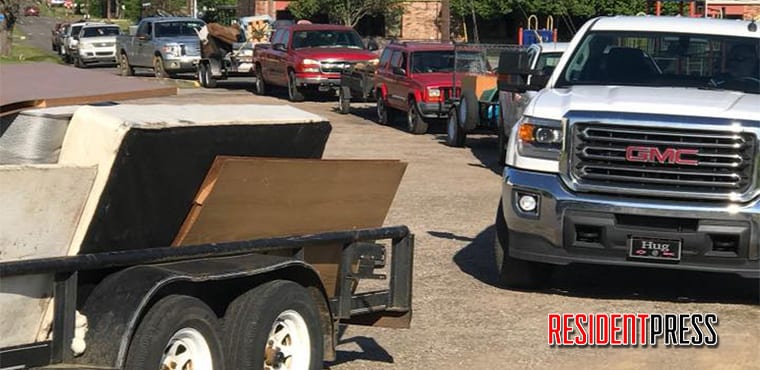
Fall is in the air and that means it’s time for our Fall Cleanup Campaign. Residents of Sebastian County are encouraged to use the cleanup Site dumpsters, to pick up litter, tackle illegal dumps and do whatever else it takes to put a shine on Sebastian County. This countywide cleanup campaign is in coordination with the Great American Cleanup.

Proof of Sebastian County residency is required by Arkansas Driver’s License for disposal of trash
at the cleanup site.

The County Campaign will take place on Saturdays starting September 2nd and go through September 30th 2023.

“By working together to clean up our properties we all can make a difference and make our community more beautiful, safer and a healthier place to live, work and play,” says Judge Steve Hotz.

As in past cleanup campaigns, dumpsters will be placed in several locations throughout the County for County residents to have a convenient place to bring collected trash for safe and legal disposal.
Fall County Cleanup Sites
• Saturday, September 2
7AM -2PM – Midland -County Park / Bob Boyer Park Hwy 45
• Saturday, September 9
7AM- 2PM – Milltown/Washburn Fire Station
• Saturday, September 16
7AM – 2PM – White Bluff Fire Station at 2731 Gate Nine Road
• Saturday, September 23
7AM – 2PM – Greenwood – Road Yard
• Saturday, September 30 7AM -2PM -Lavaca Rural-Rodeo Arena Parking Lot – Rodeo Arena Road

Dumpsters will be placed by 7:00 A.M. on Saturday and are available until 2:00 p.m. on the same day. Dumpsters will be picked up by 2:00 P.M. in order to be hauled to the Landfill and dumped by closing time. (3:30 P.M.)

Any resident of Sebastian County who does not have a cleanup site in their city, as well as residents in the unincorporated areas, may utilize ANY of the County Cleanup sites.

A Recap of the Fall 2023 County and City Cleanup Schedule is attached.

*E-Waste Trailers
**Tires
All Household trash must be in bags before bringing to the site to dispose of. There will be an E-Waste trailer at each of the County sites to accept Computers, TVs, or Electronics. These items are not acceptable in the “Dumpsters.”
**Tire Disposal Policy
Tires “will NOT be accepted” as a part of this cleanup campaign. County residents may dispose of up to four passenger tires, without rims, at no charge during the cleanup campaign in September, by taking the tires to the disposal site located at 601 Oak Grove Road in Van Buren, Monday through Friday 8:00 a.m. to 5:00 p.m. No tires accepted on Saturdays, If you have questions, you may contact John Spence at (479) 652-3705.

Cleanup Dumpsters will be managed by County Employees at all times to assure that only
acceptable wastes are disposed of. The following items are NOT acceptable in the “Dumpsters” due to Landfill regulations:
*TVs’ Computers- Electronic Equipment (place ni E-Waste trailers located at each County site)
• Yard waste, grass, leaves and brush
• Used Batteries
• Hazardous or toxic wastes
• Herbicides or pesticides
• Cleaning chemicals
• Paints or liquids of any kind
• Fluorescent Bulbs
• Freon containing appliances (appliances using Freon MUST have the compressor removed before it can be accepted)
Burn Barrels for Trash are Illegal
Barrels used to burn trash are illegal in the State ofArkansas and “will NOT be accepted” as
part of this cleanup campaign
White Goods
White goods (appliances, refrigerators, etc.)m a y be placed in a designated area with the County
Road Department disposing of these items on the day of the cleanup date in your area.
Refrigerators, Freezers, Air Conditioners, MUST HAVE COMPRESSORS REMOVED.
This cleanup is for Residents only and NOT for Commercial Disposal, Proof of Sebastian County residency (by driver’s license) will be required prior to disposal.

Hogs Dominate Arkansas State in Soccer Season Opener

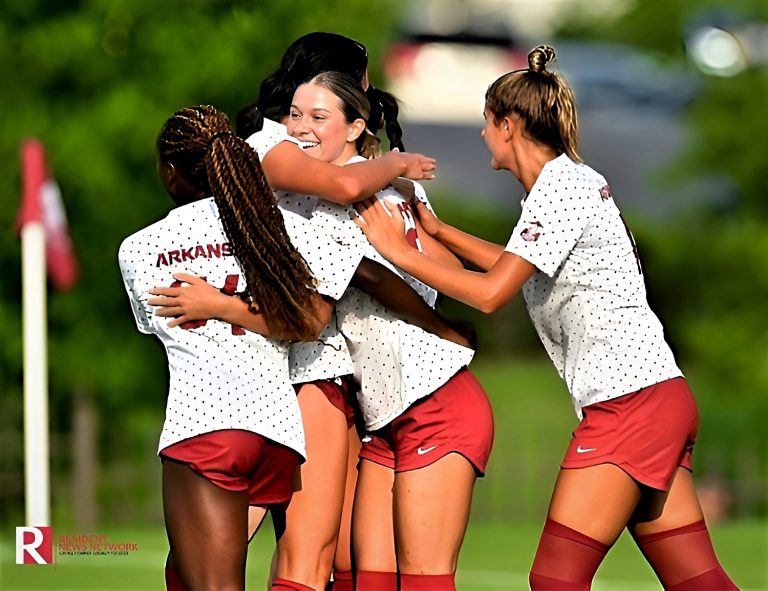
FAYETTEVILLE – No. 8 Arkansas (1-0-0) scored five minutes into the match and didn’t look back as the Hogs blanked Arkansas State 6-0 in their season opener.

All six goals were scored by different Razorbacks, including first-time scorer freshman Patricia Tsokos.

In goal, junior Sierra Cota-Yarde made her first start for the Hogs and also converted a penalty kick in the 54th minute. Cota-Yarde is no stranger to the task, having taken a penalty in two shootouts last season.

Arkansas’ first goal of the 2023 campaign was scored by sophomore forward Ainsley Erzen. Erzen started the match at midfielder and was there to pick up freshman Avery Wren’s shot that ricocheted off the post.

The Hogs were blessed with an own goal by Arkansas State in the 11th minute and went up 2-0.

The last two goals of the first half were scored within two minutes of each other. First up, veteran midfielder Bea Franklin scored in the 39th minute. The goal, made possible by a booming free kick from defender Emilee Hauser, is Franklin’s first scored with her feet as a Hog.

Tsokos followed up in the 41st minute with a textbook header on a ball from defender Margot Reemtsen to send the Razorbacks up 4-0 on 22 shots.

Senior forward Kiley Dulaney followed Cota-Yarde’s made PK and finished the night off with a gritty goal, in which she had to come face-to-face with the Red Wolves’ goalkeeper. Dulaney won the ball and knocked it in for her first goal back since missing the 2022 season due to injury.

Arkansas finished the match with 34 shots and held Arkansas State to seven.

“It’s early in the season, but there’s some details we need to clean up for sure,” head coach Colby Hale said. “But they are details, right? And those things will come. We’ve got a lot of young and new faces out there, and some of the sets aren’t super organized, so we’ve got to just clean some stuff up.”

Next Up

The Hogs will return to the pitch next week and face Oregon on Thursday, Aug. 24 at 6:30 p.m. The match will be streamed on SEC Network+.

For more information on Arkansas Soccer, follow @RazorbackSoccer on Twitter.

– ArkansasRazorbacks.com || On Twitter @ArkRazorbacks Facebook.com/ArkansasRazorbacks

Note to Our Readers: The previous story was sourced directly and in its entirety from the University of Arkansas Office of Communications, Fuller Birch.

Financial Focus: Should You Invest…or Speculate?

You’ll find some big differences between traditional and speculative investments — and knowing these differences can matter a great deal when you’re trying to reach your financial goals.
To begin with, let’s look at the basic types of traditional and speculative investments. Traditional investments are those with which you’re probably already familiar: stocks, bonds, mutual funds, government securities, certificates of deposit (CDs) and so on. Speculative investments include cryptocurrencies, foreign currencies and precious metals such as gold, silver and copper.
Now, consider these three components of investing and how they differ between traditional and speculative investments:
The first issue to consider is risk. When you own stocks or stock-based mutual funds, the value of your investments will fluctuate. And bond prices will also move up and down, largely in response to changing interest rates. However, owning an array of stocks — small-company, large-company, international, etc. — can help reduce the impact of volatility on your stock portfolio. And owning a mix of short- and long-term bonds can help you defend yourself somewhat against interest-rate movements. When interest rates fall, you’ll still have your longer-term bonds, which generally — but not always – pay higher rates than short-term ones. And when interest rates rise, you can redeem your maturing short-term bonds at potentially higher rates.
With speculative investments, though, price movements can be extreme as well as rapid. During their short history, cryptocurrencies in particular have shown astonishingly fast moves up and down, resulting in huge gains followed by equally huge, or bigger, losses. The risk factor for crypto is exacerbated by its being largely unregulated, unlike with stocks and bonds, whose transactions are overseen by well-established regulatory agencies. There just isn’t much that investors can do to modulate the risk presented by crypto and some other speculative investments.
A second key difference between traditional and speculative investments is the time horizon involved. When you invest in stocks and other traditional investments, you ideally should be in it for the long term — it’s not a “get rich quick” strategy. But those who purchase speculative investments want, and expect, quick and sizable returns, despite the considerable risk involved.
A third difference between the two types of investments is the activity required by investors. When you’re a long-term investor in traditional investments, you may not have to do all that much, once you’ve built a portfolio that’s appropriate for your risk tolerance, goals and time horizon. After that point, it’s mostly just a matter of monitoring your portfolio and making occasional moves — you’re not constantly buying and selling, or at least you shouldn’t be. But when you speculate in crypto or other instruments, you are constantly watching prices move — and then making your own moves in response. It’s an activity that requires considerable attention and effort.
One final thought: Not all speculative instruments are necessarily bad investments. Precious metals, for instance, are found in some traditional mutual funds, sometimes in the form of shares of mining companies. And even crypto may become more of a stable vehicle once additional regulation comes into play. But if you’re investing for long-term goals, such as a comfortable retirement — rather than speculating for thrills and quick gains, which may disappear just as quickly — you may want to give careful thought to the types of investments you pursue.This article is provided by Jeffrey O’Neal, Financial Advisor
Edward Jones
20 N Express St, Paris, AR 72855
479-963-1321
jeffrey.o’neal@edwardjones.com
edwardjones.com/jeffrey-o’neal
Edward Jones, Member SIP
This article is provided by Jeffrey O’Neal, Financial Advisor
Edward Jones
20 N Express St, Paris, AR 72855
479-963-1321
jeffrey.o’neal@edwardjones.com
edwardjones.com/jeffrey-o’neal
Edward Jones, Member SIPC

Waldron’s New Dollar General Slated to Open in the Fall

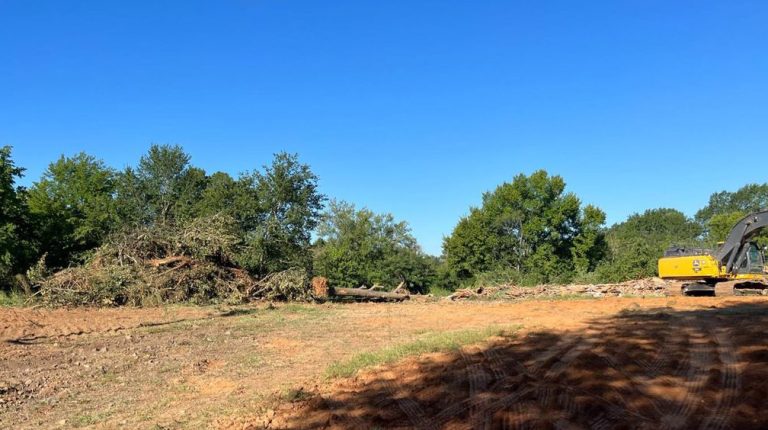
The ground breaking is underway and construction will soon follow on the City of Waldron’s new Dollar General store location at 643 South Main Street.

Media relations for the Dollar General store stated that at this time, the store opening is slated for fall of 2023, but construction may alter this date.

“Our customers are at the center of all that we do, and meeting customers’ needs is Dollar General’s top priority when choosing store locations.  In selecting store sites, we take a number of factors into consideration, carefully evaluating each potential new store location to ensure we can continue to meet our customers’ price, value and selection needs. We further strive to provide convenience for customers who may not have affordable nearby retail options.”

The store will serve as a traditional Dollar General store and employ approximately 6-10 employees, depending on the individual needs of the store.

Anyone interested in joining one of America’s fastest-growing retailers with competitive wages and benefits, world-class training and development and the ability to further their career through our growing organization may apply for available positions online at www.dollargeneral.com/careers.

SR Tigers Prove To Be “Mean’a” Than Mena In Scrimmage

Let’s face it, a scrimmage is just practicing against another program. But depending on who you are depends on how you really look at it. Coaches look to see where improvements need to be made while finalizing their starting lineups before the real games start. Players look at the scrimmage as their first chance to play full-contact live football against someone else and to prove a point to upcoming opponents. Fans look at the final on the scoreboard. Even though there’s no true winner or loser in a scrimmage, fans tend to always use the score as bragging rights. Even if the scoreboard isn’t lit up, they’ll still keep a mental tally of what the final was. The Mansfield Tigers took on the Mena Bearcats in a live scrimmage on Tuesday, August 15th and in the end it really didn’t matter whose definition of a scrimmage was used, the Tigers looked good.

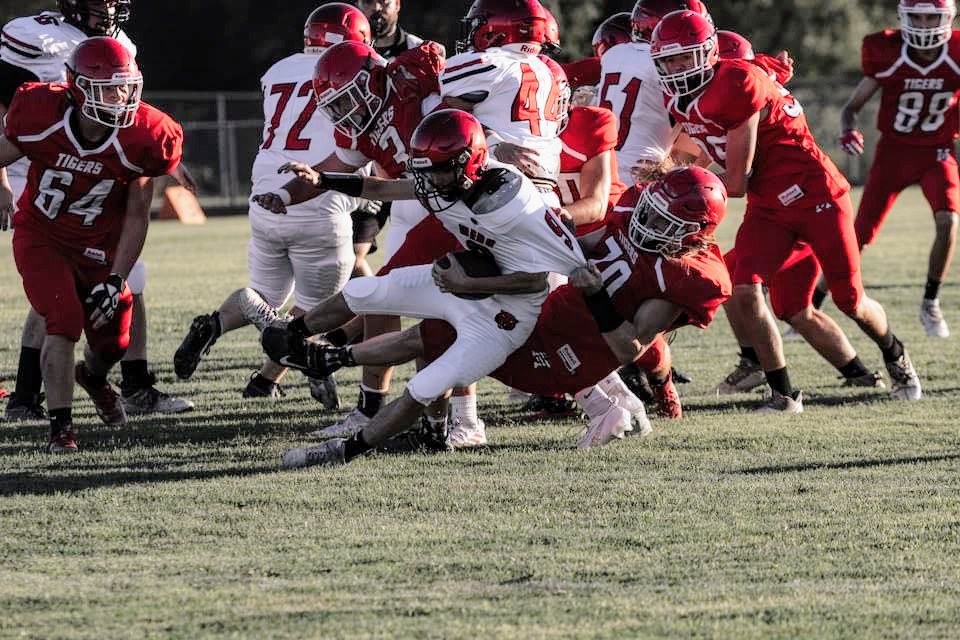
Defensive lineman, Dakota Deer, yanks down a Mena ball runner for a loss of yards.
Photo courtesy of Joey Bolin

The layout of the scrimmage was simple. Each team would start out playing their second string for fifteen plays each on offense and follow that with a live 12 minutes of play. Once done, the first string offenses and defenses would follow suit. The Tigers opponents in the scrimmage were by no means a walk over cupcake program. The Mena Bearcats are a notorious year-in and year-out State Playoff contender in the 4A with their impeccable size, speed, and solid coaching staff. To even keep up against Mena is considered quite a feat. But Mansfield wasn’t content with keeping up in the scrimmage, they were out to make a statement to the entire state. That statement was clear and concise to all. Just Bring It.

Quarterback, Cole Kindle, zips a pass to a receiver by the Mansfield sideline.
Photo courtesy of Joey Bolin

Mansfield’s second-string squad stood tall by leaning heavily on their defensive prowess. Through their section of the scrimmage, the Tigers defense showed extreme depth in their defensive skill and talent as they stuffed Mena on nearly every snap of the ball. The showstoppers of the Tigers opening series was the entire defensive line which consited of Dakota Deer, Cole Kindle, Cadien Ore, and James “Critter” Bausley. With the Bearcats primarily focusing on their run game, the Mansfield linemen were able to gorge themselves with a Thanksgiving meal of tackles as they accounted for eight of the team’s stops and forced a fumble on Mena’s first fifteen offensive plays. Offensively, the Tigers struggled but still showed some poise. The Tigers were able to gain large chunks of yardage with scrabbles by quarterback Cooper Edwards and solid runs by Trey Powell and Dawson Robinson. Unfortunately, mental mistakes and penalties left a mark on each gain down the field for Mansfield as both teams second strings left the field with a 0-0 draw.

A slew of Tigers swarm a Mena player to earn another tackle for loss against the Bearcats.
Photo courtesy of Joey Bolin

After a small taste of Tiger football, the fans were eager for more as Mansfield and Mena ushered their first-string teams onto the field. What fans got was a plate of defensive desert as Mansfield continued their dominance over the Bearcats offense forcing a punt on Mena’s first series. Mena paid the Tigers back though as they stuffed Mansfield’s run game and forced a bad snap which set the Tiger way back on fourth down. With a positive field position, Mena began to throw the ball effectively to the perimeter of the field. It didn’t take long for Mansfield to sniff out the Bearcats new plan of attack though as Peyton Martin and Daniel Burton took turns swatting down passes to force a turnover on downs against Mena. The Tigers next offensive possession started out the way their previous one ended with a bad snap, but Daniel Burton took the ball on second down and juked around for a fifteen-yard gain giving the Tigers a first down. The flash of yards ended as quickly as it began though as mental mistakes pushed the Tigers back to punt the ball back to Mena again.

One of the Tigers tripple threats at quarterback, Cooper Edwards, scrambles downfield for a first down.
Photo courtesy of Joey Bolin

With neither team’s offense proving effective, the scrimmage would come down to who’s defense could execute better. That execution came from the Tigers head executioner, Ethan Martin. Martin scooped up a Mena fumble and rolled 13 yards into the end zone for a Tiger touchdown. Jeremy Strozier tacked on the extra point kick to give the Tigers a 7-0 lead. Mena would again give the ball up on their next series as linebacker Zander Walters picked off a pass and darted 34 yards for a Tiger touchdown. Unfortunately, a penalty brought the touchdown back but still gave Mansfield possession of the ball. Both teams continued to duel it out as the lights came on and the clock ran down, but it was Mansfield who prevailed in the scrimmage with a 7-0 victory over Mena.

Cole Kindle shows that a Mansfield quarterback can be a duel threat on both sides of the ball as he tackles a Bearcat from his defensive end position.
Photo courtesy of Joey Bolin

Although it was merely a scrimmage, the night was quite impressive overall for Mansfield. Both teams held back on a lot of their play calling so that they didn’t show all of their cards to future early-season opponents. That being said, Mansfield proved they can hang with a solid 4A team with some plain jane vanilla play calling on both sides of the ball. The Tigers also showed plenty of depth as the line between the first string and second string was blurred with equal amounts of talent. Even with a whole new layout for the program and a lot of inexperience on the field, Mansfield proved that when they smooth out all of the bumps, they’ll be a force to be reckoned with in 2023. The Tigers will officially start their 2023 campain on Friday, August 25th at home against the Magazine Rattlers.

Income Tax School offers in-person, virtual training for advanced income tax preparation

By Rebekah Hall U of A System Division of Agriculture

For Arkansans interested in advanced income tax preparation, the University of Arkansas System Division of Agriculture will offer five in-person and virtual Income Tax School training courses later this year.

The Income Tax School is offered through the Community, Professional and Economic Development unit of the Cooperative Extension Service. Each of the two-day courses will provide information about the latest tax code updates and insight into what taxpayers can expect for the 2024 tax season.

“As one of only a few tax school options in Arkansas, we offer high-quality, affordable federal tax education that fits your schedule,” said Kim Magee, director of the Income Tax School for the extension service. “We provide the information you want and continuing professional education you need every year.”

In-person training will be offered in four Arkansas cities:

· Jonesboro: Nov. 13-14 at the Arkansas State University Delta Center for Economic Development, 319 University Loop

· Fayetteville: Nov. 16-17 at the Don Tyson Center, 1371 W. Altheimer Drive

· Hope: Nov. 27-28 at Hempstead Hall, 2500 S. Main Street

· Little Rock: Nov. 29-30 at Cooperative Extension Service State Office, 2301 S. University Avenue

A virtual option will be offered via Zoom Dec. 6-7.

The cost of the course is $270 for those who register before Aug. 25, or $310 after the priority registration deadline. Registration is available at uada.formstack.com/forms/tax. Classes run 8 a.m.-4:30 p.m. daily. A certificate of attendance will be awarded after class is dismissed on the second day.

Curtis Davis, a certified public accountant with more than two decades of tax experience, and Bill Laird, a retired Internal Revenue Service agent, will be instructors at the schools. The course will offer a general review of current tax regulations and updates on changes in existing tax laws.

The Income Tax School is approved by the IRS as a continuing education provider. Participants can earn 16 hours of continuing professional education credit, including two hours of ethics. For more information, contact Kim Magee at 501-671-2081 or kmagee@uada.edu.

To learn about extension programs in Arkansas, contact your local Cooperative Extension Service agent or visit www.uaex.uada.edu. Follow us on Twitter and Instagram at @AR_Extension. To learn more about Division of Agriculture research, visit the Arkansas Agricultural Experiment Station website: https://aaes.uada.edu. Follow on Twitter at @ArkAgResearch. To learn more about the Division of Agriculture, visit https://uada.edu/. Follow us on Twitter at @AgInArk.

About the Division of Agriculture

The University of Arkansas System Division of Agriculture’s mission is to strengthen agriculture, communities, and families by connecting trusted research to the adoption of best practices. Through the Agricultural Experiment Station and the Cooperative Extension Service, the Division of Agriculture conducts research and extension work within the nation’s historic land grant education system.

The Division of Agriculture is one of 20 entities within the University of Arkansas System. It has offices in all 75 counties in Arkansas and faculty on five system campuses.

The University of Arkansas System Division of Agriculture offers all its Extension and Research programs to all eligible persons without regard to race, color, sex, gender identity, sexual orientation, national origin, religion, age, disability, marital or veteran status, genetic information, or any other legally protected status, and is an Affirmative Action/Equal Opportunity Employer.

Timepiece: Charity in the Midst of War

Dr. Curtis Varnell

The date was September 27. 1863 and the country was in the middle of the great Civil War. Flags and guidons were flying as Joseph Shelby’s Iron Brigade travelled up the old military road. Eight-hundred cavalry, twelve wagons, and two cannon would have resulted in a column stretched a mile or more. Passing through the sparsely settled but politically divided farmland of what is now Logan County, the Confederates encountered warm welcome on the one hand and abject hostility on the other. Occasionally Union sympathizers took the opportunity to fire on the column from the surrounding brush and forests. To prevent these attacks, Shelby assigned Captain Tuck Thorpe the duty of preceding the column and clearing the way.

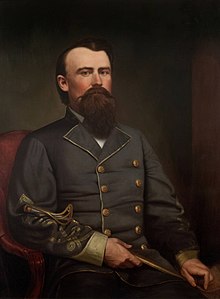
Portrait of General Joseph O. Shelby

Nearing Haguewood Prairie, Thorpe and his group unexpectedly ran upon an encamped group of the Arkansas (union) first infantry. The First Arkansas Infantry were composed of locals, many of whom had visiting family members with them. Surprised by the advance scouts, the men quickly fell back into the trees along Haguewood creek and formed a line of defense. Gunfire erupted as the two sides engaged. Hearing sounds of battle, Shelby advanced rapidly to the aide of his scouts. Outnumbered, but in a good defensive location, the eighty men of the union army put up a good fight. A two-hour skirmish ensued as the two sides exchanged gunfire across the prairie. Shelby, tiring of the battle, ordered an all-out charge on either flank. His colorful official report states, “the simultaneous charge scattered them like chaff and our rough riders rode them down like stubble to the lava tide.”

There were casualties on both sides and Shelby took a number of captives. Among the captured were two women and three little girls. While the firing continued, they all huddled behind a huge white oak tree and prayed. When their father was brought in bleeding and pale, the young children crowded around him, distraught and crying. “Father, father please don’t die,” they wailed in distress. “Your bleeding so bad and you are so pale and sick.” The man’s wife set dejected and wringing her hands in distress, her eyes filled with tears.

Confederate troopers gathered around, moved by the pathetic scene played out before them. Some of the men, no doubt thinking of their own loved ones left behind, turned from the scene with tears. Some of the men began to pull money from their own possessions and to lay it before the small family. Shelby collected at least twelve months’ provisions for the family and then provided them with overcoats and blankets. Stating he was sorry that their dad was hurt, he took a leather purse of gold coin from his pocket and pressed it into the hands of the woman.

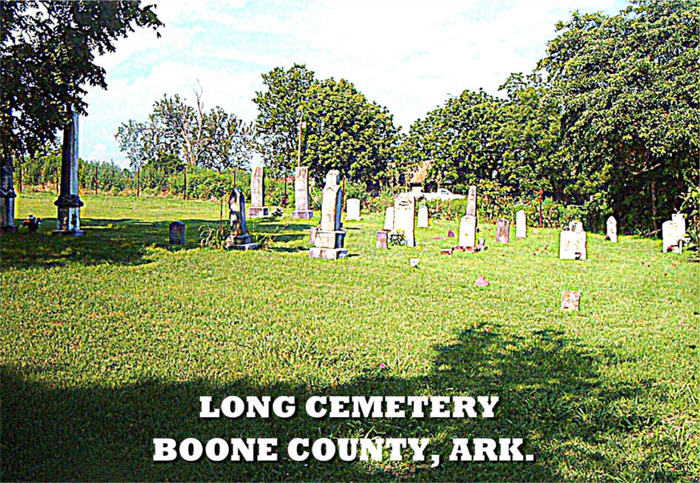
Research indicates that the wounded man was Isaac Plumley, a 48-year-old farmer that had enlisted in Fayetteville in March of 1863. Isaac had a large family, eventually a total of at least 11 kids with his first wife. His wife Sirena and the younger children Cerenta, Sarah, and Narcissa would fit the description from official records. Official records show that Isaac was severely wounded in the lower leg and ankle and spent months in the military hospital. He was eventually discharged in Fort Smith, AR in Nov. of 1864. It is said that the money given them was equal to several year’s wage. After the warm, Plumley filed for and was awarded a pension of 12 dollars monthly. The 1870 census shows that his wife Sirena had died and that Isaac had remarried to his sister-in-law who had lost her husband. His new wife had four children and they proceeded to have seven more children together. No doubt, with 22 children between them, they needed every accumulated penny to survive! He died in March of 1897 and is buried in Long Cemetery, Boone County, Arkansas.

Shelby continued on his raid into Missouri. During the raid, his troops killed or wounded 600 Federal troops, captured thousands of weapons, destroyed two forts, destroyed miles of railroad and telegraph lines, while preventing more than 100,000 Missouri and Arkansas troops from assisting in the Tennessee campaign. Shelby and his men conducted one of the most successful campaigns in the west, yet found time for mercy and compassion in the midst of war.

Arkansas Blackberry Breeder will Develop New Tools to Unlock Consumer Preference

By John Lovett
University of Arkansas System Division of Agriculture
Arkansas Agricultural Experiment Station

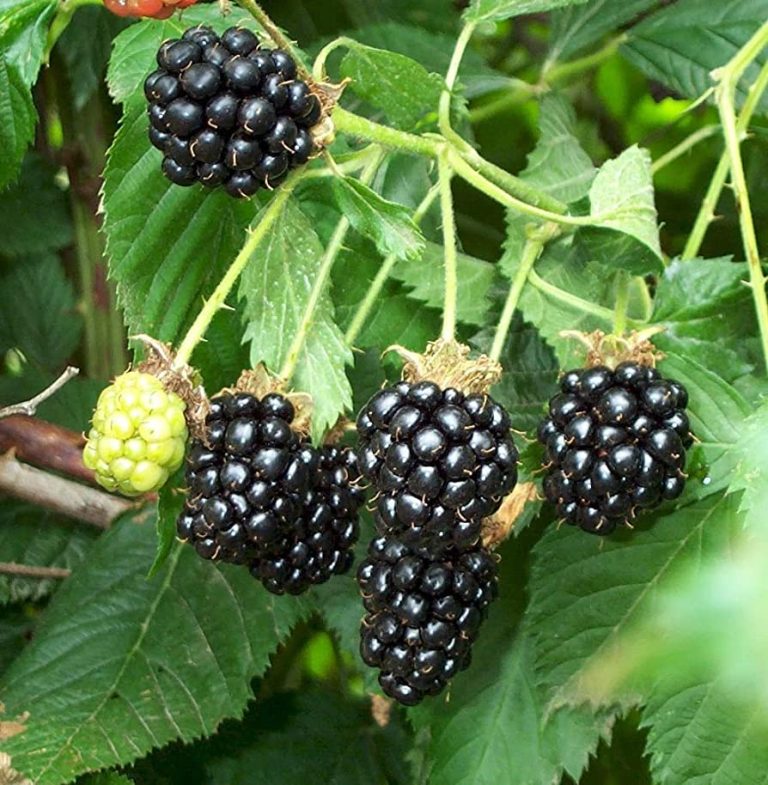
Despite leaps in Arkansas blackberry breeding over the past few decades, there is still room for advancement with the help of genomewide association mapping, consumer panels and a machine with a mouthful of a name — a gas chromatography-olfactometry-mass spectrometer.

Margaret Worthington, associate professor of fruit breeding and genetics for the Arkansas Agricultural Experiment Station, has tasted a lot of blackberries and knows what a good berry tastes like. But consumer sensory panels are more accurate and objective than a fruit breeder’s ratings, Worthington said.

As the principal investigator for a new U.S. Department of Agriculture grant, she will use new genomic tools and novel approaches for improving flavor to support her efforts in propelling the largest public-sector breeding program for fresh-market blackberries in the United States.

The University of Arkansas System Division of Agriculture’s blackberry breeding program has developed and patented 43 fresh-market blackberry cultivars, including many combining erect growth habit, thornlessness, and improved shipping ability. The first primocane-fruiting blackberry cultivars, which produce fruit on first-year canes, were also developed in the breeding program. The experiment station is the research arm of the Division of Agriculture.

The USDA’s National Institute of Food and Agriculture will administer the $650,000 Agriculture and Food Research Initiative grant over the next four years. In addition to more data from consumer panels, the grant also provides funding to conduct studies that identify genomic variants statistically associated with a particular trait, known as genomewide association mapping.

Consumer sensory panels are considered the “gold standard for evaluating flavor in fruit crops,” Worthington said, but they cost money and time.

“This is all about discovering what drives consumer preference,” Worthington said. “Comparing the chemistry data on blackberries with consumer panel data, we’ll have much more power to make inferences about what consumers want and how to breed blackberries.”

She said that even with the rise in blackberry consumption and sales, inconsistent flavor is considered a barrier to industry growth. She added that a common complaint about blackberries from consumers and grocers is that they are too tart or not sweet enough, either from being picked too early or simply having an “off” taste.

The USDA-NIFA grant will support investigations that tie in the consumer sensory panel data with the different flavor volatiles found in the blackberry genotypes most favored by consumers, which is where the gas chromatography-olfactometry-mass spectrometer plays a role. This instrument can be used to analyze the chemical components of blackberry flavors, including specific flavor and aroma compounds called “volatiles.”

Although the basic tastes of blackberries — sweetness, sourness, and bitterness — impact their flavor, volatile aroma compounds are also responsible for typical aromas and aromatic flavors of blackberries, Worthington noted. Volatiles are substances in fruit that vaporize easily at ambient temperature. In blackberries, those volatiles include acids, esters and alcohols, but vary by variety, ripeness, harvest time and storage conditions.

Worthington will take all the information collected to help guide selections for advancing blackberry plants in breeding trials.

The grant also provides funding for a Ph.D. student, Katelyn Lust-Moore.

“We want to look for correlations between certain volatiles and consumer preferences to determine what exactly makes the flavor of a blackberry desirable or off-putting,” Lust-Moore, said. “Then, we can use this information to create tools for breeders so they can more efficiently select plants that produce better-tasting fruit.”

Worthington, who is part of the horticulture department, is teaming up with food science researchers Renee Threlfall, research scientist of horticultural postharvest/quality, and Scott Lafontaine, assistant professor of flavor chemistry; Samuel B. Fernandes, assistant professor of agricultural statistics and quantitative genetics with the experiment station’s Center for Agricultural Data Analytics; and Lust-Moore.

Worthington noted the collaboration includes complimentary fields and tools. Lafontaine, for example, operates the Shimadzu gas chromatography-olfactometry-mass spectrometer that evaluates samples for chemical analysis. And Fernandes combines computer science advances with elements of agriculture to help plant breeders, growers and consumers.

Two prerequisites

Worthington said this scale of a project would not have been feasible even a few years ago.

One factor that makes the project possible is her work with a team of international scientists who assembled the first complete sequence of the blackberry genome. Another factor, oddly enough, was the COVID-19 pandemic.

During the pandemic, when restrictions prevented researchers from conducting sensory panels, Threlfall and her team devised a protocol that allowed them to preserve blackberries until restrictions were lifted. They froze the blackberries after harvest, thawed them, and made a puree for tasting right before the sensory panels took place.

Operating consumer sensory panels during the blackberry harvest season is difficult to manage in tandem with regular blackberry breeding duties, Worthington said. Threlfall’s pandemic-era protocol will allow Worthington’s team to conduct the sensory panels in the winter and spring when they are less busy with blackberry breeding duties.

The blackberry research is supported by USDA grant number 2023-6703-39448.

To learn more about Division of Agriculture research, visit the Arkansas Agricultural Experiment Station website: https://aaes.uada.edu. Follow on Twitter at @ArkAgResearch. To learn more about the Division of Agriculture, visit https://uada.edu/. Follow us on Twitter at @AgInArk. To learn about extension programs in Arkansas, contact your local Cooperative Extension Service agent or visit www.uaex.uada.edu.

About the Division of Agriculture

The University of Arkansas System Division of Agriculture’s mission is to strengthen agriculture, communities, and families by connecting trusted research to the adoption of best practices. Through the Agricultural Experiment Station and the Cooperative Extension Service, the Division of Agriculture conducts research and extension work within the nation’s historic land grant education system.

The Division of Agriculture is one of 20 entities within the University of Arkansas System. It has offices in all 75 counties in Arkansas and faculty on five system campuses.

The University of Arkansas System Division of Agriculture offers all its Extension and Research programs and services without regard to race, color, sex, gender identity, sexual orientation, national origin, religion, age, disability, marital or veteran status, genetic information, or any other legally protected status, and is an Affirmative Action/Equal Opportunity Employer.

Support Greenwood First Responders by Giving Blood at the Greenwood Boots and Badges Aug 22nd at the ROC

0

 Roll up your sleeve and support your local first responders by giving blood with Our Blood Institute at a local blood drive and you too can help save a life!

Our Blood Institute (OBI) will hold the Greenwood Boots and Badges Blood Drive on Tuesday, August 22, 1 p.m. to 6 p.m. at the ROC (Recreation Outreach Center).       

Successful donors will also receive a limited-edition Boots & Badges T-shirt, and a free ticket to Science Museum Oklahoma, Frontier City or Hurricane Harbor. 

“Each and every single day Arkansas’s first responders see the need for life-saving blood donations,” said Dr. John Armitage, president and CEO of Our Blood Institute. “We are incredibly thankful for our local first responders who continue to keep us safe, and we owe it to them to do our part in making sure blood is readily available in emergency situations.”

Anyone who is healthy and 16 years old* or older can give blood. Blood can be donated every 56 days and platelets can be given as often as every seven days, up to 24 times a year.

Appointments to donate can be made online at obi.org or by calling 877-340-8777.

*16-year-olds must weigh at least 125 pounds and provide signed parental permission; 17-year-olds must weigh at least 125 pounds; 18+ year-olds must weigh at least 110 pounds. Photo ID required.

NHTSA and Arkansas Law Enforcement Remind Drivers: Drive Sober or Get Pulled Over

During the Labor Day holiday period, including the end of summertime and the busy holiday weekend, the U.S. Department of Transportation’s National Highway Traffic Safety Administration (NHTSA) will be working alongside law enforcement in Arkansas to decrease impaired driving. From August 18 through September 4, Arkansas law enforcement will be participating in the Drive Sober or Get Pulled Over high-visibility enforcement campaign. During this time, you’ll see officers working together to take drunk drivers off the roads in support of law enforcement’s dedication to protecting the lives of residents in their communities. No matter how you plan to celebrate the end of summer this year, make sure you plan to do it safely.

  For this year’s campaign, the National Park Service (NPS), and NHTSA Region 7, which includes Arkansas, Missouri, Kansas, Nebraska, and Iowa, are again partnering to emphasize the importance of driving sober and saving lives on America’s roadways in and around our region’s National and State Parks. There will be an increased presence of state and local law enforcement officers along with NPS rangers during this campaign, whose expanded efforts to protect against impaired driving will be conducted in a fair and equitable way. Campaign activities will be highlighted by NHTSA at a press conference in St. Louis, Missouri at the Gateway Arch on August 25. Law enforcement officers in all regions will be participating in the Drive Sober or Get Pulled Over campaign throughout the Labor Day weekend. 

According to NHTSA, 13,384 people were killed in drunk-driving crashes in 2021 — that’s one person every 39 minutes. On average, more than 11,000 people were killed in drunk-driving crashes each year from 2017 to 2021. This is why Arkansas law enforcement officers are working together with NHTSA to remind drivers that drunk driving is not only illegal; it’s a matter of life and death. As you head out to festivities during the end of summer and Labor Day weekend, remember: Drive Sober or Get Pulled Over.

  “We want our community members to understand that it’s our first priority to keep people safe, so we’re asking everyone to plan ahead if they know they’ll be out drinking,” said Colonel Mike Hagar, Arkansas Public Safety Secretary, and the Governor’s Highway Safety Representative. “In addition to enforcement, the Drive Sober or Get Pulled Over campaign is an awareness effort to get the message out that drunk driving is illegal and it takes lives. Let’s make this a partnership between law enforcement and drivers− help us protect the community and put an end to this senseless behavior,” he said. 

  During the 2021 Labor Day holiday period (6:00 p.m. September 3 to 5:59 a.m. September 7), there were 531 traffic fatalities nationwide. Of these 531 fatalities, 41% (216) involved a drunk driver, and more than a quarter (27%) involved drivers who were driving with a BAC almost twice the legal limit (.15+ BAC). Among drivers between the ages of 18 and 34 who were killed in crashes over the Labor Day holiday period in 2021, 48% of those drivers were drunk, with BACs of .08 or higher.

  No one should mix drinking and driving, and no one is immune to the effects of drinking. If you find yourself drunk and stranded with your vehicle, give your keys to a sober driver who can safely drive you home. Remind your friends to never get into a vehicle with a drunk driver. If you have a friend who is about to drive after drinking, take away their keys and help them get home safely. Most importantly: Always have a plan before you head out for the evening. If you wait until after you’ve been drinking to figure out how to get from one place to the next, you will already be too impaired to make the right choice.

  So remember, this Labor Day weekend and all year long: Drive Sober or Get Pulled Over. It could save your life.

  For more information on impaired driving, visit www.nhtsa.gov/risky-driving/drunk-driving or call the Arkansas Highway Safety Office at (501) 618-8136. For more on Arkansas’ ongoing Toward Zero Deaths campaign to eliminate preventable traffic fatalities, visit www.TZDArkansas.org.