

80.3 F
Fort Smith
Wednesday, June 24, 2026
Home Blog Page 268

Four Hogs Named Preseason All-SEC


FAYETTEVILLE
– Led by running back Raheim Sanders’ first-team selection, four Razorbacks earned preseason All-SEC honors on Friday morning in a vote by members of the media.

In addition to Sanders, Arkansas quarterback KJ Jefferson and offensive lineman Brady Latham garnered preseason second-team All-SEC praise. Defensive back Dwight McGlothern was the Razorbacks’ lone representative on the defensive side of the football, picking up preseason second-team All-SEC honors.

Sanders, the first Razorback running back to earn preseason first-team All-SEC recognition since Knile Davis in 2012, is coming off one of the greatest seasons by an Arkansas running back in recent memory after rushing for 10 touchdowns and 1,443 yards – fourth-most in a single season in school history – in 2022. Sanders became just the second Razorback to ever run for 1,400+ yards and return to school the following year, joining Arkansas legend Darren McFadden, who ran for a then school record 1,647 yards in 2006 before breaking his own record in 2007 with 1,830 yards. Sanders finished second in the SEC in rushing yards en route to being named First-Team All-SEC by the Associated Press and USA Today.

Jefferson, the first Razorback quarterback to earn preseason All-SEC accolades since Tyler Wilson in 2012, is poised to rewrite a large portion of the Arkansas record book this fall as he heads into his third season as the Hogs’ full-time starter. Jefferson already sits inside the career top 10 in school history in completions (436 – 7th), yards (5816 – 7th), touchdown passes (48 – 6th), 300-yard passing games (5 – 3rd), total plays (1028 – 6th), total yards (7245 – 5th) and touchdown responsibility (67 – 4th). Jefferson’s name is already dotted throughout the school record book for numerous single-season records, including twice for completion percentage in 2021 (.673 – 3rd) and 2022 (.680 – 2nd).

Latham, a third-team All-SEC selection by Pro Football Focus last year, has been a staple on the Arkansas offensive line over the last three seasons, starting in a team-leading 36 consecutive games dating back to 2020. In 2022, he tied for the team lead in offensive snaps played (983) while allowing only two sacks and committing just two penalties.

McGlothern, who earned second-team All-SEC honors from the league’s coaches last year, had an impressive season for the Hogs in 2022, staring all 13 games and racking up a career-high 52 total tackles. He led the Arkansas defense and finished second in the SEC with four interceptions, picking off passes in each of his first two games as a Razorback against Cincinnati and South Carolina before adding interceptions against Alabama and Kansas in the Liberty Bowl.

As a team, the Razorbacks were picked to finish fifth in the SEC West, receiving three first-place votes. Arkansas head coach Sam Pittman has led the program to consecutive winning seasons and back-to-back bowl victories entering 2023.

Arkansas kicks off the season at 3 p.m. Saturday, Sept. 2, against FCS foe Western Carolina at War Memorial Stadium in Little Rock, Ark. Season tickets are on sale now and can be purchased by clicking here or by calling the Razorback Ticket Center at (479) 575-5151.

– ArkansasRazorbacks.com || On Twitter @ArkRazorbacks || Facebook.com/ArkansasRazorbacks

Note to Our Readers: The previous story was sourced directly and in its entirety from the University of Arkansas Office of Communications, Oliver Grigg.

Cardinals Acquire Minor League Catcher in Trade with Toronto

A SPECIAL NOTE FROM RNN SPORTS TO OUR READERS!

With the following story, RNN Sports is proud to announce the addition of St. Louis Cardinals baseball to our growing footprint of sports coverage! RNN Sports will bring you the latest news releases directly from St. Louis to all of our readership. We are proud to bring you this new and exciting coverage, and we hope that Cardinals fans everywhere will enjoy the latest Redbird news from RNN Sports!

ST. LOUIS- The St. Louis Cardinals announced this afternoon that they have acquired minor league catcher Samuel “Sammy” Hernandez from the Toronto Blue Jays in exchange for left-handed reliever Génesis Cabrera who had been designated for assignment on Monday.


Hernandez, 19, was the Blue Jays 14th round selection in the 2022 MLB Draft out of Lakeland (Fla.) High School. Born in Ponce, Puerto Rico, the 5-9, 185-pound Hernandez has played this season for both the FCL Blue Jays and Dunedin (Single-A) of the Florida State League. He will be assigned to the FCL Cardinals roster.


The right-handed hitting Hernandez was batting .261 in 14 games this season with the FCL Blue Jays, with seven of his 12 hits going for extra bases. Fourteen of his combined 32 hits between Dunedin and FCL Blue Jays this year have been for extra bases, including three home runs.


Note to Our Readers: The previous story was sourced directly and in its entirety from the St. Louis Cardinals Media Relations.

Entomologists study how colors attract wild bees to improve surveys, other research

By Fred Miller
U of A System Division of Agriculture

Editor’s Note: This is the third in a series of three stories about research into the fascinating and agriculturally important world of bees. Today’s story is about building a better research trap to monitor the behaviors of native, solitary bees that make important yet largely unrecognized contributions to the pollination of flowers and food crops.

Red means stop. Green means go. But to bees, colors reveal a smorgasbord of available food sources.

Neel Joshi, associate professor of entomology for the Arkansas Agricultural Experiment Station, the research arm of the University of Arkansas System Division of Agriculture, said colors serve as visual cues to bees. Color helps them identify flowers from which they can collect nectar for food. For this reason, monitoring traps are often brightly colored to attract and collect bee specimens for study.

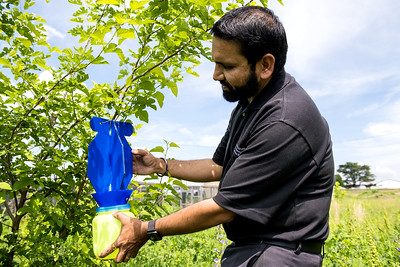
Many different types of traps are commercially available, Joshi said, and vane traps that use blue and yellow vanes to attract bees are a common device to trap them. But their effectiveness varies depending on bee species and the environment in which they are used.

Keeping count

Joshi said many research goals require trapping bees. For example, his lab is currently sampling and documenting native bee species in six ecoregions of Arkansas.

“There are about 4,000 species of wild native bees in the United States,” Joshi said. “We have documented more than 200 species in Arkansas, but we think there may be as many as 400 or more native species in the state.”

Most bees in Arkansas are ground-nesting and tunnel-nesting species, and they are solitary bees, Joshi said. These include small carpenter bees, sweat bees leafcutting bees and mason bees. Some, like carpenter bees, dig their own tunnels for nests. Mason bees, like blue orchard bees, use existing tunnels cut by other insect species into trees or wooden structures.

Native bees are important pollinators, Joshi said. Along with other pollinators, including moths and butterflies, native bees benefit more than 75 percent of plants in Arkansas, including 35 percent of crop plants.

“Monitoring their abundance and diversity is necessary to develop appropriate conservation and management practices to protect them,” Joshi said.

Building a better bee trap

Roshani S. Acharya, a former graduate student in Joshi’s insect ecology lab, led a research project to determine which colors worked best to attract bees to vane traps. Joshi said his lab team converted commercially available vane traps by refining the design and constructing new vanes from yellow, red and blue micro prismatic material that reflects light in selected color spectrums.

“These colors reflect into the ultraviolet spectrum where bees see,” Joshi said.

The research has been published in Scientific Reports, an online journal for Nature Portfolio, a research publishing branch of Nature, the international weekly journal of science.

The base material is plastic, chosen for durability and weather resistance, Joshi said. The reconfigured traps were placed in newly established livestock pastures that include pollinator-friendly native flower mixes that are frequented by wild bees.

The traps were deployed only 24 hours at a time to avoid oversampling. “We only need enough bees to identify the species,” Joshi said. Care was taken to preserve as many bees alive as possible.

“We want to collect as few as possible because pollinators, including bees, are in decline,” Joshi said. “Generally, while conducting biodiversity studies, we identify many of them in the field and released them immediately.”

Joshi said the different colors tended to attract different species of native bees, but the bright blue with micro prismatic material proved to be the most popular.

“Thirty-six out of 49 species captured in the traps went to bright blue,” Joshi said. “And of those, six were unique species that were not found in any other colored traps in the study.

“These results showed that different light wavelengths and reflectivity from the vane traps influence bee capture rates,” Joshi said. “Knowing this can help optimize bee sampling methods in different ecosystems.”

The traps are now being tested in native flower test plots on the experiment station’s Milo J. Shult Agricultural Research and Extension Center in Fayetteville.

To learn more about Division of Agriculture research, visit the Arkansas Agricultural Experiment Station website: https://aaes.uada.edu/. Follow us on Twitter at @ArkAgResearch and on Instagram at @ArkAgResearch. To learn more about the Division of Agriculture, visit https://uada.edu/. Follow us on Twitter at @AgInArk.

Molecular survey of parasite threats helps Arkansas beekeepers protect their colonies

By Fred Miller
U of A System Division of Agriculture

Editor’s note: This is the second in a series of three stories about research into the fascinating and agriculturally important world of bees. Today’s story focuses on a molecular survey of pathogens and parasites that pose threats to Arkansas’ managed honeybee populations.

Honeybee health is in decline in the United States and no single cause has been identified. Arkansas Agricultural Experiment Station researchers conducted a molecular survey of managed honeybee colonies in Arkansas to identify parasites and pathogens contributing to this decline in the state.

Allen Szalanski, professor of entomology and insect geneticist for the experiment station, the research arm of the University of Arkansas System Division of Agriculture, said Varroa destructor, a species of parasitic mites, was the top threat to Arkansas’ honeybees, based on the survey.

Threat detection

Szalanski said Dylan Cleary, a former Ph.D. student in his lab who graduated last year, led the survey.

While threats like the Varroa mite are well-known, Szalanski said, little research has been done to evaluate the risk that other parasites and pathogens pose to honeybees. Also, nationwide surveys of honeybee pests are not very detailed for individual states. “So, it’s important to do a state-based study,” he said.

In Cleary’s study, the researchers tested for a single-cell fungal parasite, a protozoan parasite called trypanosome and two bacterial pathogens known to invade bee populations in other areas of the country. Szalanski said knowing the presence or absence of these pests is critical to understanding invasive parasites and pathogens that may present future health threats to Arkansas honeybee colonies.

Szalanski said he and Cleary asked beekeepers registered with the Arkansas State Plant Board to collect and send in samples of bees from their colonies.

“We sampled 107 beekeepers around the state,” Szalanski said. “The participants submitted 541 samples from 47 counties.”

The State Plant Board has 3,849 registered beekeepers managing more than 61,000 honeybee colonies. Most Arkansas beekeepers keep “backyard” colonies that provide pollination services to their own or nearby farms, Szalanski said.

Test results

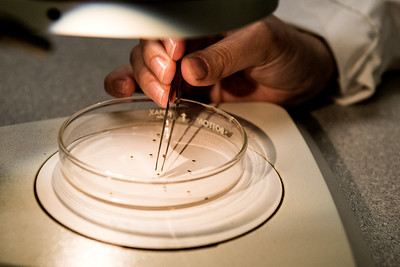
The researchers identified Varroa mites by separating the parasites from the bees and counting them. They submitted bees to DNA tests to identify the two fungal parasites and two bacterial pathogens. Varroa mites infected 41.1 percent of the samples, Szalanski said.

Varroa mites are tiny, button-shaped, no more than 2 millimeters wide and slightly shorter in length. They feed on fats sucked from honeybees’ bodies.

“The Varroa mite is like a vampire,” Szalanski said. “It feeds on both immature and adult bees.” The mite is also a carrier of honeybee viruses, he said.

While it’s virtually impossible to eliminate Varroa mites, Szalanski said beekeepers could control the parasite effectively with oxalic acid, a pest control in crystal form. “You heat up the crystals with an electric wand to fumigate the hive,” he said. The fumes kill about 70 percent of the mites without harming the bees.

A protozoan parasite called Nosema ceranae was found in 11.65 percent of the samples, followed closely by a trypanosome parasite, Lotmaria passim, in 11.28 percent of the bees.

“This is the first time we’ve seen Lotmaria passim in Arkansas,” Szalanski said.

None of the samples were positive for the bacterial pathogens for which they tested.

“It’s good to know what we have or don’t have in the state,” Szalanski said. “Even verifying that Varroa is widespread across Arkansas is important.”

Szalanski said that knowledge generated by this ongoing research could help Arkansas beekeepers make management decisions to protect the health of their colonies.

To learn more about Division of Agriculture research, visit the Arkansas Agricultural Experiment Station website: https://aaes.uada.edu/. Follow us on Twitter at @ArkAgResearch and on Instagram at @ArkAgResearch. To learn more about the Division of Agriculture, visit https://uada.edu/. Follow us on Twitter at @AgInArk.

Smart Ways to Invest in Bonds

Most investors are aware of the different types of stocks: big-company, small-company, technology, international and so on. And it may be a good idea to own a mix of these stocks as part of your overall investment portfolio. But the importance of diversification applies to bonds, too — so, how should you go about achieving it?
To begin with, individual bonds fall into three main types: municipal, corporate and government. Within these categories, you’ll find differences in the bonds being issued. For example, government bonds include conventional, fixed-rate Treasury bonds as well as inflation-protected ones, along with bonds issued by government agencies, such as the Federal National Mortgage Association (or Fannie Mae). Corporate bonds are differentiated from each other by several factors, but one important one is the interest rate they pay, which is largely determined by the credit quality of the issuer. (The higher the rating grade — AAA, AA and so on — the lower the interest rate; higher-rated bonds pose less risk to investors and therefore pay less interest.)
Municipal bonds, too, are far from uniform. These bonds are issued by state and local governments to build or improve infrastructure, such as airports, highways, hospitals and schools. Generally, municipal bonds are exempt from federal tax and often state and local taxes, too. However, because of this tax benefit, municipal bonds typically pay lower interest rates than many corporate bonds.
How can you use various types of bonds to build a diversified bond portfolio? One method is to invest in mutual funds that invest primarily in bonds. By owning a mix of corporate, government and municipal bond funds, you can gain exposure to much of the bond world. Be aware, though, that bond funds, like bonds themselves, vary widely in some respects. To illustrate: Some investors may choose a low-risk, low return approach by investing in a bond fund that only owns Treasury securities, while other investors might strive for higher returns — and accept greater risk — by investing in a higher-yield, but riskier bond fund.
But you can also diversify your bond holdings by owning a group of individual bonds with different maturities: short-, intermediate- and long-term. This type of diversification can help protect you against the effects of interest-rate movements, which are a driving force behind the value of your bonds — that is, the amount you could sell them for if you chose to sell them before they matured. When market interest rates rise, the price of your existing, lower-paying bonds will fall, and when rates drop, your bonds will be worth more.
But by building a “ladder” of bonds with varying maturities, you can take advantage of different interest-rate environments. When market rates are rising, you can reinvest your maturing, shorter-term bonds at the new, higher rates. And when market rates are low, you’ll still have your longer-term bonds working for you. (Generally, though not always, longer-term bonds pay higher rates than shorter-term ones.)
A bond ladder should be consistent with your investment objectives, risk tolerance and financial circumstances. But if it’s appropriate for your needs, it could be a valuable tool in diversifying your bond holdings. And while diversification — in either stocks or bonds — can’t always guarantee success or avoid losses, it remains a core principle of successful investing.
This article is provided by
Jeffrey O’Neal, Financial Advisor
Edward Jones
20 N Express St, Paris, AR 72855
479-963-1321
jeffrey.o’neal@edwardjones.com
edwardjones.com/jeffrey-o’neal
Edward Jones, Member SIPC

Paris High School Ag Teacher Named as IMPACT Arkansas Principal Fellow

FAYETTEVILLE- Jessica Gray, an Agriculture Education teacher at Paris High School, was recently selected as an IMPACT Arkansas Principal Fellow. IMPACT is a University of Arkansas-based program that has been building leadership capacity in high-needs, rural schools across the state for nearly a decade.

“I am excited to participate in the IMPACT Arkansas Fellowship program to help me reflect on myself and as a teacher leader,” said Gray, who has worked in education for 17 years. “I hope to gain more leadership abilities and how to think outside of the box when it comes to education and leadership.”

The selection process for the eighth cohort of fellows was highly competitive. The 19 new members met for the first time this summer to begin an intensive leadership institute. They spent time bonding as a cohort and taking the first steps of the 18-month program. IMPACT fellows, who earn a master’s degree in educational leadership from the U of A, have gone on to become instructional facilitators, assistant principals or principals. The program has proven successful as a teacher-leader pipeline for the highest needs schools in the state.

Image Special to RNN / University of Arkansas

The educators chosen for the latest IMPACT cohort hail from 10 Arkansas school districts and 16 schools that are new to the program. “Our footprint now includes more than half the high-poverty districts in the state,” said IMPACT Executive Director John Bacon. “We are excited to welcome this impressive group of future leaders for Arkansas schools serving high percentages of economically disadvantaged students.”

IMPACT graduates commit to staying in their current school for two years. Nearly 100% remain in Arkansas schools, and 81% remain in high-poverty schools.

“Hiring and supporting a highly qualified school leader is the single most important thing a school district can do to move the needle forward for school culture, student achievement, the desirability of the workplace and building more positive relationships with the community,” said John Pijanowski, the original creator of the program and principal investigator at the U of A.

Note to Our Readers: The previous story was sourced directly and in its entirety from the University of Arkansas, College of Education, Shannon Magsam, Director of Communications.

Timepiece: the Hermit Poet of Magazine Mt.

By Dr. Curtis Varnell

The Ouachita Mountains has produced its share of distinctive and eccentric individuals, but none more unique than Chalmers Ferguson, the hermit poet of Magazine. With a story much like The Scarlet Letter, Chalmers and his sister were born out of wedlock and suffered the pangs of growing up in a puritanical community. Scorned and ignored by the local population, his mother decided to end the life of both she and the children. Taking the two under her arms, she waded into a swift flowing stream attempting suicide by drowning. A rider rode up as the current carried the three into deep water and was able to rescue Chalmers but his mother and sister perished. The event was to have traumatic and life-long effects on the young man.

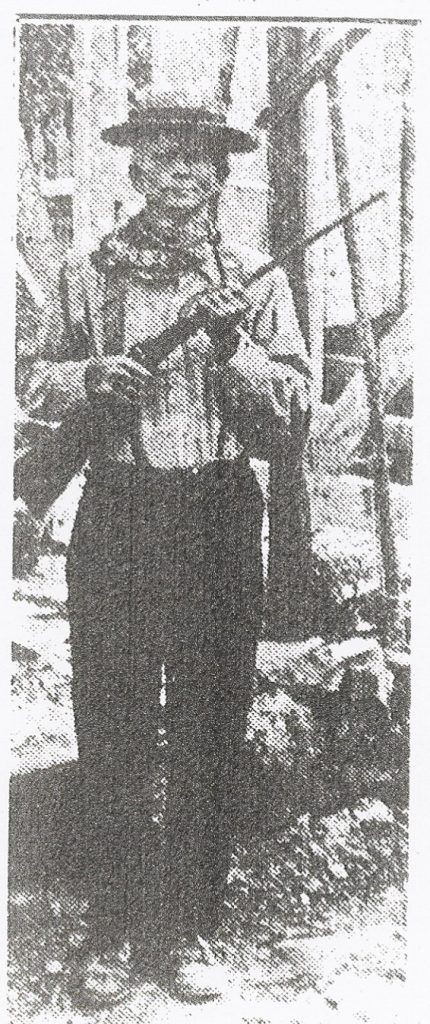
Chalmers Ferguson

Raised to young adulthood, he joined Teddy Roosevelt and the rough-riders and was eventually shipped to Cuba and was said to have been present at San Juan hill. One of the first battles to employ modern weaponry such as the machine gun, the carnage and bloodshed during the battles further alienated young Chalmers who was serving as a band member and medic.

Seeking escape from a society he rejected, the arrived at the Blue Mountain train station. Dressed with his always present bandana around his neck, decked out in a green vest, and with a gold-braided bandsman hat tilted on his head, he looked more a product of the 60’s hippie generation than a turn-of-the century farmer.

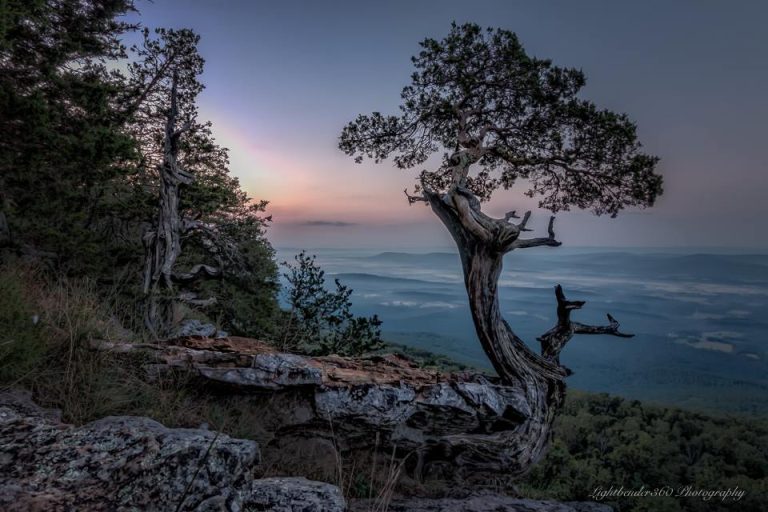
Seeking solitude, Ferguson settled in a small cover under the rim of the western cliffs of Magazine mountain. Building a small three room house, he settled into the life of a hermit. He made friends of many varieties of wildlife found on the mountain, the most unusual being his friendship with snakes. Kept in his house, he described how he handled the serpents, “In making friends with snakes, I pick it up with a stick. I never touch it unless looking it in the eye.” Snakes strike at man only when they fear him. Its fear of each other that makes us enemies.” Fearing he would roll over on his snake friends at night and provoke attack, Chalmers built a coffin-like container in which he slept at night.

Left alone in the solitude, he would compose long poems, often about the beauty and solitude of the place he called home. Haunting and beautiful, the poems often mentioned thoughts of his mother and evoke feelings akin to reading the poetry of Edger Allen Poe.

The poem, To My Mother, begins: “Betrayed and outcast and forsaken, You were laid in an untimely grave. No eye nor no voice to take pity, No arm stretched to succor or save. But you rose in your chrysalis beauty, Bejeweled as heaven’s own bride; And I welcome the whispering message, That will summon my soul to your side.”

Hearing of his poems, John P. Cravens of the Arkansas Democrat traveled by train to Blue Mountain, hiked four miles up the mountain, and visited with Ferguson. He described Chalmers as a man of great intellect- one who spoke at least three languages, wrote poetry, created professional artistic work, and could discuss history and politics in detail. The man could play several instruments, wan an expert on dynamite, land surveying, carpentry, and photography.

During subsequent years, Cravens and the Arkansas Democrat published many of Chalmers poems. Often these were picked up by other news sources and Chalmers became widely known as the Hermit Poet of Magazine Mountain.

As the years went by, Ferguson gradually turned to human companionship. Building a small home in Blue Mountain, he started staying in town for longer and longer periods of time. Many of his poems speak of his primary love; birds, flowers, and most of all little children. Eventually, this intellectual, talented man began assisting and teaching in the local schools.

Ferguson died in 1934 and is buried in Danville, Illinois. His true legacy was and remains his years served as the hermit poet of Magazine Mountain.

Logan County’s Tanner Reed Named Iowa Reserve Grand Champion

DES MOINES, IA- Tanner Reed of Logan County was recently named as the Reserve Grand Champion at the AJSA Jr. National Show in Des Moines, Iowa. In doing so, his award ranked him second nationally. Reed’s award was in the fullblood Fleckvieh Heifer category.

The show consisted of Simmental cattle from 37 states represented and over 1200 head of cattle. Tanner competed in competitions related to the cattle industry. The competition lasted five days before Tanner was awarded the Reserve Grand Champion Fullblood Simmental Heifer.

Tanner began the project back in December and decided that he wanted to show on a national level. He has done very well. The Heifer’s name is Augusta, and she is a 16-month-old Fullblood Simmental. She was born on TCBO Farms owned by Terry and Cindy Bowman.

Augusta also placed third overall Fullblood at the south central regional in Springfield, Missouri back in June. The Reeds are looking to finish up the season with both county fairs along with stops in Fort Smith, Little Rock and Fayetteville.

Tanner is a member of the American Junior Simmental Association and the American Simmental Association. Reed is also a member of the County Line FFA show team and a member of the Arkansas Junior Cattleman’s association.

RNN Sports congratulates Tanner Reed and the entire Reed family on this great honor!

Image Special to RNN Sports / Michael Reed

Note to Our Readers: RNN Sports would like to thank Mr. Michael Reed for his contributions to this story.

Nonresident hunters should check twice for new permits when renewing licenses

Randy Zellers Assistant Chief of Communications

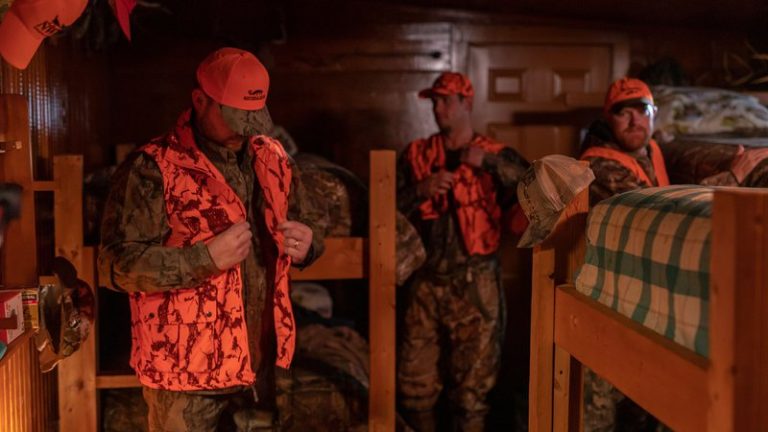
Every July, many Arkansas hunters make it a point to renew their hunting licenses to ensure they’re legal and ready for the next year of enjoying all The Natural State has to offer. This year, nonresidents also may have to purchase a few additional permits if they plan to engage in a few of the state’s calling card hunts. 

Nonresident hunters will still be able to take a full limit of six white-tailed deer and enjoy small game hunting with the Nonresident Annual Hunting License as before, but additional permits, much like the Nonresident Arkansas Waterfowl Stamp, will be required for bear, turkey, elk and alligator beginning this year. Nonresident temporary licenses now only apply to either deer or small game, depending upon the license type. A nonresident wishing to pursue deer with dogs in Arkansas also will have to purchase a special permit. In addition to this, most existing nonresident licenses saw slight price increases.

The nonresident license restructure is part of a change to bring Arkansas’s hunting licenses up to par with recent increases in inflation and license formats of neighboring states. According to market research, Arkansas’s nonresident license prices were near the bottom of the nation’s, especially for hunters pursuing some highly sought  species like turkey, bear, elk and alligator. 

The new license and permit structure is as follows: 

Fishing Licenses:

  • Nonresident Annual Fishing License – $60                  
  • Nonresident 3-Day Trip Fishing License – $30
  • Nonresident Guide License/Fishing – $500
  • Nonresident Trout Permit (must accompany valid fishing license) — $20 (no change)

Hunting Licenses:

  • Nonresident Annual Hunting License (includes up to six deer and small game) – $410
  • Nonresident 5-Day Hunting License (includes up to two deer) – $225
  • Nonresident 3-Day Deer Hunting License (includes one deer) – $175
  • Nonresident 1-Day Deer Hunting License (includes one deer) – $100
  • Nonresident Hunting Dog Permit (required to use dogs to hunt, chase or retrieve deer or to train a dog for such purposes)- $20
  • Nonresident Annual Small Game Hunting License – $110 (no change)
  • Nonresident 5-Day Small Game Hunting License – $80
  • Nonresident Trappers Permit – $125 (no change)
  • Nonresident Bear Permit (must accompany valid Nonresident Annual Hunting License) – $300
  • Nonresident Turkey Permit (must accompany valid Nonresident Annual Hunting License) – $100 each, limit two permits per year
  • Nonresident Elk Permit (must accompany valid Nonresident Annual Hunting License) – $300
  • Nonresident Alligator Permit (must accompany valid Nonresident Annual Hunting License) – $300
  • Arkansas Nonresident Waterfowl Stamp (must accompany any valid nonresident hunting license) – $50
  • Nonresident 5-Day WMA Waterfowl Hunting Permit (Must accompany any valid nonresident hunting license and Arkansas Nonresident Waterfowl Stamp) – $40

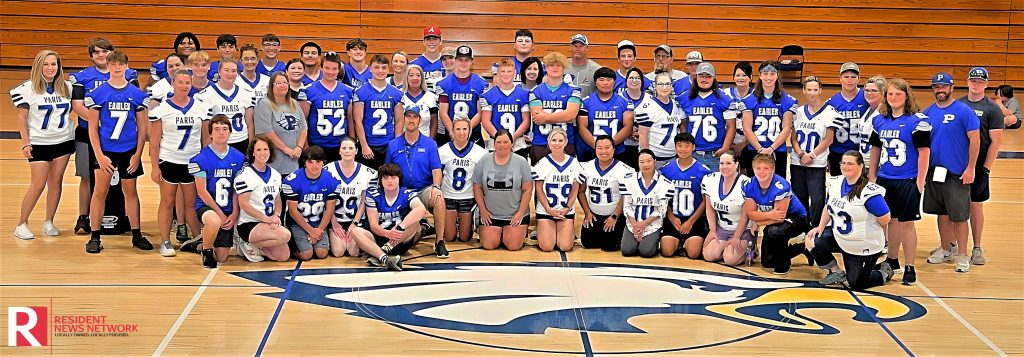
Paris Football’s “Moms 101” Proves Again to be a Big Hit

PARIS- Paris head football coach Jeff Weaver has had a big influence on the Eagles’ football program. His approach of not only being a good football coach but also one of teaching good personal values to his players will always make him a success in the eyes of many of the Eagles football fans.

But perhaps one of the most popular elements of his program that he has brought to Paris has been the “Moms 101” program. Coach Weaver uses this fun event that is enjoyed by his players and their moms every summer to help his players continue to appreciate their mothers’ influence in their lives, as well as to teach them how to respect women and others around them.

Weaver and the Paris football staff take the moms through various drills, individual skills, and even running plays and having fun competitions. But the most poignant moment of each year’s event is when he has the players sit around the Paris coach with their moms to listen to his thoughts on how the players should love and appreciate their families. And most of all, Coach Weaver defines success for his players by telling them in the presence of their moms that not only do they want to win on the field, but he wants them to grow into good men, husbands, and fathers.

“Moms 101” made its debut at Paris in Weaver’s first season in 2021. That year, the event was held outdoors at Eagles Stadium. For the second consecutive season, the event was moved indoors due to excessive heat. Temperatures on the day of the event eclipsed 103 degrees, and at the time of the event, the muggy Paris air was still as high as 96 degrees.

“Moms 101” features mothers and players of Paris football players that will be entering the 9th through 12th grades each season.

“Moms 101” Class #3 (RNN Sports Photo / Jim Best)