
75.2 F
Fort Smith
Wednesday, June 24, 2026
Home Blog Page 269

Presence of blight pathogen confirmed in Arkansas pine trees

By Nick Kordsmeier
U of A System Division of Agriculture

For months, foresters and researchers have been investigating reports of ailing pine trees in Arkansas. New diagnostic lab results help tell part of the story, but researchers are continuing to investigate the cases of loblolly pine decline.

Michael Blazier, director of the Arkansas Forest Resources Center, said that diagnostic results from pine tree samples sent to Auburn University this spring tested positive for the fungal disease brown spot needle blight. Blazier is also dean of the College of Forestry, Agriculture and Natural Resources at the University of Arkansas at Monticello.

While brown spot hasn’t typically been a disease of concern for Arkansas’ predominant pine tree species, the loblolly pine, Blazier said that several years of higher-than-usual levels of rain created perfect climatic conditions for spreading the disease.

Loblolly pine is the most economically significant tree species in the state’s approximately $6 billion forest economy, Blazier said.

“It’s been present more along the Gulf Coast in a different species of pine,” he said, referring to longleaf pine trees. But parts of Arkansas have gotten 200 to 250 percent of average precipitation during the winter-spring period in recent years — perfect conditions for growing fungal inoculum that could spread to loblolly pine trees.

“The prevailing suspicion here is that climatic conditions have been ripe enough for growing enough of it that it would jump over and affect another species,” he said. “Once it had a toehold there, it just kind of feeds itself, and it seems to be spreading across the Southeast.”

The lab results indicating brown spot needle blight are helpful but don’t tell the whole story, said Vic Ford, associate vice president of agriculture and natural resources for the Arkansas Cooperative Extension Service, the outreach arm of the University of Arkansas System Division of Agriculture.

“It tells us that it may be a factor in some locations,” he said. “There are locations with dying trees that don’t have it, and locations with dying trees that have it.”

Ford said that the effects of tree stressors tend to compound each other. For example, he said, trees that grow in wet conditions, like those experienced in recent Arkansas winters and springs, put fewer roots down. When dry conditions follow, fewer roots mean less water intake. The reduced water triggers the tree’s stress mechanism, which includes the production of an aromatic compound called terpenes, which attract insects that further stress the tree.

“Mortality is a function of a lot of things,” Ford said. “There are compounding factors.”

Blazier noted that the diagnostic chemical analyses turned up one other disease — needle cast — and were inconclusive concerning the presence of herbicides.

How did we get here?

Blazier said that forestry consultants first began contacting him this spring, reporting an uptick in dying pine trees in their stands.

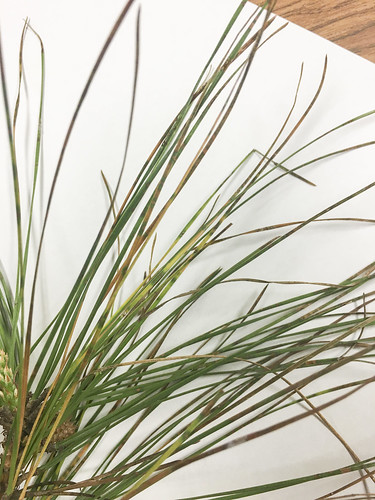
“They first brought to me some samples that looked like they had some sort of ailment to it. You could see brown striping on a lot of the needles,” he said.

Blazier explained that pine trees have two sets of needles — older needles from the previous year’s growth and new needles from the current year. Initially, the disease was only affecting the older needles.

“It was the prior year’s needles that were infected at first, and they would brown out and then fall off, so the tree’s kind of left with this ‘Charlie Brown Christmas tree look,’ to borrow an expression from a forester who’s been investigating the forest health problems of eastern Arkansas.”

Soon, when it came time to harvest timber, the forestry consultants noticed that the disease had jumped to the newer needles as well.

“That coincided with an uptick in pine cone production,” Blazier said. “That’s a tell-tale sign that the tree has been triggered to understand that it’s about to die, so it needs to propagate its genetics before it shuffles off the mortal coil.”

Blazier shared photos of the disease with a colleague at Auburn University, Lori Eckhardt, professor and director of the Auburn Forest Health Cooperative. Eckhardt told Blazier the symptoms looked similar to those attributed to brown spot needle blight in Alabama since 2018.

A team of researchers and forestry experts is working to tackle the problem, Blazier said. The team includes members of the Forestry Division of the Arkansas Department of Agriculture, the Arkansas Forestry Association, and the Arkansas Forest Resources Center, which is headquartered at the University of Arkansas at Monticello and conducts research and extension activities through the Arkansas Agricultural Experiment Station and the Cooperative Extension Service, the Division of Agriculture’s research and outreach arms.

Searching for more answers

Blazier said that moving forward, the team is casting a wider net to determine the extent of tree health decline.

“We’re trying to accelerate that pace by using the better technologies of aerial photography and machine learning that help target us a bit better on where we’re sampling and trying to make inferences about where it can be,” Blazier said.

Continued sampling is also part of the plan, he said.

“We plan to continue that through this fall and resume it, starting in February next year, and doing it on a monthly schedule through the summer period,” he said. “By then, we will have had a full year’s worth of seasonal sampling.

“We’re also monitoring the areas that we know have been infested with it to see how those forests will continue to progress,” Blazier said. “There’s some evidence that forests will outgrow it.”

While the trees may display symptoms of pine decline for a time, they may be able to fight it off, he said. “That’s room for hope.”

Sound management is the best policy

Blazier said the evidence so far suggests no need to panic. Instead, he recommends a proactive approach to managing loblolly pine stands.

“Sound management is always the best policy for resiliency against any kind of stressor,” Blazier said. “We don’t want to give up on continuing to manage.”

“It’s not like a wildfire that’s coming across the state fast,” Ford said. “It’s not killing large swaths.

“Hold tight, manage for a healthy stand. In other words, don’t let it get too thick, plant at the right density and those kinds of things,” he said. “You should be able to have a very hard, strong, vigorous stand,” he said.

“If it is going to be a problem, we’re trying to get ahead of it,” Ford said.

In the meantime, experts in Arkansas and across the southeastern U.S. are working to better understand management practices that specifically help mitigate the current instances of pine decline.

“The other thing we’re trying to do is working with industry and these other universities to look for patterns, and where it has been more prevalent, and where it hasn’t been, and trying to understand if there are management strategies that were conducted in some stands that made them less susceptible to it,” Blazier said.

Blazier said that representatives from across the U.S. are gathering at a multi-state meeting in Alabama next month to discuss research efforts on brown spot needle blight in loblolly pine trees.

Homeowners beware

Ford said that if owners of pine trees near homes or other structures observe pine decline symptoms, they should consider taking the tree down.

“A dead tree overhanging your house or access is dangerous,” he said. Ford recommended that tree owners contact their local county extension agent to help them determine the best path forward.

To learn more about Division of Agriculture research, visit the Arkansas Agricultural Experiment Station website: https://aaes.uada.edu/. Follow us on Twitter at @ArkAgResearch. To learn about extension programs in Arkansas, contact your local Cooperative Extension Service agent or visit www.uaex.uada.edu. Follow us on Twitter and Instagram at @AR_Extension. To learn more about the Division of Agriculture, visit https://uada.edu/. Follow us on Twitter at @AgInArk.

Lady Eagles Volleyball Senior Abbi Walker Ready to Lead Paris to the State Playoffs

PARIS- The Lady Eagles volleyball tradition is a championship legacy. One that was built by several years of volleyball seniors who led their teams to state playoffs and championship game appearances. For everyone involved, it is fun to win and to be in playoff contention every season. But for this year’s seniors, like setter Abbi Walker, there is a pressure of high expectations to perform at their best individually, as well as a team.

The Lady Eagles made another state tournament appearance in 2022, losing in the quarterfinals to the eventual Class 3A champion, Little Rock Baptist Prep. Gone from the 2022 team are both seniors and a junior transfer, leaving this year’s team with just a few seniors, but with a group of talented juniors who received significant playing time last year.

One of those seniors is Abbi Walker, a setter and defensive specialist for the Lady Eagles. Last week, RNN Sports had the opportunity to visit with Abbi to get her thoughts on the upcoming season and the challenges and opportunities that await the Paris Lady Eagles. It will no doubt be a challenging season for Paris. The Hackett Lady Hornets will once again be the pick to win the 3A West, and in this year’s schedule, Paris will travel to Hackett very early in the season to face the 3A state finalists from 2022.

But with challenges come opportunities for success, and there is no doubt that this year’s Lady Eagles team will work hard and do everything they can do to uphold the championship legacy of Paris volleyball.

So, when Abbi and I began her interview, I asked her about the feeling of pressure in leading the team back to the playoffs. Abbi began by saying, “Definitely; there is always pressure but it is how you deal with the pressure. Our team does really well with not putting the pressure on just one person…we all take time with the pressure. Like if I am down, someone else steps up, and we go back and forth with that. We have been really good with communication and all of that. The pressure isn’t just on me, but we all have an equal amount of pressure going into the season. In the past we have put that pressure on just one person, and it has taken a toll. But this year, we have all shared the pressure.”

Abbi Walker (17) prepares to serve at Little Rock Episcopal in 2022 (RNN Sports File Photo / Jim Best)

The 2023 summer offseason has been productive for the Lady Eagles. In fact, Abbi believes they have “turned the corner” in the last month. She said, “It has definitely been a broken approach over the summer. You come into the summer, and everyone is everywhere; there’s cheer, basketball, softball, and all kinds of camps everywhere. But this last camp that we had at 501 really showed us what we could do. It was in the silver bracket, and it all came together in the last game, and it was amazing just to see what everyone can do under just that little bit of pressure. In the last match, we won the first set, lost the second, and came back to win the third by two points. It really showed what our serving can do under pressure, and it was amazing.”

With the summer team camps opportunities, the young talent of the Lady Eagles has begun to rise up to the level that they are capable of playing at in the 2023 season. I asked Abbi if this is the case or is it a matter of the team starting to bond and play together. She answered by saying, “Yes, that was the highest our team has finished this summer. And it all started with the Branson (MO) camp this summer. We really got to know each other and see the different personalities, and you have to see what the differences are and who can take the pressure. There are some younger players now that aren’t able to take the pressure right now, and you have to find out a way to talk to them under this type of pressure. You have to find out the different ways they need to be talked to for sure.”

As a senior, I asked Abbi about her perceived leadership style. She described it as, “I definitely like to be encouraging, because if you, and we learned at camp this summer, you definitely can’t get “into peoples’ faces.” It really went downhill, really fast. We ended up losing a game pretty badly, because we were just into each other’s faces, and it did not go well. So, we have learned that we have to be encouraging toward each other to win games. It’s very important that we encourage each other instead of bringing each other down. And there are sometimes where some older players that have to say, “Come on, let’s get it together.” But there are some different personalities on this team, and you can’t do that very often. So, being encouraging is the most important part.”

Listening to Abbi, it appears that the Branson team camp experience gave the team a chance to filter out the team chemistry and how the seniors would lead the team.

Part of the many changes for this year’s team will be the addition of a new head coach. Coach Jordan Devine has retired from the coaching part of her position with the Paris Schools. Taking the reins for the program is Josh Hart, who was promoted after serving as the program’s junior high coach. I asked Abbi about Coach Hart’s influence on the team so far, and she responded by saying, “I think he (Coach Hart) is kind of letting us figure our problems out. He doesn’t step in and show us how to do things. If we are down, he is encouraging, and he is an energy source for the team, for sure. If there is any kind of swing, kill, or play, he is all there. He is louder than the entire team when it comes down. He is really into it. He is very encouraging, and it is just fun to play and to let us figure things out. He doesn’t want to make us figure things out; he wants to help us figure things out.”

Abbi perceives her role as a senior on this year’s team as “being an encouraging person; I want to make sure that everyone is comfortable with what they are doing. Because some of the younger players need to accept the role they are in, and you (Abbi as a senior) you have to do your best to make sure that they are prepared. And I think that is where we are at right now. Making sure that everyone is ready, and everyone knows what their role is on this team.”

The team is making good progress toward being ready to start the season on August 22. I asked Abbi how she thought the team’s progress this summer at this point compared to where they were a year ago. Abbi shared, “I think our front row this year is going to be a big thing for us. Last year, we depended on our outsides and our middle (hitters), and this year, we have a lot more coming from the right side. We are able to use both ends and middle, which is really nice as a setter because we can spread things out, and they are not just going to cheat to our outside. It’s really good as a setter to be able to go to that right side.”

The development of this year’s front line has made a lot of progress as they look forward to the August 22 opener at Russellville. Abbi said, “For sure. Tons and tons of progress has been made on the front row. And that all also comes from our passing; I think our passing has improved tremendously. Since the last camp, things have improved and are seeming to all come together.”

Abbi will once again be a setter and a defensive specialist on the 2023 team. As a setter, she is the “quarterback” of the offense, making split-second decisions on where to set the ball based upon the defense and the position of her team’s front row hitters. Abbi explained, “Yes, the setter runs the offense, and our libero runs the defense. I definitely have to see the other side of the net to see where the opposing team is moving at the time, and then I have to see who is ready on my side of the court (front line hitters) to receive the ball.” All of this is taking place in a split-second, and to the casual fan, it can be easily lost how difficult the setter position is, and how important the position is to the overall success of the offense. In my observation over the years, and in listening to Abbi analyze the position, Paris will be in very good hands this season with this crucial position and its effect on the Lady Eagles’ success.

As a senior, Abbi will be carrying this very important responsibility for the Lady Eagles. In her words, “If there is anything going wrong (volleys in a game), it is the setter’s responsibility to fix it.” She shared openly that as a younger player, the responsibility and pressure got to her. But throughout her own personal development going into her senior year, she feels prepared and ready to meet this important responsibility head on.

Looking ahead to the start of the 2023 season, Paris will once again play a very tough non-conference schedule that will include an early start to the 3A West conference schedule. And part of that early conference schedule will include a trip to Hackett to play a very tough Lady Hornets team on their home floor on August 31, just nine days into the season. I asked Abbi for her thoughts on the schedule, in particular the early days of the schedule leading into Labor Day weekend. She shared, “Our schedule is very much compressed, that is for sure. We have two to three games per week, and we are used to two games per week. But I think it is going to show us how much we can do and how much we can mentally put ourselves through. And I think having Hackett right out of the summer will be really good. We will have our team chemistry and team strong after the so many weeks we have had preparing ourselves for those games.”

The Lady Eagles open at Russellville on August 22 and will then travel to Little Rock Pulaski Academy on August 24. Paris will open 3A West conference play on August 29 vs. Charleston and will then go back on the road to play the defending 2022 3A state finalists, Hackett Lady Hornets, on August 31. Quite a daunting schedule for the young Lady Eagles, but an opportunity to play some important games early and perhaps see the schedule flip in their favor in the finals weeks of the season heading toward the district tournament and the state playoff.

We would like to thank Abbi for taking time to contribute her interview for this story. As the season unfolds, RNN Sports will follow-up with her and other members of the team. Abbi is talking with college recruiters, and we will bring you updates on future opportunities that may be coming her way, as well.

RNN Sports will be in Russellville on August 22 to bring you the action in pictures, both online and in social media, but in RNN’s Logan / Franklin Counties weekly newspaper. And we will be there all season long to bring you the best coverage of River Valley volleyball action.

So, if you have not yet subscribed to Logan and Franklin Counties’ only weekly newspaper covering LOCAL news and sports, go to our link now so you can catch all of the action this season! Just go to residentnewsnetwork.com/subscribe to get the counties’ only weekly print newspaper, as well as our online digital media!

RNN Sports…the BEST high school sports coverage in the River Valley!

Grand Lodge Awards Prestigious College Scholarships

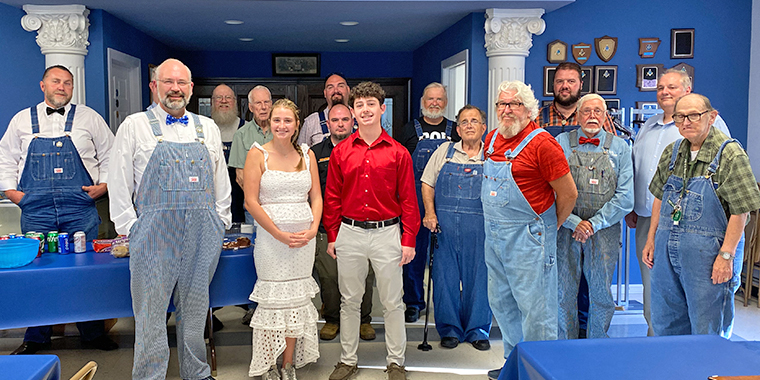
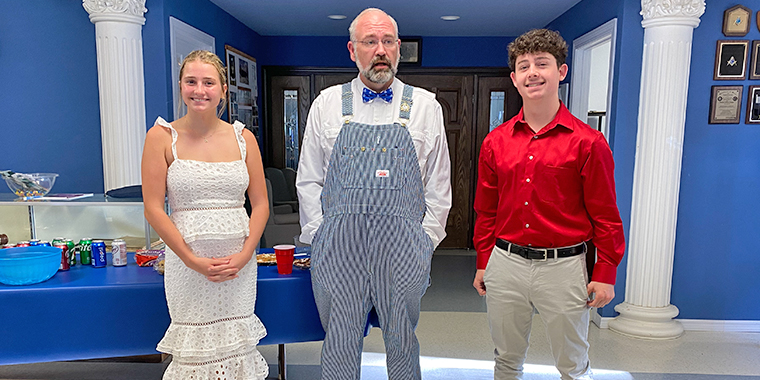
The Masonic Grand Lodge in Little Rock, Arkansas has awarded their annual Arkansas Grand Lodge Scholarship to Anna Claire Roberts, and Greyson Baggett.

On Tuesday, July 19, Neil Roberts introduced both recipients to members of Belle Point Lodge No. 20 in Fort Smith where they were recognized through an appreciation speech, and given time to extend their personal intent of the scholarship in their respective collegiate careers.

Belle Point Lodge No.20 Master Mason, Neil Roberts introduces Anna Claire Roberts, and Greyson Baggett to members.

Anna Claire Roberts is a 2023 Southside High School graduate, attending University of Arkansas majoring in Marketing, with future plans of Law School.

Greyson Baggett is a 2023 Mansfield High School graduate, attending University of Arkansas – Fort Smith majoring in Business & Marketing, with a focus on Sports Marketing.

Both recipients were two of nine finalists chosen for final interviews in May following the procedural guidelines, then ultimately granted the scholarships based on elements from the personal interview process and written essays.

The Arkansas Grand Lodge scholarship awards high school students pursuing their collegiate aspirations through undergraduate work, renewable each semester for up to eight semesters, where recipients must maintain a 2.5 GPA, and enrolled in at least 12 hours each semester.

The tradition of the masonic lodge, and the scholarship itself are both representative in not only the hopes of lodge members representing their community outreach through a lasting impact of youth and education, but to also pay it forward within future generations.

Man First Set Foot on the Moon: July 20, 1969

HOUSTON- July 1969. It’s a little over eight years since the flights of Gagarin and Shepard, followed quickly by President Kennedy’s challenge to put a man on the moon before the decade is out.

62288main_aldrin_ladder_full.jpg
Image Credit: Nasa.gov

Buzz Aldrin climbs down the Eagle’s ladder to the surface.

Credits: NASA


Now, on the morning of July 16, Apollo 11 astronauts Neil Armstrong, Buzz Aldrin and Michael Collins sit atop another Saturn V at Launch Complex 39A at the Kennedy Space Center. The three-stage 363-foot rocket will use its 7.5 million pounds of thrust to propel them into space and into history.

At 9:32 a.m. EDT, the engines fire and Apollo 11 clears the tower. About 12 minutes later, the crew is in Earth orbit. (› Play Audio)

After one and a half orbits, Apollo 11 gets a “go” for what mission controllers call “Translunar Injection” – in other words, it’s time to head for the moon. Three days later the crew is in lunar orbit. A day after that, Armstrong and Aldrin climb into the lunar module Eagle and begin the descent, while Collins orbits in the command module Columbia

Collins later writes that Eagle is “the weirdest looking contraption I have ever seen in the sky,” but it will prove its worth.

When it comes time to set Eagle down in the Sea of Tranquility, Armstrong improvises, manually piloting the ship past an area littered with boulders. During the final seconds of descent, Eagle’s computer is sounding alarms.

It turns out to be a simple case of the computer trying to do too many things at once, but as Aldrin will later point out, “unfortunately it came up when we did not want to be trying to solve these particular problems.”

When the lunar module lands at 4:17 p.m EDT, only 30 seconds of fuel remain. Armstrong radios “Houston, Tranquility Base here. The Eagle has landed.” Mission control erupts in celebration as the tension breaks, and a controller tells the crew “You got a bunch of guys about to turn blue, we’re breathing again.” (› Play Audio)

Armstrong will later confirm that landing was his biggest concern, saying “the unknowns were rampant,” and “there were just a thousand things to worry about.”

At 10:56 p.m. EDT Armstrong is ready to plant the first human foot on another world. With more than half a billion people watching on television, he climbs down the ladder and proclaims: “That’s one small step for a man, one giant leap for mankind.” (› Play Audio)

Aldrin joins him shortly, and offers a simple but powerful description of the lunar surface: “magnificent desolation.” They explore the surface for two and a half hours, collecting samples and taking photographs.

They leave behind an American flag, a patch honoring the fallen Apollo 1 crew, and a plaque on one of Eagle’s legs. It reads, “Here men from the planet Earth first set foot upon the moon. July 1969 A.D. We came in peace for all mankind.”

Armstrong and Aldrin blast off and dock with Collins in Columbia. Collins later says that “for the first time,” he “really felt that we were going to carry this thing off.”

The crew splashes down off Hawaii on July 24. Kennedy’s challenge has been met. Men from Earth have walked on the moon and returned safely home.

In an interview years later, Armstrong praises the “hundreds of thousands” of people behind the project. “Every guy that’s setting up the tests, cranking the torque wrench, and so on, is saying, man or woman, ‘If anything goes wrong here, it’s not going to be my fault.'” (› Read 2001 Interview, 172 Kb PDF)

In a post-flight press conference, Armstrong calls the flight “a beginning of a new age,” while Collins talks about future journeys to Mars.

Over the next three and a half years, 10 astronauts will follow in their footsteps. Gene Cernan, commander of the last Apollo mission leaves the lunar surface with these words: “We leave as we came and, God willing, as we shall return, with peace, and hope for all mankind.”


Note to Our Readers: The previous story was sourced directly and in its entirety from Nasa.gov

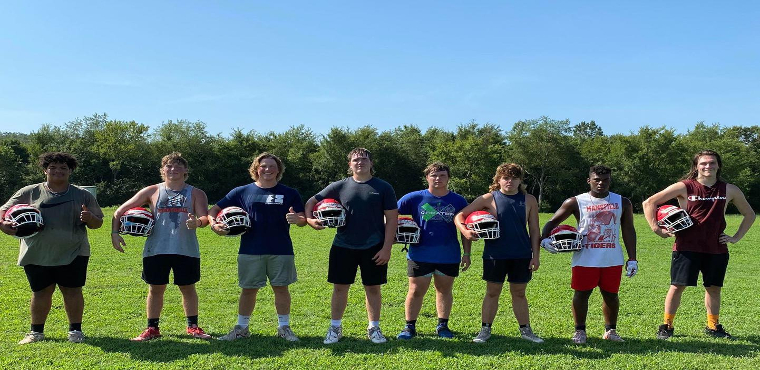
SR Tigers Linemen Soaking Up The Underdog Spotlight

The Mansfield Tigers boasted one of the most experienced lines on both sides of the ball in 2022. Mansfield was blessed with players who have spent their entire careers as starting linemen and that was a key factor in the Tigers 2022 success. Behind the wall of “Well Seasoned Beef” built by the likes of seniors John Broadaway, Kindel Noblitt, Braxton Byers, Austin Quinalty, and Caleb Collier, Mansfield was able to make their first State Playoff appearance since 2019. Those players are gone now though, and a younger group is stepping in. They say experience beats youth every time. Although that can be true on most occasions, people tend to forget that there’s only one way to obtain experience and that’s by getting on the field and earning it.

Coach Overton going over the Xs and Os with the offensive line.

Mansfield will start their 2023 season loaded to the brim with talented athletes on offense. But after losing all but one of their starting offensive linemen from last season, the question mark of moving the ball downfield consistently cannot be overlooked. True, Mansfield’s line will be undersized and inexperienced, but it’s not the size of the Tiger in the fight, it’s the fight in the Tiger that matters. Turner Wright will be the sole returner and only senior for the Tigers line in 2023. Of course, every wall needs a solid foundation and if you could pick one player to single handily hold up a freshly bricked wall, Wright would be the right choice. Wright was thrown into the fire as a starting offensive lineman for Mansfield’s senior high in the tenth grade and has obtained a wealth of knowledge and experience ever since then. Wright will not only be the leader of the group in both knowledge of the position and skills, but he’ll be leading younger versions of himself this season as well as the Tigers list of seven sophomore linemen also vying for starting positions on the line.

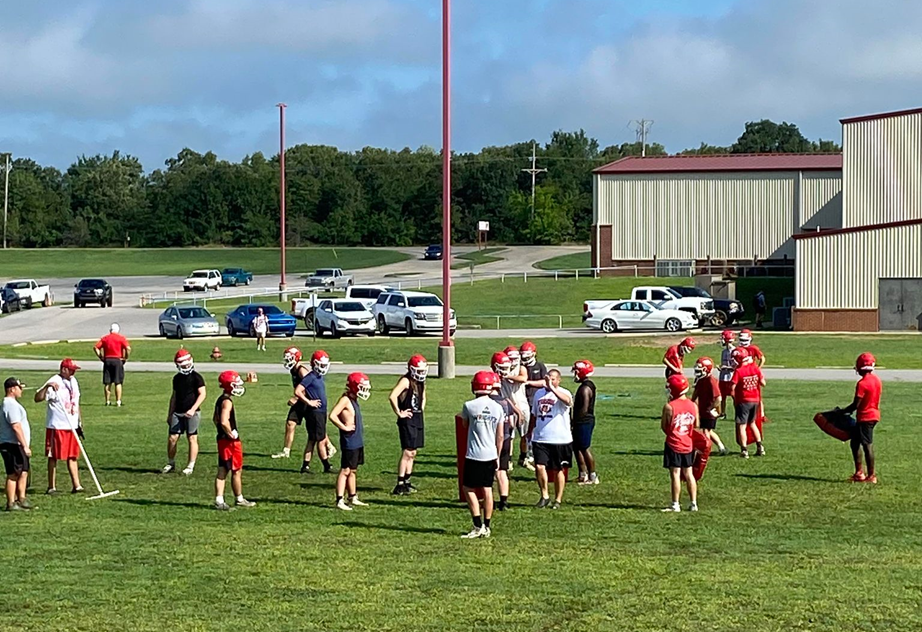
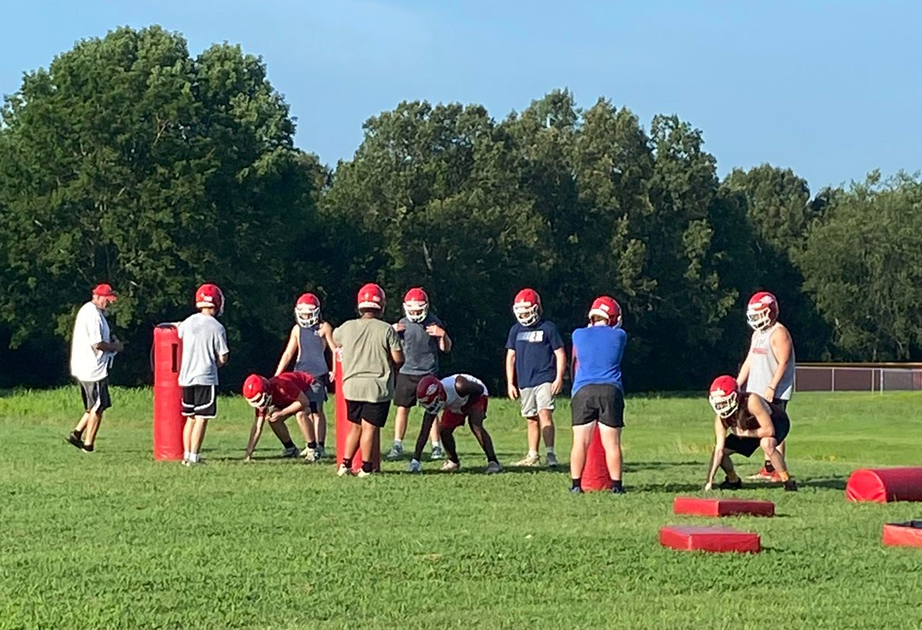
The Tigers getting through their drills to earn some fall thrills of victory.

Although the experience and leadership role will fall heavily on Wright, he’ll have some good help to handle the full weight of the line. Junior, Dakota Deer, has stepped up big time in the weight room and on the practice field this offseason to become a force to be reckoned with. Deer has spent most of his football career as a defensive nightmare for Mansfield’s opponents and has chosen to move across to the other side of the ball to assist in this time of need for the Tigers offense. Deer hasn’t played offense since junior high and will not bring much experience, but what he lacks in the experience department he makes up for tenfold with aggression and determination.

Mansfield lines up and stares down Danville in their Lavaca scrimmage.

Then there are the senior high rookies of the line. These greenhorns were the epitome of immovable force in little league and junior high, but as everyone knows, once you hit senior high the game goes to a whole new level. These aren’t just ordinary sophomores though. James “Critter” Bausley has started each game he’s been in since the second grade and has only bulked up in size and strength since then. Bausley has mostly played center in his offensive line career with a dangerous left and right hook at his disposal in the trenches. Those hook punches come from brothers and twins, Logan and Cadien Ore. The “Brothers of Destruction” have pummeled their way to the level of most of their upcoming opponents through sheer speed and strength. But the Tigers were still a few linemen short before the four horsemen of volunteers stepped up. Sophomores Ethan Martin, Pacen Strozier, Matt “Bear” Burton, and Zander Walters were all key in last season’s 8-2 record for the junior high team, but in positions other than linemen. Although they aren’t your typical linemen nor have the experience to lean on, these four definitely have the capability of producing results on the field this fall.  

The Tigers working on getting the small things perfect so they can make a big impact.

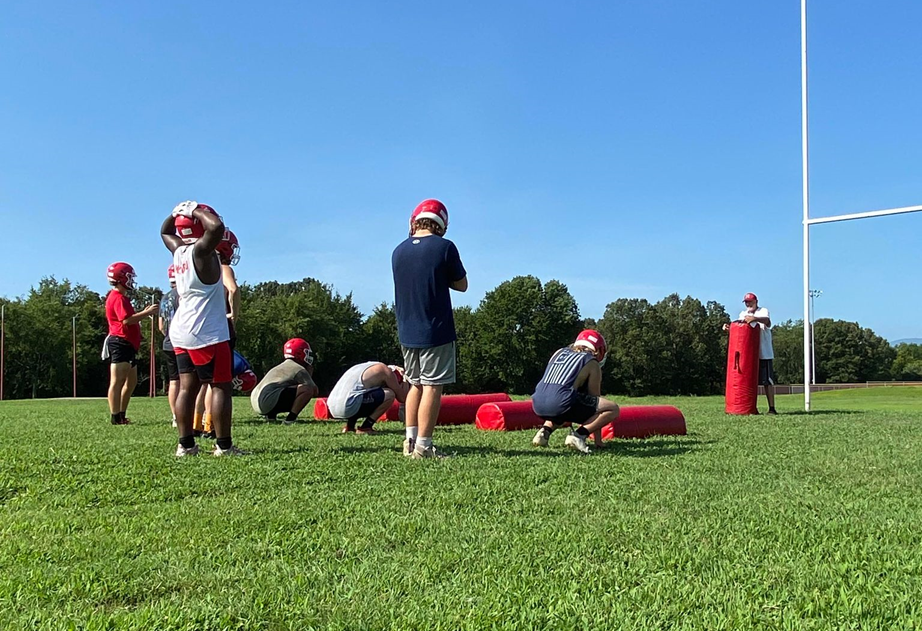
With all of the skilled players on Mansfield’s offense this season, protection will be key. A running back can’t hit the hole if there’s no hole present. A quarterback can’t complete a pass from his back. The Tigers and their coaching staff know this which is why they are making the linemen a priority in their practices. Coach Whit Overton has given veteran lineman coach, Keith Stovall, additional tools and personnel to assist in getting the Tigers linemen ready to go this fall. The players themselves are working on their footwork and their firing off, they’re watching film, and the group as a whole is even taking quizzes over their plays before practices.

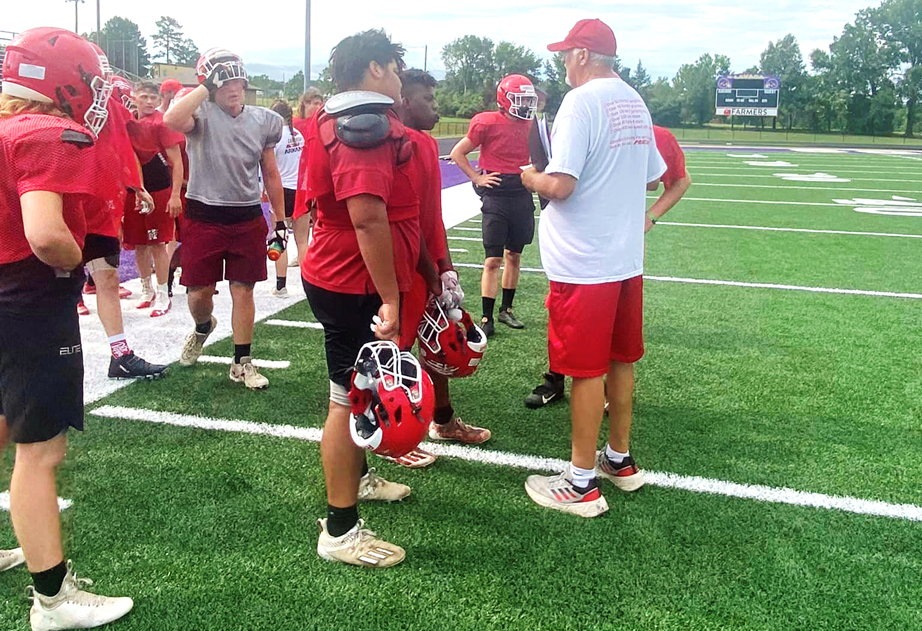
Mansfield linemen Coach, Keith Stovall, answering questions from his linemen at their recent Lavaca camp.

Of course, Mansfield’s linemen will continue to hear “you’re too small”, “you don’t have depth”, and “you don’t have the experience needed” from the naysayers, which is fine by them. The Tigers linemen know the void they must fill and that it is a massive task. But are they eager to prove that they’re up for the challenge? With Wright and Deer anchoring the offensive line and a hungry slew of underclassmen eager to jump in the trenches, Mansfield just might make up for their lack of size, depth, and experience at the lineman position this season. In fact, they’re counting on it!

Researchers trace ancestry of Arkansas honeybees to original ‘colonists’

By Fred Miller
U of A System Division of Agriculture

Editor’s note— This is the first in a series of three stories about research into the fascinating and agriculturally important world of bees. Today’s story is about a surprising discovery concerning the ancestry of Arkansas’ managed honeybee populations.

Honeybees in some areas of Arkansas have a direct, genetic link to the first European honeybees brought to America in the 17th century.

Allen Szalanski, professor and insect geneticist for the Arkansas Agricultural Experiment Station, said research to identify the distribution of pathogens in managed honeybee colonies throughout the state uncovered this hidden genetic history.

The Arkansas Agricultural Experiment Station is the research arm of the University of Arkansas System Division of Agriculture. Szalanski also has a teaching appointment in the Dale Bumpers College of Agricultural, Food and Life Sciences at the University of Arkansas.

Szalanski said the honeybees commonly used in managed colonies for pollination services and honey production are not native to North America. They were first imported from Europe in the 1600s by immigrants who treasured their honey and agricultural value. Those early honeybees, often called European dark honeybees or “German” honeybees, were darker in color than the more familiar, yellow-striped bees that are common today.

Entomologists call the ancestry of these European dark honeybees the “M” lineage, Szalanski said. They were the most common managed pollinators in the United States until the 19th century.

At that time, a Philadelphia-born clergyman and beekeeper named Lorenzo Lorraine Langstroth invented a modular beehive with moveable frames in which the bees build honeycombs. This construction, called a Langstroth hive, is still the most popular honeybee hive in use today by both professional and amateur beekeepers.

Langstroth, descended from Italian immigrants, preferred southern European honeybees, sometimes called Italian honeybees. He found them “gentler” and easier to manage than the German honeybees that were still common at that time.

While serving Congregationalist churches around Massachusetts, Langstroth studied the behavior of his bees and designed a revolutionary moveable frame hive based on a principle he termed the “bee space.” He published the results of his research in a book, “The Hive and the Honey-Bee,” which is still highly regarded by beekeepers.

Langstroth came to be known as the father of American beekeeping and through his influence, Szalanski said, the Italian, honeybee — part of what entomologists call the “C” lineage ± became the standard subspecies for beekeepers.

As the European dark honeybees became less desirable, Szalanski said, some of their colonies became feral, taking up residence in the wild. Szalanski said many beekeepers believed that, because they were no longer protected by managed beekeeping practices, those feral German honeybees would probably die out.

“Today, the queen breeders for managed colonies are nearly belong to the “C” lineage, familiar to observers as the yellow striped honeybees,” Szalanski said.

Arkansas has more than 3,800 registered beekeepers managing more than 61,000 honeybee colonies, according to the Arkansas Department of Agriculture. Most of the managed honeybee colonies in Arkansas are local “backyard” hives, Szalanski said.

Szalanski, while conducting a genetic survey of honeybees with former graduate student Dylan Cleary, found the genetic strain “M” lineage of those earlier European dark honeybees among numerous samples of “C” lineage honeybees.

Cleary, who graduated last year with a Ph.D. in entomology, sent collection kits to registered Arkansas beekeepers. She and Szalanski conducted genetic tests on the samples that were sent back.

“We received samples from 110 beekeepers around the state,” Szalanski said. “The samples represented 540 colonies from 47 counties.”

Their goal was to identify pathogens and parasites that infected managed honeybees in the state. But they also tested mitochondrial DNA from the bees to identify the maternal lineages, or matrilineal DNA. Mitochondrial DNA is handed down through the mother and is often used to track ancestry in animals and humans.

Szalanski said they identified four lineages in the Arkansas honeybees. The vast majority were the “C” lineage that includes the Italian honeybees.

They also found smaller numbers of “A” lineage, designating Africanized honebees, and “O” lineage, known as oriental honeybees. But the surprise was the discovery that some of those Arkansas bees had mitochondrial DNA from those earlier European dark honeybees that were the standard domesticated pollinators for 200 years.

Szalanski said this research will be published in the Journal of Apicultural Research later this year.

Szalanski believes the European dark honeybee lineage became part of managed honeybee colonies when beekeepers gathered a swarm — a bee mating behavior — from a feral colony into a hive.

“It can be difficult for a beekeeper to determine the source of a honeybee swarm,” Szalanski said. “It can be from their own or a neighbors managed colony, or from one that has been feral for a long time. We really don’t know how many feral colonies exist.”

“This research provides evidence that descendants of these ‘M’ lineage honeybees still exist in Arkansas,” Szalanski said.

Why European dark honeybee descendants still exist in Arkansas is a mystery. “Do they survive better in Arkansas’ climate?” Szalanski asked.

It’s not uncommon for some managed honeybee swarms to become established as feral colonies in hollow tree cavities or other favorable environments. But Szalanski said entomologists expected that feral European dark honeybees would be long gone, likely wiped out by Varroa mites, the most important parasite of domesticated bees.

“Descendants of these ‘M’ lineage honeybees are rare or non-existent in northern states, but not in Arkansas,” Szalanski said. “They may have become adapted to the environment in Arkansas. We need more study to understand why they exist here.”

To learn more about Division of Agriculture research, visit the Arkansas Agricultural Experiment Station website: https://aaes.uada.edu/. Follow us on Twitter at @ArkAgResearch and on Instagram at @ArkAgResearch. To learn more about the Division of Agriculture, visit https://uada.edu/. Follow us on Twitter at @AgInArk.

Local College Star Brings Camp to Waldron

The 2,775-point scorer, good for 6th all-time in state history, Payton Brown is returning to his old stomping grounds. The former Waldron guard is hosting a shooting academy inside the Waldron Activity Center on August 5th. “I’ve always been proud to be a Bulldog!” added Payton.

  His one-day shooting academy will focus on training, thinking, and practicing like a shooter. The two-time All-Lone Star Conference player will lead athletes through shooting break-downs, workouts, and a shooter’s mindset. In addition to Payton, staff members from the University of Arkansas Fort Smith men’s basketball team will also be in attendance to assist with individual skill development and showcase a college shooting workout.

This camp is open to all area athletes in 3rd through 12th grade. Pre-registration price is $50 per athlete or $55 on the day of. Registration is open at 9:30 am, with the camp running from 10 am to 4 pm. There will be concessions available and every camper will receive a shirt.

“Prioritizing basketball to the younger guys has always been important to me. Not everyone from these small communities gets the same opportunities and exposure that other places do. I just hope to pass a little knowledge on while having lots of fun at the same time!” It’s not every day that a talent like Payton Brown comes back to his hometown gym and opens a camp for the youth. Take advantage of this awesome opportunity!

Arrest Reports 7/9

Arresting agency – Fort Smith Police Department:
Mark Alan Balm of Booneville was booked into the Sebastian County Detention Center on July 11 at 2:30 p.m. and remains at the SCADC without bond. Balm was charged with ADC commitment hold, Obstructing Governmental Operations-info, Public Intoxication – Danger to self or other, absconding, and parole violation.

Jennifer Lynn Escoffier of Hackett was booked into the Sebastian County Detention Center on July 13 at 11 a.m. and released on bond July 13 at 7:43 p.m. Escoffier was charged with Contempt-willful disobedience (Failure to Pay Fine) and Driving While License Cancelled/Suspended/Revoked.

Mark Edward Sanders of Lavaca was booked into the Sebastian County Detention Center on July 9 at 10:16 p.m. and released on signature bond July 10 at 12:44 a.m. Sanders was charged with Contempt-willful disobedience (Failure to Pay Fine).

Richard Aarron Schafer of Waldron was booked into the Sebastian County Detention Center on July 11 at 7:57 a.m. and released on legally sufficient bond July 11 at 4:17 p.m. Schafer was charged with Driving While Intoxicated 1st Offense, Driving While License Cancelled/Suspended/Revoked, and Refusal To Submit To a Chemical Test-adult.

Arresting agency – Sebastian County Sheriff’s Office:
Jeremiah Thomas Dupree of Booneville was booked into the Sebastian County Detention Center on July 11 at 9:46 p.m. and remains at the SCADC without bond. Dupree was charged with failure to appear – class C felony.

Nicholas Heath Franklin of Greenwood was booked into the Sebastian County Detention Center on July 12 at 8:58 p.m. and remains at the SCADC. Franklin was charged with two counts of surrender off bond.

Terry Ross Moore of Greenwood was booked into the Sebastian County Detention Center on July 14 at 12:04 p.m. and remains at the SCADC without bond. Moore was charged with ADC commitment hold.

Soulykone May Phonlasouk of Booneville was booked into the Sebastian County Detention Center on July 9 at 6:33 a.m. and released on legally sufficient bond July 9 at 1:11 p.m. Phonlasouk was charged with Refusal To Submit To a Chemical Test-adult and Driving While Intoxicated 1st Offense.

Tammy Irene Roberts of Booneville was booked into the Sebastian County Detention Center on July 9 at 2:33 p.m. and released on cash bond July 10 at 4:10 p.m. Roberts was charged with petition to revoke – felony.

Alexander Leon Wyrick of Greenwood was booked into the Sebastian County Detention Center July 12 at 5:41 p.m. and released on cash bond July 12 at 9:33 p.m. Wyrick was charged with Failure to Appear – Class C Felony.

Arresting agency – Arkansas State Police Troop H:
Sherry Elliott of Ratcliff was booked into the Sebastian County Detention Center on July 15 at 9:29 p.m. and released on legally sufficient bond July 16 at 2:38 a.m. Elliott was charged with driving while intoxicated – 1st offense.

Ronnie James Freeman of Greenwood was booked into the Sebastian County Detention Center on July 9 at 2:12 a.m. and remains at the SCADC without bond. Freeman was charged with petition to revoke – felony, ADC commitment hold, assist outside agency – misd., parole violation, Violation of Restricted Driver’s License, Driving While License Cancelled/Suspended/Revoked, leaving the scene of an accident – property damage, Reckless Driving 1st Offense, and driving while intoxicated – 4th offense.

Arresting agency – Lavaca Police Department:
Daniel Joseph Hartfield of Lavaca was booked into the Sebastian County Detention Center on July 11 at 8:53 a.m. and released on legally sufficient bond July 11 at 11:36 a.m. Hartfield was charged with Assault On Family Or Household Member-2nd Degree.

Ralph Jones of Charleston was booked into the Sebastian County Detention Center on July 12 at 3 a.m. and released on cash bond July 12 at 3:44 a.m. Jones was charged with Contempt of Court–(child support), FTAS, FTRespond Subpoena, FTComply WCO.

Julieanna Genevieve Stubblefield of Lavaca was booked into the Sebastian County Detention Center on July 11 at 9:25 a.m. and released on legally sufficient bond July 12 at 7:56 p.m. Stubblefield was charged with Assault On Family Or Household Member-2nd Degree.

Arresting agency – Huntington Police Department:
Tommy Dean Hudson was booked into the Sebastian County Detention Center on July 10 at 4:43 p.m. and remains at the SCADC. Hudson was charged with Failure to Comply with Reporting Requirements of the Sex and Child Offender Registration Act.

Arresting agency – Greenwood Police Department:
Rachel Nicole Kerr of Spiro, OK was booked into the Sebastian County Detention Center on July 14 at 1:44 a.m. and released on legally sufficient bond July 14 at 2:25 a.m. Kerr was charged with Domestic Battering in the Third Degree – Purposely.

Darrian Lamont Mays of Fort Smith was booked into the Sebastian County Detention Center on July 13 at 3:25 p.m. and released on legally sufficient bond July 13 at 11:01 p.m. Mays was charged with theft by receiving.

Arresting agency – Bonanza Police Department:
Rodney Brent Sirratt of Bonanza was booked into the Sebastian County Detention Center on July 11 at 6:40 p.m. and released on legally sufficient bond July 11 at 9:30 p.m. Sirratt was charged with aggravated assault.

Arresting agency – Franklin County Sheriff’s Office:
Eric Alan Figgins, 37 of Ozark, was booked into the Franklin County Detention Center on July 10 at 3:31 p.m. Figgins was charged with violation of no contact orders.

Jaquan Tashickia Criswell, 25 of Morrilton, was booked into the Franklin County Detention Center on July 11 at 6:04 a.m. Criswell was charged with simultaneous possession of drugs and firearms, tamper with physical evidence – obstruct prosecution/defense felony, possession of firearm by certain persons, and possession of SCH VI with purpose to deliver GT 4 oz. but LT 25 lbs.

Christopher Eason, 25 of Conway, was booked into the Franklin County Detention Center on July 11 at 6:43 a.m. Eason was charged with simultaneous possession of drugs and firearms, fleeing by vehicle, fleeing – on foot, possession of SCH VI with purpose to deliver GT 4 oz. but LT 25 lbs., failure to obey traffic control device, reckless driving, and driving while license suspended.

Kelly Renee Eveld, 46 of Ozark, was booked into the Franklin County Detention Center on July 14 at 12:11 p.m. Eveld was charged with two counts of failure to appear on unclassified misdemeanor (FTA).

Arresting agency – Logan County Sheriff’s Office:
Miguel Rodriguez, 32 of Paris, was booked into the Logan County Detention Center on July 9 at 9:48 a.m. Rodriguez was charged with battery in the second degree.

John Harris, 40 of Paris, was booked into the Logan County Detention Center on July 9 at 10:19 a.m. Harris was charged with aggravated assault, and terroristic threatening in the first degree.

Blaine Duvall, 26 of Scranton, was booked into the Logan County Detention Center on July 9 at 4:28 p.m. Duvall was charged with domestic battering in the second degree.

Alisa Scates, 38 of Booneville, was booked into the Logan County Detention Center on July 10 at 4:41 p.m. Scates was charged with domestic battering in the third degree, and disorderly conduct.

Timothy Robertson, 36 of Mena, was booked into the Logan County Detention Center on July 12 at 3:59 p.m. Robertson was charged with parole hold.

Randell Gray Dakota, 32 of Booneville, was booked into the Logan County Detention Center on July 13 at 2:55 a.m. Dakota was charged with unauthorized use of a vehicle.

Desirae Newman, 31 of Paris, was booked into the Logan County Detention Center on July 13 at 3:17 a.m. Newman was charged with failure to appear, and bond revocation.

Alexander Mason, 24 of Booneville, was booked into the Logan County Detention Center on July 13 at 5:32 p.m. Mason was charged with failure to pay.

Jason Dill, 45 of Fort Smith, was booked into the Logan County Detention Center on July 13 at 7:07 p.m. Dill was charged with failure to appear.

Allen Miner, 27 of Paris, was booked into the Logan County Detention Center on July 13 at 10:06 p.m. Miner was charged with body attachment, and possession of drug paraphernalia.

Dalton Martin, 29 of Magazine, was booked into the Logan County Detention Center on July 14 at 11:52 p.m. Martin was charged with failure to use a turn signal, possession of a controlled substance, simultaneous possession of drugs and firearms.

Robert Baker, 47, was booked into the Logan County Detention Center on July 14 at 8:35 p.m. Baker was charged with domestic battering in the third degree, and driving while driver’s license cancelled, suspended or revoked.

Mary Austin, 66 of Dardanelle, was booked into the Logan County Detention Center on July 15 at 8:45 p.m. Austin was charged with failure to appear.

**The charges against those arrested are allegations and the cases are still pending in the courts.**

Obituary –Lois Ailene (Vassar) DuCharme (1935-2023)

Lois Ailene (Vassar) DuCharme, 87, of Waldron, Arkansas went to be with her Lord and Savior, Sunday, July 16, 2023 at her home surrounded by her loving family. Lois was born October 18, 1935 to Volney Vassar and Lillian (Nelson) Vassar in Florence, Wisconsin. She was one of fifteen children. Lois was married to Ned Charles DuCharme and together they raised six children and played a huge role in the lives of their grandchildren.

Lois enjoyed going to the Senior Citizens Center in Mena. She had many friends that she would play bingo with, listen to music and dance. She was a hard worker her entire life, she raised her six children while being a homemaker and doing farm work including tending to the cows. Lois loved baking and would bake cakes for her children’s afterschool snack daily. She enjoyed fishing and being with her family. Above all, Lois was a caregiver at heart and took care of her husband and daughter. She was a compassionate and caring person.

Lois leaves behind to cherish her memory four of her children: Glen DuCharme and Ressa of Butler, Missouri; Marie Himes and husband Bill of Waldron, Arkansas; Mark DuCharme and wife Kate of Las Vegas, Nevada and Barton DuCharme and wife Debby of Nella, Arkansas. Grandma will forever remain in the hearts of her ten grandchildren: Ned DuCharme, Preston DuCharme, Brandi Ortega, Cassie Beck, Celeste Ashford, Ridge Robinson, Koleman DuCharme, Daintrie DuCharme, Christina Metcalf and Candace Curtis; as well as multiple great-grandchildren and great great-grandchildren. Lois is also survived by one sister Linda Erickson of Connecticut and many nieces and nephews. Lois will be missed by all that knew her and those lives she impacted and cared for.

Lois was preceded in death by her loving husband, Ned DuCharme; her parents, Volney and Lillian Vassar, and her children Hartley Aaron DuCharme and Odette Louise DuCharme.

Lois’ memorial service will be at 10:00 a.m. Friday, July 21, 2023 at the DuCharme Family Farm in Nella, Arkansas with Rev. Mike Shaddon officiating. Arrangements & Cremation Services are being entrusted to the Heritage Memorial Funeral Home in Waldron, Arkansas.

Obituary –Lucille Edwards

Lucille Edwards, 85, of Mansfield, Arkansas, passed away July 14, 2023 in Greenwood, Arkansas.

She was an avid gardener, a member of Pleasant Grove #2 Baptist Church, and a devoted mother and grandmother.

She is survived by one daughter, Rosalee (Dennis)Townley, two sons, Preston Edwards and Gene Edwards, one sister, Florence Parker, seven grandchildren, nine great-grandchildren and one great-great-grandchild.

She is proceeded in death by her husband, Afton Edwards.

Visitation will be 10:00 am to 1:00 pm Tuesday July 18, 2023 at Martin Funeral Home Chapel in Mansfield with a graveside at 2:00 pm at Pleasant Grove #2. 

Online condolences may be sent at www.martinfuneralhomes.com