


Where there’s smoke, there’s habitat: Prescribed fire missing piece to many management puzzles
By Randy Zellers
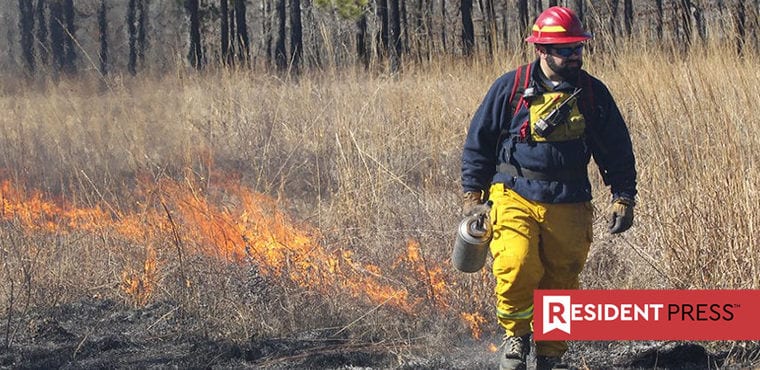
When snow and sleet blanket The Natural State, the benefits of fire are on full display for most Arkansans as they remain within reach of a warm fire. The rejuvenating effects of controlled fire are just as critical to the vibrance of many plant communities and wildlife habitat, but its use is often misunderstood, especially when used as a tool in early spring, when some birds are beginning to nest.
“The Southeast (U.S.) has a long history of naturally and culturally applied fire; except for a relatively brief period of fire suppression during European settlement, there’s always been fire in Arkansas,” Emily Roberts, Statewide Fire Program coordinator for the Arkansas Game and Fish Commission, said. “Arkansans are rekindling this fire history by applying prescribed fire to meet a lot of different objectives ranging from fuel reduction to wildlife habitat.”
Roberts says prescribed fire offers so many more benefits than clearing debris. On the right site, clearing the leaf litter and grass thatch to promote sunlight penetration can stimulate native grasses and wildflowers.
“We’ve been able to reclaim rare habitats like glades and prairies that host rare plants and wildlife by removing invasive vegetation and reintroducing fire,” Roberts said. “The native plants that are able to reestablish during restoration projects like this provide better cover and forage for wildlife. Think of how few species could use an eastern red cedar thicket versus how many could use a diverse glade with different plant species flowering and seeding all throughout the year.”
Time to Burn
Prescribed fires are much more detailed than a person in a yellow jumpsuit walking across some land, setting brush ablaze. The site must be prepared with firebreaks to contain the fire, and managers need a specific set of conditions that involve relative humidity, temperature, wind speed and direction. All of these conditions are written into a burn plan based on the objective of the burn, topography, vegetation type and other factors.
“We’ve historically completed 70 percent of our burn acreage between February and April,” Roberts said. “We’ve recently begun to move some of that acreage to July-October to better mimic the natural fires caused by lightning strikes that our prairies, savannas and woodlands initially adapted to. Maintenance and fuel reduction burns conducted in high-quality, or remnant, habitats also are shifting to November through January, when possible, to avoid repeated effects on early flowering plants in spring.
Roberts says there simply isn’t enough time or manpower to complete all the prescribed burn acres in the AGFC’s annual goal during the short windows of time Arkansas weather typically allows. That means biologists and burn bosses must re-prioritize burn units each year.
“Each year our spring burn season provides us with a weather window during which we can conduct prescribed fire,” Roberts said. “This window can be especially important when the weather of the previous year didn’t give us many opportunities to burn, like in 2024 when we had burn bans in the fall and then above-average rainfall over the winter.”
Roberts says wildlife habitat managers also carefully consider how often a unit is burned.
“If a prairie or open savanna doesn’t see a burn within 2-3 years, we usually see woody plants take over, forming dense thickets and shading out the plants underneath, reducing the habitat’s ability to provide quality forage and cover for wildlife, including turkeys, quail and other ground-nesting birds,” Roberts said. “Our woodland systems are typically on a longer rotation of every 3-5 years.”
Managing turkey habitat is critical, and may occasionally require some April and May burns, but managers prioritize burn units during this time that have not been burned in the last three years and are not serving as high-quality habitat.
“We also heavily consider burn unit size and adjacent refuge habitat when planning these burns,” Roberts said.
Whole Truth
Despite all these efforts, a picture or two occasionally pops up showing a turkey nest sitting in an area where a prescribed fire had been conducted. David Moscicki, AGFC Turkey Program coordinator, says basing an argument on that snapshot is like watching a preview of a thriller movie and assuming that’s the whole story.
“What the picture doesn’t show are the hundreds of failed nests each year from hens being killed or chased by predators in an area too dense for her to see danger coming,” Moscicki said. “There’s no way to tell when the nest was abandoned. Jeremy Wood, the AGFC’s previous turkey program coordinator, completed his master’s thesis on this very subject. In his research, only 6 percent of the turkey nests he located and monitored would have been exposed to fire had the nest still been active at the time of the event. And, in those cases, the nests failed because of nest predators or hens abandoning them before any fire occurred. Zero nests marked during that research failed due to a burn. Some looked like it, but they had long been abandoned when the fire occurred.”
Moscicki adds that even if a hen pulls off a nest in these denser habitats, poult mortality is so high that nearly all of these young birds are essentially doomed from the start.
“In addition to needing cover, poults need nearby access to bugging grounds where broad-leaved annual plants attract insects that will provide the protein needed for fast growth,” Moscicki said. ”The further away these sorts of areas are from the nest site, the lower the chances poults have to survive to adulthood.”
Small Acres, Big Benefits
The AGFC and its partners have conducted prescribed burns on 18,000 to 30,000 acres of AGFC’s 380,000-plus acres of land each of the last five years. That’s less than 8 percent of the acreage in AGFC-owned wildlife management areas.
“Even in some of the most intensively managed areas, we’re only burning about 20 to 30 percent of the area in a given year,” Roberts said. “Gene Rush WMA, for example, has seen about 3,500 acres of prescribed fire per year in the last three years. The area is 17,652 acres, and local turkey hunters will tell you that it’s consistently one of the best turkey-hunting areas owned by the AGFC.”
Moscicki said, “The Camp Robinson Special Use Area and Stone Prairie complex is another example of prescribed fire helping transform and maintain prime wildlife habitat. During the last three years, we’ve averaged 1,457 acres of prescribed fire annually on these 5,018 acres. We see fantastic turkey harvest numbers there, with 11 of the 15 permit winners harvesting a bird the year before last. We’re also seeing the resurgence of wild quail on Stone Prairie, which is very exciting.”
Partners, Private and Public
The benefits of prescribed fire are taking root in Arkansas, but the AGFC cannot do it alone. The agency manages just under 12 percent of the state’s public land, making partnerships with organizations like the U.S. Forest Service and The Nature Conservancy vital. The real frontier, however, is private land, which makes up almost 90 percent of the state. Through the AGFC’s Private Lands Habitat Division and the Conservation Incentive Program, the AGFC has been able to foster prescribed burn associations. These groups help landowners join together to conduct prescribed burns on their land, playing a lead role in habitat management across Arkansas.
Charleston Water Department Announces Scheduled Maintenance on Water Storage Tanks

The Charleston Water Department today announced an essential maintenance project on the city’s water storage tanks, scheduled to begin in March 2026.
The multi-week project is part of ongoing efforts to ensure the continued reliability and safety of the municipal water supply for all Charleston residents and businesses.
The comprehensive maintenance work will focus on the city’s water storage infrastructure and is
expected to last several weeks. Charleston Water officials emphasize that the project is a routine
but critical component of maintaining the integrity of the city’s water system.
What Customers Should Know
During the maintenance period, some customers may experience intermittent fluctuations in water
pressure. These fluctuations are expected to be temporary and will not affect water availability or
quality.
“Water will remain safe to drink throughout the entire project,” confirmed Charleston Water
Department officials. “We are committed to minimizing any disruption to service while performing
this important infrastructure work.”
The department will work diligently to complete the project as efficiently as possible while
maintaining service standards for all customers.
Project Details
- Estimated Start Date: March 3, 2026
- Duration: Several weeks
- Impact: Possible intermittent water pressure fluctuations
- Water Quality: No impact – water remains safe to drink
- Service Availability: Continuous service maintained
Customer Support
Customers who have questions or concerns about the maintenance project are encouraged to
contact the Charleston Water Department at 479-965-2231.
The Charleston Water Department thanks customers for their patience and understanding as this
essential maintenance work is completed.



National Ag Law Center, NASDA Foundation team up for 2026 Mid-South ag and environmental law conference
By Ramie Parsons
University of Arkansas System Division of Agriculture
Two national agricultural organizations are partnering again in 2026 to provide timely legal and policy education for the agricultural community.
The National Agricultural Law Center and the National Association of State Departments of Agriculture Foundation, or NASDA Foundation, will co-host the 13th annual Mid-South Agricultural and Environmental Law Conference. The event is scheduled for June 5 at the University of Memphis Cecil C. Humphreys School of Law in Memphis, Tennessee. Registration is open online, and a livestream option will be available for those who cannot travel.
“We’re really excited to be able to offer this program again, and especially to continue to grow it by co-hosting with our friends at the NASDA Foundation,” said NALC Director Harrison Pittman.
The NASDA Foundation is an educational and research organization that serves the nation’s state departments of agriculture.
The Mid-South conference is part of a long-running effort to provide timely agricultural and environmental law information for attorneys, lenders, accountants, consultants, students and other agricultural professionals across the region, Pittman said. The program offers continuing legal education credit, including ethics, as well as continuing education from the American Society of Farm Managers and Rural Appraisers.
Early bird bonus session
An online-only “Early Bird” session on May 13 will offer three hours of bonus CLE and CE to those who register for the Mid-South conference by May 12.
Topics scheduled for the Early Bird program include a U.S. Supreme Court and agricultural litigation update, a Mid-South policy panel featuring leaders from state departments of agriculture and a mid-year review of agricultural law and policy developments from NALC attorneys.
Main conference agenda
The main Mid-South conference on June 5 will feature six hours of continuing education programming, including one hour of ethics credit. The agenda will cover a range of pressing issues for agricultural stakeholders, including:
· Agricultural labor and immigration enforcement
· Farm debt and land transactions
· U.S. Department of Agriculture policy and reorganization
· Federal legislative and trade developments
· Artificial intelligence and legal ethics
· Environmental regulatory and litigation updates
Featured speakers will include Judge Stephen A. Vaden, USDA deputy secretary, as the keynote speaker, and Hunt Shipman, principal and director at Cornerstone Government Affairs, among others still to be announced.
New this year, the conference will include a “Next Generation of Ag & Food Law: Roundtable for Students” on the afternoon of June 4 at the law school, offering law students an opportunity to engage with practitioners and explore career pathways in agricultural law. That evening, attendees are invited to a networking reception at The Rendezvous in Memphis.
Organizers note that Memphis-area lodging is available near the law school, with many attendees traditionally staying at The Peabody Memphis.
Registration details, agenda information and continuing education accreditation are available on the conference website.
“These conferences are premier learning and networking opportunities for attorneys, students and other ag professionals who work throughout the nation’s agricultural community,” Pittman said. “The Mid-South program continues to bring together leading voices on the legal and policy issues that matter most to agriculture.” For more information about the NALC, visit NationalAgLawCenter.org and subscribe to receive NALC communications, including webinar announcements, the Quarterly Newsletter and The Feed.
About the National Agricultural Law Center
Created by Congress in 1987, the National Agricultural Law Center serves as the nation’s leading source of agricultural and food law research and information. The NALC works with producers, agribusinesses, state and federal policymakers, lenders, Congressional staffers, attorneys, land grant universities, students, and many others to provide objective, nonpartisan agricultural and food law research and information to the nation’s agricultural community.
The NALC is a unit of the University of Arkansas System Division of Agriculture and works in close partnership with the National Agricultural Library, a subsidiary of the USDA’s Agricultural Research Service. For information about the NALC, visit nationalaglawcenter.org. The NALC is also on X, Facebook and LinkedIn as @nataglaw. Subscribe online to receive NALC Communications, including webinar announcements, the NALC’s Quarterly Newsletter, and The Feed.
About the Division of Agriculture
The University of Arkansas System Division of Agriculture’s mission is to strengthen agriculture, communities, and families by connecting trusted research to the adoption of best practices. Through the Agricultural Experiment Station and the Cooperative Extension Service, the Division of Agriculture conducts research and extension work within the nation’s historic land-grant education system.
The Division of Agriculture is one of 20 entities within the University of Arkansas System. It has offices in all 75 counties in Arkansas and faculty on three campuses.
Pursuant to 7 CFR § 15.3, the University of Arkansas System Division of Agriculture offers all its Extension and Research programs and services (including employment) without regard to race, color, sex, national origin, religion, age, disability, marital or veteran status, genetic information, sexual preference, pregnancy or any other legally protected status, and is an equal opportunity institution.
State Capitol Week in Review from Senator Terry Rice
To improve efficiency within state government, Governor Sarah Huckabee Sanders, signed an executive order this week to streamline permitting. The executive order is part of the Governor’s Arkansas Forward initiative to save money and improve efficiency. Consequently, this will help refine government processes and expedite permits to protect natural resources and foster economic growth. State agencies are now required to review their processes around permitting and then submit a plan on how to expedite permits.
The governor stated, “Arkansas is one of the best states in the nation to start, build, and grow a business – but we have to do better to compete across the country and globe.” This will help to add transparency and speed up our permitting process to ensure major economic development projects aren’t held up by unnecessary red tape.”
The executive order will require each cabinet-level state agency, board, or commission that issues permits, licenses, certifications, or other regulatory approvals to conduct a comprehensive review of all such processes within 120 days. Findings may include unnecessary steps that can be eliminated, consolidated, or digitized; laws or regulations that slow down the processing of permits and ways to expedite permits using artificial intelligence.
Specific agencies mentioned in the executive order include the Department of Agriculture, the Department of Energy and Environment, the Department of Labor and Licensing, and the Department of Health.
Within 180 days of the new order, these agencies must submit a written improvement plan to the governor’s office outlining their current performance metrics and proposed improvements. Agencies will be required to establish timelines available to the public for all major permits and licenses, develop “one-stop” online application portals, expand concurrent reviews across agencies, and provide applicants with real-time status updates and single points of contact.
“The Department of Labor and Licensing applauds the Governor’s business-friendly approach and will continue to improve its user-friendly licensing procedures by expanding its online, interactive licensing platform as funding permits,” said Arkansas Secretary of Labor and Licensing Daryl Basset. “The Department works closely with Arkansas businesses to provide the licensing resources and assistance needed to foster the state’s economic growth and prosperity.”
In 2024, Governor Sanders established Arkansas Forward, outlining at least $300 million in potential cost savings and cost avoidance across five main areas: information technology, procurement, fleet management, personnel, and real estate.
A Legacy of Service: Otis and Donna Strozier Celebrate a Combined 68 Years with James Fork Regional Water

After a combined 68 years of dedicated service, Otis and Donna Strozier are closing an extraordinary chapter as they retire from James Fork Regional Water—leaving behind a legacy built on reliability, professionalism, and commitment to the residents of Sebastian County.
Together, the Stroziers spent decades serving the public through roles that were essential to the daily operation of the regional water system. Their careers stand as a testament to the value of long-term public service and the quiet dedication required to keep critical infrastructure running.
Otis Strozier devoted 35 years to James Fork Regional Water, retiring as a Senior Distribution Operator. Throughout his career, Otis worked on the front lines of water distribution, ensuring the system operated efficiently and safely. From routine maintenance to emergency responses, his technical expertise and steady presence helped ensure uninterrupted service for customers across Sebastian County.
Donna Strozier dedicated 33 years to the organization and retired as Assistant Manager. In this leadership role, Donna played a key part in administrative operations, customer service, and internal coordination. Known for her professionalism and attention to detail, she served as a trusted point of contact for both staff and the public, helping guide the organization through years of growth and change.
Working side by side for the same utility for more than three decades, Otis and Donna exemplified teamwork, dependability, and dedication to public service. Their contributions extended far beyond job titles, shaping the culture and institutional knowledge of James Fork Regional Water.
As they enter retirement, the impact of Otis and Donna Strozier’s service will continue to be felt throughout the system they helped maintain and the community they served. James Fork Regional Water—and the people of Sebastian County—are grateful for their decades of commitment and wish them the very best in this next chapter.