

46.7 F
Fort Smith
Sunday, May 3, 2026
Home Blog Page 3

Arrest Reports 4/12

This content is reserved for RESIDENT INSIDER members.

Please or subscribe to view.

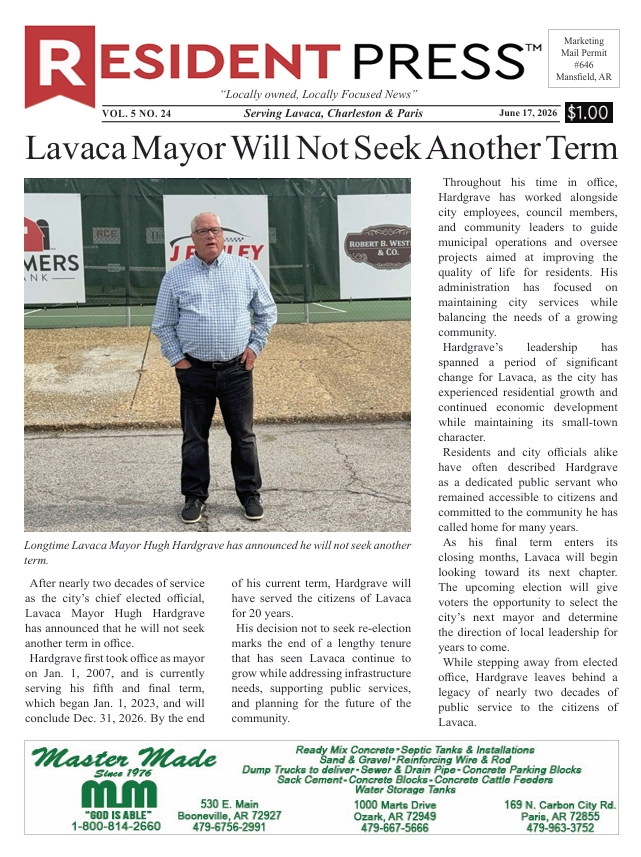
Resident Press (Lavaca, Charleston, Paris edition) 4/22/26 Vol. 5 No. 16

This content is reserved for RESIDENT INSIDER members.

Please or subscribe to view.

Greenwood Resident 04/22/26 Vol. 6 No. 16

This content is reserved for RESIDENT INSIDER members.

Please or subscribe to view.

Resident Press (Scott & So. Sebastian County edition) 4/22/26 Vol. 8 No. 16

This content is reserved for RESIDENT INSIDER members.

Please or subscribe to view.

“Just Roll with It” Serving up Recipes and Humor

By Sheri Hopkins, Lifestyle Contributor

Hello everyone!! Been wet in the River Valley. We needed it, so that’s okay. We are having our family Easter this Saturday at my nephew’s—you all know the one—so I am going to have some stories to tell next week. We are going to cook out and have a big egg hunt for the kids.

Did you all ever hang posters on your wall when you were teenagers?? Back in my day it was Tom Selleck, aka Magnum P.I. I had a poster of him on my wall, and most of the guys back then had Farrah Fawcett. My younger sister was in love with Leif Garrett—she thought he was dreamy. If you are my age, you remember Teen Beat magazine.

Speaking of magazines, there was the National Enquirer. If you ever checked out at the local grocery store or Walmart, you got to stand there and read all the headlines. It was all fake news—like they would have a giant snake swallowing a man or a half-man, half-alligator. You couldn’t help but look at all that crazy stuff.

I had an older brother—his name was Jerry. If it was in the National Enquirer, he believed it. You could not convince him it was not true. We made fun of him, but he didn’t care—it was all true in his eyes.

There was also National Geographic—my dad loved that magazine. There was also True Grit, and those old West magazines. My dad loved all of those. Those were the good old days. My dad passed when I was 18, and let me tell you, I have never stopped missing him.

I had two older brothers, and they were both in the Army. My brother Larry reenlisted and retired from the Army. They were stationed in Panama City, Panama. Keep in mind, Wagoner men are pretty tall, and the Panamanians were not tall people—Wagoners are just big people. My brother and sister-in-law decided to have a yard sale, and she had put in some of my brother’s jeans. One of the customers held a pair up and kept repeating, “Grande!! Grande!!”—which we all know means large!! Needless to say, I don’t think they sold any of them.

You all have a blessed week—hug your loved ones hard.

NO BAKE COCONUT COOKIES
1 ¾ cup sugar
½ cup butter or margarine
½ cup milk
¼ cup unsweetened cocoa powder
2 teaspoons vanilla
2 cups quick oats
1 cup coconut
optional chopped almonds
In a a large saucepan, heat the butter, sugar, milk and cocoa. Bring to a full rolling boil and boil for one minute. Remove from the heat and add the vanilla, oats, coconut and almonds (optional) and mix well. Drop by the spoonful onto parchment paper. Let it stand for one hour. Hope you enjoy these. Have a wonderful week and always count your blessings.

Spotted a honey bee swarm? Stay calm and call a beekeeper

By Rebekah Hall University of Arkansas Division of Agriculture

LITTLE ROCK — As spring blooms in Arkansas, honey bee populations are swarming, but there’s nothing to be afraid of — most swarms are harmless, and the colony will soon fly away to establish its new home.

“A honey bee swarm is an incredibly complicated, amazing and majestic process,” said Jon Zawislak, extension assistant professor of apiculture and urban entomology for the University of Arkansas Division of Agriculture. “Swarming is the honey bees’ response to crowded conditions in the springtime when there is an abundance of food — nectar or pollen. When spring comes, the population of the beehive starts to increase exponentially.”

“As a result, the bees will begin raising a new queen bee, and then the old queen leaves the hive,” he said. “She takes anywhere from one-half to two-thirds of the worker bees with her and they fly away. Their goal is to establish a new colony.”

The swarm will land nearby and settle on a tree limb or a fence post, or sometimes on the wall of a building.

“I’ve seen them on picnic tables, mailboxes and stop signs,” Zawislak said. “But usually, they’re up in trees. When people see a giant mass of bees hanging off a limb, inside of that is the queen and thousands of worker bees, along with a few male bees that we call drones. It could be anywhere from a few thousand bees to 50,000 bees.”

These bees are in a temporary resting location, which is sometimes called a bivouac. While the appearance of so many honey bees can be frightening, a new swarm is usually gentle in temperament and they rarely sting, Zawislak said.

If you come across a swarm, Zawislak said the most important practice is to do no harm.

“Leave it alone — don’t throw rocks at it or squirt it with a garden hose or spray it with an insecticide,” he said. “If you wait and don’t do anything, chances are those honey bees will just disappear and find another home.”

However, in an urban environment, “we don’t want to risk that the bees will move into the wall of a home or building because it becomes much more difficult to relocate them when they’re inside of a wall,” Zawislak said. Zawislak recommends contacting your local county extension office, as many counties maintain a list of local beekeepers who can quickly come and collect the bees.

The Arkansas Beekeepers Association is also a helpful resource, Zawislak said. The organization has a county-by-county list of beekeepers who will collect swarms, including those who will collect bees from inside of a wall.

House hunting for a new hive

Honey bees have been swarming in different parts of Arkansas for almost a month, Zawislak said.

“They reach their peak around mid-April to mid-May. That’s when we see most of them,” he said. “But especially in the southern part of the state, where spring comes a bit earlier, you may see it sooner, and you’ll see it later in the northern part of the state. It just depends on how many flowers are in bloom around the hives of individual colonies.”

Once the bees have swarmed and are resting in their temporary location, several hundred become scout bees who then “travel in all directions looking for a new place to live,” Zawislak said.

“This could be a hollow tree or a cavity that’s the right size and easily defensible,” he said. “If it looks like a place where they think their family would be happy, the scout bees go back to the swarm and do a dance on the backs of the other bees as they are all piled on top of each other.

“They do a figure-8 dance that we call a waggle dance,” Zawislak said. “It conveys information about which direction the potential new home is, how far away it is and the quality of the new site.”

Over the next few hours to a few days, the bees “reach a quorum decision, where enough of the bees have checked the new place out and decided it will be the best home for them,” Zawislak said.

To travel to their new destination, the scout bees guide the rest of the group using a pheromone, or chemical odor, that they emit as they fly through the crowd of bees.

“One minute you have this big cluster of bees hanging on a limb, then it looks like utter chaos, then they will suddenly all take off in one direction, and they’re gone within a few minutes,” Zawislak said. “The first thing they must do there is build honeycomb because they can’t do anything else if the queen doesn’t have space to lay eggs and they can store food. They start building it right away, and they’ll often have built a comb the size of your hand in 12 hours.”

Zawislak said he encourages beekeepers to be vigilant and try to manage swarms by keeping a close eye on bees in the springtime and collecting swarms right away. Watch the Division of Agriculture’s “Why Do Honey Bees Swarm?” video on YouTube or visit the Beekeeping in Arkansas page on the Cooperative Extension Service website to learn more about swarms, honey bees and beekeeping.

The extension service is the educational outreach arm of the Division of Agriculture.

To learn about extension programs in Arkansas, contact your local Cooperative Extension Service agent or visit uaex.uada.edu. Follow us on Facebook and Instagram. To learn more about the Division of Agriculture, visit uada.edu. To learn more about ag and food research in Arkansas, visit the Arkansas Agricultural Experiment Station at aaes.uada.edu.

About the Division of Agriculture

The University of Arkansas Division of Agriculture’s mission is to strengthen agriculture, communities, and families by connecting trusted research to the adoption of best practices. Through the Agricultural Experiment Station and the Cooperative Extension Service, the Division of Agriculture conducts research and extension work within the nation’s historic land grant education system.

The Division of Agriculture is one of 20 entities within the University of Arkansas System. It has offices in all 75 counties in Arkansas and faculty on three campuses.

Pursuant to 7 CFR § 15.3, the University of Arkansas Division of Agriculture offers all its Extension and Research programs and services (including employment) without regard to race, color, sex, national origin, religion, age, disability, marital or veteran status, genetic information, sexual preference, pregnancy or any other legally protected status, and is an equal opportunity institution.

State Capitol Week in Review from Senator Terry Rice

The fiscal session in the Arkansas General Assembly continued this week. This was a busy week in which legislators really dug into budget details.

Some highlights:

The Joint Budget Committee directed the legislative staff to draft a reappropriation measure that would bar the Department of Corrections from spending any of the $73.7 million in state funds for construction of a prison in Franklin County. The funds were left over from a previous prison expansion in Calico Rock.

The committee also approved a $1 million appropriations bill for the Department of Corrections for a pilot program designed to detect, identify, and terminate illegal cell phones used by inmates in state prisons. It is estimated that one out of every four inmates have access to an illegal cell phone. Prisoners are using these phones for a wide range of criminal activity.

Over the last several years, Arkansas prison officials have recovered over 6,500 illegal phones from inmates, but not all of them can be found because prisoners hide them in many places. This system will find any phone as soon as it connects with cell service for calls, messaging, or other apps. A similar program in Georgia eliminated 10,000 contraband phones from its prison system. The pilot project will take place at the Cummins and Varner units.

The Senate convened Tuesday afternoon to honor the late Senator Gary Stubblefield with a memorial resolution recognizing his many contributions to the state and to his community.

After serving one term in the Arkansas House, Sen. Stubblefield represented his district in the Senate from 2013 until his passing in September 2025.

Senators also joined together to commission a portrait of Sen. Stubblefield by artist Barry Thomas. The painting will hang in the Senate through the remainder of what would have been his term, after which it will be presented to the Stubblefield family.

Following adjournment, senators lined up to visit with and embrace members of the Stubblefield family, reflecting the deep respect and affection felt throughout the chamber.

On Wednesday, Senator Mark Johnson presented the Senate Memorial Resolution honoring former Senator Luther Boyd “Lu” Hardin, who passed away in August 2025. He was elected to the Arkansas Senate in 1983, where he served for 14 years. After his legislative career, he served on Governor Mike Huckabee’s cabinet as the Director of the State Department of Higher Education. He later served as the President of the University of Central Arkansas. His son Scott Hardin delivered thanks to the chamber.

The legislature’s sessions are open to the public. You can attend in person at the State Capitol complex in the committee rooms or in the public galleries of the Senate and House chambers. You can also watch meetings live and on demand at https://senate.arkansas.gov.

You can read and download PDFs of the bills that have been filed for the session at https://arkleg.state.ar.us/. Click on “Bills” in the menu, where you can search by keyword or filing date.

Greenwood Athletics News and Notes

Spring has arrived in Greenwood, and along with it, coaching changes and other news and notes.

Girls Basketball

Head Girls Basketball Coach Ryan Casalman stepped down as the Head Coach and will return as the Junior High Boys Basketball Coach. It did not take long to find the next candidate. Roland Girls Head Coach Scott Nelke takes over the program, which is just two seasons removed from completing a Three-Peat under then Head Coach Clay Reeves.

Coach Nelke recently had stops in Sallisaw, Pocola, and Northside. While at Northside, he was an assistant under then-Head Coach Eric Burnett, when current Oklahoma City Thunder players Jaylin Williams and Isaiah Joe were there.

“We reached out to Coach Nelke a couple years ago when this job came open, and heard great things about him. He’s been around the area; he’s been a head coach. He had success at Pocola and had success in Roland.” Athletic Director Chris Young said after signing day activities. “They [Greenwood] tried to hire him for the head [coach] job when it came open with the boys. Everybody we talked to had great things to say about him. Not only as a coach, but him as a person.”

In his most recent stop in Roland, he posted a 59-20 record with trips to the Class 3A State Tournament. Trips to the State Tournament have become a tradition for the Lady Bulldogs, who make it an annual trip. The Lady Bulldogs have eight State Championships on nine State Championship game appearances.

Signing Day

Greenwood had its fourth signing day of the 25-26 school year. Lexi Gordon (Cross Country), Luke Brandt (Cheer), Jordin Jackson (Dance), and Wyatt Edwards (Football) signed on the line to continue their athletic careers.

“It’s awesome to see our kids being able to continue doing what they do. And whether it’s dance, cheer, or cross country, or football. Number one, it’s just a reflection of all the programs we have available at Greenwood.” Athletic Director Chris Young said. “I think it’s something special about Greenwood, is the success of our kids in various programs. But also a reflection of our coaches.”

School Record setters Kylah Pearcy (Basketball -UAFS) and Kane Archer (Football – Utah) signed last year, with Cody Taylor and Champ Davis signing with Charlotte and Southern University in December. February Football signing day saw Cody Johnson and Akira Fujibayashi sign with Central Oklahoma and Henderson State, respectively.

Scholarships

It is getting to be that time when Greenwood High School awards scholarships to students, and there are a few athletics-based scholarships.

Ken Hamilton Memorial Tennis Scholarship winners were Wesley Jerrell and Kylah Pearcy.

Volleyball Booster Club Scholarship went to Raylee Wagoner.

Isaiah Arrington Memorial Scholarship was awarded to Akira Fujibayashi.

More will be announced on the Greenwood High School Facebook page.

Thirsty Arkansas strawberry crop gets off to early start 

By Mary Hightower 
University of Arkansas Division of Agriculture 

Arkansas’ strawberry crop is not only looking good, but is also running a little early this year, said Amanda McWhirt, extension fruit and vegetable specialist for the University of Arkansas Division of Agriculture.  


Good thing too. Berries are flying off the shelves at the Ferndale Market, which noted on its Facebook page last week that it twice sold out of the fruit.

“Many growers across the state have been picking for seven days or more now,” McWhirt said on Monday. 

“Generally, there has only been minor damage from the mid-March freeze,” she said. “Some blooms were killed in that event which will delay the start of the season for some growers in northwest Arkansas.” 

On the plus side, there’s been little disease, likely due to the very dry conditions statewide. 

“Growers are irrigating more this year than what has been typical in years past because of how dry it is,” she said.  

“Despite the freeze, I think we are still running a tad early, so there will be fruit for Mother’s Day!” she said. “Hopefully temperatures stay cool and we can have a nice long season. If it gets too warm too early — with temps in the upper 80s-90s — things will start shutting down.” 

 To learn about extension programs in Arkansas, contact your local Cooperative Extension Service agent or visit uaex.uada.edu. Follow us on Facebook and Instagram. To learn more about the Division of Agriculture, visit uada.edu. To learn more about ag and food research in Arkansas, visit the Arkansas Agricultural Experiment Station at aaes.uada.edu.  

About the Division of Agriculture  

The University of Arkansas Division of Agriculture’s mission is to strengthen agriculture, communities, and families by connecting trusted research to the adoption of best practices. Through the Agricultural Experiment Station and the Cooperative Extension Service, the Division of Agriculture conducts research and extension work within the nation’s historic land-grant education system.  

 The Division of Agriculture is one of 20 entities within the University of Arkansas System. It has offices in all 75 counties in Arkansas and faculty on three campuses.  

 Pursuant to 7 CFR § 15.3, the University of Arkansas Division of Agriculture offers all its Extension and Research programs and services (including employment) without regard to race, color, sex, national origin, religion, age, disability, marital or veteran status, genetic information, sexual preference, pregnancy or any other legally protected status, and is an equal opportunity institution.