84.2 F
Fort Smith
Sunday, June 28, 2026
Home Blog Page 398

2022-23 Paris Elementary School Student Supply Lists

Hard to believe, but the new school year is just around the corner! As a public service to our readers, RNN is pleased to provide you with the following student supply list information for Paris Elementary School. Any school in the area can email RNN at Jim@residentnewsnetwork and we will be pleased to include it in the upcoming Logan County weekly newspaper!

Paris Elementary School principal, Lakaen Schluterman, would like parents to know that they should be on the lookout for information to arrive in their mailboxes the first week in August regarding the opening of school, Open House, and student assignments (who their teachers will be).

List courtesy of Paris Elementary School

Eagles Continue Preparation for Upcoming Season at Pottsville Football Camp

Unique to almost any other sport, the game of high school football requires players to practice outdoors during periods of extreme heat, wearing layers of protective equipment, and engaging in contact between players. It requires dedication, a desire to play, and a degree of mental toughness that could easily be argued to be second to no other sport. That is not said in disrespect to other sports; each requires dedication and discipline to be successful.

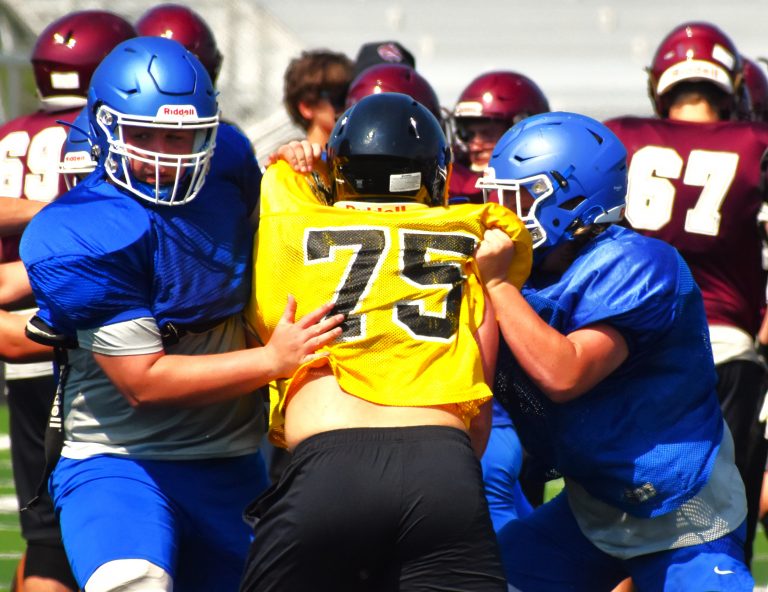
The Hackett Hornets showed they are ready to make a playoff run this season in the 3A-1 conference (RNN Sports Photo / Jim Best)

And on a very warm July morning last week in Pottsville, six teams donned the pads to continue their preseason conditioning and practices to will eventually lead up to the start of the season just after the start of the new school year. In addition to the host school Pottsville, Hackett, Lincoln, Mena, Ozark, and Paris all played session rotations against each other on the blistering hot artificial turf at Pottsville High School. The unofficial temperature was approximately 95 degrees, and the turf temperature was approximately 10 degrees warmer.

High school football coaches, in this writer’s opinion, have become increasingly aware of the risks of heat-related illness and are doing a very good job of keeping players hydrated, taking frequent breaks, and reducing the camp sessions from approximately two hours down to approximately 90 minutes. So, in addition to the great plays that were made by players from all of the schools, perhaps most impressive were no visible signs of heat exhaustion or lack of conditioning and acclimatization to the heat. The players and coaches are to be congratulated on having their teams in good condition at this point of the summer.

The Hackett Hornets, who play in the 3A-1 conference with Charleston and Booneville, were very impressive all morning at the camp. The Hornets have talented players at the skill positions, and they showed off that talent, particularly at the wide receiver position. Hackett appears to be ready to make a playoff run this season, possibly as a number three seed behind top contenders Charleston and Booneville.

The young Paris Eagles continue to work hard to develop chemistry with several new players at the critical skill positions on offense, and in the defensive secondary. The Eagles graduated several starters on both sides of the ball last year, and the 2022 season will be a “work in progress” as the coaching staff continues to teach and install a system to the new starters. Paris will start the season at Waldron and will also face another tough non-conference game a few weeks later at West Fork. Patience will be the operative word for Eagles fans this year. It will be critical for the team to remain relatively injury-free in several key positions.

RNN Sports will bring our readers a preseason special in August that will analyze the Eagles’ 2022 schedule and personnel. Watch for this announcement soon in the Logan County weekly newspaper.

And thanks to the good people of Logan County and the surrounding communities for the great response to the newest weekly print newspaper. We appreciate your subscriptions, and we hope you will pass the word along to others who would like to read LOCALLY focused news and sports each week!

Financial Focus: Prepare yourself for a long retirement

By Jeffery O’Neal
Financial Advisor

We all want to live long lives. We all expect to live long lives. But are we financially prepared for this longevity?

Before we get to the issue of preparation, let’s look at a couple of interesting findings from a 2022 survey by Age Wave and Edward Jones:

• The surveyed retirees said, on average, they expect to live to 89, and they said the ideal length of retirement is 29 years.

• When asked if they want to live to 100, nearly 70% of the respondents said “yes.” The main reason for this desire for long life? To spend more years with their family and friends.

​Of course, none of us can see into the future and know how long we’ll be around. But with advances in medical care and a greater awareness of healthy lifestyles, these aspirations have a real basis in reality.

​However, if you’re going to enjoy a longer lifespan, and the extra years with your loved ones, you need to ensure your finances are also in good shape. How can you make this happen?

​Here are some basic steps to follow:

​• Save and invest early and often. This may be the oldest piece of financial advice, but it’s still valid. The earlier you start saving and investing for your retirement, the greater your potential accumulation. Consider this: If you began saving just $5,000 per year at age 25, and earned a hypothetical 6.5% annual rate of return, and didn’t take any early withdrawals, you’d end up with $935,000 by the time you reached 65. But if you waited until 35 to start saving and investing, and you earned the same hypothetical 6.5% return – again with no early withdrawals – you’d only end up with $460,000. And if you didn’t start saving until 45, you’d end up with just over $200,000, again given the same 6.5% return. 

​• Be mindful of debt. You may not want to be burdened with certain debts when you enter retirement. So, while you’re still working, try to reduce unwanted debts, particularly those that don’t offer the financial benefits of tax-deductible interest payments. The lower your debt load, the more you can save and invest for the future.

​• Keep reviewing your progress. It’s important to monitorthe progress you need to make toward achieving your goal of a comfortable retirement. Over the short term, your investment balances may fluctuate, especially in volatile financial markets such as we’ve seen in the early part of this year. But you’ll get a clearer picture of your situation if you look at long-term results. For example, have your accounts grown over the past 10 years as much as you had planned? And going forward, do you think you’re in good shape, or will you need to make some changes to your investment strategy? Keep in mind that, if you’re 50 or older, you can make “catch-up” contributions to your IRA and 401(k) that allow you to exceed the regular limits. You may also want to adjust your investment mix as you near retirement topotentially lower your risk exposure.

​Hopefully, you will enjoy many years of a healthy, happy retirement. And you can help support this vision by carefully considering your financial moves and making the ones that are right for you. 

This article is provided by Jeffrey O’Neal, Financial Advisor 
Edward Jones
20 N Express St, Paris, AR 72855
479-963-1321
jeffrey.o’neal@edwardjones.com
edwardjones.com/jeffrey-o’neal
Edward Jones, Member SIPC

Drought forcing Arkansas farmers to make hard choices between crops 

By Mary Hightower
U of A System Division of Agriculture

As fiercely hot, dry weather continues, Arkansas farmers are having to make hard choices between their crops.

“Water’s getting tight,” said Jeremy Ross, extension soybean agronomist for the University of Arkansas System Division of Agriculture. “Corn is at reproductive stage, farmers are trying to get rice flooded and irrigation to cotton and soybeans, we’re spreading it pretty thin already. It’s just a struggle on where we need to pump.

“I hear guys talking about 1980,” Ross said. 1980 had 15 straight, 100-degree-plus days at Little Rock — 10 of which were at or above 105 degrees — and 42 100-degree days for the year.

Jarrod Hardke, extension rice agronomist for the Division of Agriculture, said that for the upper 75 percent of the Delta, “it’s been anywhere from the 25th of May to the 4th of June since they’ve had a measurable rain.”

Frequently, the July Fourth weekend is marked by significant precipitation — dubbed a “million-dollar rain.” This year, it was a no-show for most of the state.

“The dynamic here becomes a multi-crop issue. What do we do when it’s this dry?” Hardke said. “Decisions have to be made. Do you have the water and the pumping capacity to move over and irrigate soybeans as opposed to keeping water on your rice?

“We were at this stage a week ago and it’s probably going to get more serious very quickly,” he said.

Pushing water

In a normal growing season “it can take a week or 10 days to get the initial flood on,” Hardke said. “Now in that same field; it’s 14-21 days this year. It’s double the amount of time just to do the initial flood.”

Even with row rice, pushing water across a field has become difficult.

“Between what is used by plants and evaporation to dry air, the water is disappearing faster,” he said. “If a 2-inch rain came across the Delta, it would be huge, but it still wouldn’t be enough.”

For soybean growers, the drought impact varies depending on what stage their crop has reached. Those who planted later are faced with seeds that aren’t germinating or have small plants.

“There are a lot of beans just planted, to soybean plants that are 5-6 inches tall,” Ross said. “Typically, we don’t irrigate small beans. We can kill or drown them. They don’t have the capacity to withstand the flooded conditions for an extended period of time.

“It’s a hard decision. We’re telling them they can either watch them dry up and die, or irrigate and maybe lose some of your stand, but still have moisture in there to get what’s not coming up to come up,” Ross said.

The news in Monday’s crop report from the National Agricultural Statistics Service wasn’t good for soybeans. In Arkansas, 10 percent of soybeans were classified as poor-very poor.

“If 10 percent of Arkansas’ soybean crop is rated ‘poor-very poor, that’s the equivalent of about 320,000 acres,” said Scott Stiles, extension economist for the Division of Agriculture.

Hot nights

Hot nights — when lows don’t drop below the 70s — are worrisome for soybean, corn and rice farmers whose crops are in the reproductive stage.

“Photosynthesis happens during the day and generates a lot of energy,” Ross said. “Night time is when the plant does the hard work of filling pods, making seeds and filling those seeds.”

Without cooler temperatures, plants struggle.

“Small changes make a world of difference in our progress,” Hardke said. “If we can drop into the low 90s during the day and near 70 at night, with partly cloudy skies, it can make a huge difference in the overall health of our crop and in our irrigation progress.”

Expensive diesel, expensive crop

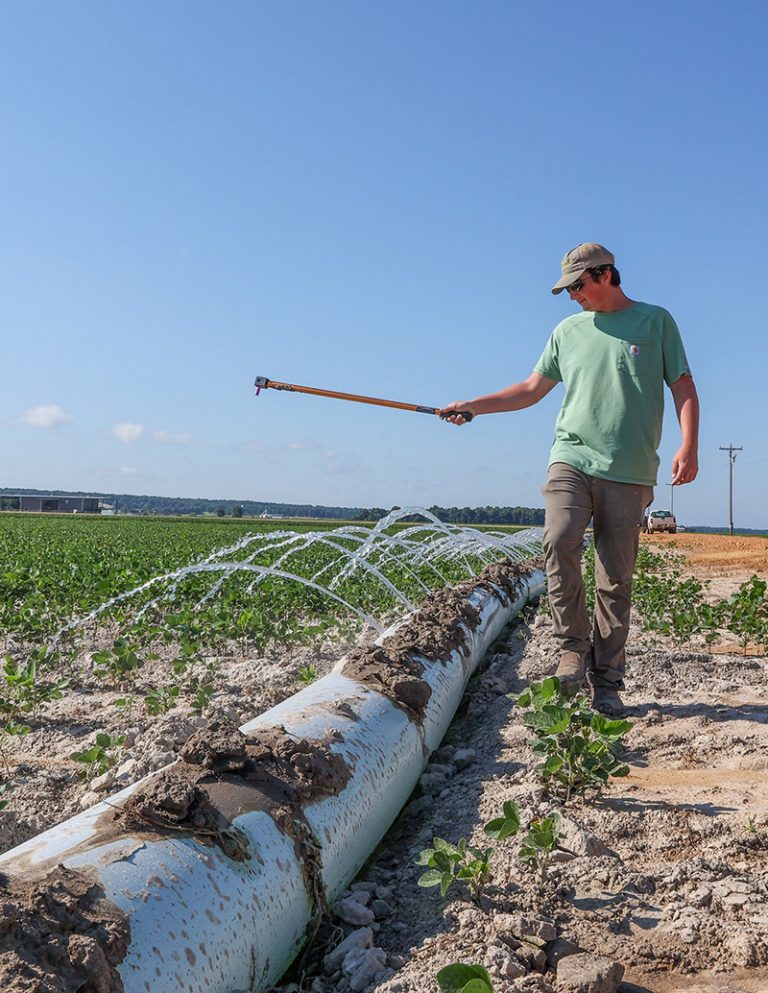
While Arkansas farmers have access to groundwater, irrigation isn’t free. The pumps run on diesel fuel.

“Fuel costs are a concern and although diesel prices have backed off, the current cost per gallon is still 76 percent above last year at this time,” Stiles said. “In recent weeks, diesel prices have been double what they were last year.” 

Higher petroleum prices are also making poly pipe more expensive. This tubing is connected at one end to a pump and the other end sprawls across the top of crop rows. Holes are punched in the tubing, allowing water to flow out at calculated rates. 

“Many growers report the cost per roll of irrigation pipe being around 25 percent more expensive than last year,” he said.

Ross said if one “starts factoring in diesel prices and that commodity prices have dropped in the last 10 days, hopefully a lot of people have some of those $15 beans booked.

“A bunch of us were banking on that July Fourth ‘million-dollar rain’ and most places didn’t get it,” Ross said.

To learn more about Division of Agriculture research, visit the Arkansas Agricultural Experiment Station website: https://aaes.uada.edu. Follow on Twitter at @ArkAgResearch. To learn more about the Division of Agriculture, visit https://uada.edu/. Follow us on Twitter at @AgInArk. To learn about extension programs in Arkansas, contact your local Cooperative Extension Service agent or visit www.uaex.uada.edu.

Timepiece: Middle of Nowhere

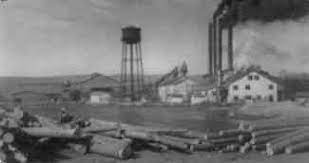
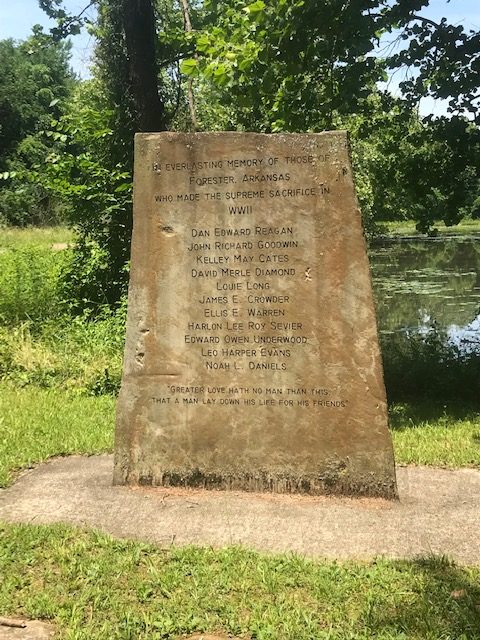
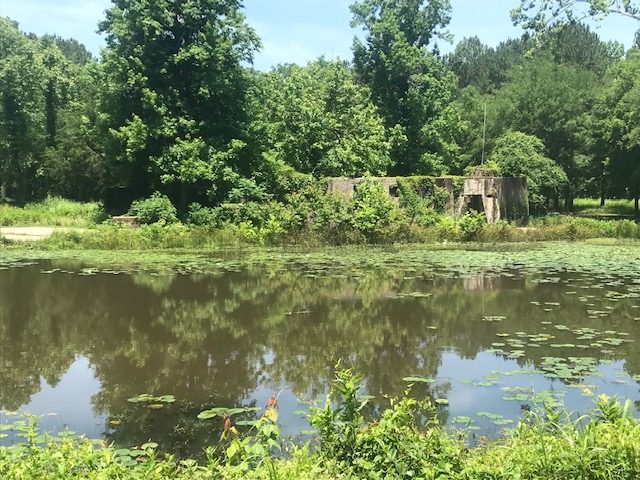
Traveling the backroads, we crossed over the mountain from Dutch Creek to Fourche Valley, through the town of Gravelly and up state highway 28 before turning south on a forest road.  In actuality, I didn’t know where the heck I was but it appeared to be the middle of nowhere. My guides, the Millard family, turned into a forested region marked by an Arkansas state forestry sign.  We had arrived in Forester, Arkansas and there was absolutely nothing there but decaying foundations, a small lake formed for the logging industry, and a few historic markers.  A once vibrant city, the largest in Scott County, had returned to its native state.

Forester was a sawmill town, founded by Thomas W. Rosborough in 1930 to harvest the wealth of pine trees in the region.  Under the name of the Caddo River Lumber company, they built what was the largest lumber mill in the state at that time. The lumber shed alone measured 80 feet wide and 1,000 feet long. Millions of kiln-dried lumber was processed at the mill and distributed around the world. So large was the business that the railroad extended a line from Waldron just to haul the lumber out and goods into Forester.

Forester was a self-contained mill meaning it was company town.  The company provided church, school, theater, post office, a hotel, car lot, and even a ballpark and stadium.  It had a local Masonic Lodge and a company store which would provide goods on credit to workers.  A local doctor provided free health care and the companies water and light company supplied the homes with utilities found few other places in rural, depression era, Arkansas.  The company marshal provided police protection, something little needed in the tight knit community. 

With nearly 1,500 residents, the town was divided into sections called Cannon Town, Happy Hollow, and other communities.  Progressive for his time, Rosborough provided jobs for more than 350 Afro-Americans who lived in rustic homes in the Quarters region of town.

Rosborough did not practice sustainable forestry, his men simply cut the available trees and moved on.  As profits decreased, he sold the mill to Dierks Lumber in 1945.  According to locals, the beginning of the end began with unionization of employees.  Many of the local lumber mills had voted to go union and the employees at Forester were warned it they went union; the company would leave.  The vote was taken and the vote was pro-union.  Within days, the mill closed, everyone fired, and the town ceased to exist.  Many of the buildings were sold and moved; some of the homes are still found in Waldron. Within years, not a building was left, leaving a landscape of second growth trees and brambles surrounding dozens of foundations.

As I walk over the site, I picture in my mind what once was.  I can see the huge sawmill, smoke puffing from the engines that powered it.  The smell of pine and creosote fill the air and the pond is full of logs, soaking up water that will allow the easy removal of tree bark.  Model T’s line the streets where stores once stood and the sound of the piano echoes through the open door of the church.  The sounds of kids at play drifts from the nearby schoolyard.

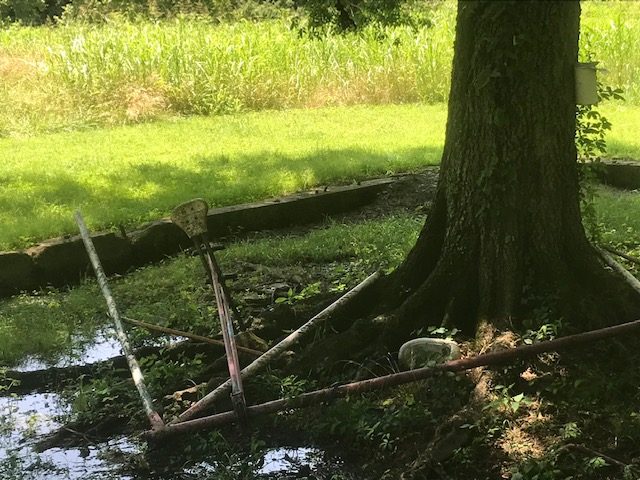
With a shake of my head, my mind clears.  The buildings disappear in vapor and a solitary broken down swing is all that is left in the school yard. Nothing remains of the once vibrant town and I am again in the middle of nowhere!

Lady Rattlers Serve Up Historic First Season 

By Brandy Young

Passed on June 3 1972, Title IX prohibits sex-based discrimination in schools and all federally funded entities. This amendment opened doors and removed barriers for girls and women to participate in sports at the high school and collegiate levels. It seems so fitting that this year, the 50thAnniversary of this historic law, the Magazine School District is adding girls’ volleyball to its list of athletic activities.

This past spring a group from the Magazine Student Council presented to the school board requesting the addition of volleyball.  While there has been previous discussion to add volleyball it has now become more feasible due to an increase in student interest.

“We are extremely excited to start the volleyball program,” stated Superintendent Dr. Beth Shumate. “This will allow our girls to compete in a different way while also increasing participation for some of our students who aren’t traditionally involved.  One of our main goals is to provide opportunities for our students to feel and be more involved in the school, community, and obtain their brightest futures.”

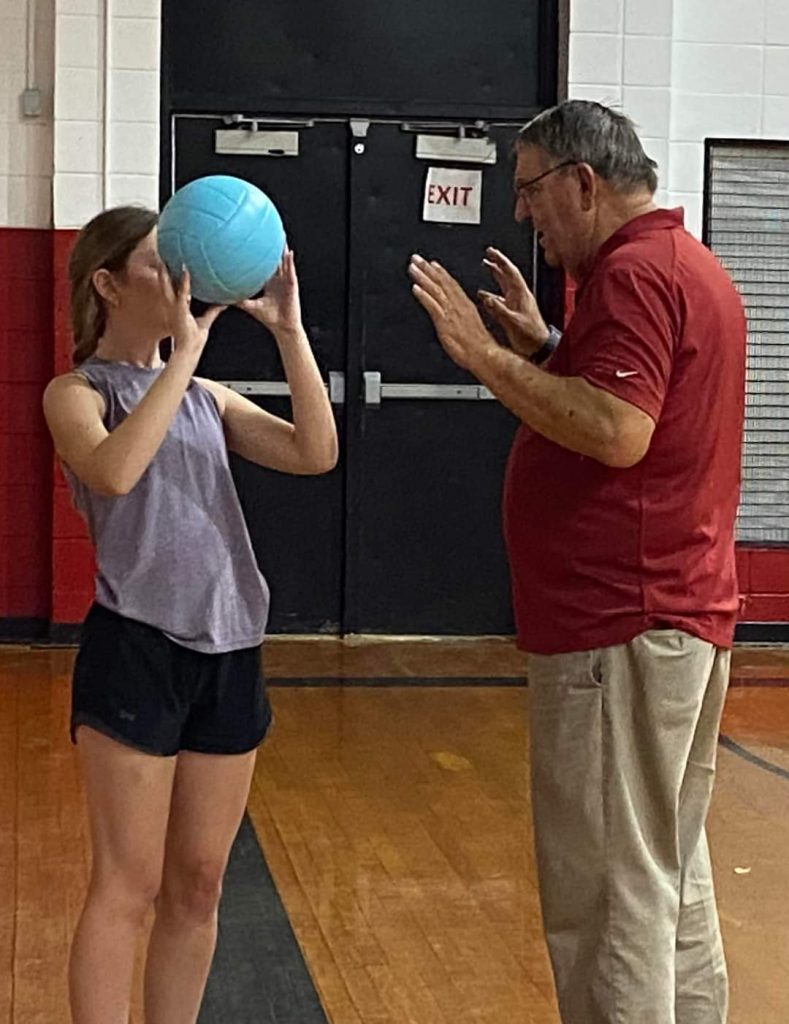
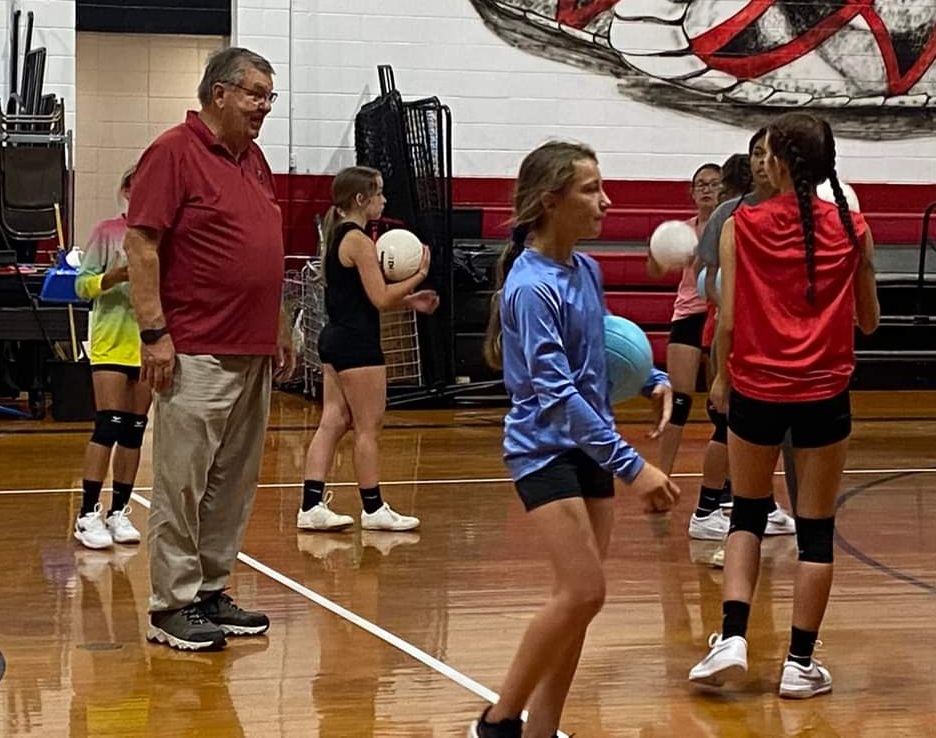
With the new program also comes new additions to the coaching staff. Robert Dean was selected as the head volleyball coach. Coach Dean is no stranger to starting new volleyball programs from scratch.  In addition to 45 years of coaching experience, he has started programs at Booneville High School, Stephens School District in Southwest Arkansas, and Ozen High School in Beaumont, Texas. “As we began to evaluate potential coaches for the program, we were blessed that Coach Robert Dean who has started many successful volleyball programs joined our team as head volleyball coach and science teacher,” stated Dr. Shumate.

Also joining Coach Dean is Aleeah Blansett who will be serving as a Volunteer Assistant Coach. Blansett is a 2019 graduate of Booneville High School, 2019 All-State Volleyball player, and played collegiate volleyball for 2 years at Seminole State College in Oklahoma. Blansett has recently been a coach for the Fort Smith Juniors Volleyball Club where she took her team to nationals. “I’m just excited that Magazine gets to have a (volleyball) program, and I get to be a part of it,” said Blansett. 

The first week of practices has been extremely promising with girls already hitting the ball and some even learning to jump serve. There has been an average of 16 girls per practice, including both junior and senior high. Coach Dean encourages any girls who may be interested to come and see what it is all about.  Parents are also welcome to attend a practice and see the girls in action. Volleyball terminology and rules are unlike any other sport. Coach Dean encourages patience from parents as the athletes learn not just skills, but the rules of the game. “Substitution rules will be especially confusing,” stated Coach Dean. He also warns that at first, the drills they are doing may seem comical, but that is part of the learning process. “We just laugh together and try it again,” said Dean. He encourages the girls to do their best while still realizing it is a game. “Volleyball is really fun,” said Freshman Kilee Hurst. “Coach Dean makes it more fun.” She has been having a great week bonding with her teammates and learning the basics: how to serve, dig, and set. She is looking forward to getting to play games against other schools. 

While there are currently only a couple of matches scheduled for this fall, the coaching staff hopes to add a few more to give the players more court time. The program will be considered independent for the next 2 years, playing scrimmage games with other schools.  The program will be AAA sanctioned with a full game schedule in the 2024-25 school year.

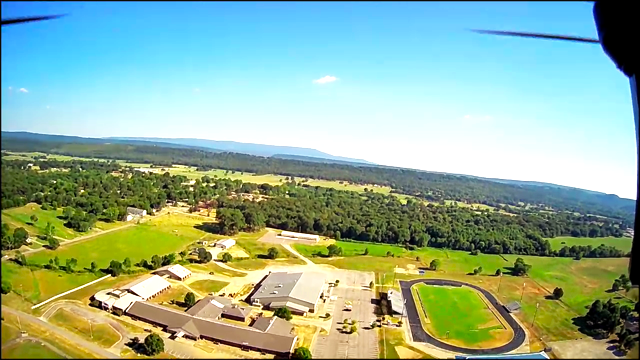
Aerial Photography Coming to RNN Sports this Fall!

RNN Sports is proud to add aerial photography to the sports photos we love to bring to you during each season! Photos from the drone “Eagle” will be included along with other photos in RNN’s Logan County Edition that is available by subscription. The Logan County Edition is the area’s newest print publication that is published each week. You can subscribe today by going to residentnewsnetwork.com and following the subscription links.

Thanks for reading RNN Sports, and look for new aerial photography to bring you all of the action next school year!

Homemade Bee Waterer

Bees, and other pollinators, are essential if you want a garden. With conditions outside getting more and more dry, its harder for our pollinator friends to find water close to their hives.

I would have never noticed our bees were needing drinks had they not taken over our kiddie pool as soon as my youngest was put in it. Honey bees are docile, and will not harm unless very threatened, but they do have stingers and are capable of using them.

Because my kids are so young I worried they would hurt a bee on accident causing it to sting them. Also, when one honey bee stings they release a scent that causes others to be on high alert, and more likely to sting. So we decided to make a waterer for our overly friendly bee friends.

Any container with high sides will work. We decided to use a bright colored frisbee to attract them. Place marbles or rocks inside to keep the bees from falling in. Add water as needed.

Arrest Reports 7/3

Arresting agency – Greenwood Police Department:
Katie Elizabeth Brown of Greenwood was booked into the Sebastian County Detention Center on July 5 at 9 p.m. and released on legally sufficient bond July 6 at 12:27 p.m. Brown was charged with Possession Drug Paraphernalia – Felony.

Joe Nathan Evatt of Greenwood was booked into the Sebastian County Detention Center on July 7 at 11:20 p.m. and released on July 11 at 5:23 p.m. Evatt was charged with failure to appear – class C misdemeanor.

Kristina Marie Strozier of Fort Smith was booked into the Sebastian County Detention Center on July 4 at 10:08 p.m. and remains at the SCADC without bond. Strozier was charged with parole violation, assist outside agency – misd., failure to appear – class C felony, and family to appear – class A misdemeanor.

Colin Randall Studyvin of Greenwood was booked into the Sebastian County Detention Center on July 6 at 4:40 p.m. and released legally sufficient bond July 6 at 9:47 p.m. Studyvin was charged with Domestic Battering in the Third Degree – Purposely.

Dylan Royce Wood of Greenwood was booked into the Sebastian County Detention Center on July 4 at 10:13 p.m. and released on legally sufficient bond July 6 at 5:13 p.m. Wood was charged with possession of drug paraphernalia – misdemeanor, possession of controlled substance – schedule VI misdemeanor <4oz., and possession of drug paraphernalia – felony.

Arresting agency – Hartford Police Department:
Judith Lee Francis Dooley of Huntington was booked into the Sebastian County Detention Center on July 6 at remains at the SCADC without bond. Dooley was charged with parole violation, absconding, and theft of property <$1k.

Arresting agency – Arkansas State Police Troop H:
Justin Boyd Gipson of Greenwood was booked into the Sebastian County Detention Center on July 9 at 2:11 a.m. and remains at the SCADC without bond. Gipson was charged with furnishing a prohibited article – correctional facility, possession of schedule I/II controlled substance with the purpose to deliver >2g., possession of drug paraphernalia – ingest meth/cocaine, no liability insurance, parole violation, and absconding.

Arresting agency – Hackett Police Department:
Michael Don Harris of Hackett was booked into the Sebastian County Detention Center on July 7 at 10:04 p.m. and remains at the SCADC. Harris was charged with ACT 570 – parolee, parole violation, pubic intoxication – annoyance, and theft of property <$1k.

Corey Justin Turner of Bonanza was booked into the Sebastian County Detention Center on July 8 at 10 p.m. and released on signature bond July 9 at 1:30 a.m. Turner was charged with Contempt-willful disobedience (Failure to Pay Fine).

Arresting agency – Sebastian County Sheriff’s Office:
Mareka Keon Kendall of Greenwood was booked into the Sebastian County Detention Center on July 8 at 10:31 a.m. and remains at the SCADC without bond. Kendall was charged with drug court sanctions.

Fallon Nichole Steffen of Booneville was booked into the Sebastian County Detention Center on July 7 at 12:49 p.m. and remains at the SCADC. Steffen was charged with two counts of Failure to Appear – Class C Felony.

Arresting agency – Bonanza Police Department:
Kash Colby Knight of Fort Smith was booked into the Sebastian County Detention Center on July 8 at 2:49 p.m. and is being held as a fugitive from justice – out of state.

Arresting agency – Fort Smith Police Department:
Brandon W Thomas of Greenwood was booked into the Sebastian County Detention Center on July 7 at 1:22 p.m. and remains at the SCADC without bond. Thomas was charged with parole violation and fleeing on foot – misd.

Arresting agency – Logan County Sheriff’s Office:
James Parent, 38, of Booneville was booked into the Logan County Detention Center on July 6 at 1:46 a.m. Parent was charged with possession of a schedule I or II controlled substance with the purpose to deliver, two counts of possession of drug paraphernalia, and controlled substances – offenses relating to records, maintaining premises, etc.

Lenara Shott, 45, of Booneville was booked into the Logan County Detention Center on July 6 at 10:36 p.m. Shott was charged with contempt of court, and violation of probation/suspended imposition of sentence.

Daniel Jones, 39, of Fort Smith was booked into the Logan County Detention Center on July 7 at 10:04 a.m. Jones was charged with failure to appear, and contempt of court.

Robert Yarberry, 37, of Booneville was booked into the Logan County Detention Center on July 7 at 5:24 p.m. Yarberry was charged with possession of schedule I or II controlled substance with purpose to deliver, two counts of possession of drug paraphernalia, controlled substances – offenses relating to records, maintaining premises, etc., and possession of a controlled substance.

Cheryl Hamby, 44, of Booneville was booked into the Logan County Detention Center on July 7 at 5:58 p.m. Hamby was charged with contempt of court.

Arielle Stone, 32, of Booneville was booked into the Logan County Detention Center on July 9 at 9:51 p.m. Stone was charged with two counts of speeding, refusal to submit to arrest, fleeing, driving while intoxicated, and battery in the second degree.

Thomas Jelks, 39, of Fort Smith was booked into the Logan County Detention Center on July 10 at 7:20 p.m. Jelks was charged with failure to appear.

Richard Smith, 20, of Ozark was booked into the Logan County Detention Center on July 11 at 11:41 a.m. and was sentenced to the Arkansas Department of Corrections.

Jarrad Davis, 29, of Booneville was booked into the Logan County Detention Center on July 11 at 4:21 p.m. Davis was charged with failure to appear.

Karen Downs, 44, of Booneville was booked into the Logan County Detention Center on July 12 at 12:44 a.m. Downs was charged with failure to appear.

Auston Umholtz, 36, of Ozark was booked into the Logan County Detention Center on July 13 at 9:08 a.m. Umholtz was charged with contempt of court.

**The charges against those arrested are allegations and the cases are still pending in the courts.**


Remember the Three R’s When Boating on a River

Randy Zellers Assistant Chief of Communications

The heat of summer often leads anglers to large rivers and the promise of large catfish and an extended period of fish activity thanks to current keeping surface water moving and slightly cooler than in backwaters and reservoirs. But traveling on a river like the Arkansas can be a daunting task for people who don’t know what all those buoys and channel markers mean. How do you know which side of the buoys to stay on when traveling up or down a river?

Remember the 3 R’s of boating: “Red right returning.” It applies in Arkansas and all over the nation.

Whether you are paddling a canoe, chugging along in a john boat, zipping by in a bass boat or cruising on a houseboat, this simple rule will keep you in the right place – in the channel where it’s safe.

Returning means coming upstream from the ocean or the mouth of the stream. Keep the red buoys on your right as you travel upstream. That means the green buoys will be on your left.

If you are going downstream, just reverse this. The red buoys will be on your left, green buoys on your right.

Buoys are found in many sizes and shapes. Just the red and green ones mark channels. Others are white and are for information. This may be directions to a facility, for controlled areas like no-wake zones, and to identify underwater dangers like rocks or dams. A buoy with black and white vertical stripes marks an obstruction; don’t travel between it and the shore or bank.

For more details on boating navigation rules in Arkansas and boater education courses offered by the AGFC, visit www.agfc.com/en/education/first-steps-outdoors/boatered.