
84 F
Fort Smith
Saturday, July 4, 2026
Home Blog Page 430

Forage, hay producers faced with fertilizer decisions

By Mary Hightower
U of A System Division of Agriculture

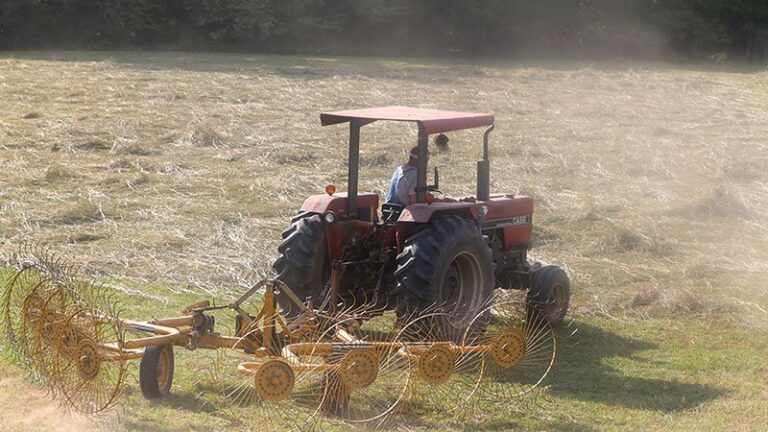
The record high costs of fertilizer are prompting hay and forage growers to look at all their options, including whether to use urea or ammonium nitrate and whether a urea additive will help.

“Urea is becoming the dominant nitrogen fertilizer because of increased regulations and higher costs associated with ammonium nitrate,” said John Jennings, professor and extension forage specialist, for the University of Arkansas System Division of Agriculture. “However, the decision of whether urea is the best nitrogen choice is not without question.”

Jennings said that in spring when soil temperatures are cool, urea fertilizer will give the same forage yield response as ammonium nitrate when applied at the same rate of nitrogen per acre.

“The myth persists that nitrogen from urea will be lost from volatilization when applied during summer,” he said. “Past and recent forage fertility research has shown that urea can be as effective as ammonium nitrate as a nitrogen source for bermudagrass when applied at the same nitrogen rates.”

Jennings said if urea is incorporated into the soil by rainfall within several days after application, nitrogen losses are minimal.

In recent years, additives such as NBPT — the active ingredient in nitrogen stabilizer Agrotain — has been added to urea fertilizer to reduce nitrogen losses by inhibiting the action of the enzyme urease in soil. Urease causes volatilization of ammonia from urea fertilizer. NBPT has been shown to effectively reduce nitrogen losses from urea in row crop fields.

“However, several research studies in Arkansas have shown that NBPT added to urea fertilizer did not increase forage dry matter of bermudagrass compared to urea alone,” Jennings said. “Thus, the added cost of NBPT may not be necessary when using urea for forages. Producers should consider all information when making forage fertilization decisions.”

Find additional resources for livestock and forages at the Cooperative Extension Service website.

Mention of product names does not imply endorsement by the University of Arkansas System Division of Agriculture.

To learn more about Division of Agriculture research, visit the Arkansas Agricultural Experiment Station website: https://aaes.uark.edu. Follow on Twitter at @ArkAgResearch. To learn more about the Division of Agriculture, visit https://uada.edu/. Follow us on Twitter at @AgInArk. To learn about extension programs in Arkansas, contact your local Cooperative Extension Service agent or visit www.uaex.uada.edu.

About the Division of Agriculture

The University of Arkansas System Division of Agriculture’s mission is to strengthen agriculture, communities, and families by connecting trusted research to the adoption of best practices. Through the Agricultural Experiment Station and the Cooperative Extension Service, the Division of Agriculture conducts research and extension work within the nation’s historic land grant education system. 

The Division of Agriculture is one of 20 entities within the University of Arkansas System. It has offices in all 75 counties in Arkansas and faculty on five system campuses.  

The University of Arkansas System Division of Agriculture offers all its Extension and Research programs to all eligible persons without regard to race, color, sex, gender identity, sexual orientation, national origin, religion, age, disability, marital or veteran status, genetic information, or any other legally protected status, and is an Affirmative Action/Equal Opportunity Employer.

Crappie on the half shell

Wil Hafner East Central Regional Educator

CASSCOE — As the old adage states, the dogwoods are blooming, so the crappie are biting. With that, spring is a great time to fill a cooler full of slabs. With a statewide limit of 30 crappie, a few good days of spring fishing can yield many meals for friends and family. While crappie is most often fried, there is no law that says it has to be. The mild flavor of crappie makes it a great choice for a variety of dishes. My favorite non-fried crappie dish is Cajun crappie on the half shell. 

This dish was inspired from a redfish trip out of Venice, Louisiana. Redfish, a saltwater cousin of the freshwater drum, is highly sought as a sportfish as well as a delicious option for the table. Redfish on the half shell is a staple in Cajun cooking. “Half shell” refers to a filet where the ribs have been removed, but the meat is still attached to the skin and scales. Substituting crappie for the redfish not only adds a Natural State twist to a classic dish, but it also offers a way to enjoy a lighter-flavored approach to your fishing success. 

  • 4 large crappie filets (skin and scales attached) 
  • 1 stick of melted butter 
  • ¼ cup Worcestershire sauce 
  • 1 tablespoon Louisiana style hot sauce 
  • 2 tablespoon cajun seasoning 

Preheat grill or smoker to 225 degrees. Place coals to one side to use indirect cooking method. Pat filets dry and place skin down on a non-metallic tray. Sprinkle ¼ tablespoon of Cajun seasoning on each filet. Place filets on grill or smoker, skin side down, away from coals and cover grill for 10 minutes. While the filets are cooking, combine melted butter, Worcestershire sauce, hot sauce and remaining Cajun seasoning. 

After 10 minutes, baste each filet with the butter sauce, let cook 5 more minutes. Baste and cover again. When fish is white and flaky (about 20 to 30 minutes) pull off the grill and baste with the butter sauce one more time. Serve with rice and grilled vegetables.

Pasture-weaned calves put weight back on faster, study shows

By John Lovett 
U of A System Division of Agriculture 

Recent Arkansas Agricultural Experiment Station research shows that ranchers may be able to mitigate stress in weaned calves and improve the bottom line. 

Results from the first year of this three-year study showed calves regained more weight the first 21 days of weaning in a pasture, either with or without physical contact of their mothers, compared to a “drylot” used for beefing up livestock with feed troughs. 

Weaning, which is the act of removing a calf from its mother’s milk, reduces the likelihood of respiratory diseases that can result in decreased performance and revenue compared to unweaned calves, said Daniel Rivera, director of the Southwest Research and Extension Center and principal investigator in the study. 

“It’s probably one of the biggest revenue losses in cattle production,” Rivera said of unweaned calves. 

He said U.S. Department of Agriculture data indicates cattle ranchers with more extensive operations tend to wean their calves more often than ranchers with smaller operations. 

“In terms of helping them make it to that next transition, looking at it from a pasture-based system, it’s probably a little easier on the animal than what we traditionally do with a ‘drylot,’” Rivera said. 

“Dr. Rivera’s research highlights the substantial impact that social and housing environments can have on agricultural animals during stressful and necessary husbandry practices,” Shawna Weimer, director of the Center for Food Animal Well-Being, said. “Weaning is one of the most stressful times for beef calves and it is outstanding to see Dr. Rivera’s team working on practical, resource-efficient weaning methods to mitigate stress and facilitate good animal welfare.” 

The Center for Food Animal Well-Being is a unit of the University of Arkansas System Division of Agriculture. The experiment station is the research arm of the division. 

Rivera also noted the potential cost-savings for ranchers. In the study, it cost about $2.50 per head daily in the “drylot” group for 56 days. Feed for the two pastured groups cost around $1.10 per head daily for that time span. In situations where a preconditioning program requires 28 days, Rivera said it could be more economical to wean in pasture the first 28 days. A “preconditioned” calf has been properly vaccinated and can eat and drink from water troughs and feed bunks.  

The Study 

About 115 Angus-based calves were weaned at about 200 days old from September through the end of November in the 2021 study. Rivera said the pastured calves grazed on Bermuda grass and were fed a supplement in a feed trough at a limited rate to match the energy content calves received in the drylot. One group of pastured calves — dubbed “Fenceline” for the study — had physical nose-to-nose contact with their mothers. The other pastured group — dubbed “Pastured” for the study — did not have contact with their mothers. 

Weaned calves were weighed every seven days up to day 28. A final weigh-in for all the calves was on day 56. 

While all calves lost weight the first week away from their mothers, the “Drylot” group dropped the most weight and then gained back less weight during the first three weeks of the weaning process. 

The “Fenceline” group dropped the least weight right after being weaned. At 14 days, the calves weaned in a pasture away from their mothers slightly exceeded the body weight of the “Fenceline” weaned calves. 

Rivera said he and co-researchers believe the steady weight gain during the first 21 days for the two pasture-weaned calf groups was due to the familiar environment and feed. 

At 28 days, all three groups were about 20 pounds heavier than when they were first weaned. On day 56, the “Drylot” group exceeded the two pastured groups in body weight change.  

The first year of this study showed that calves didn’t put on more weight just because they had nose-to-nose contact with their mothers in an adjacent pasture.  

The study’s preliminary results agree with data from the Mississippi State University Agricultural and Forestry Experiment Station that showed in Brahman-influenced heifers it took up to 14 days after weaning before they were consuming enough feed to meet maintenance requirements, Rivera said. The Mississippi study was conducted with support from Texas A&M University, Rivera noted. 

Rivera said part of the Arkansas study’s benefit was to show that producers do not need a lot of extra facilities to wean their calves. Pasture space and a dedicated feed trough are the two main requirements. While calves in a non-adjacent pasture, or paddock, can be weaned using an electric “hot wire” fence, Rivera said “fenceline” weaning that allows for nose-to-nose contact between a calf and its mother calls for a more robust “net wire” fence. 

“Just a hot wire fence would be torn through by the cows trying to reconnect, so in those cases, we use a stouter net wire fence,” Rivera said of “fenceline” weaning. 

Rivera’s co-researcher is program technician Whitney Rook. Research field technicians Cody Shelton and Richard Cyle Jones also are involved in the study. 

To learn more about Division of Agriculture research, visit the Arkansas Agricultural Experiment Station website: https://aaes.uada.edu/. Follow us on Twitter at @ArkAgResearch

The University of Arkansas System Division of Agriculture’s GoGreen program (https://bit.ly/36XtpqM) continues to offer verification of “preconditioned” calves through the Cooperative Extension Service. 

To learn about Extension Programs in Arkansas, contact your local Cooperative Extension Service agent or visit https://uaex.uada.edu/. Follow us on Twitter at @AR_Extension

About the Division of Agriculture 

The University of Arkansas System Division of Agriculture’s mission is to strengthen agriculture, communities, and families by connecting trusted research to the adoption of best practices. Through the Agricultural Experiment Station and the Cooperative Extension Service, the Division of Agriculture conducts research and extension work within the nation’s historic land grant education system. 

The Division of Agriculture is one of 20 entities within the University of Arkansas System. It has offices in all 75 counties in Arkansas and faculty on five system campuses. 

The University of Arkansas System Division of Agriculture offers all its Extension and Research programs and services without regard to race, color, sex, gender identity, sexual orientation, national origin, religion, age, disability, marital or veteran status, genetic information, or any other legally protected status, and is an Affirmative Action/Equal Opportunity Employer.
 

Students at Subiaco Academy take first steps into the outdoors

Randy Zellers Assistant Chief of Communications

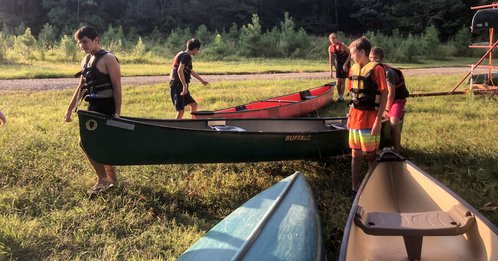
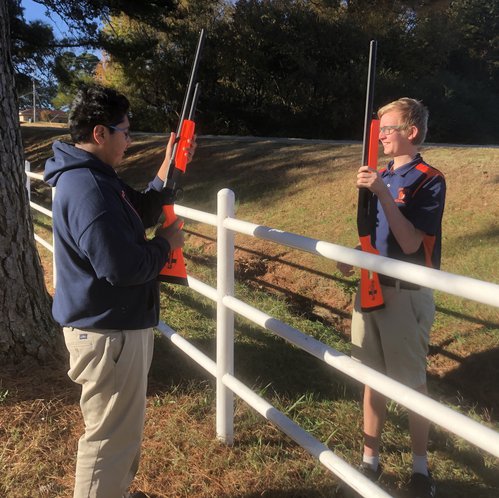
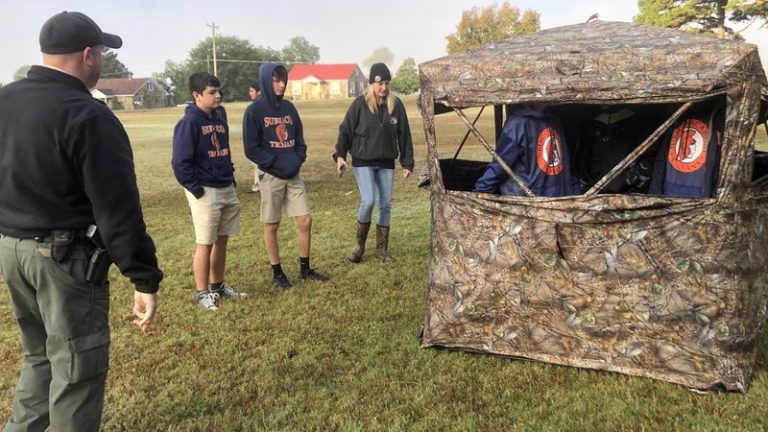
SUBIACO — With 500 acres of wooded terrain beside Mount Magazine Wildlife Management Area, Subiaco Academy has enjoyed a rich history of introducing young men to the outdoors as well as preparing them for productive lives. However, during the last few decades, as pursuits sports and other extracurricular activities have become increasingly organized and some of the more outdoors-oriented faculty have left, there has been a need to revitalize outdoor experiences at the school. Nick McDaniel, a new science teacher on the hill, was hired with the goal of reinvigorating the school’s outdoor program.

Having grown up on an Iowa farm and having a parent who was part of the Iowa Department of Natural Resources, McDaniel was well-versed in the outdoors, but living an outdoor lifestyle and teaching it are two different things. He turned to the Outdoors Adventure Program to help bridge that gap. The program was developed by the Outdoors Tomorrow Foundation and is offered in partnership with the Arkansas Game and Fish Commission. It fosters outdoor education by offering lesson plans and curriculum to support a full year of outdoor education while meeting all teaching standards. While the students taught at Subiaco Academy are all male, the program is developed on a co-ed basis. Writing, math, science and other core subjects are highlighted in the curriculum, so students learn more than the outdoors, they learn about life.

Not only does the program offer curriculum, but it provides contacts and help from AGFC education professionals who can help with subjects such as Hunter EducationBoating Education and Fishing in The Natural State, an education program focused on biology, conservation and angling for some of Arkansas’s favorite sportfish.

Camping, rock-climbing, mountain biking and many other activities are featured throughout the semester-long course, so students always have a new experience waiting when they get to class. 

In his first full year with the Outdoors Adventures program, McDaniel has been able to introduce 14 young men in his Physical Education class to the outdoors, as well as 20 to 30 participants through the afterschool program offered through the Academy. 

“All of my PE students have completed Hunter Education and Boating Education,” McDaniel said. “We’ve been able to keep students’ attentions and all of them are more willing and excited to get outside, even when conditions are not ideal. And the people at the AGFC have been great in helping teach me how to teach the students. Some have even helped with class trips and lessons.” 

Some things that might seem like second nature to many people who have grown up outdoors are foreign to today’s students. It’s not that they are lazy or unable to learn these skills, they’ve just never been in a setting where such skills are prevalent. 

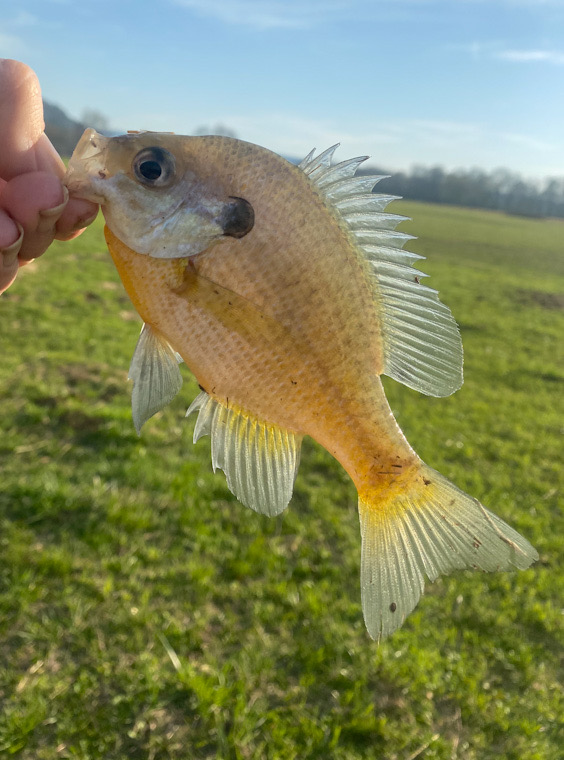
“Two students in the program learned to ride a mountain bike for the first time, and a student who really had no interest in mountain biking before the program went out and purchased his own bike to continue enjoying the outdoors,” McDaniel said. “I have one student who just learned to fish who caught his first bream and went through the whole process of cleaning and cooking his catch using one of the program’s camp stoves. It’s just amazing watching some of these young men take an interest in something that was such a formative part of my life and knowing the outdoors experiences available to them throughout their lives because they learned these skills.”

Teachers interested in the Outdoors Adventures Program can learn more from Sheila Connerly, who helps coordinate this and other programs aimed at teaching educators how to incorporate more outdoors education in their daily curriculums. The curriculum and lesson plans must be purchased, but it comes with a matching grant to help purchase equipment needed to conduct the lessons. 

“The upfront cost is more to ensure school’s have a vested interest in the program’s success,” Connerly said. “But we can even find programs like the AGFC’s fine money conservation education grants, to reduce that cost even more. Fine money collected in each county is allocated to education grants administered by the Arkansas Department of Rural Services.” 

According to McDaniel, OTF also has a monthly newsletter for teachers to really learn how to adapt the program to different settings. 

“I’m really fortunate to have such a wonderful setting to teach the outdoors, but there are resources in the newsletter for teachers to teach the basics of paddling or other outdoors recreation in a gym or other indoor setting before taking their students out for a trial run,” McDaniel said. “It’s great for a person who has the desire to take kids outside, but might not have the outdoor knowledge and wants to learn as they go.” 

McDaniel hopes to expand the lessons even further in Subiaco Academy’s outdoor education program, adding larger components of outdoor cooking and the AGFC’s Fishing in the Natural State Program to get the students even more comfortable with fishing and cooking their catch.

“People are separated so much from their food, it’s important to me that we help reconnect them with understanding how that whole process works,” McDaniel said. “The curriculum is a great baseline to guide future purchases and develop the process to solicit future grants and donations to enrich the students’ learning experiences even more. We have many more mountain biking, hiking and camping trips planned as well as participation in archery through the [Arkansas National Archery in the Schools] program. 

“Each of these experiences may hold a golden nugget to something valuable about life and what is available in the world,’ McDaniel said. “I’ve been given the honor of taking 50 to 60 young men to learn about the outdoors here so far, and every student has found at least one thing they’ve connected to through these experiences.”

Lady Eagles Pick-up Needed Conference Softball Victory Over Cedarville

The spring rains continued in Logan County on Monday, forcing the postponement of the Paris vesus Cedarville baseball game to be played today. But Tuesday’s scheduled conference softball match-up between Paris and Cedarville was played in Paris as scheduled. Both teams were looking for much-needed conference wins after a tough pair of conference losses last week. And under the clear blue sky that matched the Lady Eagles’ uniform trim, Paris defeated Cedarville 13-0. Paris senior Karsyn Tencleve got the shutout win in leading the Lady Eagles to a much-needed conference victory.

It only took Paris one hitter to take the lead and never look back in the lopsided win. Paris junior Jayden Wells, moved to the lead-off hitter position in the Lady Eagles’ lineup, hit a solo home run in her first at-bat. From that point, it was a non-stop series of Paris hitters that reached base and eventually scored, early and often for the Lady Eagles.

The game also provided a glimpse into the Paris softball future when Tencleve was lifted in the top of the fifth inning and relieved by freshman pitcher Kaydence Freeman. The move gave Tencleve rest for her upcoming conference starts and provided game experience for Freeman who may be counted upon to take the circle for conference starts next season. Freeman pitched well in her conference debut. She allowed two base runners in the only inning of her appearance, but was able to show poise and eventually settled down to get out of the inning without giving up a run.

Paris now turns their attention to a critical game and rematch with the Charleston Lady Tigers that will be played today at 4:30 p.m. in Charleston. Paris dropped their first meeting in a game that saw the Lady Eagles commit several defensive errors while at the same time being shut down at the plate by Charleston pitcher Rylee Ross. The game is a must-win for Paris to get back into the conference race. A loss at Charleston will drop Paris to two games behind the Lady Tigers in the conference standings.

Stay with Resident News Network for the latest in River Valley high school softball action!

Greenwood Woman Killed in Fatal Crash

A multi car accident left one Greenwood woman dead on Tuesday, April 5. That accident took place at approximately 9:18 a.m. on U.S. Highway 71 and Old Jenny Lind Loop.

The Arkansas Department of Public Safety Report identified that woman as Jennifer Eryn Barger, 27.  The vehicle Barger was driving was traveling north on U.S. Highway 71 and rear ended another vehicle that had slowed to make a turn.

The reported stated that there was one additional injury in the accident, and that they were transported to Mercy Hospital.

The deceased’s next of kin had been notified, according to the Arkansas State Police.

Spring Fishing

Fishing season is here! All the fishermen, and the wives who are ready for the fishermen to leave the house, rejoice! It’s still early spring which means a lot of variation in temperatures which can make fishing a bit more difficult. Warmer days are coming, though, and there are a few tips for helping get some fish to the shore even now!

  1. Find warm water; fish will be as deep as they can when the water is cold. Wait for warmer days to head out to increase your chances of catching any.
  2. Even on warm days, the mornings are cold. Similar to the first tip wait until afternoon hours when the day is as warm as possible to wet your line. 
  3. Use live bait- fish are sluggish due to the cool waters they are in. Having a smaller bait option that’s wiggling is much more attractive than a giant bait that’s moving fast. Our kids love perch jerking in the early spring, the suspended live worms being still allows them ample time to make their way over. It’s fast moving enough to keep me our littles entertained.
  4. Set your hook slower than normal. This tip is great for me, I’m always slow to set my hook it seems. Pros recommend delaying a second or two also because of the cool temps.
  5. Be patient- because of the variation in temps a spot may not prove fruitful just yet. Don’t write off a spot this early in the year, check back once temperatures warm. 

Fishing is a great way to spend time together as a family, or just to get out of the house solo. As the days get warmer the fish will come off their bed hungry and ripe for the taking. It’s always a good day with a fishing pole in hand, though; even if they aren’t biting.

Obituary – Gail Wixson (1929-2022)

Master Chief Gail Arnold Wixson, (USN Retired) passed away Monday March 28 in Fort Smith after a brief illness. He was the beloved patriarch of the Wixson clan; at 93, he was the last survivor of his generation. Gail was born in Cedarville, California on February 22, 1929, the second child and oldest son of Laura (Cerwenka) and Gail Francis Wixson.

His early years were spent in northern California and the Nevada desert. In 1937, following the death of his mother and his father’s injury in an industrial accident, Gail and his three siblings became wards of Kearns-St. Ann’s Catholic Orphanage in Salt Lake City. As one of the older boys, Gail got his first taste of farming, as he worked the fields there and helped harvest the food grown for the school. Despite the difficulties of being raised without their parents, the Wixson clan was extraordinarily close, a bond that lasted their lifetimes. The bonds of family expanded to include several other orphaned children who became lifelong “family.” The boys remained at the orphanage several years until they were able to join their father on a farm he had purchased on the North Fork near Chehalis, Washington (older sister Maybelle graduated out of the orphanage).

A brief early marriage produced Gail’s only child, Edna Wixson Bonfield, who preceded him in death but gave him treasured grandchildren. He joined the US Navy and enjoyed a long and storied career, achieving the rank of Master Chief. The majority of his service saw him stationed in Ewa Beach, Hawaii, but he also had stints onboard ship and in Japan, California and on Whidbey Island in Washington state. He married Dorothy Peck on May 22, 1959 at Brownsville, Texas; they were together until her death in 2010. This union brought him two stepchildren and an extended family. He asked Dorothy to pick out a farm of her choosing as he prepared to retire from the Navy; she chose a farm in Greenwood, Arkansas, where they lived for many years before finally settling at the Wixson Farm in Huntington. Gail continued to farm, including haying those fields until 2016. Together he and Dorothy were active in several Veteran organizations including the Fleet Reserve Association.

Gail lived his life purposefully, and with gusto. Early pranks included putting snakes in his sister’s bed. Whenever he got together with his adult Siblings, he mesmerized his nieces and nephews with tales from his Youth. He loved children and indulged all of us with stories of the pink chicken. He would pretend to be our pet elephant and ate every wild fern we would feed him. He had a great sense of humor and was delighted when children would stop and point at him in a store, as they asked their parents if he was “Mr. Clean ” (yes, he bore quite the resemblance). He was a hero for serving his country, but also for how he conducted his life. When he was diagnosed with diabetes in his early forties, immediately began taking good care of his health, quitting smoking and drinking, eating healthy and exercising. This gave him the gift of longevity, as all of us who loved him are grateful for the extra years we had with him. We all have cherished memories of visits with him.

Gail was also preceded in death by his parents; his wife, Dorothy (2010); his siblings Maybelle, George and Mahlon Wixson; his grandson, Mel Bonfield; and nephews, Gail, Richard and Brian Wixson and Irvin Urquhart. He is survived by his devoted companion of eight years, Margaret Mergen, of the home Huntington, Arkansas. Survivors include grandchildren Stacy (Lupe) Flores, Nipomo, California, Angela Cabrera, Oycutt, California, Justin Bonfield, Guadalupe, California, nieces Vicky Wixson, Yvette Wixson, Cindy (Randy) Badgett and Candace Regan, and nephew David (Carolyn) Wixson, all of Washington state; step children Ronald (Yvonne) Peck of Rio Hondo, Texas and Jacquin (James) Tyler of Honey Grove, Texas; numerous step grandchildren, great grandchildren and great nieces and nephews, and his orphanage family, Sister Timothea Kingston of Notre Dame, Indiana.

A service for Gail Arnold Wixson will be held at 10 a.m., Saturday, April 23, 2022, at Rock Creek Baptist Church. A memorial service will also be held in Washington state, dates to be announced. The family suggests that in lieu of flowers, donations honoring the life of Gail Wixson may be made to the Fleet Reserve Association Veteran Service Foundation, 125 Northwest Street, Alexandria, VA 22314 or online at FRA.org. or his local church Rock Creek Baptist, Mansfield Arkansas.

Arrest Reports 3/27

Arresting agency – Hackett Police Department:
Cory Justin Bennett of Fort Smith was booked into the Sebastian County Detention Center on March 30 at 8:30 p.m. and remains at the SCADC. Bennett was charged with public intoxication – danger to self or others, two counts of endangering the welfare of a minor in the third degree, and two counts of failure to appear – class B misdemeanor.

Arresting agency – Sebastian County Sheriff’s Office:
Justin Ray Carrol of Hackett was booked into the Sebastian County Detention Center on March 29 at 12:37 p.m. and remains at the SCADC. Carrol was charged with failure to appear – class A misdemeanor, contempt-willful disobedience (failure to pay fine), and two counts of failure to appear – class B misdemeanor.

Nicholas Andrew Morgan of Greenwood was booked into the Sebastian County Detention Center on March 28 at 3:54 p.m. and released on bond March 31 at 4:42 p.m. Morgan was charged with failure to appear – class C felony, and petition to revoke – misdemeanor.

Arresting agency – Fort Smith Police Department:
Brittany Nicole Collier of Greenwood was booked into the Sebastian County Detention Center on March 27 at 12:46 a.m. and released on legally sufficient bond March 27 at 2:21 a.m. Collier was charged with domestic battering in the third degree – purposely.

Arresting agency – Greenwood Police Department:
Breanna Kim Grant of Greenwood was booked into the Sebastian County Detention Center on April 2 at 3:49 p.m. and released on signature bond April 2 at 11:48 p.m. Grant was charged with contempt – willful disobedience (failure to pay fine).

Jessica Powell-Brady of Greenwood was booked into the Sebastian County Detention Center on April 1 at 6:48 p.m. and released on legally sufficient bond April 2 at 10 a.m. Brady was charged with possession of drug paraphernalia – misdemeanor, possession of methamphetamine (10-200 g) – inmate, and possession of cocaine <2g.

**The charges against those arrested are allegations and the cases are still pending in the courts.**

Obituary – Janet E. (Siebenborn) Edwards (1930-2022)

On March 30, 2022 Janet Edwards left her home to abide with her heavenly Father. A resident of Parks, Arkansas she was also a cherished member of the Waldron Community.

Jan was born in Connecticut and was very proud of her Yankee heritage. She moved to California and after a few years she met and married her soul mate Kyle Edwards. After retiring they moved to Parks and built their dream home which was always warm and welcoming. After 40 years she became known as a beautiful southern belle.

Jan was a world traveler and had a zest for life. Her days consisted of lunching with her friends whenever she got the opportunity, attending Bible study and of course, playing bridge with beloved friends. She was the ideal hostess and loved to entertain.

Music was high on her list of enjoyment, especially the country and cajun sound of “Gator and Friends”. Whenever they were playing on Tuesday night at Hatfield, you could find Jan in her glory, listening to the music, visiting with friends and occasionally even dancing.

Jan is survived by her beloved and faithful Pomeranian, Molly, countless friends who love her and will miss her especially her best friend, Verna.

Preceding her in death were her soul mate and loving husband, Kyle Edwards, two sons: Michael and Dennie West and her parents and grandparents.

Jan’s memorial life celebration will be at 2:00 p.m., Sunday, April 10, 2022 at the United Methodist Church in Waldron, Arkansas with Rev. Diane Miller, and Rev. Roger Rice officiating. Arrangements and cremation are being entrusted to the Heritage Memorial Funeral Home & Crematory in Waldron, Arkansas.

In Jan’s honor a memorial garden will be created at the United Methodist Church in Waldron, Arkansas. Memorial contributions for this project can be made to Waldron United Methodist Church or at Amber’s Bistro.