78.4 F
Fort Smith
Sunday, July 5, 2026
Home Blog Page 448

Money Tips for 2022

We are still fresh into a new year, and if you had a goal to save money or get out of debt I’m here to help! I found six of the best tips for your finances for 2022.

1. Set a budget, and make it realistic. If you are spending $600 a month on groceries it’s probably not practical to decide you can do it for $150 a month. You will likely starve doing that. Maybe you could shop your fridge, pantry, and freezer and get by for the first month, but after a short time you will run out of food. Try reducing by $50 or $75 in the beginning and work from there to your realistic goal budget.

2. Set a shopping timer. Yikes. This one is aimed at me. I’m a late night shopper, and I can spend a lot of time on Amazon while I’m up for a feeding with my baby. Setting a timer and sticking to your list are game changers for your budget! If you didn’t get it after 5 or 10 minutes you probably didn’t know you “needed it”.

3. Delete your auto fills- get up and get your wallet. It will make you think twice about the money you’re spending.

4. Splurge with cash, cash has no interest applied. Cash doesn’t result in overdrafts. Pay for your splurges in cash.

5. Make your goals visible. What happens when you pay off debt? Or what will you do with the money you save? Print out/draw/write down your goal and put it where you will see it or set it as your phone or desktop background. Keep it on your mind to keep you motivated.

6. Try a no-spend week or weekend once a season. You can set your parameters for what is allowed and what isn’t. Necessities like gas to get to work, bills, etc. may be exemptions if going for a whole week. Decide what is still allowed but cut out all unnecessary spending for your set amount of time.

The beginning of a new year is when so many start new goals, but a random Wednesday is also a good time to get your finances in order. The most important thing is getting started.

State Capitol Week in Review From Senator Terry Rice

LITTLE ROCK – The state Division of Children and Family Services intends to try out a new method of intervention, by assigning cases to a team of workers instead of to an individual.

The Division is part of the state Department of Human Services (DHS). The department’s directors appeared during legislative budget hearings to explain their requests for funding increases and their requests for authority to reallocate funds.

When the legislature convenes in fiscal session next month it will decide whether to approve the DHS request to add 109 positions in the Division of Children and Family Services.

One reason for a “teaming approach” is that it would better ensure the safety of caseworkers.

When they visit a home to investigate an allegation of child abuse or neglect, they would no longer have to visit alone. There would always be at least two workers on the visit.

The department wants to add $11 million to the Division for added personnel costs. The additional money would not only pay for more staff, but would allow DHS to pay overtime and to pay staff when they’re on call.

Those measures help reduce the high turnover rate among family case workers, who burn out due to high caseloads and the emotional nature of their jobs.

Also, the department wants to expand an intensive family services approach that it now has in about half the state. According to the top official at the agency, it has made “a massive difference” in reducing the number of children who end up in the foster care system.

With an additional $4 million the department would like to expand the intensive family services to 16 more counties.

DHS has a Division of County Operations. It staffs offices around the state where people apply for a wide variety of benefits, such as food stamps, Medicaid and welfare. DHS is seeking about $2 million in additional funding for the Division because it is paying more for utilities, janitorial services, rent and other costs that have gone up due to inflation.

Also, the Division wants to expand and make permanent an automated address verification system. It has been a pilot program.

DHS anticipates additional one-time costs when the federal medical emergency expires. During the period of emergency the state has not been able to lower the number of people who are eligible for the health care program, because of federal restrictions.

As a result, Medicaid participation has increased during the pandemic. Increases in enrollment are a main driver in the rising costs of Medicaid.

For the current fiscal year, Arkansas Medicaid officials estimate the program will spend about $9.39 billion. The state’s share of that amount is $1.8 billion and the rest is provided by the federal government.

Next fiscal year, which begins on July 1, Arkansas Medicaid will spend an estimated $9.4 billion. The state’s share will be $2.269 billion, the head of DHS told legislators during budget hearings.

After the federal emergency declaration has expired, Arkansas should be able to hold down Medicaid spending because it will re-determine the eligibility of people enrolled. State officials expect that the number of people enrolled will drop by a “significant number,” the DHS official told legislators.

“Just Roll with It” Serving up Recipes and Humor

By Sheri Hopkins
Lifestyle Contributor

Hello everyone! Glad to be back, for those who don’t know, I have had COVID. I feel 100 percent better, but it got me down for about six days. Stay safe and be careful.

I know we all have a favorite cake that we always ask for on our birthdays. When I was a little girl, I was the odd kid. I always asked for coconut cake.

Momma always made me a coconut cake on July 25 for my special day. I still love coconut cake. But, I also love Italian Cream Cake. It is one of my favorites. I cheat and use a cake mix.

I just want to thank everyone for all the calls, prayers, food and concern during my illness. I can truly say I have the best friends, family and neighbors. Which reminded me of a story.

When Chuck and I lived in Owego, NY I had always heard New Yorkers were not friendly. Keep in mind I was a hick from Arkansas. I was out and about by myself one day checking out the town while Chuck was at work. I was driving around and headed down a street. Everyone was waving and honking. I thought boy, everyone is sure wrong about these New Yorkers not being friendly, this is such a friendly town! When I got to the end of the street, I noticed I was going down the wrong way of a one-way street. Hmmm, now I know why everyone was waving at me.

I still enjoyed my time in Owego and I have always managed to do crazy things.

The lady we rented from while there was very kind to me. She knew how homesick I was, so she was always so nice to me. One thing about New York back then is that they didn’t know what biscuits and gravy was. When I say that, I am not kidding. Not a restaurant in town had them. They looked at me like I was crazy when I asked for it.

This nice lady tried to make them for me. Bless is all I can say. Do you know how hard it is to eat something in front of someone that tastes awful? I tried to choke them down, but it was horrible.

Funny how I always remember stories about food, haha!

I hope you enjoy a good old ITALIAN CREAM CAKE:
1 yellow cake mix
1 small instant vanilla pudding
1 cup of water
4 eggs
1/2 cup oil
1/2 cup chopped pecans or walnuts
1 cup of flaked coconut
Preheat your oven to 350 degrees. In a large bowl, mix the cake mix, pudding mix, water, oil, and eggs. Beat two minutes, fold in chopped nuts and coconut. Spray a 9×13 pan with nonstick spray and pour in batter. Bake for 25-30 minutes, or until toothpick comes out clean.
ICING:
3 1/2 cups of powdered sugar
1 stick of soft butter
8 oz. cream cheese
1 tablespoon of vanilla
Mix ingredients well spread on cooled cake and sprinkle with crushed nuts.

DIY Wool Dryer Balls

Did you know dryer sheets are full of yucky chemicals? Well, if you didn’t- they are.

You can just not put anything in your dryer, I do that more often than not during the summer. But during the winter, I want something to help with all that static! Wool dryer balls are the perfect dryer sheet alternative! You can add essential oils to them to add scent. They cut down on drying time, and there is no more need to buy dryer sheets saving you money!

Wool dryer balls are simple (and cheap) to make! All you need is panty hose and wool yarn.

Sample yarn from walmart.com. It’s most important to make sure it’s 100% wool.

One skein of yarn makes several dryer balls, and one skein at Walmart is about $6. If you don’t have a pair of old panty hose you can also grab a pair at Walmart for $1 or so.

To begin wrap the yarn around two fingers 15-20 times. Slip the yarn off your fingers and wrap around the middle 2-3 times. You will end up with something resembling a bow.

Keep tightly wrapping around and around, it will slowly start resembling a ball. Go until you reach your desired size, about the size of a tennis ball is ideal.

Snip the yarn and tuck the end back into the ball. Cut the leg part off your panty hose and place your yarn ball inside, tie a knot right about the ball. Repeat until you have the desired number of dryer balls.

Wash the hose with the dryer balls on a hot cycle. Using hot encourages the wool to fuse together. You can throw in a load of towels so you aren’t wasting water. Washing a couple times is key to get it heated.

Now dry on the highest heat setting in your dryer. Remove from the hose once completely dry, cutting may be required.

And now you are ready to tackle some laundry! Add a few drops of essential oils and 3-4 dryer balls to each load. Or just one if you are like me and your kids run off with them often leaving just one where it should be.

Timeline: Escape at Fort Chaffee

By Dr. Curtis Varnell

Fort Chafee was created in 1941 as a training military training camp for those about to depart to fight WWII.  A little know part of the story is that the area also served as an internment area of German prisoners of war. 

Nearly 23,000 captured troops, mostly from Rommel’s Afrika Korps, were sent to POW camps in Arkansas.  Nearly 4,000 of those prisoners were sent to Chaffee where they were housed on a remote 83-acre section of the fort.   It must have been quite a welcome shock to see the verdant green country-side of Arkansas after spending years defending the sands of North Africa. 

The Afrika Korps were an elite group and most of the men decided to make the most of their time in captivity. In an article by Pritchett and Shea, life for the prisoners was pleasant for war years and many locals felt they were coddled.  They were put to work on local projects within the fort and spent leisure time playing soccer, practicing music, or performing in plays.  Later, because of extreme labor shortages in Arkansas, they were allowed to work outside the fort and were paid a modest wage.  In our region, several worked on the levees along the river and 150 of them went to Russellville and worked for the Chickasaw Wood Products making stave bolts.

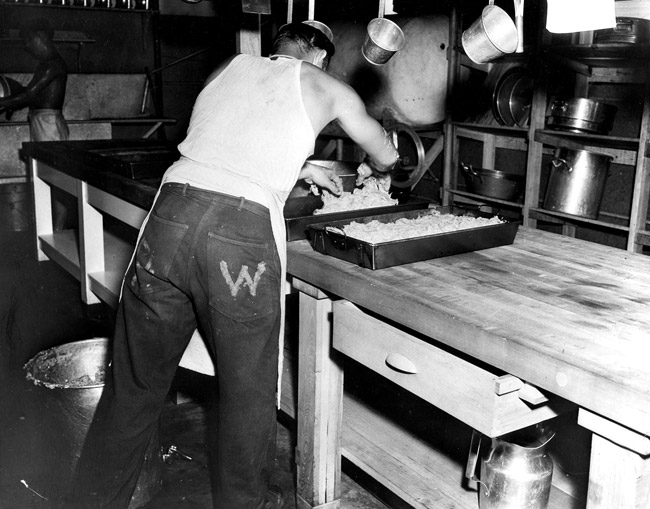
Very few tried to escape.  When they did, they were generally captured within a short period.  They were astonished to discover how very large America was and how remote they were from home.  In a story provided by Mrs. Frank Huck of Branch, Michael Huebinger, a young German soldier, escaped by simply walking away from a work squad.  Even though he had on a prison uniform with PW painted in white across the seat of his pants, he walked right by the guards.  When one asked him where he was going, he replied “Fort Smith” and just kept on walking.  He walked all night and slept in a thicket. He hid the next day in a parked truck near a dairy then walked until day break of the second day.  In the distance, he saw the spire of Sacred Heart Church in Charleston and decided to join the service.  Kate Classen saw the P.W. on his trousers and alerted her husband and the priest.  They talked to Huebinger and, after taking him home for breakfast, convinced him it was his duty to return.  He later wrote a thank you note to the family for their kindness.  Another escapee, when asked by his superior why he attempted the impossible escape, replied, “I just wanted to see those pretty girls in Fort Smith.”

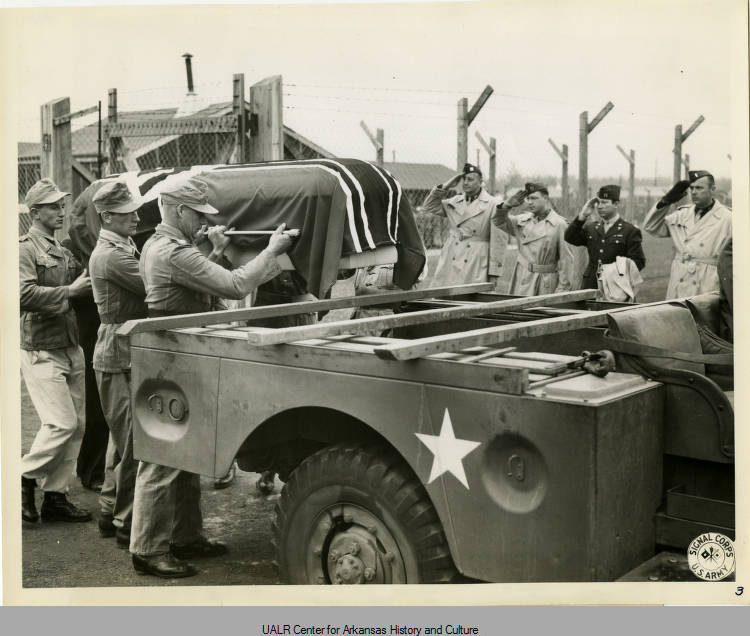
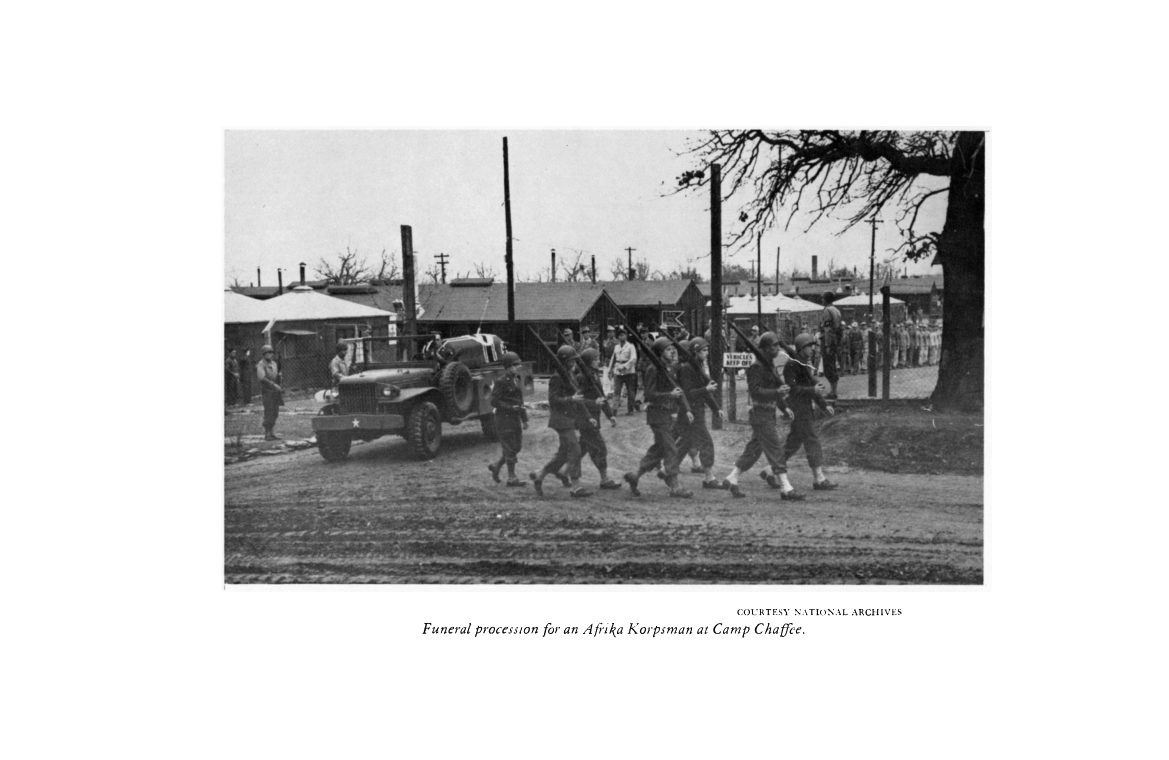
Hundreds of prisoners cycled through the prisoner barracks of Fort Chaffee between the years of 1943 and 1946.  Due to extreme labor shortages and the required period of transition time to return home, many were retained for more than a year after the war was over.  During those three years, eight POW’s died from natural causes.  German officers and men were allowed to participate in the funerals and to bury their dead in respect and dignity.  In the intervening years, those bodies have been disinterred, and unless claimed by family, received final burial and Fort Sam Houston. The fair and kind treatment formed a lasting impression on these men, many of whom have returned to observe once again the site where they were imprisoned. 

As one stated, “We are so happy and excited that people still want to know about our story, our history, and to read about and learn from it.”

TAG (Tigers Achieving Greatness) Program Up and Running at Mansfield Middle School

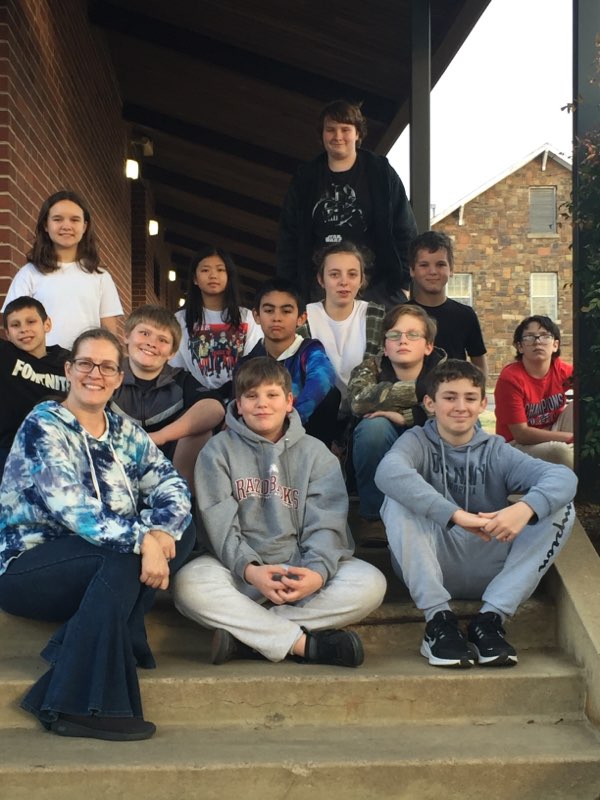
After a long process of planning and preparing, the Mansfield Public School TAG program is underway.  The TAG program is an after-school program offered, with no cost to parents, at Mansfield Middle School sponsored by the Arkansas ARP ESSER III Afterschool and Summer Learning Competitive Grant.  The grant is through the Arkansas Out of School Network and Arkansas State University, which received funding from the AR Department of Elementary and Secondary Education (DESE).   The Mansfield Middle School team volunteered their time to write the grant led by TAG Director Mrs. Lori Lamb.  The team was composed of Middle School Teachers Dimity Beran,  Malinda Wesley, and Principal,  Floyd Fisher.  After multiple hours of planning and writing, the team was awarded the highest AOSN grant in the state of Arkansas.  The grant was approved for just under $155,000.00. 

The program finally received the official contracts to begin just prior to Christmas Break.    As we have all learned these past two years, nothing is easy during covid related times.  The TAG program was set to begin January 10th upon arrival for the New Year.  Unfortunately, that week the district had to move to offsite instruction due to an increase of faculty positive covid cases.  After all the setbacks and tribulations, we are excited to announce our first day of TAG was a success!

Mrs. Lori Lamb and her team of Mansfield Public School teachers are building a program like none we have seen in our community before.  The first day was full of fun activities with just over 50 after-school students.  The TAG team continues to build on ideas from students, faculty, and community input.  The TAG program is working to offer students access to music, art, physical activity, STEM activities, robotics, community service projects, and many other items we are excited about.  

The TAG program begins daily with Mansfield Public School Cafeteria staff working to provide after-school snacks and ends with the serving of a third meal which is made possible by a  grant through DHS.  The after-school snack grant and third meal DHS grant was put in place by Mrs. Sonia Norris, Mansfield School District Cafeteria Supervisor.   Students not only have the opportunity to explore a variety of learning environments, but also a plethora of activities to enhance learning outside of the traditional classroom setting.  We look forward to sharing pictures and bringing in community resources to teach students how to be more successful in our society.  We look forward to adding technology that students have had limited contact with and learn the applications to real-world scenarios. Community members with special skills are asked to contact our TAG program coordinator.  Businesses are also encouraged to support TAG by volunteering as guest speakers to help our students develop community relationships and career field exposure.  Registration is currently open for TAG.

Obituary – Margo Linda Parish (1949-2022)

Margo Linda (Pena`) Parish of Waldron, Arkansas went to be with her Lord and Savior, Thursday, January 20, 2022 in Waldron, Arkansas with loved ones by her side. Margo was born September 13, 1949 in Bedford, Ohio to Marcus Pena` and Evelyn Louise Anderson. She was 72 years old.

Margo was retired from being a store clerk. She enjoyed camping, fishing, and spending time with her family. Margo was very talented and accomplished in arts and crafts. She looked forward to making memories and sharing good laughs with those she loved.

Margo leaves behind to cherish her memory, her loving husband of 40 years, Paul Parish of the home, one daughter, Andrea Reynolds and one son David Drozdowski Jr. as well as her siblings: Debbie, Kenny, Tom Henry and Jack. Memaw will forever be missed by numerous grandchildren, great-grandchildren and one great great-grandchild. Margo will be missed by all that knew her and the many whose lives she impacted including a host of nieces, nephews, friends and loved ones dear to her.

Margo was preceded in death by her parents, two daughters, Davell “DeeDee” Fuss and Chrissy Drozdowski, one grandson, Ray Reynolds, one granddaughter, Tiffany Drozdowski and two sisters, Barbara Lynn and Billie Leigh.

Margo’s memorial life celebration will be 10:00 a.m., Monday, January 24, 2022 at the Heritage Memorial Funeral Home Chapel in Waldron, Arkansas with Rev. Pat Ray Biggs officiating.

Gardening from Scraps

We all know seeds grow vegetables, but did you know some vegetables (and fruit) can regrow from scraps? I find this fascinating! I also love doing it in my own kitchen.

Green onions- save the bulb of your onions, place them in water, and watch the green shoot back up!

Celery- leave an inch or two at the base when cutting the stalks. Place in direct sunlight in water for about a week, once the green stalks have good growth on them transfer to soil.

Romaine lettuce and Bok Choy- save the bottom of your lettuce or bok choy and like celery, place in water until regrowth begins and then move to soil.

Leeks- leeks are regrown like onions, leave about two inches at the bottom when cutting. The size of leeks means they take longer to regrow.

Pineapple- its important to keep in mind it can take two years on average to get fruit from a pineapple tree.

When cutting a pineapple twist off the leaves, then tear off the bottom few leaves that were closest to the pineapple. Place in water for two to three weeks until a good root system has started. Transplant into well draining soil and research pineapple care!

With prices skyrocketing getting the most out of any and all food is of utmost importance. See what you can regrow on your kitchen counter!

Arkansas public access to benefit from modernized Marine Fuel Tax Program

Randy Zellers Assistant Chief of Communications

The Arkansas Game and Fish Commission unanimously approved at today’s regularly scheduled meeting a minute order authorizing AGFC Director Austin Booth to sign an agreement with the Arkansas Department of Transportation to update the existing Marine Fuel Tax program to enhance public boating access to The Natural State’s waters.

“From the community perspective, the two largest things we provide to Arkansans are our game wardens and public access to land and water throughout The Natural State,” Booth told commissioners during committee meetings held yesterday. “This modernization can help us better serve Arkansans by not only broadening the aperture on how much money we can invest in this sort of access, but also broadening the aperture of what we can do.”

The Marine Fuel Tax Program was created in 1970 in cooperation with the Arkansas Department of Transportation and AGFC to collect a portion of taxes on gasoline purchases devoted to boats and devote those funds toward public access on Arkansas’s waterways. Traditionally, MFT funds could be used only on boat ramps, parking areas and roads devoted to those boat ramps. The money was administered by ArDOT after projects were approved by the AGFC. Local partners were required to contribute matching funds or in-kind contributions to ensure local commitment to the project was healthy.

According to AGFC Chief of Staff Chris Racey, the Marine Fuel Tax Program currently delivers about $1.7 million per year in these construction projects to Arkansans, but there are even more opportunities available.

“We’ve been able to deliver more than $65 million in access projects through this program since 1970, and that’s great, but the formulas used to generate those numbers are based on calculations made in 1967 when the program was being established,” Racey said. We all know a lot has changed since then in how our constituents use our public waters and in the benefits we can offer them.”

According to Racey, updated calculations developed by ArDOT engineers project the funding for the program could be close to $3.7 million per year.

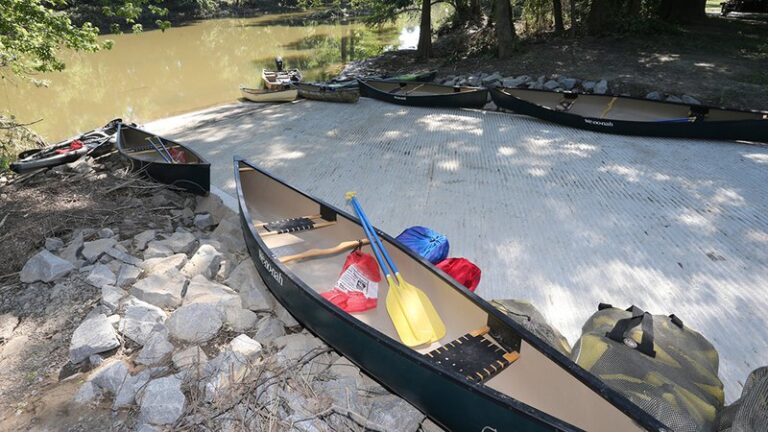
“The inter-agency working team discussed a lot of things that have changed over time and potential needs that have developed for boating access users since 1967,” Racey said. “Recreational boats have much larger motors than in 1967. Additionally, we have boaters who use kayaks and canoes who load them up in the back of a truck or on top of an SUV and drive to those accesses. There are just a lot more ways fuel is being used for boating than the traditional model was designed for.”

The modernized agreement not only will increase the amount of funding for the Marine Fuel Tax program, but it will give the AGFC and its partners more flexibility in the way those funds are spent.

“We’ll now be able to look at other aspects of public boating access,” Racey said. “Things like restrooms, kayak launches, fighting aquatic nuisance species at boat ramps, bank stabilization projects and other projects that can improve people’s ability to enjoy our waters.”

Lastly, the new agreement would transfer the administration of Marine Fuel Tax funds to the AGFC, and would create a position within the agency to develop and track these projects. This will reduce the complexity of approving and administering MFT projects and provide an additional level of oversight and accountability for contractors engaged in these projects.

Booth spoke about the amount of work within both the AGFC and the Arkansas Department of Transportation to bring the modernization to fruition.

“We’d be remiss if we did not thank [former AGFC Director] Pat Fitts for his vision to take an existing asset that the Arkansas Game and Fish Commission had and shared with ArDOT and reinvent that to address the needs of the agency, but also the desires of Arkansans in the 21st century,” Booth said.

One project made possible by the previous Marine Fuel Tax program also was approved at today’s meeting. Commissioners authorized Director Booth to enter into agreements with the Arkansas Department of Transportation and NUCOR-Yamato Steel Company to construct a concrete boat launch ramp and parking facility at the current location of Barfield Access on the Mississippi River in Mississippi County. The project, which is estimated at $1 million, with the AGFC reimbursing up to $250,000, will fill a void in public boating access from the Arkansas side of the Mississippi River between Osceola and Blytheville.

During yesterday’s committee meetings, AGFC Real Estate Officer Kevin Mullen explained that access points on the Mississippi River are a priority not only for fisheries and angler use, but also for search-and-rescue operations conducted by the AGFC Enforcement Division and other first responders.

“There was a man that fell off of a barge near this access, and rescuers had to drive all the way to Osceola to launch a boat to be able to get to him,” Mullen said.

The Commission also authorized Director Booth to execute a perpetual conservation easement with Potlatch Deltic Timber to add a 160-acre inholding to Moro Big Pine Natural Area Wildlife Management Area in Calhoun County. The Commission also approved a $54,000 budget increase from the agency’s Stability and Enhancement Fund to complete the transaction and add this interior piece of property to public access in perpetuity.

In other business, the Commission:

  • Recognized six employees with a combined 125 years of experience for their service and dedication to the natural resources of Arkansas;
  • Heard from AGFC Fisheries Division Assistant Chief Jason Olive on the division’s forage fish production in 2021 (LINK TO PRESENTATION);
  • Heard from AGFC Nongame Mammal Program Coordinator Blake Sasse on the 2021 furbearer trapping and hunting report (LINK TO PRESENTATION);
  • Heard from AGFC Fisheries Division Chief Ben Batten on the division’s strategic plan update (LINK TO PRESENTATION);
  • Authorized Director Booth to execute a grant agreement with The Nature Conservancy for $25,000 to implement a pilot program in summer 2022 that will offer 16- to 18-year-olds from the Little Rock area opportunity to work on conservation, recreation and community-improvement projects and build backgrounds in conservation for future career opportunities;
  • Approved code clarifications for youth turkey bag limits and turkey season dates on wildlife management areas. These clarifications state that youths will be allowed only one legal turkey during the youth hunt on each WMA, matching overall harvest limits for those areas. These clarifications were read at the agency’s November 2021 meeting and have been open for public comment for 60 days;
  • Awarded retiring AGFC Wildlife Officer Sr. Cpl. Joe D. Purdom his service sidearm after 29 years of dedicated service to the people and natural resources of Arkansas;
  • Approved the removal of outdated and obsolete inventory with a total original cost of $152,815 and a present net book value of $7,447;
  • Approved a budget increase of $2.2 million for fleet purchases to replace 57 vehicles that will be sold at auction to reclaim a large portion of their replacement cost;
  • Approved a budget increase of $500,000 to update information technology infrastructure that has exceeded its expected reliable lifespan;
  • Authorized Director Booth to enter into a lease agreement with F5 Investments, LLC to lease an office facility in Mountain Home. The facility will serve as a temporary regional office location to improve working conditions for staff due to the current state of the previously leased office space. Commissioner Rob Finley recused himself from the vote and all discussions on the matter to prevent any conflicts of interest, as he is an officer in the LLC which will serve as the leaseholder in the agreement.

A video of the meeting is available at https://www.youtube.com/user/ArkansasGameandFish.

‘Club in a tub’ program provides resources for new and returning 4-H club leaders

By Rebekah Hall
U of A System Division of Agriculture 

Among the many things the COVID-19 pandemic has disrupted, the passing along of leadership roles within organizations — 4-H clubs among them — can be one of the most difficult to navigate. 

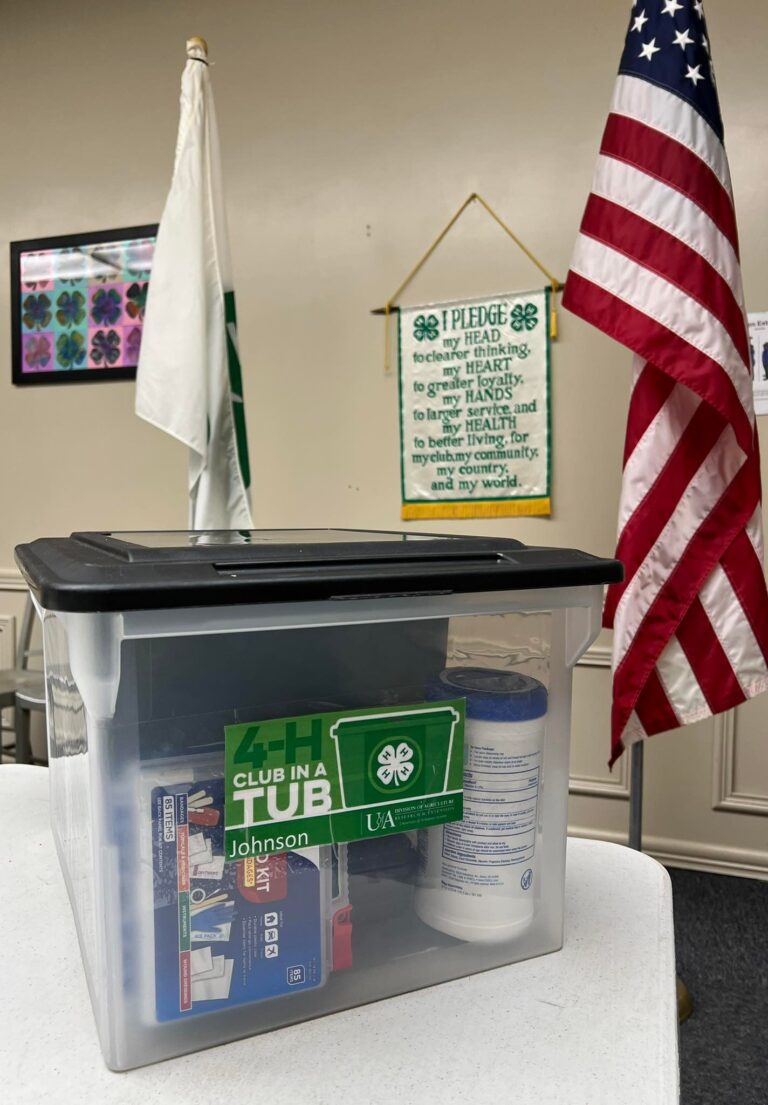
To help new and returning 4-H leaders gain their footing within their respective clubs, Johnson County extension 4-H agent Jeanie Rowbotham designed “Club in a tub,” a new resource for 4-H club leaders containing information and tools.  

Rowbotham said she worked with Clark County extension 4-H agent Cindy Ham to create a tub that contains “everything you need for a club in one spot” and aids 4-H leaders in starting the new program year.  

“Right now, I think recruiting and promotion for clubs is such a big deal, more so than it’s ever been before, because of these last few years,” Rowbotham said. “I think the tubs make that easier, and it gives leaders a resource that has everything right in front of them, so if someone is interested in becoming a 4-H leader, they have something to go off. This gets them started, this helps them, and it takes a little bit of stress off them.”  

Rowbotham said it was important to ensure the tubs were self-contained and portable, as many clubs meet in shared conference rooms or community buildings. The clear tubs, usually used to store files, measure 18 ½ inches long, 14 inches wide and 11 inches tall. The tubs contain a variety of tools and information for leaders, starting with the basics: a 4-H and American flag set, a first aid kit, hand sanitizer and disposable masks, pencils, a stapler and tape.  

Each tub also comes with file folders that have “everything you would need to conduct your club meetings,” Rowbotham said. This includes the Arkansas Volunteer Guidebook, a laminated copy of the 4-H pledge, club charter forms and bylaws, the club ritual agenda and 12 copies of the monthly 4-H club agenda, promotional materials, registration information and forms to enroll or re-enroll club members, leadership information packets and a list of officers with a book of officer responsibilities. The tubs also contain icebreakers, project ideas, programming resources, game ideas and club songs.  

Rowbotham said she and Ham came up with the idea for the tubs around Christmastime because “there’s so much transition in leadership with clubs.” After brainstorming what should be in the tubs, they also consulted with new and longtime 4-H club leaders about what items should be added or taken out. The leaders suggested they add record books, which club members use to keep track of their community service, leadership and projects throughout the year, “so kids could get started on record books from the very beginning.”  

The club in a tub program is still in its beginning stages, and Rowbotham said she hopes to eventually expand it to provide club leaders in all counties with the resource. So far, only club leaders in Rowbotham’s Johnson County and Ham’s Clark County will receive tubs. Rowbotham said she and Ham have plans to discuss the program with their district directors and with Angie Freel, Associate Department Head for 4-H.  

Rowbotham said she is excited about the potential for the tubs to help smooth leadership transitions and provide a fresh start for returning leaders.  

“In 4-H, you always have lulls where you have a change of leaders and new clubs forming, but right now, it seems like all of our clubs are there,” Rowbotham said. “We’ve kind of been on pause, and we’re getting things back going, so I think it’s the perfect time to implement this.” 

For more information about getting involved with Arkansas 4-H, visit 4h.uada.edu/ or contact your county extension agent.