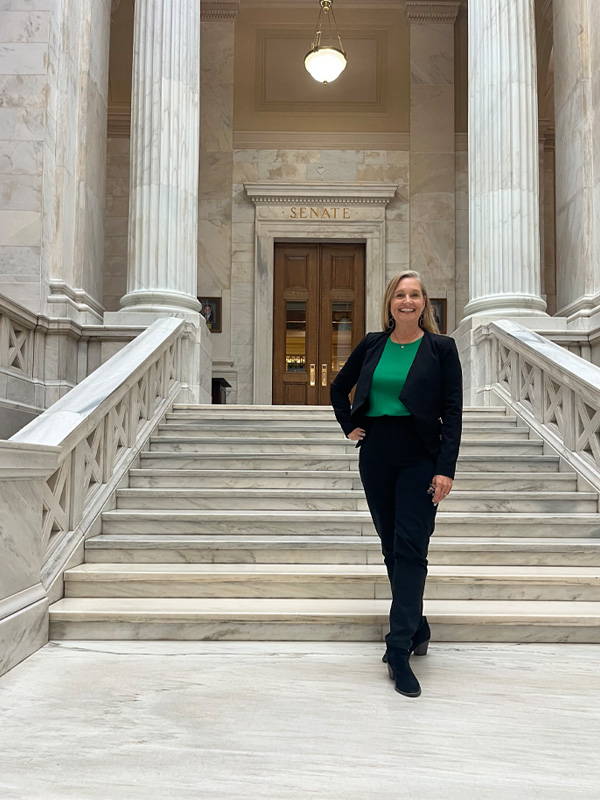


Scout Stubbs to Perform National Anthem at Town Hall
The upcoming Meet the Candidates Town Hall Forum on November 18, 2025, will open on a high note—literally. Attendees will be treated to a special performance of the national anthem by Scout Stubbs, Republican candidate for State Representative in District 42.
For Stubbs, the anthem is more than a song—it represents a journey that began when she was just 15 years old. Looking for a talent to showcase in a pageant that offered scholarship money, Stubbs—who had never sung in public nor received any formal training—decided to take a leap of faith and sing.
“My parents were shocked and a little leery,” Stubbs recalled. “They first heard me rehearse in the car on our way to the pageant.” To everyone’s surprise, she not only performed with confidence, she won. That victory sparked a new dream.
Stubbs went on to work with a music producer to record 10 original songs, which were compiled into a CD sold locally in her hometown of Batesville and for a time on Amazon. While still in high school, she landed her first paying gig at a coffee shop, competed in singing contests, and even traveled overseas to perform—including a country music festival in Germany.
Perhaps the highlight of her early career came when she was asked to open for country music legend Merle Haggard in Batesville. “That was the thrill of a lifetime,” Stubbs said.
Her passion eventually led her to pursue a Music Business degree in the Nashville area. Though the competitive market there was tough to break into, Stubbs gained invaluable experience in the entertainment industry, including a stint as a publicist for TNA Wrestling, where she worked alongside household names like Hulk Hogan and Ric Flair.
Life eventually brought Stubbs back home to Arkansas, where she and her husband built a successful chain of retail stores from the ground up. Today, she’s a homeschooling mom of two, a small business owner, and now a candidate for state representative—channeling the same determination that once fueled her music career into public service.
Her campaign centers on smaller government, lower taxes, protecting Second Amendment rights, supporting the unborn, fostering business growth, and preserving Arkansas’ rural conservative way of life.
As Stubbs steps up to the podium on November 18, she’ll take the stage as she first did as a teenager—sharing her voice. Her rendition of the national anthem promises to set a heartfelt and patriotic tone for the evening’s forum.
“Just Roll with It” Serving up Recipes and Humor
Hello everyone! It’s raining in the River Valley. I have a funny story to tell, and please don’t think I’m making fun. I have permission to tell this story, and I’m not making fun of plus-size folks—I am one of them.
My niece is dating the nicest man. His name has been changed to protect the innocent, so let’s call him Jimbo. He used to be a big guy and has since lost a lot of weight. The incident I’m going to tell you about is what helped him make the decision to lose it.
He and his wife were on a trip, and she booked him an excursion that happened to be ziplining. Have you ever seen a big guy zipline? First of all, you have to walk upstairs forever just to get to it. Jimbo finally sat down and said, “I can’t make it.” One of the people with him told him, “There are only five steps left.” He decided he could do five steps.
He finally made it up to the platform, completely out of breath. Then they tried to put the harness on him, and he said, “They had to make two trips to the barn to get a harness big enough to fit me.” He thought that was the worst of it. But when they pushed him off, he made it halfway across before coming to a dead stop. He couldn’t move—just stuck like a tick.
He said, “What could I do but just hang there until they got help?” Finally, two guys worked their way out to him and pulled him the rest of the way over. Did I mention there was an audience watching? People waiting to zipline couldn’t go because Jimbo was stuck. He said, “It was the worst thing ever.”
When he finally got down and made it back to the hotel, his wife asked, “How was it? Did you have fun?” His response: “Don’t talk to me!” When he told the story, it was so funny we were rolling with laughter. He said, “I will never zipline again.” And for me? There is no way I would even attempt to zipline—ever.
The only thing that would have made the story funnier would have been if they had called the fire department to get Jimbo down. I fell through the front porch once, and that was an ordeal for sure. I did not want them calling the fire department, though—it took a while to get rescued!
On another note, my husband loved peanut butter, and so does my son. If I ever opened the jar and found a big glob missing, I knew my son had gotten himself a big spoonful. This reminds me of a great dessert recipe:
Nutter Butter Peanut Butter Lush
Crust:
1 (16 oz) package Nutter Butter cookies
1/2 cup melted butter
Filling:
8 oz cream cheese (softened)
1 cup creamy peanut butter
1 cup powdered sugar
1/2 cup milk
Pudding Layer
1 (3.4 oz) box instant chocolate pudding mix
2 cups cold milk
Topping
1 (8 oz) container whipped topping
Optional garnish: crushed Nutter Butter cookies, Reese’s Pieces, or chopped Reese’s Cups
Instructions
Prepare crust: Crush cookies until fine, add melted butter, mix, and press into a 9×13 baking dish. Refrigerate while preparing the other layers.
Peanut butter layer: In a large bowl, beat cream cheese until smooth. Add peanut butter, powdered sugar, and milk. Beat until light and fluffy, then spread evenly over the chilled crust.
Pudding layer: Whisk together pudding mix and cold milk for about 2 minutes. Pour pudding over the peanut butter layer and spread evenly.
Topping: Add whipped topping and garnish as desired. Keep refrigerated.
Have a blessed week and enjoy the cooler temps!
Obituary: Robert White (1953-2025)
It is with heavy hearts that we announce the passing of Robert Leslie White Jr., a beloved father, grandfather, brother and friend. Robert was born June 29, 1953, and raised in San Diego California. He enjoyed his career with longtime friend Pete Tarantino in USDA quality control. In 2015 he retired and moved to Waldron Arkansas to be near family.
Robert enjoyed deep sea fishing with his father and brother’s, camping and gemology.
He is survived by his children, Amy Jamieson and Robert L. White, 3rd; his granddaughter Abigail Jamieson.; and his son-n-law, Dale Jamieson. He also leaves behind his loving sisters, Cathy Galloway and his twin sister Jo Anne Swanson; his brothers Richard White and Jim White; and his sister-n-law, Jane White.
He was a loving brother and remembered by many extended family and friends.
He will be greatly missed and forever remembered. We take comfort in the thought that Robert is once again casting a line alongside his beloved father.
And we will see again in the everlasting Kingdom of our great God and Savior Jesus Christ.
A memorial service celebrating Robert’s life will be held Wednesday, Oct 15, 2025, at 1:00 p.m. at the Heritage Memorial Funeral Home Chapel.
State Capitol Week in Review from Senator Terry Rice
LITTLE ROCK – Last year about 173,000 Arkansans spent more than 265 million hours taking care of family members or friends who were suffering from Alzheimer’s. They were not paid for those hours.
Measured another way, that amount of care would have cost $5.4 billion if government or private insurance had paid for it.
An estimated 60,400 people in Arkansas have Alzheimer’s, which represents 11.3 percent of the population older than 65. The deaths of 1,577 people in 2022 can be directly attributed to Alzheimer’s, making it seventh on state Health Department’s list of leading causes of death.
The effect on caregivers can be overwhelming, according to a report presented to the state Alzheimer’s Disease and Dementia Advisory Council. Almost 70 percent of caregivers have chronic health conditions and more than 30 percent report that they must cope with depression. More than 18 percent of caregivers are themselves in poor physical health.
The Council is composed of private citizens with expertise on the topic, and co-chaired by a senator and a member of the House of Representatives. At a meeting in the Capitol, members reviewed their 2025 annual report.
Providing care to people with Alzheimer’s and dementia is a growing public policy concern for legislators because of its financial cost. For example, last fiscal year the state Medicaid program spent $492 million on care for people with Alzheimer’s. The legislature considered several proposals to improve early diagnosis and treatment, but they were put off because of concerns about their potential fiscal impact.
One measure would have mandated insurance coverage of assessments of the cognitive functions for certain patients. It was still in committee when the legislative session ended.
Another measure would have created income tax credits for the expenses of caregivers, and it also was still in committee when the session ended. The Department of Finance and Administration did a fiscal impact in which it estimated that 13.9 percent of the population of Arkansas provided unpaid care for loved ones.
The fiscal impact suggested amendments to the proposal in order to clarify questions that would certainly arise, such as how to provide tax credits to several different family members who claim a credit for the care of the same person.
A federal pilot project has provided some grant money for respite services that provide relief for caregivers, with about a third of the funding going into rural areas. According to a policy analyst at the Council, making the project into a permanent program would greatly help patients with Alzheimer’s and their caregivers.
Re-entry Training
Little Rock has received $4 million from the federal government for workforce training of inmates, to better prepare them to be productive after they get out of prison. Some of the money will pay for job training, some will pay the salaries of staff who will run the program and some funding will subsidize the salaries of about 200 inmates who participate.
Training will focus on construction, transportation, hospitality and advanced manufacturing. Every county jail in Arkansas has a stake in the success of the program because prison overcrowding affects the operations of county jails, due to the backup of inmates for whom there is no space in a state prison unit.
Center for Food Safety fills gaps in research on hand sanitizers
By John Lovett
University of Arkansas System Division of Agriculture
Arkansas Agricultural Experiment Station
Hand sanitizers became ubiquitous during the COVID-19 pandemic, but scientists are still finding answers to questions about their efficacy.
While hand sanitizers are considered a reliable alternative to soap and water when hands are not visibly dirty or greasy, the application time of hand sanitizer remained a question, according to a recently published study from researchers with the Arkansas Center for Food Safety, a part of the University of Arkansas System Division of Agriculture’s research arm, the Arkansas Agricultural Experiment Station.
Francis Torko, a Ph.D. student and research assistant in the food science department, worked with Kristen Gibson, a professor of food safety and microbiology and director of the center, to put five commercially available foam hand sanitizers to the test. They found that application time made a big difference.
In their evaluation of hand sanitizers with 30 volunteers, tests revealed that those who rubbed their hands with sanitizer until it was dry saw a greater reduction of viruses than those who rubbed their hands for the typical 10 seconds.
Four of the hand sanitizers were alcohol-based, and one had benzalkonium chloride as its active ingredient. Surrogate viruses representing those that cause respiratory and gastrointestinal illnesses were applied on the palm area of the volunteers’ hands before the hand sanitizer was used.
The study also supported other research that found product formulation, rather than just active ingredient concentration, impacted product efficacy.
“The study simulated real-world conditions and provides valuable evidence to inform future hand sanitizer practices aimed at maximizing the reduction of infectious viral pathogens on the hands,” said Gibson, who is also the Donald “Buddy” Wray Endowed Chair in Food Safety for the experiment station and the Dale Bumpers College of Agricultural, Food and Life Sciences.
The study, titled Product formulation and rubbing time impact the inactivation of enveloped and non-enveloped virus surrogates by foam-based hand sanitizers,” was published in the journal Applied and Environmental Microbiology in March.
Torko also presented the results of the study at the 2025 International Association for Food Protection conference in Cleveland.
Filling the gaps
Differences between this study and past research on hand sanitizers include the use of commercially available hand sanitizers, rather than lab-based solutions, and evaluation of the whole palm area of the hand, rather than just the fingers.
The Center for Food Safety study also used direct comparisons between different rubbing times and the volume of sanitizer applied to hands for “enveloped” and “non-enveloped” viruses. Examples of enveloped viruses include those that cause respiratory diseases like influenza and coronaviruses. Non-enveloped viruses include human noroviruses that cause gastrointestinal illnesses.
Enveloped and non-enveloped viruses can potentially be transmitted by contaminated surfaces, according to Gibson.
In environments with high contact rates, such as childcare centers, food establishments, public transport, and gyms, contaminated surfaces and hands play a critical role in pathogen transmission, Torko noted, because hands often make primary contact with pathogen points of entry such as the eyes, mouth and nose.
Formulation factor
The U.S. Centers for Disease Control recommends that alcohol-based hand sanitizers contain a minimum of 60 percent alcohol, whereas the World Health Organization recommends 80 percent ethanol or 75 percent isopropanol.
Although most previous studies on hand sanitizer efficacy noted the concentration of active ingredients as a key factor, Torko said the results of their study and other recent publications suggest that the efficacy of hand sanitizers may not solely depend on the concentration of active ingredients but rather on the overall formulation of the product.
For example, studies cited by Torko and Gibson showed there were significant differences between products with similar active ingredient concentrations, as well as a lack of significant differences between products with varying active ingredient concentrations. Two other studies they cited observed that reducing glycerol in hand sanitizers appeared to positively impact the efficacy of the formulations. Glycerol is added to moisturize skin and to slow the evaporation of alcohol, Gibson said.
Results of the Center for Food Safety study showed, for example, that a 63 percent isopropanol demonstrated a higher log reduction than a 70 percent isopropanol product that was formulated differently. These results emphasize that overall product formulation impacts efficacy, not just concentration of active ingredients.
Members of the Arkansas Center for Food Safety seek evidence-based solutions to food safety issues within Arkansas and beyond through research, innovation and collaboration between the public and private sectors. In addition to food safety issues in vegetables and meats, the center also focuses on novel processing technologies, mitigating mycotoxins in grains, and low-moisture food safety challenges.
The hand sanitizer study was supported by Agriculture and Food Research Initiative Competitive Grant No. 2020-67017-32427 from the United States Department of Agriculture National Institute of Food and Agriculture.
To learn more about the Division of Agriculture research, visit the Arkansas Agricultural Experiment Station website. Follow us on X at @ArkAgResearch, subscribe to the Food, Farms and Forests podcast and sign up for our monthly newsletter, the Arkansas Agricultural Research Report. To learn more about the Division of Agriculture, visit uada.edu. Follow us on X at @AgInArk. To learn about extension programs in Arkansas, contact your local Cooperative Extension Service agent or visit uaex.uada.edu.