


Monarchs, milkweed and migration
By Mary Hightower
U of Arkansas System Division of Agriculture
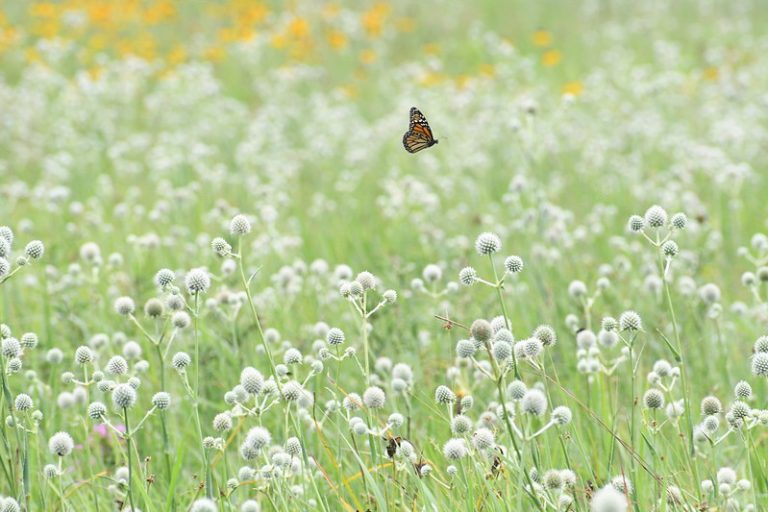
A pollinator admired for its beauty and migratory endurance, monarch butterflies are being proposed for addition as an endangered species. Some in Arkansas are supporting these highly recognizable insects as they migrate and breed.
In December, the U.S. Fish and Wildlife Service proposed that the monarch be protected under the Endangered Species Act. The public comment period for that proposal ended in May, said Brigit Rollins, staff attorney for the National Agricultural Law Center.
“We are waiting on final action,” she said. And with more than 81,200 public comments submitted, “it will take some time for FWS to get through them.”
The fragile-winged butterflies can endure migrations of thousands of miles each year, with eastern monarchs flying as far northward as Canada from their winter grounds in central Mexico. Western monarchs have a shorter trip, migrating from Utah and Arizona to coastal California for the winter.
“The monarch butterfly is a species that has declined significantly over the last 20 years,” said Jon Zawislak, assistant professor-apiculture and urban entomology for the University of Arkansas System Division of Agriculture.
“Arkansas lies within the migratory and spring and fall breeding area of their annual migration route,” he said. “A critical factor in their successful migration is the availability of food plants. While adults feed on energy-rich nectar, their caterpillars consume only leaves of milkweed, and therefore these are the only plant onto which adult monarchs will deposit eggs.”
According to the Xerces Society, monarch populations based in central Mexico have declined more than 80 percent since the 1990s while western monarchs, have declined more than 95 percent since the 1980s.
“Major factors include loss of overwintering habitat in Mexico due to illegal logging, climate change, and loss of suitable food plants — milkweed in particular for reproduction — but also general loss of wildflowers for adult food across their migratory route, due to changes in land use and pesticide use,” Zawislak said.
“Despite their reputation for sequestering distasteful compounds, there are several predators that do eat monarch larvae and adults. So, they serve as food for other critters,” he said.
The monarchs have another role in the environment.
“As pollinators, butterflies have no specific home like bees,” Zawislak said. “As they migrate across the landscape, they can genetically connect patches of flowers that are geographically distant. Their impact as pollinators is a little different than bees, which stay within a specific radius of their nests.”
Leslie Cooper, the Arkansas monarch and pollinator coordinator for Quail Forever, said that “the most important thing that every Arkansan can do to help monarchs and pollinators is by planting Arkansas native plants.
“Arkansas has 21 native milkweed species that tolerate a variety of conditions from full-sun to part-shade and dry to moist soils,” she said. Those who enjoy citizen science projects.
“can also join the Arkansas Monarch Mapping Project on iNaturalist and report their monarch sightings. They can also check out the Monarch Joint Venture website and learn about additional community science opportunities.”
Zawislak said some people capture and tag monarchs with tiny stickers printed with unique ID numbers.
In Mexico, locals find the tagged butterflies and log them, to give researchers “an idea of how many make the full journey, and from where they started,” he said. “But if you find one anywhere you can go online to report where it was.”
Details about tagging and reporting tagged butterflies can be found online.
Milkweed
Monarchs depend on milkweed: It’s the only host plant for monarch caterpillars. Monarchs are uniquely adapted to milkweed which contains compounds toxic to other animals. Female monarchs lay their eggs on milkweed and once hatched, the caterpillars eat the milkweed and store the toxins, which make them uninviting to predators.
Growing milkweed is a focus for Marty Powers, a Master Gardener who just retired from his work at the Shiloh Museum of Ozark History in Springdale.
“I really got into it pretty heavy in 2016 when we had planted a tray of milkweed from Monarch Watch at the Shiloh Museum,” Powers said. “I planted that tray of milkweed and the first year — instantly — we had caterpillars. It just kind of dawned on me: ‘Wow. This is pretty easy to get caterpillars. Why don’t we plant more milkweed?”
He’s never looked back. Since 2016 the Shiloh Museum has given away more than 25,000 milkweed plants, including more than 4,500 this year alone.
“It’s an incredible day to see all the energy. There’s a lot of people really wanting to help” the monarchs and other pollinators, he said. “And that kind of feeds us — makes us want to do more.”
At his home, Powers has also planted several patches of milkweed to collect seeds from mature and viable native varieties such as swamp, common, tuberosa or butterfly weed and spider milkweed.
Growing milkweed
Milkweed is fairly easy to grow. Gardeners collecting their own seeds need to be sure the seeds are mature.
“They need to be brown and the seed pod is ready to pop open,” Powers said.
Milkweed seeds need a little moisture and cold to be ready to emerge in spring, through a process called stratification. Powers said the cooling process can be done in the wild, with seeds left on the ground starting in fall. However, to prevent critters from vacuuming them up, Powers puts his in the fridge.
He places seeds on top of paper towels that he soaks with water. Once the seeds are nice and damp, he bundles them into a zip-top bag and puts it in the refrigerator for 30 to 45 days.
Once spring arrives, they’re ready to plant, simply by scattering them on the surface of the ground.
Powers keeps his milkweed in a separate plot in his garden, but the rest of the garden is also planted for pollinators.
“I have all the native nectar plants — Joe Pye weed and purple cone flower” among others, he said.
For fall nectar, when the monarchs are on their southbound migration, Powers said he does “stray from the natives a little bit. The Mexican sunflower is a really, really great nectar plant for fall.”
Other fall bloomers that monarchs love include native goldenrods, blue mistflower and Arkansas ironweed.
Swamp milkweed tends to be a late-bloomer and good for southbound monarchs.
Since his retirement from the Shiloh Museum, Powers now grows milkweed at the Elkins High School green house.
Raising butterflies
Kathy Peek takes another approach to supporting monarch populations: she raises them. Peek said she’d always loved butterflies, but her appreciation for them deepened during photography club discussions.
“I realized they were endangered and so I asked, ‘what could I do?’” she said.
She decided to raise them, using restaurant takeaway boxes to house eggs she finds in her garden until they hatch, and about a half-dozen pop-up fabric cages for when the caterpillars are ready to metamorphose into butterflies — all with the help of a lot of milkweed.
Peek recalled seeing a monarch in Minnesota in October, clinging fast despite hard, cold fall winds. She was amazed that as “fragile as they are, how resilient they can be.”
Peek will be releasing monarchs during the Monarch Flight Festival in Springdale. This year’s event is set for Sept. 20 at Luther George Park in Springdale from 11 a.m. to 4 p.m.
She documents her efforts with monarchs on YouTube.
Flagship species
“A majority of people recognize monarch butterflies much more than they can identify other butterfly species,” Cooper said. “This is valuable because monarchs can be considered a ‘flagship species’ and may be used to raise awareness and efforts toward native plant and pollinator conservation.”
To learn about extension programs in Arkansas, contact your local Cooperative Extension Service agent or visit www.uaex.uada.edu. Follow us on X and Instagram at @AR_Extension. To learn more about Division of Agriculture research, visit the Arkansas Agricultural Experiment Station website: https://aaes.uada.edu/. Follow on X at @ArkAgResearch. To learn more about the Division of Agriculture, visit https://uada.edu/. Follow us on X at @AgInArk.



Magazine High School Named National Beta School of Merit

BY NATIONAL BETA CLUB MEDIA RELATIONS
MAGAZINE – Magazine Schools is proud to announce that Magazine High School is a 2024-2025 National Beta School of Merit. The school earned this recognition by offering National Beta to all eligible grades on their campus.
The National Beta School of Merit award is given to honor a club’s dedication and commitment to academic excellence. To achieve this prestigious honor, a school must include members from all eligible grade levels in their Beta club. This year, 5,930 Beta Clubs across the country received this award.
“At Magazine, we are proud to continue honoring a strong legacy of excellence in our Beta Club,” Magazine High School Beta Club Sponsor Donna Riddle said.
With more than 500,000 active members and 14,000 clubs nationally and internationally, National Beta has become the nation’s largest independent, non-profit, educational youth organization.
National Beta recognizes outstanding achievement, promotes character and social responsibility, encourages service involvement to school and community, and fosters leadership skills. National Elementary Beta includes grades 4-5, National Junior Beta includes grades 6-8 and National Senior Beta includes grades 9-12.
“Thank you for your continued support of National Beta and commitment to developing future leaders,” Bobby Hart, National Beta CEO, said in a congratulatory letter to the school.
“Just Roll with It” Serving up Recipes and Humor

By Sheri Hopkins, Lifestyle Contributor
Hello everyone! Looks like rain, smells like rain, but I see no rain. We are dry as dust when. When I walk across the yard, it is like walking on Doritos.
I love talking to old friends and we always have to discuss our ailments. What hurts, what we have had wrong lately. My knee is bothering me now. My friend was telling me she had gout and this and that and she said, “I have even had the skittles.” Hmmm…that is a new one. I haven’t had that nor do I know what that is, but I am sure I will eventually get it. Come to find out, she was meaning she had shingles. I cracked up. It was so funny. Well, I haven’t had them, nor do I want them.
Then I had a lady, she was going to take some “IB bufferin”, come find out, it was ibuprofen. I thought I was the only one who had funny names for things. I used to drive a Nissan Altima, and I always called it an Altemma. My brother’s nickname is Toby, and I call him Bobes, long O. My dad always had nicknames for everyone. I was always sissy, and my sister Pam was Jake. my sisters first grandson is named Jake because of her nickname from our daddy who passed away in 1981.
Back to our vacation. We were on the fourth floor at the hotel and if we were riding with someone and they got off on the third floor, we just got off with them. Not once, not twice, but every time. We were getting off that elevator like a heard of turtles following everyone like we were on the correct floor. Did I tell y’all we couldn’t find our way out of a paper sack? I don’t think I told y’all we went to this outlet mall. It was super nice, and the bathrooms were all gender neutral. They were outside in an area of the mall. I decided I better go before we started shopping, and I locked the door or so I thought. Some boy swung that door open and I promise you I scared or scarred him for life. I screamed and he took off like a scalded ape. It didn’t bother me as much as him. I thought oh well, I will never see him again. No big deal. The things that happen to me. Hope y’all have a great week. Stay cool!
Easy Pecan Pie Bars
1 1/2 cups all-purpose flour
1/2 cup unsalted butter, softened
1/4 cup granulated sugar
1/4 teaspoon salt
3 large eggs
1 cup light corn syrup
1 cup packed brown sugar
1 teaspoon vanilla extract
1 1/2 cups chopped pecans
Preheat your oven to 350°F (175°C) and line a 9×13-inch baking pan with parchment paper. In a medium bowl, combine the flour, softened butter, granulated sugar, and salt until the mixture is crumbly. Press it evenly into the bottom of the prepared pan. Bake the crust for 15-20 minutes, or until lightly golden. In another bowl, whisk together the eggs, corn syrup, brown sugar, and vanilla extract. Stir in the chopped pecans. Pour the pecan mixture over the baked crust and return to the oven. Bake for an additional 25-30 minutes, or until the filling is set. Allow the bars to cool completely before cutting into squares.
Arvest Bank Offers Money Management Tips for College Students

As college students head back to campus this fall, now is the perfect time for young adults to evaluate and adopt smart management strategies. Arvest is offering tips to help students manage finances while in school.
A 2024 study by Sallie Mae found that 64% of college students say they run out of money before the semester ends. Additionally, the National Association of Student Financial Aid Administrators reports that the average college student graduates with over $37,000 in student loan debt. These figures emphasize why developing strong money habits is crucial.
“College is an exciting time of learning, independence and new experiences, including managing personal finances for the first time,” said Jeannette Pham, Sales Coordinator for Arvest Bank – Fort Smith. “The habits formed during these years can shape a person’s financial future for decades to come.”
Pham shares money management strategies that will help any student, whether a freshman just starting out or a young graduate student trying to make money stretch.
Create a Simple Budget
Begin with what’s coming in – income from jobs, financial aid or parental support – and subtract essential expenses like rent, food and tuition. What’s left is what you can use (or save). Budgeting apps or a basic spreadsheet can help you stay on track and avoid running out of funds mid-semester.
Know the Difference Between Needs and Wants
You may want daily coffee shop runs or the latest tech, but you need essentials like housing, food and transportation. Prioritizing spending can help prevent unnecessary debt and help make sure your funds last.
Take Advantage of Student Discounts
Many restaurants, stores, streaming services and software providers offer discounts for students. A school ID or .edu email address is often all you need to capture these savings.
Avoid Relying on Credit Cards
Unless you can pay the full balance each month, credit cards can lead to high-interest debt. Using cash or a debit card helps ensure you’re spending only what you have.
Set Up a Savings Habit
Even saving just $10 a week can add up. The set-it-and-forget-it approach works well here. Set up an automatic transfer or direct deposit to a savings account so the money is transferred immediately. Developing this habit now will serve you well beyond graduation.
Earn Extra Income
Consider flexible side gigs like tutoring, freelance work, babysitting or reselling textbooks and clothes. Every extra dollar earned is one less you’ll need to borrow or charge.
Track Your Spending
Log your purchases using an app or journal. Small daily expenses can add up quickly, and tracking helps you spot and fix overspending early.
Learn from Mistakes
Financial slip-ups are part of the learning process. The goal is to reflect, reset and make better choices next time. Managing money well in college builds confidence and lays the foundation for a healthier financial future.
Magazine High School Adds Welding To Free Concurrent College Credit Courses

By Jonathan W. Gipson
MAGAZINE SCHOOLS MEDIA RELATIONS
MAGAZINE – One of the major priorities for Magazine Schools is ensuring its high school students are prepared to be successful in whatever path they take after graduation.
For some, that means pursuing a college degree or vocational/trade certification or joining the military or workforce.
None of these paths are without their challenges and obstacles in what has become a rapidly-changing job world.
For future Magazine graduates who wish to seek a career or vocation within the scope of Career and Technical Education (CTE), their chances for success are greatly increased due in part to the opportunity to earn college or vocational school credit or trade certifications for free while still attending high school.
Over the past few years, more and more emphasis has been placed on preparing high school students for CTE careers, particularly in the state of Arkansas where CTE education programs are beginning to add preparation and skill-building for careers like information technology, health services and advanced manufacturing to name a few.
Magazine Schools has been among the leaders in this CTE movement for quite some time, and it continues to build relationships with area institutions of higher learning and vocational schools to help its students get the instruction and training needed to be successful in those post-high school career paths.
“At Magazine Schools, one of our top priorities is ensuring our high school students are fully prepared for life after graduation,” Magazine Schools Superintendent Dr. Beth Shumate said. “We’ve been proud to be among the early leaders in the Career and Technical Education (CTE) movement – an initiative that has become a major focus of both the Governor’s Office and the Arkansas Department of Education. The fact that our students can access these high-quality, career-focused courses at no cost is a tremendous advantage.”
Earlier this summer, Magazine Schools announced that it had finalized an agreement with Arkansas Tech University-Ozark Campus to offer its students the opportunity to earn credit hours and certification in the field of welding through concurrent courses on the high school campus.
“As a district, we are always seeking ways to meet the growing needs of our students, both academically and professionally,” Shumate said. “We actively pursue partnerships with institutions of higher learning to offer unique opportunities that allow students to begin laying a strong foundation for their future careers while still in high school.”
The American Welding Society predicts that by 2028 there will be a need for about 330,000 welders as older members in the profession retire and the demand for welders increases.
Entry level welders can earn between $31,000-$46,000 a year on average with the annual median salary in 2024 being $51,000, according to the ADE Division of Career and Technical Education.
Welding is the latest program added to Magazine Schools’ catalog of concurrent credit CTE programs that includes banking and finance, education pathway and construction tech.
WELDING
Beginning this school year, Magazine students will have the opportunity to enroll in the recently added concurrent course in the field of welding through Arkansas Tech University-Ozark Campus. The program will be taught on the Magazine High School campus by Magazine High School Vocational Agriculture Teacher Cortney Hicks..
The fall semester course will be Introduction to Thermal Cutting.
“This will entail training on the safe use of oxyacetylene welding and cutting,” said Hicks, who will begin her fifth year at Magazine.
The spring semester course will be Introduction to Arc Welding.
“This course will cover welding basics, safety, electrode selection, welding bead practices and welding on structures,” Hicks said.
Students who successfully complete both courses will earn eight college credit hours.
“The goal of this course will be to equip students with the hands-on skills needed to pass a D.1.1 AWS Welding Certification Test,” Hicks said.
“If students successfully display the skills needed to pass, they will be taken to test for the AWS Certification. This will be beneficial for students looking to work in the welding industry and give them valuable experience.”
BANKING
Magazine students will continue to have the opportunity to earn college credit in the field of banking and finance through Arkansas Tech University-Ozark Campus.
Magazine High School Business Teacher Brad Smith, who has extensive professional experience in the field of banking and finance, will begin his third year teaching the Principles of Banking/Branch Operations course.
“This class is for students interested in banking and finance,” said Smith, who will begin his fourth year at Magazine. “It’s structured to teach students how to become a bank teller, but I know personally there’s more to banking and finance than that, so students will also learn about credit and personal finance among other things.”
Upon successful completion of the course, students will earn six college credit hours for the year.
EDUCATION
For Magazine students interested in pursuing a career in education, they will again have the opportunity to earn college credit in the field of education through Arkansas Tech University in Russellville.
The program, which is taught by Magazine High School Media Specialist and Education Pathway Teacher Cheryl Davis, consists of three courses – Introduction to Education, Education Technology and Child Growth and Development.
“Each class lasts a year long in high school,” said Davis, who is beginning her 32nd year teaching at Magazine and her third year teaching the concurrent courses.
Upon successful completion of each course, students will earn three college credit hours per course.
CONSTRUCTION TECH
For Magazine students interested in pursuing a career in construction, they will again have multiple opportunities to earn college credit in the field of construction through Arkansas Tech University-Ozark Campus.
Magazine Construction Tech Teacher Jayson McGaugh teaches four concurrent college credit courses: Residential Construction I, Construction II-Carpentry, MEP I and Introduction to Construction.
Spring bumper hay crop followed by dry fall in Arkansas
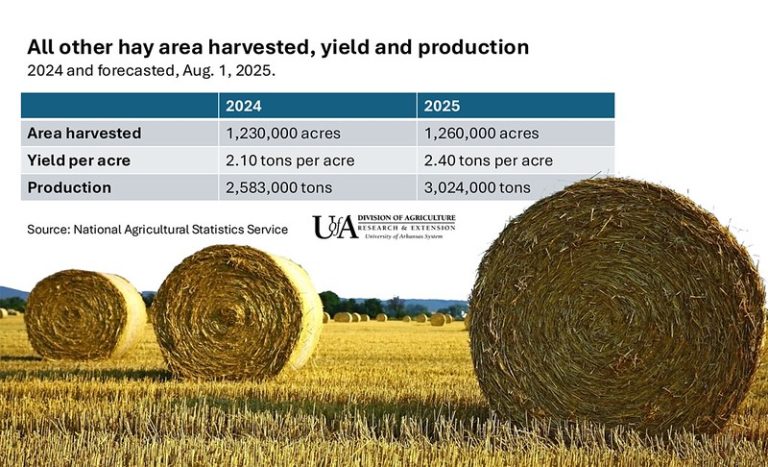
Chart showing August 2025 hay production estimates by USDA. (U of A System Division of Agriculture image)
By Mary Hightower
U of Arkansas System Division of Agriculture
LITTLE ROCK — Arkansas is expected to harvest more hay over more acres this year than last, according to the U.S. Department of Agriculture.
In its August Crop Production report, the National Agricultural Statistics Service said it expected Arkansas to harvest 1.26 million acres of non-alfalfa hay in 2025, up from 1.23 million acres in 2024. The estimated yield for 2025 was 3.024 million tons up from 2.583 million tons last year.
A rainy spring led to a bumper crop in Arkansas, said Jonathan Kubesch, extension forage specialist for the University of Arkansas System Division of Agriculture.
“Spring was very wet across Arkansas and a lot of fields were cut later for the cool-season grasses, and earlier for warm-season grasses,” he said.
“Delaying harvest timing increased the amount of hay present when it finally came time to cut,” Kubesch said. “A lot of fields had a lot of quantity, and in some places, quality was higher than expected. We appear to be accumulating hay in spring and not using up that supply in the fall or winter over the past two years.”
However, it’s not all smooth sailing for hay growers as Arkansas was facing increasingly drier conditions though late July and early August.
Drying out
Thursday’s U.S. Drought Monitor map showed the mildest drought conditions over 3.76 percent of Arkansas, while 64.79 percent of the state was listed as abnormally dry. Three months ago, none of the state was rated as abnormally dry or in drought.
“We find ourselves in a dry spell in pastures and hayfields,” said Jonathan Kubesch, extension forage specialist for the Division of Agriculture.
“Bermudagrass stem maggot and armyworms are cutting into what’s out there,” he said. “Hay inventory and quality are sufficient this year from earlier cuts. However, pasture condition has really deteriorated in the last week to 10 days.”
Kubesch said “good, cheap hay and dry weather may lead some folks to feed rather than try to stockpile or plant annuals around Labor Day.
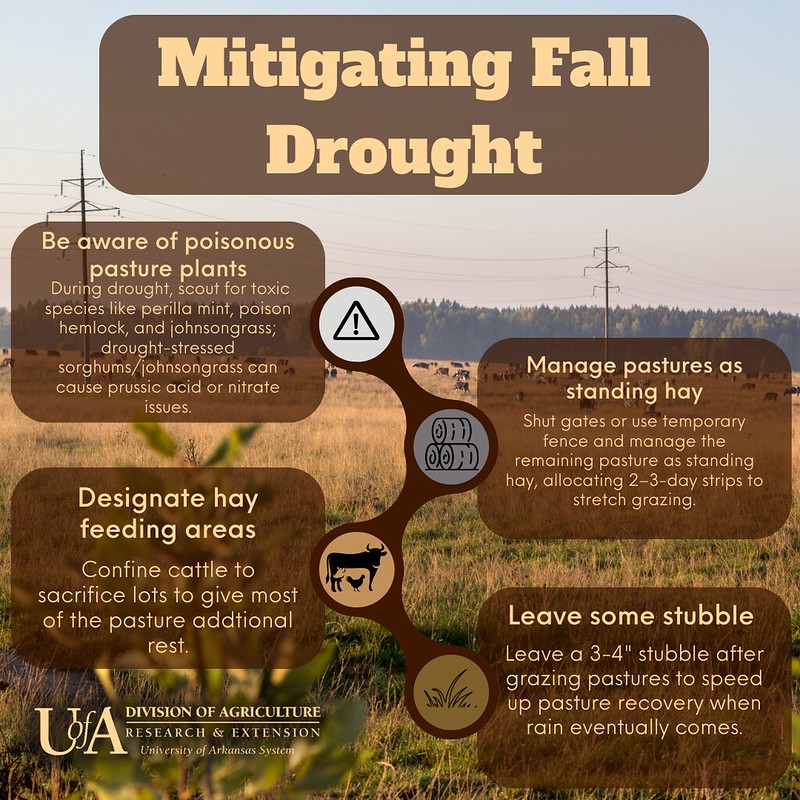
“However, now is the time to be proactive: monitor pasture condition and avoid overgrazing. Leave a 4-inch stubble and keep the stand,” he said. “Rationing remaining pasture will be important if we stay in drought.”
Kubesch also said that now is the time to identify the best areas to feed hay.
“Low fertility areas or weaker pastures can be used as sacrifice lots and then renovated when rain eventually comes,” he said.
Prussic acid and nitrates
In addition to affecting forage growth, drought can have a more dangerous effect as stress prompts some plants to accumulate prussic acid or nitrates, which can be deadly to ruminants such as cattle, goats and sheep.
“Sorghum species such as johnsongrass and sorghum-sudangrass might be suspect for prussic acid or nitrate poisoning,” he said.
To develop an integrated drought plan, see MP530, “Drought Management and Recovery for Livestock Systems”. For more information about prussic acid and nitrates in forage, see FSA2069, “Prussic Acid.” And FSA 3024 “Nitrate Poisoning in Cattle.”
To learn about extension programs in Arkansas, contact your local Cooperative Extension Service agent or visit www.uaex.uada.edu. Follow us on X and Instagram at @AR_Extension. To learn more about Division of Agriculture research, visit the Arkansas Agricultural Experiment Station website: https://aaes.uada.edu/. Follow on X at @ArkAgResearch. To learn more about the Division of Agriculture, visit https://uada.edu/. Follow us on X at @AgInArk.