
68.6 F
Fort Smith
Sunday, June 14, 2026
Home Blog Page 796

Rutledge Announces Settlement with Equifax for Historic Data Breach

Arkansas Attorney General Leslie Rutledge today announced a $2,521,481.31 settlement from Equifax for the largest-ever breach of consumer data, exposing the data of 56 percent of American adults. The investigation into the 2017 data breach found that Equifax’s failure to maintain a reasonable security system enabled hackers to penetrate its systems. Attorney General Rutledge and a coalition of 49 other Attorneys General, comprising 48 states, the District of Columbia, and the Commonwealth of Puerto Rico reached a settlement with Equifax.

“Arkansans trusted Equifax with their personal information as a means to track their credit scores,” said Attorney General Rutledge. “We are holding the company accountable for its failure to safeguard personal information.”

The coalition secured a settlement with Equifax that includes a Consumer Restitution Fund of up to $425 million, a $175 million payment to the states, and injunctive relief, which also includes a significant financial commitment. The settlement fund for affected consumers will provide up to 10 years of free credit monitoring and identity theft services, and reimburse affected consumers for time and money spent trying to avoid or recover from identity theft.

Equifax has also agreed to take several steps to assist consumers who are either facing identity theft issues or who have already had their identities stolen, including:

  • Making it easier for consumers to freeze and thaw their credit and dispute inaccurate information in credit reports;
  • Requiring Equifax to maintain sufficient staff dedicated to assisting consumers who may be victims of identity theft;
  • Restructuring its data security team and performing regular security monitoring, logging and testing;
  • Minimizing its collection of sensitive data and the use of consumers’ social security numbers;
  • Reorganizing and segmenting its network including employing improved access control and account management tools;
  • Reorganizing its patch management team and employing new policies regarding the identification and deployment of critical security updates and patches.

On September 7, 2017, Equifax announced a data breach affecting more than 147 million consumers. Breached information included social security numbers, names, dates of birth, addresses, credit card numbers, and in some cases, driver’s license numbers.

Shortly after, a coalition that grew to 50 attorneys general launched a multi-state investigation into the breach. The investigation found that the breach occurred because Equifax failed to implement an adequate security program to protect consumers’ highly sensitive personal information. Despite knowing about a critical vulnerability in its software, Equifax failed to fully patch its systems. Moreover, Equifax failed to replace software that monitored the breached network for suspicious activity. As a result, the attackers penetrated Equifax’s system and went unnoticed for 76 days

Consumers who are eligible for restitution will be required to submit claims online, by mail, or by phone. Consumers will be able to obtain information about the settlement, check their eligibility to file a claim, and file a claim by phone or online. To receive email updates regarding the launch of the Equifax Settlement Breach online registry, consumers can sign up at www.ftc.gov/equifax. Consumers can also call the FTC at (833) 759-2982 for more information.

Consumers who have been impacted by the breach can call the Arkansas Attorney General’s Office at 800-482-8982 or email Equifax@ArkansasAG.gov.

In addition to Arkansas, other Attorneys General participating in this settlement include Alabama, Alaska, Arizona, California, Colorado, Connecticut, Delaware, Florida, Georgia, Hawaii, Idaho, Illinois, Iowa, Kansas, Kentucky, Louisiana, Maine, Maryland, Michigan, Minnesota, Mississippi, Missouri, Montana, Nebraska, Nevada, New Hampshire, New Jersey, New Mexico, New York, North Carolina, North Dakota, Ohio, Oklahoma, Oregon, Pennsylvania, Rhode Island, South Carolina, South Dakota, Tennessee, Utah, Vermont, Virginia, Washington, Wisconsin, Wyoming, and the District of Columbia. Also joining are Texas, West Virginia and the Commonwealth of Puerto Rico.


Obituary – Lois Christeen (Martin) Blaylock (1931- 2019)

Our precious Mother and Mamaw, Lois Christeen (Martin) Blaylock, 88, of Booneville, Arkansas went home to be with her Lord and Savior, Jesus Christ Saturday, July 20, 2019.

Lois was born March 23, 1931, in Booneville to William and Elsie (Brown) Martin. She was a hardworking woman, working as a Licensed Psychiatric Technical Nurse at the Little Rock and Benton, Arkansas State Hospitals. After moving to Booneville, she went to work for Oak Manor Nursing Home where she worked for eighteen years as a Licensed Practical Nurse before retiring. Lois was a devoted lifetime member of Booneville First Assembly of God. Known as a Prayer Warrior, she loved spending time with God in prayer for her church, family and friends. She would read her Bible daily listening for God’s wisdom and guidance. Lois was considered the Mother of all Mothers by her family, she loved each of them unconditionally. She looked forward to each and every moment spent with them, they were her greatest legacy.

She is preceded in death by her parents, William and Elsie Martin; her precious husband of fifty years, Hurley Jay Blaylock; one daughter, Brenda Dice; one son, Charles Blaylock; two sisters, Evelyn Turner and Oleta Martin; four brothers, Dee Martin, Jay Martin, Aubry Martin and William Martin and one grandson, David Seth Owens.

Lois is survived by two daughters, Martha Boyd and husband, Tommy of Mansfield, Teresa Owens and husband, David of Dover; two sons, Dee Blaylock and wife, Dawna of Booneville, Tommy Blaylock and wife, Brenda of Sheridan; one sister, Vivian Sterenberg of North Bend, Oregon; sixteen grandchildren, Tommy Jay Boyd, Sara Lester, Heather Griggs, Destiny Blaylock, Logan Blaylock, Brenton Blaylock, Erin Loveland, Dillon Owens, Kaleb Owens, Allen Truhett, Tracey Reed, Gary Blaylock, Mandy Luttrell, Corey Dice, Millissa Dimbert and Clinton Meals; a special nephew, George Martin of Booneville; one son-in-law, Charles Dice of Prescott; one daughter-in law, Shirley Blaylock of White Hall; thirty six great-grandchildren and numerous nieces, nephews, other family members and friends.

Visitation will be held on Monday, July 22, 2019 from 6:00-8:00 P.M., at the Booneville Funeral Service Chapel.

Funeral service will be held at 2:00 P.M., Tuesday, July 23, 2019 at Moores Chapel United Methodist Church in Waveland with burial at Moores Chapel Cemetery under the direction of Booneville Funeral Service.

Pallbearers will be Tommy Jay Boyd, Kaleb Owens, Dillon Owens, Logan Blaylock, Brenton Blaylock, Gaston Griggs, Robert Lester and Mitchell Loveland.

Honorary Pallbearers will be Jessie Blaylock, Leon Blaylock, Harold Edward Blaylock and John David Weaver.

Pickin’ in the Round Change in Dates

The newest Waldron tradition and by far the best sounding, Pickin’ in the Round, has made a change to their performance schedule.

They initially were meeting every Thursday night, but have moved to a bi-monthly meeting. Now, the jam is scheduled for the first and third Thursdays of every month.

The time will remain the same, however, from 6- 9 p.m. Originators Gregg and Rita Shively said, “we have wonderful musicians and patrons coming regularly, with some delightful music! Come join us for Pickin’ in the Round!”

The local musical talent is showcased at “The Hall” in Waldron, located at 264 S. Main, next to the Nook & Cranny.

Pickin'-Round-Waldron

New Laws to Come into Effect

Several new laws become effective on July 24, 91 days after the legislature adjourned. Bills that had an emergency clause took effect immediately when the governor signed them.

A total of 1,670 bills were filed in the Senate and House, and 1,092 became laws. The legislature convened on January 14, and adjourned on April 24.

The new laws that will go into effect July 24 include:

  • Act 738 changed the definition of texting and driving to include instant messaging.
  • Act 738 prohibits drivers under the age of 18 from using a cell phone, or a hands-free device. Drivers who are 18, 19 and 20 may use a hands-free device while driving. Drivers of all ages are prohibited from using a cell phone while in construction zones with workers present, or in school zones during school hours when students are present. Fines for a first offense range from $25 to $250, and from $50 to $500 for a second offense. If the driver is in an accident or collision, the fines will be doubled.
  • Act 650 allows bicycle riders to slow down for stop signs and proceed through red lights, after stopping. In both instances the bicycles must yield to oncoming traffic and proceed cautiously.
  • Act 423 clarifies when farmers may apply powerful herbicides such as dicamba. It had an emergency clause, which made it effective on March 11.

According to State Senator Terry Rice, a few bills had specific dates written into them, indicating when they will go into effect.

  • Act 784 raises the speed limit to 75 miles an hour on four-lane, controlled access highways, but not until July 1, 2020. The controlled access highways must be divided by a median strip and in rural areas. The speed limit will be 70 miles per hour for commercial vehicles. The Highway Commission may lower the limits if it completes an engineering and traffic safety investigation.
  • Amendment 7 gives citizens 90 days to file petitions seeking to overturn or amend any acts passed by the legislature.
  • SB17 reduced the fees for a license to carry a concealed handgun and reduced the fee to renew. The initial license fees were cut in half from $100 to $50 ($25 for those 65 and older) and the renewal cost will be $25.
  • Act 510 designates the Bowie knife as the official state knife.
  • Act 685 designates the shotgun as the official state firearm.
  • Act 576 designates the alligator gar as the official state primitive fish.

Lavaca’s Annual Back to School Bash!

At Lavaca’s City Park Saturday, July 27th, is the place for the Lavaca Back-to-School Bash! Kids and adults are urged to attend the fun and festivities that will include free hot dogs and drinks, games, Kona Ice, bounce-around, face-painting and much, much more! Who knows? We might even sell Funnel Cakes?
At 9:00 pm, the new movie “Dumbo” will be shown outdoors. There is no admission charge for the movie and everyone is invited whether you are a kid or not!
We are also having a ‘Stuff the Bus” program where people are urged to bring any type of school supplies to fill up one of Lavaca’s school buses. All of the supplies collected will only go to our public schools.
Mark your calendars and have a fun night at the Back-to-School Bash, sponsored by your Lavaca Area Chamber of Commerce!

Record Blackberry Reflective of a Wet Season

By Ryan McGeeney
U of A System Division of Agriculture

As with every season, high summer in central Arkansas has its own traditions — not least among them, the hunt for the largest berries in the land.

As the blackberries grown at the University of Arkansas System Division of Agriculture’s Fruit Research Station in Clarksville approach peak ripeness, the dozens of seasonal field workers set about trying to find the next record-breaker lurking in the bushes.

Jackie Lee, resident director for the Fruit Research Station, said most of the harvest workers are graduate students in the Dale Bumpers College of Agricultural, Food and Life Sciences or students at the nearby University of the Ozarks.

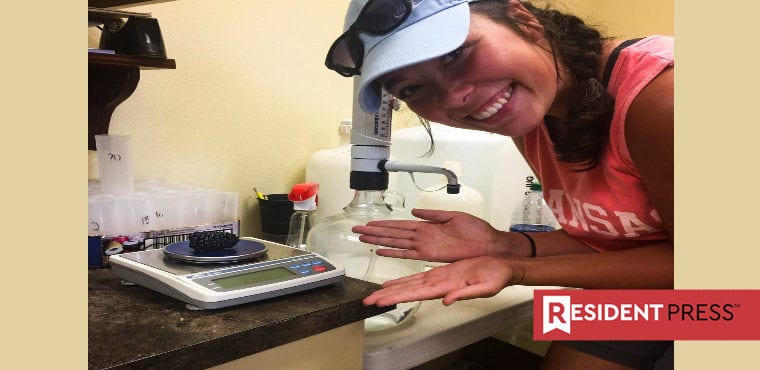
Laura Teague, a University of Arkansas horticulture student and an intern with Amanda McWhirt, extension horticulture specialist for the Division of Agriculture, brought in the season’s champion blackberry last week, weighing in at a whopping 29.5 grams — 2 grams heavier than the previous record-holder at the station, picked in 2018.

The blackberry Teague picked was a Natchez variety, originally developed by John Clark, a long-time fruit breeder for the Division of Agriculture. The Natchez variety is now grown in similar climates throughout the United States.

The overall size of many of the berries coming out of the 2019 crop — Teague’s champion included — are in part due to the seemingly endless rainfall that has saturated so much of the state since September of last year, Lee said.

“In terms of blackberry production, we’ve had a very good year,” Lee said. “Yields are average to high.” 

But the high yields come at a price, she said. 

“The rainy conditions cause the fruit to not store as long,” Lee said. “It can soften the fruit. So even though we’ve had high yields, the fruit quality has suffered.” 

Lee said she is excited to begin raising plots of Caddo, a new, early-ripening variety of blackberry, released from the Division of Agriculture this year. 

To learn about fruit horticulture in Arkansas, contact your local Cooperative Extension Service agent or visit www.uaex.edu. Follow us on Twitter at @UAEX_edu. To learn more about Division of Agriculture fruit breeding and research, visit the Arkansas Agricultural Experiment State online at https://aaes.uark.edu. Follow us on Twitter at @ArkAgResearch, and on Instagram at ArkAgResearch

AG Warns: Be Careful Posting Child Photos

Childpredators see this time of year as an excellent opportunity to exploit pictures of children found on the internet. As the weather changes and the air gets warm, many families head out to enjoy the amenities that make the Natural State special. As families enjoy our state it is important to remember that sharing pictures and videos of family this summer while being seemingly innocent, can have unintended and harmful side effects.

It is common for ill-intending users of social media to search through popular hashtags such as #bathtime and #poolside to find pictures of children in order to sell or trade with others. It is important that parents be wary of posting content featuring children during activities such as swimming, sleepovers, lake days and tanning, among others.

“No Arkansans intend to subject their children to exploitation through the things they post online, but often predators will prowl social media sites in search of pictures featuring children in swimsuits, athletic gear or wearing other formfitting and revealing clothes,” said Arkansas Attorney General Leslie Rutledge. “It is also a good idea to ask for consent from a child’s parent or guardian before including him/her in content with your child. Protection of our children is a community-wide responsibility.”

Attorney General Rutledge has issued the following tips to follow as you use social media this summer:

· Think twice about posting pictures of children online, especially photos of children that show a lot of skin.

· Remember that status updates, photos and videos posted on social networks are permanent. Once the user posts, it is out of his/her control and you do not know where it will end up. Consider purchasing cell phone monitoring services from a provider to monitor children’s mobile devices.

· Just as children are taught to use strong privacy settings, adults should use the strictest settings that are available to prevent unwanted individuals from seeing images of their children. For example, on Facebook, one of the available privacy settings requires explicit permission from the account holder before he or she can be tagged in a post or picture.

· Monitor social media posts from friends to ensure they are not posting photos of loved ones that could be stolen by people with sinister motives and end up in the hands of a child predator. Many social media platforms allow users to submit complaints regarding problematic posts and to request deletion of posts.

Whether enjoying a swim in Lake Ft. Smith, a hike at Petit Jean or just an afternoon with kids at a fair, it is important to remember that the safety of our children is everyone’s responsibility. We help by doing our part to protect our future by protecting our children.

Arkansans can report child exploitation by calling the National CyberTipline, (800) 843-5678, or visit CyberTipline.com. To report child abuse, call the Arkansas State Police Child Abuse Hotline, (800) 482-5964, or, in the event of an emergency, dial 911 or a local law enforcement agency.

For more information about other consumer-related issues or to file a consumer complaint, contact the Attorney General’s office at (800) 482-8982 or consumer@arkansasag.gov or visit ArkansasAG.gov or facebook.com/AGLeslieRutledge

The Vicious Trend of Vaping

The use of e-cigarettes, or vaping, has become a dangerous trend in which too many Arkansas teens are participating. Eight years ago, just two percent of Arkansas teens vaped. Today, more than 20 percent of Arkansas teens vape. Vaping is the act of inhaling and exhaling a vapor, which is produced by an e-cigarette or similar device. The term “vaping” is used because e-cigarettes do not produce tobacco smoke, but rather an aerosol that actually consists of fine particles containing varying amounts of toxic chemicals, which have been linked to cancer, as well as seizures, respiratory and heart diseases.

“As adults, we need to be watchful of the young people around us and educate them about the dangers of vaping,” said Arkansas Attorney General Leslie Rutledge. “Manufacturers make these products to look flashy and appealing to teens. This is an extremely dangerous trend that is hitting Arkansas’s middle and high school students at alarming numbers.”

Attorney General Rutledge released the following tips to warn parents, teachers and children of the dangers of vaping e-cigarettes:

  • Review the ingredients carefully because many of them contain substances known to be carcinogenic, such as nicotine, vegetable glycerin and propylene glycol.
  • Consult your physician about the risks associated with vaping. One pod used in an e-cigarette can have the same amount of nicotine as an entire pack of traditional cigarettes. Exposure to nicotine can alter the structure and function of developing children’s brains.
  • Remember that studies have shown that nicotine products are highly addictive and is associated with later onset of cigarette smoking habits.
  • Investigate the incidence of product failure as some e-cigarette device batteries have exploded or caught on fire, causing burns or even death.
  • Remember to keep e-cigarette supplies out of the reach of small children as some have become sick or died from swallowing the pleasant-smelling e-juice.
  • Be mindful that e-cigarette pods can be used for illegal purposes such as for odorless marijuana oils based upon online tutorials.

There are many different types of e-cigarettes and other vaping devices, most of which contain pods of nicotine-filled e-liquid, sweet-smelling flavorings, and other potentially harmful chemicals. With sweet-smelling aromas and catchy flavor names like Strawberry Watermelon POP, Sunrise Pressed eJuice, Pink Lemonade Risky and Ice Cream, teens are experimenting with, and ultimately becoming addicted, to e-cigarettes. Once they get hooked, teens are often able to hide their addictions from parents, teachers and other adults by purchasing widely available vaping devices disguised as everyday items like pens or USB flash drives.

For more information and tips to avoid scams and other consumer-related issues, contact the Arkansas Attorney General’s office at (800) 482-8982 or consumer@arkansasag.gov or visit ArkansasAG.gov or facebook.com/AGLeslieRutledge.

Flatheads: Big, Good Eating and Challenging to Anglers

Of the three species of catfish in Arkansas, the flathead may rank at the top, at least in fishermen’s interest.

Flatheads aren’t the most numerous. Channel catfish hold the lead there. Flatheads also aren’t the largest; the blue catfish holds the state record at well over 110 pounds. But flatheads hold a special place in many anglers’ hearts, mainly for their hard-fighting nature and their impressive table quality.

Like many Arkansas fish, flatheads are known by other names here and there – Opelousas cat, Appaloosa cat, yellow cat, shovelhead. Three distinguishing features are the broad, flattened head that gives the fish its name, a square instead of forked tail and a mottled yellowish-brown color in contrast to the gray color of blue cats and channel catfish.

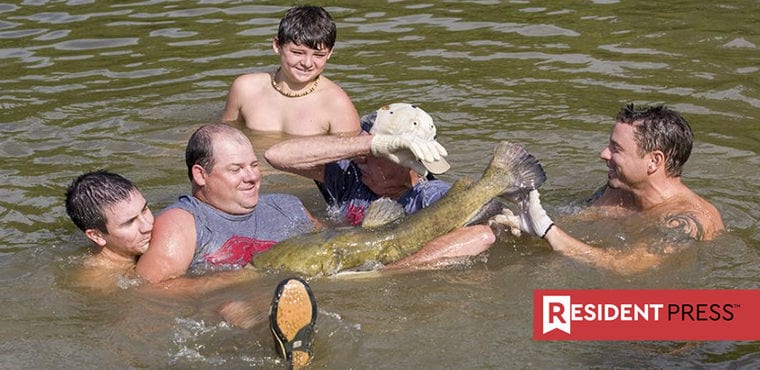
Flatheads are native to Arkansas, primarily the larger river systems. Anglers in the state use three methods to catch them. The most common two ways to fish for them are with a rod-and-reel or with a trotline or jug set on the water. The third method, hogging, is not for the squeamish. Catfish hogging means setting large barrels under the water or digging holes into an undercut bank and reaching in with bare hands to pull the unwilling fish out.

Most Arkansas flatheads are found in flowing water – but this is not an absolute. Lake Conway, for instance, has produced big flatheads for more than 60 years. Flathead fishermen often look for submerged wood like logs and root wads as likely spots for their quarry. If these objects are close to flowing water, chances of finding a flathead may improve.

Flatheads also are usually taken on live bait – but, again, this is not always the case. Many anglers seeking flatheads bait up with small bream including “ricefield slicks,” more formally known as green sunfish. Gizzard shad in bigger sizes are frequently used for flathead work. Anglers using live baitfish should be sure that the bait they use comes from the same lake where they are fishing, as it is illegal to transport live baitfish, such as shad and bream between bodies of water and possibly transmit diseases or accidentally transport an invasive species such as silver carp in their baitwell. Catching bait for flatheads can be an adventure of its own, throwing a cast net for shad, or fishing with tiny jigs to net up a bunch of slicks. 

Use large, strong hooks for flatheads, and pick out a good-sized bream or a big shad for the bait. The weight should be heavy enough to get the bait and hook to the bottom of the water quickly.

Like other forms of catfishing, patience is an asset. Flatheads feed by both sight and smell, and fishermen usually toss out the baited hook, let it sink to the bottom and wait. Bobbers are used, and so is the tightlining method. When the line begins to move, the fisherman waits. Catfish of all species have a habit of moving off with the bait in their mouths for several feet, sometimes many feet, before stopping to swallow it.

The general rule is to let the fish take the bait with an open reel. Then when the movement stops, close the reel and set the hook – hard.

Daily limit for catfish set by the Arkansas Game and Fish Commission is 10. This is for any species or a combination of species. A few waters in the state have more generous daily limits but for channel and blue catfish, not flatheads.

The state record for flathead catfish is 80 pounds, set in 1989 with an Arkansas River fish by Wesley White of Hartford. A recent trotline catch on Blackfish Lake in St. Francis County by Preston Gracey of Forrest City on June 10 weighed an impressive 85 lbs. 6 oz. Although Gracey’s catch does not qualify for the rod-and-reel state record, it does hold the record for the largest flathead caught in Arkansas by any tackle.

Janet Huckabee Nature Center Summer Programs

July 18, 2019 at 9 a.m. – Aug. 16, 2019

Free Admission

Now until Aug. 9 | Daily – Weekly – Special Programs
Sept. 21, Noon-2 p.m. | Youth Marksmanship Challenge

Daily
2 p.m. Critter crunch

Weekly Programs
Thursday
9 a.m. Fishing
9 a.m.-noon Target casting*
Self-guided event.
11 a.m. Animal hour

Friday
9 a.m. BB guns and slingshots*
10 a.m.-noon Canoe and kayak
3:45 p.m. Nature break
For 3- to 7-year-olds.

Saturday
9 a.m. Guided hike
10 a.m.-noon Canoe and kayak
3 p.m. Laser Shot

Sunday
2:30 p.m. Archery*


Special Programs
Aug. 7
Nature arts and craft project
Call for event times and to register.

July 24, 31
Arkansas River barge tours
Call for event times and to register.

Aug. 6, 6 p.m.
Duck decoy painting
Call to register.

Aug. 16, 6 p.m.
Becoming a conservationist


Youth Marksmanship Challenge
Sept. 21 | Noon- 2 p.m.
Take aim at events marked with an asterisk then demonstrate your skill in the Youth Marksmanship Challenge next fall. The challenge will include archery, 3D archery, BB gun shooting, target casting and slingshot shooting.