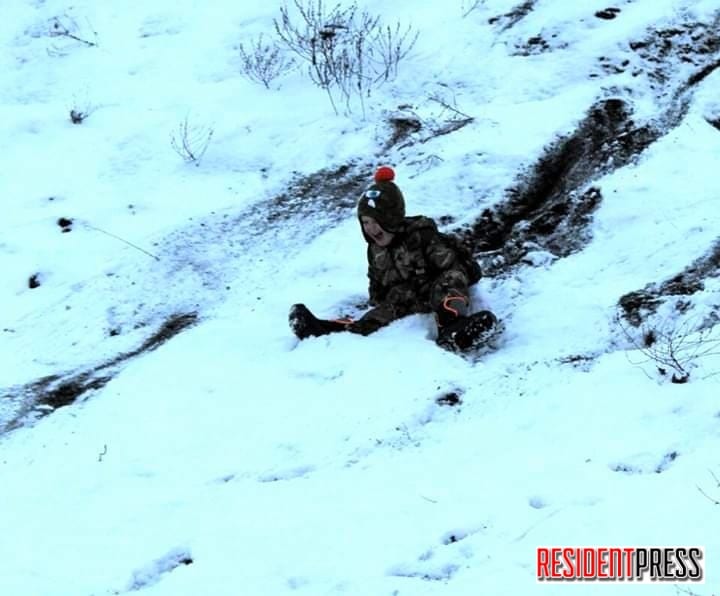
The snow has finally fallen and it’s time to put the taste to the test of the snow! I’ve always been told don’t eat the first snow that falls; however, I’ve always been an impatient person. Even though we get many predictions for snow, we all know snowfalls in Arkansas are few and far between. So, I have survived always eating the first snow that falls!
So, bundle up and get ready to get some snow or send your kids out with a bowl and a spoon and gather some snow! Get ready to make snow ice cream!
Ingredients:
1 Large Bowl of Freshly Fallen Snow (approximately 8 to 10 cups of snow)
3 cups of Whole Milk
1 1/4 cups of Sugar
2 Tablespoons of Vanilla Extract
Instructions:
Gather snow in a large bowl. You want to be careful when scraping the snow that you do not get dirt, sticks and grass, especially if your kids are gathering for you! Now, come inside to mix up the ice cream.
Add milk first to your snow and stir. Next add sugar and vanilla extract. Stir until completely combined. Do not over stir or your ice cream will end up soupy. We like to add chocolate syrup and the kids love to add sprinkles and chocolate chips.
Adding the milk and vanilla.
Extra: Whenever a snowfall is predicted and I make my normal panic run to the grocery store, I try to remember to pick up a can of sweetened condensed milk for snow ice cream. If you have a can of this, you can replace it for the sugar and only use 1 1/2 cups of Whole Milk instead. You will still need the vanilla extract. Taste test and add more sugar if you desire.
This is part four in a series on the Juvenile Treatment Center, located just outside Mansfield. Throughout this series we will take an in-depth look into the program, find out what life is like for the offenders, workers and the impact it has on the area.
In this installment we will share with you the story of two former clients of the MJTC. The facility changed the lives of a young lady, whom we will refer to as T and a young man, whom we will refer to as J.
T came to the MJTC at the tender age of 14. A self-described rebellious spirit, T, came from a broken, drug addicted home near Little Rock.
“When I first came in, everyone treated me so good. I was welcomed with open arms and they didn’t judge me.”
She acknowledged she challenged the system, but in retrospect has great appreciation for the safety and love she found at Mansfield.
T was released only to find her way back at nearly 16 years of age. “I acted out on purpose. I felt safe at Mansfield, and I felt love. I didn’t have that at home,” she confessed.
She found, as she described, a second family. T was at the facility when the juveniles were given the opportunity to be out performing community service.
“They gave us options to go to church on Wednesday night, and once a month a group called ‘Riders for Christ’ would come and we could ride horses, fish and just enjoy being outside the fence.”
The church services and the community service projects were things T and others worked hard to earn. Good behavior gained privileges, poor behavior excluded you. She recalled the feeling of regret of having to sit in her room while others received these privileges. “At the time I thought it was so unfair, but I learned if I wanted to do those things I had to earn it.”
T also enjoyed spending time with the MJTC’s bloodhounds. They were given opportunities to bathe and feed the dogs. “It was very therapeutic and rewarding,” she added.
Upon completion of the program, T had received her GED. Against all odds, T, at the age of 19, is engaged to be married, a mother to a 10 month old and is about to enroll in college. “My life is better because of my time at Mansfield,” T concluded.
J came to the MJTC at the age of 15. He had been transferred to Mansfield following a stay at the Alexander facility. At that time, Alexander was also ran by the state. “It was terrible,” he said. Those moments stuck with him, too. He recalled seeing a group of boys grab another by the throat and force him against the wall.
“I felt depressed and hopeless,” J added. He didn’t know when he would be up for release, as a judge labeled him “EJJ,” extended juvenile jurisdiction. “That meant I had no release date,” he explained. “I had no clue as to when I would get out.”
After he got to Mansfield, something changed. He felt welcomed, loved and cared for. “Looking back on my life, I miss the people and that place. I know it’s weird to say, but I had some really good times.”
J admitted it was the behavior rewards that helped him most. Things like getting out into the community, being a part of the town’s Christmas, mowing cemeteries and getting to go to church services. “I think it’s sad they can’t do that any more. I feel sorry for those kids there now because I know those things meant a lot to me while I was there. It not only helped us, but it helped the community.”
After completing his time at Mansfield, J never returned. He made life changes and is now living a successful life. He admits, however, that the MJTC “made me the man I am.”
T and J, and other former clients aren’t the only ones who’ve had their lives changed by the facility. Suzie Stovall, a member of the Greenwood First Baptist Church, has spent over a decade and a half sharing in the lives of the kids at the MJTC.
Every Tuesday night, Stovall makes her way to the facility to spend time with the girls, studying God’s Word. Stovall remembered when it seemed like she was spending more time with these kids than she was her own. “In the past they were able to come to the church for services, but they have cut that out now.”
She recalled her pastor asking what fruits she had seen from her work over the years, and she replied, “I planted the seeds while they were with me for a season.” It wasn’t long after that, Stovall said she began hearing testimonies from some of the girls she had spent time with. One in particular that had escaped the camp during her time there. Since that time, she’s gotten saved and is serving beside her husband, an ordained minister.
Her church has assisted her in this mission of love, and helped sponsor boxes she and others delivered each year at Christmas time to both the boys and the girls.
This past year may have been her last time doing that, however. “I have been praying that the Lord would send someone else to rise up and do this work. I know they will be moving the girls out, so things are really about to change anyway.”
Stovall has great admiration for the administration and staff at the facility, and recognizes their passion for the job they do. “They aren’t there for the money,” she added. “The people there, they really care.”
According to the Centers for Disease Control, the percentage of U.S. middle and high school students who use electronic cigarettes or e-cigarettes more than doubled from 2011 to 2012. This sharp increase has prompted the CDC to declare this an epidemic.
The Mansfield School District has not been exempt. Parents, administrators and law enforcement are also reporting an increase in vaping activity.
“For the past few years I feel that we have definitely seen an increase in vaping activity,” said Mansfield High School Principal Dr. Jim Best. “We adopted a very tough policy on vaping at MHS approximately 2-3 years ago.”
That policy reads:
4.23—TOBACCO AND TOBACCO PRODUCTS
Smoking or use of tobacco or products containing tobacco in any form (including, but not limited to, cigarettes, cigars, chewing tobacco, and snuff) in or on any real property owned or leased by a District school, including school buses owned or leased by the District, is prohibited. Students who violate this policy may be subject to legal proceedings in addition to student disciplinary measures.
With the exception of recognized tobacco cessation products, this policy’s prohibition includes any tobacco or nicotine delivery system or product. Specifically, the prohibition includes any product that is manufactured, distributed, marketed, or sold as e-cigarettes, e-cigars, e-pipes, or under any other name or descriptor.
“It is very difficult to control vaping activity on campus,” added Best. “It seems to be as pervasive as the use of cell phones. My hope is that the FDA will become more aggressive in limiting the sales of vaping juice and devices to minor children. Up to now, it seems to be a wide open, unregulated substance, and it has become a challenge for schools nationwide.”
Electronic cigarettes are battery-powered devices that provide doses of nicotine and other additives to the user in an aerosol. E-cigarettes not marketed for therapeutic purposes are currently unregulated by the Food and Drug Administration. The FDA Center for Tobacco Products has announced that it intends to expand its jurisdiction over tobacco products to include e-cigarettes, but has not yet issued regulatory rules. Because e-cigarettes are largely unregulated, the agency does not have good information about them, such as the amounts and types of components and potentially harmful constituents.
“The increased use of e-cigarettes by teens is deeply troubling,” said CDC Director Tom Frieden, M.D., M.P.H. “Nicotine is a highly addictive drug. Many teens who start with e-cigarettes may be condemned to struggling with a lifelong addiction to nicotine and conventional cigarettes.”
Officer Sean White with the Mansfield Police Department also acknowledged the problem. “We’re having trouble out at the high school with it and little bit at the middle school as well.”
If students are caught vaping, they may be subject to legal proceedings in addition to student disciplinary measures.
This is part three in a series on the Juvenile Treatment Center, located just outside Mansfield. Throughout this series we will take an in-depth look into the program, find out what life is like for the offenders, workers and the impact it has on the area.
In this installment we will look at the juvenile offenders at the Mansfield location, how they ended up there and a their daily routine.
–See part 1
–See part 2
So, how do these youth end up in facilities such as the MJTC? According to DHS Deputy Director Keesa Smith, “a juvenile judge ultimately makes the determination of the delinquent. A majority of them are non-violent.” She added that most are there because they’ve committed property crimes. “The type of offenders vary greatly from misdemeanor to felony charges.” Smith did note however, that the Mansfield location does not get murderers, although there are offenders there which are considered moderate to high risk.
Originally, according to Senator Terry Rice, when the MJTC began operating in 1994, his father Senator Bud Rice, was assured that there would be no violent offenders at the Mansfield location. Following a sit down meeting with Little Rock officials two weeks ago, Rice said, “I think DHS needed to be reminded of that promise.”
Once remanded to a DHS facility, the juvenile undergoes an evaluation. This includes physical, dental and mental health screenings. Then, the determination for placement is made. The youth’s placement is in part based on their propensity to run. “Mansfield does have some offenders that are considered high-risk,” added Smith. They are placed there because of its terrain, presumably the landscape serves as a deterrent for those looking to flee.
The typical age range for offenders at the Mansfield location is between 15-18 years old. “Youth may stay past their 18th birthday if they are Extended Juvenile Jurisdiction youth, which are those who a judge decides can be kept in DYS custody until age 21, and require a secure placement,” said Marci Manley, Deputy Chief of Communications.
Statewide, the population by race is: 50 percent white, 40 percent black and 10 percent other. Arkansas District 13, which lies in the northeast portion of Garland County, made up the greatest number of commitments to the juvenile system in 2018. –See DYS statistical report.
Currently, Mansfield has a capacity of 42 beds. After July 1, and a restructuring of the system statewide, the number of beds will increase by 16. Currently, the facility has 24 boys and 12 girls (as of 1/9/19.)
Below is the typical daily schedule for Mansfield. According to DHS, “the programs are designed to equip youth with the skills they need to reach their highest potential. Foremost among these skills is the ability to make good choices: continuing their education, finding a good job or career, avoiding illegal and harmful drugs, respecting the laws of their community, interacting positively with their family and peers, keeping physically fit and mentally sound, in short, choosing to do what is good for them and their futures.”
The DYS program seeks to teach these skills in all of the daily activities: education, work groups, therapy groups, individual counseling, community service, dining hall and dorm activities, optional religious services and special events planned to enhance their learning experience.
[box style=”0″]
5:00 AM-5:30 AM
Wake-Up/Morning Hygiene
[hr style=”single”]
Dress
5:30 AM-6:00 AM
[hr style=”single”]
Chores/Inspection
6:00 AM-6:25 AM
[hr style=”single”]
Breakfast
6:30 AM-7:30 AM
[hr style=”single”]
Structured Activity
7:30AM – 7:55 AM
[hr style=”single”]
Morning Affirmation
8:00 AM – 11:35 AM
[hr style=”single”]
School
11:40 AM-12:05 PM
[hr style=”single”]
Case Manager 1
Lunch/Medication Pass
12:05 PM-12:55 PM
[hr style=”single”]
Case Manager 2
Structured Activity/Group
Large Muscle Exercises/Recreation
1:00 PM – 3:50 PM
[hr style=”single”]
School
4:00 PM – 5:00 PM
[hr style=”single”]
CM Group
5:05 PM-5:30 PM
[hr style=”single”]
Case Manager 1
Dinner
5:35 PM-6:35 PM
[hr style=”single”]
Large Muscle Exercises/Recreation
6:40 PM-7:20 PM
Upon release, DHS reports that 27 percent of offenders find their way back into juvenile facilities. When completing their time in the facility, the juvenile is either released on probation or under aftercare. According to former MJTC employee, Dana Adkins, “They need close follow up and frequent check in’s after their departure.” “I’ve seen kids cry when being released,” said one former MJTC employee. “They bond with the staff.”
Staff and administrators who have spent several decades working with these troubled youth, know what works. Experience has changed their perspective and given them a new view on success for these kids. “My definition of success changed,” the former MJTC worker said. “I always thought success was a white picket fence, you know, the American dream.” One case in particular changed their view. “I had transported one of the kids back home… the grandmother said ‘I don’t know why you brought him home, he will just go back.’ And, later, he did end up in prison. However, while he was at Mansfield he completed his GED. The aftercare counselor contacted me and said the youth was a success because he didn’t kill anyone.”
Ultimately, those who have worked with these kids learn that success is measured differently for each of them and that some have almost no chance of achieving that “dream.”
Local pastor, and one who has worked with juveniles all across the state said, “I’ve never seen one of these kids go to one of these places and turn their life around unless there is a wake up call to the family and they become more proactive.” He went on to add that his interaction in these places have been overall negative. However, he admitted he cannot comment directly on the Mansfield facility as he has neither visited nor interacted with the youth there. He has been privy to conversations with employees at the MJTC, and they expressed concerns regarding the lack of discipline and boundaries. “These workers feel like there is no recourse if the kids don’t do what they are supposed to do. Many come from homes with little or no boundaries and end up in a place like this and it only further adds to the problem.” Although he recognizes there are no clear cut answers, he feels like adult prisons, isolated from the main population, would be a better option. “I think that most people are doing the best they can with a situation where there are no easy decisions or choices to be made, and I don’t have the answers either.” Ultimately, “we need to reach these kids before they get here, by the time they get into the juvenile system, we’ve waited to long.”
In part four of this series, we will visit with some former youth who spent time at the facility.
By Karissa Niehoff, Executive Director of the National Federation of State High School Associations and Lance Taylor, Executive Director of the Arkansas Activities Association.
If you are the mother or father of a high school athlete here in Arkansas, this message is primarily for you.
When you attend an athletic event that involves your son or daughter, cheer to your heart’s content, enjoy the camaraderie that high school sports offer and have fun. But when it comes to verbally criticizing game officials or coaches, cool it.
Make no mistake about it. Your passion is admired, and your support of the hometown team is needed. But so is your self-control. Yelling, screaming and berating the officials humiliates your child, annoys those sitting around you, embarrasses your child’s school and is the primary reason Arkansas has an alarming shortage of high school officials.
It’s true. According to a recent survey by the National Association of Sports Officials, more than 75 percent of all high school officials say “adult behavior” is the primary reason they quit. And 80 percent of all young officials hang up their stripes after just two years of whistle blowing. Why? They don’t need your abuse.
Plus, there’s a ripple effect. There are more officials over 60 than under 30 in many areas. And as older, experienced officials retire, there aren’t enough younger ones to replace them. If there are no officials, there are no games. The shortage of licensed high school officials is severe enough in some areas that athletic events are being postponed or cancelled—especially at the freshman and junior varsity levels.
Research confirms that participation in high school sports and activities instills a sense of pride in school and community, teaches lifelong lessons like the value of teamwork and self-discipline and facilitates the physical and emotional development of those who participate. So, if the games go away because there aren’t enough men and women to officiate them, the loss will be infinitely greater than just an “L” on the scoreboard. It will be putting a dent in your community’s future.
If you would like to be a part of the solution to the shortage of high school officials, you can sign up to become a licensed official at HighSchoolOfficials.com. Otherwise, adult role models at high school athletic events here in Arkansas are always welcome.
For more information on the Arkansas Activities Association, please CLICK HERE
LITTLE ROCK – Turkey season may open at the beginning of April, but now is the time to begin planning for a successful season. One of the best ways to be successful on public land is to apply for one of the Arkansas Game and Fish Commission’s wildlife management area turkey hunt permits.
Many good public turkey hunting opportunities exist, particularly on the large cooperative WMAs owned by the U.S. Forest Service. However, turkeys and turkey hunters need room to spread out, which can lead to conflicts between hunters on some smaller WMAs. To increase the quality of the hunt on some of the most popular public areas, the AGFC restricts the number of hunters allowed during turkey season through random drawings.
Only permit holders may hunt on the WMA during the permit hunt. However, a permit holder can have a friend alongside them to call for them. Friends and family may camp with permit holders at designated campsites on the WMA.
Applications are taken electronically through www.agfc.com, from Jan. 15 through Feb. 15, and winning applicants will be notified via email.
Applications require a $5 nonrefundable processing fee. Winning applicants are not required to pay any additional fees beyond the purchase of their hunting license.
LITTLE ROCK – Scammers have found a way to duplicate chip-enabled credit cards, despite the extra safety design associated with the cards. Shimming is a new technique in which scammers insert a paper-thin device into the dip-and-wait slot on card readers. The “shim” is enabled with a microchip and flash storage to copy and save information from the credit or debit card.
“Credit and debit cards with the chip protect the user’s identity more than the magnetic strips,” said Arkansas Attorney General Leslie Rutledge. “The chip creates a unique transaction code that cannot be used again. Unfortunately, scammers continue to evolve their tactics and can now use the information they obtain from the shim to create a version of the card featuring a magnetic strip, which is still accepted by many retailers, especially online.”
Attorney General Rutledge released the following tips to avoid falling victim to shimming:
· Utilize contactless tap-and-go feature on your credit or debit cards instead of “dip and wait” card slots on ATMs and gas pumps.
· When utilizing a card at the gas pump, use a credit card instead of a debit card as credit cards are not tied to a bank account.
· When using an ATM, be sure to cover the keypad when entering the PIN.
· Avoid outdoor ATMs, and either see a bank teller, utilize an indoor ATM or ask for cash back on a purchase in order to obtain cash.
If consumers believe that their card number has been shimmed, contact the card issuer immediately, monitor accounts to watch for fraudulent charges and consider checking credit reports to watch for new inquiries, high balances or new accounts.
Mental health has been an issue that has become dear to me, especially among Police and Fire personnel. Over the last several years, the state of Arkansas has made significant progress in dealing with mental health issues. In August of 2017, Governor Hutchinson announced the funding of four crisis stabilization units across the state. One is currently operational here in Sebastian County. The units are a great asset to law enforcement who often were faced with limited options when dealing with people suffering from mental illness. Officers were arresting people who may have been off their medication or suffering from an undiagnosed mental condition. These units provide a much safer and beneficial option than a jail cell. They give an opportunity for proper diagnosis and the chance to lead productive lives. What happens when mental illness affects those on the front line?
According to statistics from Callforbackup.org, 43% of police officers have personally known an officer or former officer that has completed suicide. In 2017, 93 firefighters and 129 police officers died in the line of duty. That same year 103 firefighters and 140 police officers committed suicide. Unfortunately, those statistics are more than likely higher than reported. Many agencies and families fail to report the actual cause of these deaths and many victims are those officers who have retired or recently left their respective agencies. Quite simply, the mental wear and tear from the conditions in these occupations are immeasurable. Take into consideration the sights and situations these men and women see on a daily basis. They carry all of that home, only to be confronted with the stressors of everyday life such as paying bills, family issues, and other situations. What can we do as fellow officers, spouses, or friends?
One of the first things we can do is to simply be a good listener for these men and women. It’s not an easy job. Speaking as a police officer, it’s often difficult for us to open up. We don’t want to discuss what we’ve seen or dealt with because we want to push it aside and move on. We don’t want to discuss the infant whom we tried to revive and failed or talk about the scenes from the crash we worked just before shift change. As officers, it’s even more difficult to help one another. We’re accustomed to handling a call, diffusing the situation, and moving on to the next call. Simply picking up the phone and checking on a fellow brother or sister is something officers, myself included, struggle with. I hate talking on the phone. I always have. It’s something I’m working on getting better at. It only takes a minute to pick up the phone and reach out. Officers are going through problems whether it be at home or on the job. We owe it to our fellow brothers and sisters to reach out.
Overcoming the stigma associated with mental health issues among first responders is the biggest obstacle. We have to erase the fear that these men and women feel about coming forward and asking for help. So many officers are afraid of the potential repercussions of coming forward such as being taken off the street and assigned to a desk job that they’re afraid to come forward. The analogy I often use is that of a physical ailment. If you sprain your ankle on the job, you go to the doctor and take the necessary steps to fix it. The same should apply to mental health.
One organization that is leading the way in helping officers cope with mental health is Call for Backup. A service of Humanizing the badge, according to their website…
“The #CallForBackup Suicide Awareness and Prevention Campaign is built upon the principle that peers are best suited to help one another. The stigma of seeking help for stress-related issues, and departments’ seeming lack of support, have caused many first responders to continue to suffer needlessly. Our unique training program helps first responders understand how the stresses of the job impact them mentally, emotionally, physically, behaviorally, and spiritually, and also helps them see how certain skills can make them more resistant to stress and more resilient when a major stressful event occurs. Most importantly, we teach them how important it is to look out for one another – to be the backup when someone needs it, and to call for backup for themselves when necessary”
In September of 2018, I was able to attend their train the trainer program. The course allowed me to interact with a classroom full of individuals who had all in some way been affected by suicide. Bringing this type of training home to our area is something I feel is necessary not just for our local first responders but those throughout our state and nationwide. The Call for backup mental health and suicide prevention course will be held at the Greenwood Police Department on February 8, 2019, and is open to all Police and First Responders. For more information on bringing this training to your agency please visit their website at https://callforbackup.org/ or contact me directly.
Newly appointed City of Hackett Mayor Trini Harper has been on the job a little over two weeks. She came into the position with veteran city employees and city council, a positive start for her tenure.
“Everybody does great at their job,” Harper stated. “They know their job and how to do it.”
She came in on day one asking what was expected of her, and in turn her expectations of them. “I asked that they come to me with any issues and to keep me informed.”
One thing she was clear on, that the city will back each of the departments and address any concerns. “I needed to change the hours for the safety of our street supervisor,” she commented. “It was for his safety, I didn’t like him picking up trash on the side of the road in the dark, it was too dangerous.”
The welfare of the city and it’s employees is certainly a priority for Harper, not only as mayor but as a native citizen. Hackett is where her heart is and it is evident in the work she does. After becoming mayor, she relinquished her position on the City Planning Committee, but plans to continue being involved and attend the meetings. However, she does plan to continue chairing the Special Events Committee.
Earlier this month, State Representative Matt Pitsch visited the city to discuss future growth and development with Harper. Part of that discussion included the sports complex and proposed location. “We’ve been in talks over this for three years, and we’ve still got a ways to go,” Harper added.
Currently, Harper is exploring the costs of engineering fees for the grant the city received from the Arkansas Department of Transportation for a sidewalk project. –See related story. Additionally, she’s working towards an expansion at the city park’s basketball court. Lastly, Harper states she remains interested in looking at the prospect of a splash pad.