

64.2 F
Fort Smith
Sunday, May 10, 2026
Home Blog Page 94

Memory of Joel Campora Honored at 2025 Kids Fishing Derby

This content is reserved for RESIDENT INSIDER members.

Please or subscribe to view.

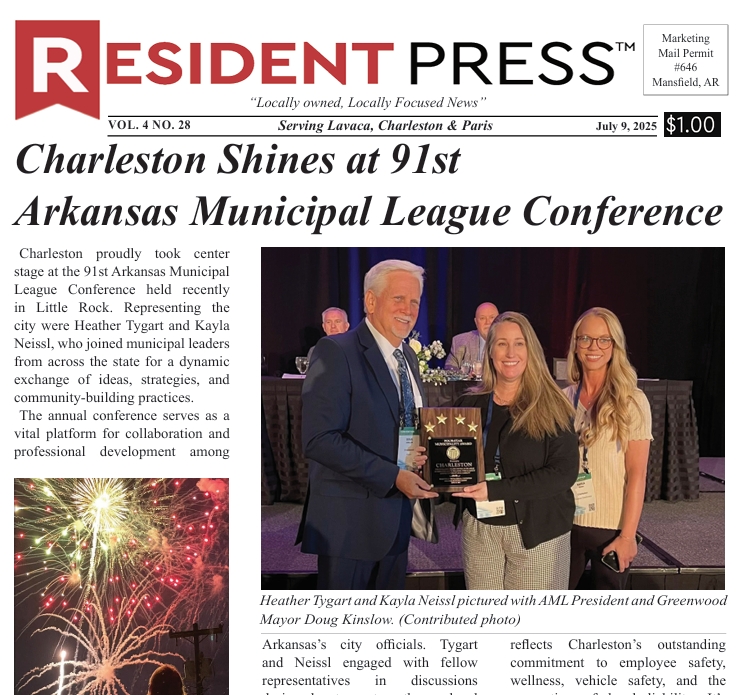
Resident Press (Lavaca, Charleston, Paris edition) 6/4/25 Vol. 4 No. 23

This content is reserved for RESIDENT INSIDER members.

Please or subscribe to view.

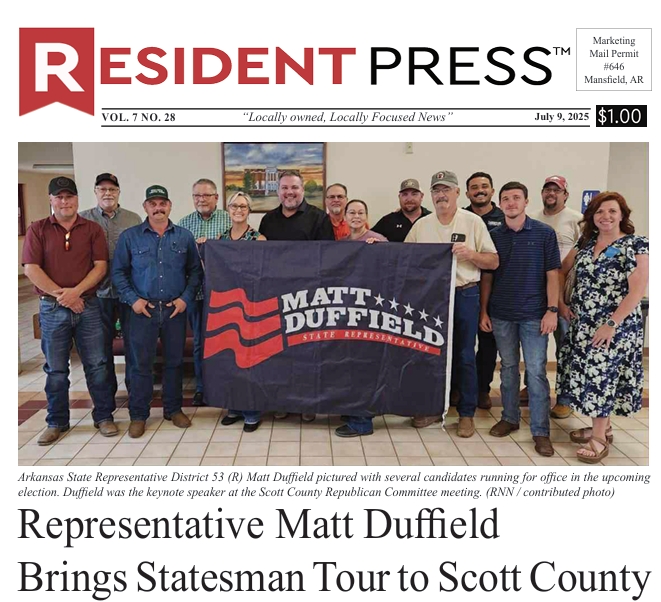
Resident Press (Scott & So. Sebastian County edition) 6/4/25 Vol. 7 No. 23

This content is reserved for RESIDENT INSIDER members.

Please or subscribe to view.

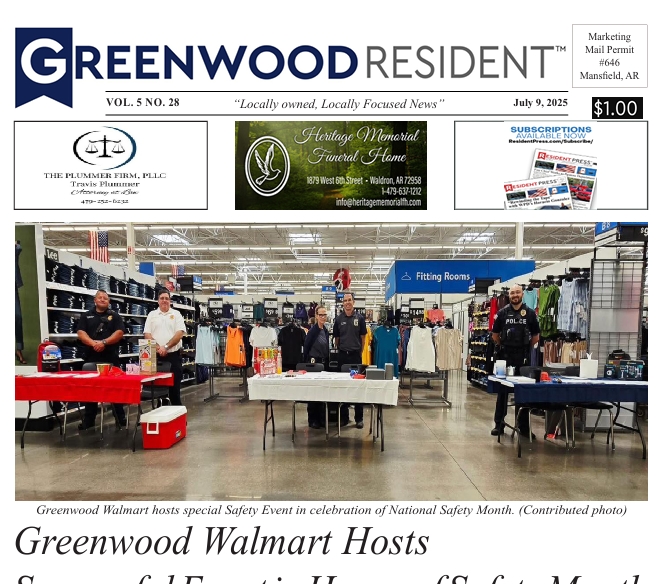
Greenwood Resident 6/4/25 Vol. 5 No. 23

This content is reserved for RESIDENT INSIDER members.

Please or subscribe to view.

Obituary: Robert Mills (1973 – 2025)

Robert Lee Mills of Parks, Arkansas passed from this life, Thursday, May 29, 2025 in Parks, Arkansas. Robert was born November 14, 1973 in Fresno, California to Richard L. Mills and Antoinette Mills. He was 51 years old.

Robert was married to the love of his life, Julie for 31 years before she went to Heaven to wait for him. Together they had one son and made life in Parks. He loved fishing, riding 4 wheelers and spoiling his grandchildren. He looked forward to seeing their sweet little faces everyday and teaching fun things to do. Robert enjoyed being close to his family and was a devoted husband, father and Papa.

Robert leaves behind to cherish his memory, one son, Justin and wife DeLani of Parks, Arkansas and a half brother Sean Mikkelson of Greenwood, Arkansas. Papa will forever remain in the hearts of his grandchildren: Waylen and Willow. Robert will be missed by all that knew him and the many whose lives he impacted including a host of friends, neighbors and loved ones.

Robert was preceded in death by his devoted wife, Julie, and his parents, Richard and Antoinette.

Robert’s family will host a private celebration of life at a later date. Arrangements and cremation are being entrusted to Heritage Memorial Funeral Home & Crematory in Waldron, Arkansas.

Senior Centers Struggle Amid State and Federal Funding Cuts

Senior centers in Sebastian County are facing an unprecedented crisis as state and federal funding is slashed, leaving the executive director of the Sebastian County Senior Centers scrambling to find a way to keep critical services running.

Deanna Rice, the Executive Director of the Region 8 Senior Centers, has never had to place seniors on a waiting list for food—until now. “In my 20 years, I have never had to turn someone away because we did not have enough food,” an emotional Rice shared.

The current budget for the five senior centers in the county is $1.4 million, with $500,000 allocated solely for food. However, on April 24, 2025, Rice received an email notifying all executive directors that the next fiscal year’s budget would be “significantly lower” than anticipated, with a devastating 17% cut.

The SRCAs are subcontracted by the Area Agency on Aging, which channels funds from the state’s Department of Human Services (DHS). However, before reaching the centers, 10% of federal grant monies is retained for administrative costs, further reducing resources for seniors.

In 2024, state and federal grants totaled $685,966. In 2025, that amount has dropped to $640,081. A staggering $45,885 loss in funding.

Additional cuts include a reduction in USDA funds, resulting in a loss of $34,333 in funding. Employees, already working limited hours at minimum wage without benefits or retirement options, now face even greater financial uncertainty.

Although nutritional shortages are the main concern, Rice added that maintenance costs and operating expenses have also increased. This compounds the shortage of funding as it fails to address overall inflation. “We have to figure out a way to come up with the funds for gas for the Meals on Wheels vans, maintenance costs, and other operating expenses,” Rice explained.

Rice allocates funds to centers based on the number of meals served, but dwindling financial support means fewer resources for those in need. When Rice began working in the field 20 years ago, state and federal grant monies covered 50–66% of the budget. Today, that number has dropped to 42%.

“Hunger hurts. Isolation and the threat of hunger lead to depression and suicide,” Rice emphasized. “These are the harsh realities of this program going underfunded.”

Though local legislators pledged their support, meaningful legislative action has failed to materialize. Bills such as HB1920, which aimed to provide emergency food funding for seniors, and SB201, intended to allocate grants for home-delivered meals, never advanced past committee.

Rice urges lawmakers to revisit these crucial measures: “The solution is not to leave this up to our cities to fill the gap in funding. They cannot afford to shoulder that burden. What we need is for the program to be funded as it was intended to be when it originated.”

Despite the financial strain, Rice continues to seek alternative funding sources, applying for grants through United Way, Medicare, and Medicaid. She also highlights the importance of community contributions.

“No one over the age of 60 is required to pay for a meal,” Rice explained. “There is a suggested price of $4 for the meal. Even if someone can pay even $1, that is a help. We also welcome donations.” Rice noted that if someone makes a donation, they can ask that the monies applied locally, or they can be directed to meet the most urgent needs.

Rice also welcomes any questions about the program and its funding needs. Those looking to help, or have questions, can contact her directly at 479-648-9970.

With state and federal funding continuing to decline, the senior meal programs in Sebastian County are suffering the adverse effects. As Rice and her team navigate uncharted territory, one thing remains clear: the well-being of seniors depends on immediate action from lawmakers and advocates for the elderly in our community.

Yell County Justice of the Peace Brent Montgomery Announces Campaign for State Representative

DANVILLE, AR — Brent Montgomery, Yell County Justice of the Peace, announced today his candidacy for Arkansas House District 52, which includes Scott and Yell Counties and a portion of Sebastian County.

“After much prayer and discussion with my family and friends, I am excited to announce my campaign for the Arkansas State House,” said Montgomery. “As a Justice of the Peace for Yell County, every action I have taken while in public service has been based upon the conservative principle that government must always live within its means. As a small business owner and cattle farmer, I know firsthand the burdensome government regulations that too often choke the success of local businesses. State House District 52 needs a State Representative who will fight for our local communities and rural Arkansans at the Arkansas State Capitol.” 

Upon announcing his candidacy, Montgomery also said, “The people of District 52 deserve a proven and experienced state representative—someone who is Christian first, conservative second, and Republican third. This order has guided my life. I will always protect the sanctity of human life, uphold our constitutional right to keep and bear arms, fight to support our rural schools, and defend the values that define our faith and community.  I humbly ask for the support and votes of the people of District 52 in the Republican Primary on March 3, 2026. I pledge to remain accessible and accountable only to you, not the special interests in Little Rock.”

About Brent Montgomery

Brent Montgomery is a small business owner, cattle farmer, and lifelong resident of Yell County. Montgomery is currently serving his second term as Justice of the Peace for District 1 of Yell County and has been a volunteer firefighter for over eighteen years. He also currently serves on the Yell County Fair Board. Montgomery is the owner of Envirotrac Safety and Erosion, Inc, a company specializing in highway construction and municipal infrastructure.  Brent and his wife, Kendra, live in Ola, Arkansas, and have three children. They are members of Jesus Name Church in Plainview, Arkansas, where he serves as secretary of the board and Sunday School teacher.  

Republican Tonya Fletcher Announces Campaign for Arkansas House of Representatives District 46

Paris – Paris Area Chamber of Commerce Executive Director and City Council Member Tonya Fletcher has announced her campaign for Arkansas State House District 46.

“I have spent over a decade working to build our local economy and look forward to taking my experience in growing our community to Little Rock as your representative. I love our district and promise to fight for what is best for our people. As a wife, mother, and grandmother, I will fight to make Arkansas the best it can be for future generations.”

Fletcher is Founder of Main Street Paris, President of the TriPeaks Regional Tourism Association, Board Secretary for the Fort Smith Regional Alliance, Board Member of the Western Arkansas Planning and Development District, Board Member of the Western Arkansas WIOA, a former Board Member of the Paris Boys and Girls Club, a 2023 Graduate of Leadership Arkansas, and 2024 Graduate of the FBI Citizens Academy.

“Working with local elected officials, stakeholders, and citizens gives me a sense of what priorities are important. Faith and experience will be my guiding light as I work to protect rural Arkansas values and promote transparent government.,” continued Fletcher. “I will advance conservative principles including the right to life and bear arms, and be a strong advocate for families, Veterans, seniors, and AR education.”

Fletcher and her husband, Brian, have five children and six grandchildren. In her free time, Fletcher enjoys visiting Arkansas State Parks.

House District 46 is currently represented by State Representative Jon S. Eubanks whose tenure has been term limited. Fletcher thanks Eubanks for his many years of dedicated service to Arkansas.

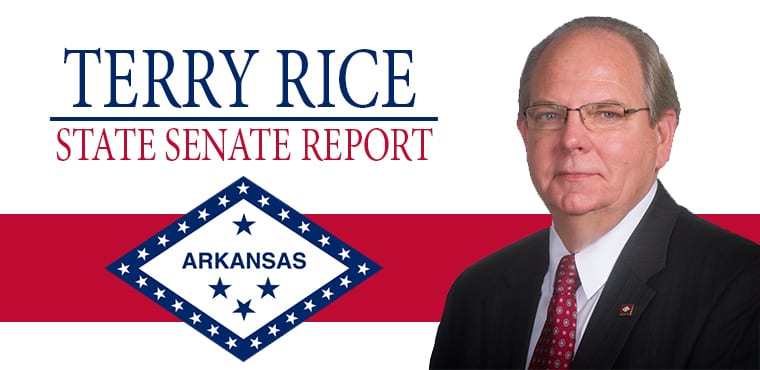
State Capitol Week in Review from Senator Terry Rice

The state Department of Human Services has contracted with experts at the University of Arkansas to update the current health care system, in order to fill the gaps in coverage for people who face the gravest health risks.

The Department has identified three groups who face higher risks for poor health. One group comprises people who suffer from mental illness or who abuse substances. The second group are senior citizens and people with physical disabilities. The third group is made up of people with intellectual or developmental disabilities.

Public health officials have identified the most significant gaps in coverage for the three groups. One gap is a lack of early diagnosis and intervention. Another is coordinating care so that they can recover and stabilize in the least restrictive environment, rather than in an institution far from home. Integrating care is especially difficult for people leaving jail, prison or a behavioral health care facility.

The contract with the university is for $10 million. The project will be led by its School of Social Work, with input from the university’s Department of Sociology and Criminology. They will work with existing providers. A partner will be the Human Services Department’s Office of Substance Abuse and Mental Health.

The goal is to develop a statewide model for prevention, early treatment and follow up. One issue will be recruiting and retaining staff. Workforce shortages for mental health professionals exist in 72 counties. Only Faulkner, Pulaski and Saline Counties are not short of health care professionals.

The workforce shortage is particularly acute because adults in Arkansas experience anxiety and depression at a rate higher than the national average. The suicide rate is higher too, according to public health agencies. They estimate that 12 percent of the state’s population, or 380,000 people, has had a medical visit with a primary diagnosis of mental illness or substance abuse.

Public health and elected officials in Arkansas have worked hard to make sure most residents have health coverage. In 2022 about 90 percent of Arkansans below the age of 65 had coverage, and 94 percent of children had coverage, either through private health insurance or public programs like Medicaid, which is the largest single source of health care payments in Arkansas.

About 17.5 percent of the Arkansas population are age 65 or older, and of those 10 percent live in poverty. The university team and DHS officials will work to expand the availability of services so they can live independently at home. DHS has a separate agreement with Arkansas State University to improve training of workers who provide those services.

ASU also administers a program to help service organizations navigate the business aspect of providing care to senior citizens and people with disabilities. The program helps them adjust to changes in regulations so they can stay current with the long-term goals of Medicaid. According to DHS, which administers Medicaid, there is a “burgeoning demand” for home and community-based services.

DHS recognizes that Arkansas needs more comprehensive screening of children, so they are diagnosed earlier for disabilities and behavioral problems. Early treatment reduces the severity of the disabilities and reduces the long-term costs of later interventions.