



By Dr. Curtis Varnell
The Arkansas river once had a disposition that ranged from housecat to wildcat and whose moods could change in minutes. When first explored, the frontiersmen used keel and flat boats and could go far upstream without difficulty. Needing little water to operate, they easily could travel to Webber’s fall, and with a little help, on to what is now Tulsa. Beginning in the 1820’s, steamboats could follow the same route but found that the water was often too shallow for transport from early summer until late fall. If they could avoid the sandbars, stumps, and some shallow rapids, they could usually navigate as far west as Dardanelle; further west the steamboat captain could expect some real problems. On occasion, a boat loaded with cotton or other goods would high-center, stuck on the sand until the water rose or they could be extracted by ropes and pulleys connected to animals on shore.
In 1836, one of the military journals kept by those required to accompany natives on the Trail of Tears described the arduous journey from Little Rock west. On several occasions, people were offloaded to lighten the load and traveled along the river through the marsh and swamp until the boat again reached deeper water. Goods and merchandise, pulled on a smaller boat that was weighted down, had to be left behind. Nothing about the journey sounded fun. The boats were finally abandoned at Roseville and the journey to Oklahoma continued by wagon andon foot.
On September 27, 1863, General Jo Shelby described his cavalry crossing the river at Roseville. The river was described as deep as the horse’s chest, the bed of the river a soft sand and easy to cross. Contrast that to 1927 when half of Arkansas was covered with water. The raging river covered up all of the bottom land and hundreds of farms. People escaped by fleeing to the tops of levees and dikes, often staying for weeks waiting on the water to recede. People described watching entire houses float by, carried downstream by the swollen torrents of water. Holla Bend area near Dardanelle was inundated with water as far as you could see in the distance. When the water receded, sand several feet deep covered the region leaving the land worthless.
The federal government, in an effort to alleviate the problems, began to look at ways to develop a navigation system that would deepen the river, make it navigable to Tulsa year-round, and create recreational areas as well as produce electricity. A grand plan, all that was lacking was the money to complete it and a method to keep the river from clogging up sediment and filling in the various lakes as quickly as they developed. A little-known fact, Hans Albert Einstein, son of Albert Einstein, developed the flow method for the Arkansas river that would prevent much of the sedimentation and made it possible to construct the system.
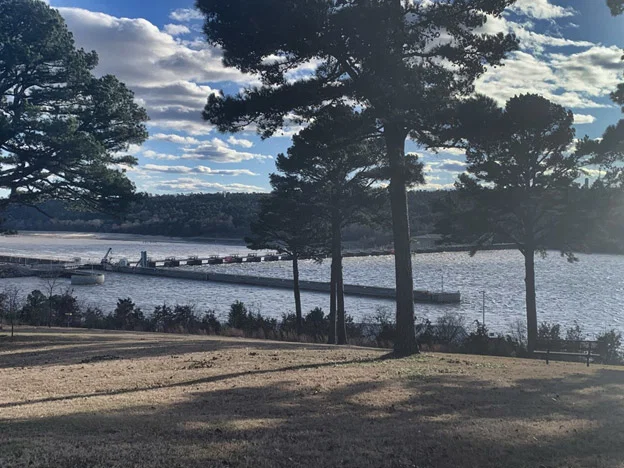
Governor Robert Kerr of Oklahoma and Senator John McClellan were able to get the federal government to authorize the funding on a dam-by-dam basis, thus ensuring the eventuality of completing the project.
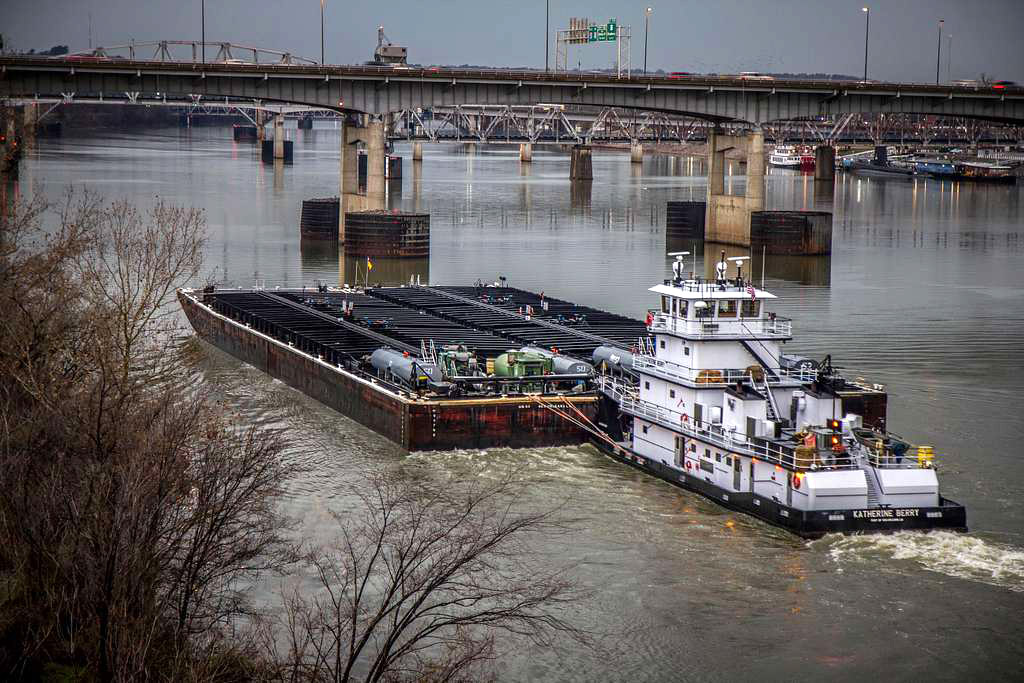
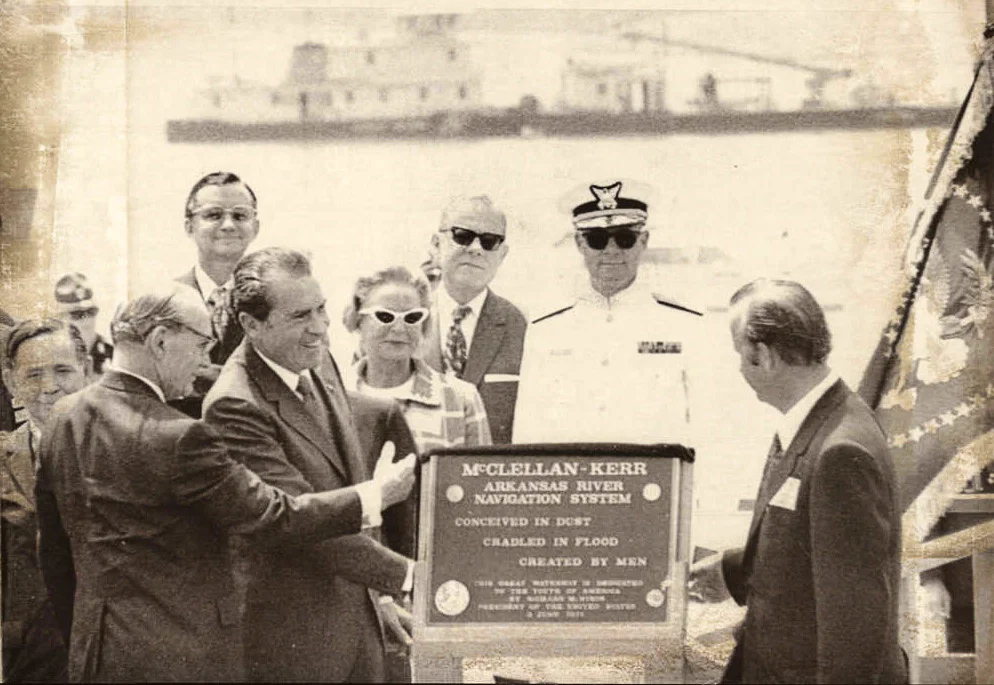
Eufala, Oologah, and Keystone reservoirs in Oklahoma were the first constructed, creating a body of water that could be used to maintain channel flow. The lake Dardanelle reservoir began in 1958, eventually followed by Little Rock and downstream. By 1971, The Arkansas River Navigation Project provided a minimum nine-foot-deep channel with a total lift of 420 feet, 450 miles long from the Mississippi River to the head of navigation at Catoosa, near Tulsa. On January 3, 1971, the first commercial barge pulled into the Port of Muskogee, containing steel pipe manufactured by Republic Steel. On June 5, 1971, President Richard Nixon dedicated the McClellan-Kerr Navigation system and the Arkansas River, although never completely tamed, was brought under control and open for use.