


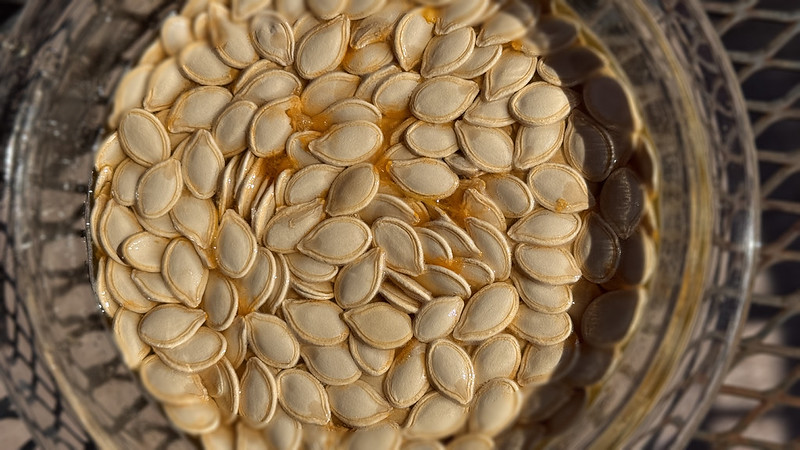
Pumpkin seeds freed from pulp float to the top of the bowl. (UADA image)
By Mary Hightower
University of Arkansas Division of Agriculture
Saved pumpkin seeds from a jack-o’-lantern can turn into a snack, a sauce or a second generation of pumpkins, but is there an easy way to separate the seeds from the pulp?
Quadarius Whitson, extension instructor for culinary nutrition, hospitality and tourism for the University of Arkansas Division of Agriculture, said that for jack-o’-lanterns or any winter squash, start by using a sturdy spoon to scrape out the mass of seed and pulp.
“One easy trick is to put the seeds and pulp in a bowl of water and work the mixture gently with your hands,” he said. “What makes this work is that the seeds float while the pulp sinks, making separation easier. A colander can then be used to strain and rinse the seeds.”
Using the seeds
Whitson said that after rinsing, pat or spread the seeds out to dry before roasting.
And while roasting may be the most common way to enjoy the pumpkin’s buried treasure, “pumpkin seeds are pretty versatile beyond roasting,” Whitson said, adding that they can also be eaten raw after rinsing and drying. “Roasting simply adds more flavor and crunch,” he said.
“They can be added to salads, soups, oatmeal, yogurt, smoothies, granola, and trail mix, or incorporated into breads, muffins, energy bites, pesto, or seed butter,” he said. “Using the seeds is a nice way to reduce food waste while adding texture and nutrition,” he said.
The scoop on pulp
So, what is that stuff inside the pumpkin?
Amanda McWhirt, associate professor and extension fruit and vegetable specialist, said the different layers that make up the fruit have different functions that help develop and disperse the seeds to become the next generation of the plant.
The rind is the “exocarp,” the flesh or meat of the pumpkin is the “mesocarp,” and the pulp is the “endocarp” which surrounds the seeds.
“The pulp generally acts as a protectant around the seeds,” she said.
“If you think about tomatoes, there is a very similar setup — with the skin, the tomato flesh/meat and then generally some pulp around the seeds,” McWhirt said. “In other fruits like citrus, the pulp is the interior juicy segments we eat and the mesocarp is the white fleshy part we don’t eat.”
The Cooperative Extension Service in Arkansas and other states have many resources about pumpkins and other squashes:
- Home Gardening Series: Pumpkins
- Pumpkin: More than Jack-o’-lanterns or Pie
- Pumpkin Breakfast Bread
- Plant of the Week: Pumpkin
- How to Roast Pumpkin Seeds
- Pumpkin Seed Cluster Snack
To learn about extension programs in Arkansas, contact your local Cooperative Extension Service agent or visit uaex.uada.edu. Follow us on Facebook and Instagram. To learn more about the UADA, visit uada.edu. To learn more about ag and food research in Arkansas, visit the Arkansas Agricultural Experiment Station at aaes.uada.edu.