Oct. 15th 2016 is the planned date for this years Huntington Old Miner’s Fall Festival. The festival will begin at 8:00am, and ends that night at 11pm.
Arts/Crafts Vendors, Live entertainment, Raffles, Pie Walk, Food Vendors, and Much More!
Space size is 10ft x 14 ft, at $15.00 each, or $25.00 for two. (Spaces are first come, first serve basis)
Electric is limited and will cost an extra $5.00, and it is encouraged to bring your generator.
Earlene Moore, President of the Huntington Planning Committee, stated, “I am seeking new vendors for this event. This event usually pulls in 80-100 vendors a year. Forms will be ready for sending out in April, along with a letter to all vendors explaining changes and updates.”
For more information, or to reserve your spot, email Earlene Moore at [email protected]
It takes courage to step out from what you know, to try a new product. As adults, we typically fall into preset patterns around our home, our diet, and even our hygiene. With limited experience using handmade, or artisan=style soaps, we came across Goatie Girls right before Christmas, while perusing Belle Starr Antiques, in Fort Smith .
After using their products, we had to learn more of what it takes to produce this product. So, we were invited to spend a few hours getting to know what exactly is behind Goatie Girls.
After meeting Ginger Ballard, we could tell she is definitely passionate about her goats, and the products she produces, from her small farm, located just South of Hackett, Arkansas. “Goatie Girls” is all about educating the consumer on the positive effects of using goats milk products, especially the soaps, not only for health purposes, but for their therapeutic values. Both elements, we totally agree. “Tropicana”, one of the Ballards herd at Gaotie Girls, proudly giving us her best side.
Ballard stated, “At the moment I have six does, and one wether. Goats are herd animals and they you should always have at least two. The six does I have are all good producers and at their peak production give 1-1/2 gallons a day each. Milking twice a day. So that definitely covers my needs.” Goatie Girls is a simple, yet complex small business that operates out of a small milking station in the barn, then progresses into the garage, turned production, and packing stations. That’s where the real work begins.
Ballard added, “When I make my goat milk soap I don’t use any water. There is only the oils, the goat milk, the lye and whatever additives such as fragrance oil, essential oil, honey, oatmeal, etc. The goat milk gives the soap and really rich creamy lather that is very moisturizing. And goat milk absorbs easily into the skin. Goat milk is a natural alpha-hydroxy and naturally exfoliates and hydrates dry skin. Goat’s milk contains Vitamins A, B6, B12 and E.”
Goat’s milk is naturally homogenized, meaning it doesn’t separate like raw cow’s milk does, and is also easier to digest than cow’s milk.
Try one bar of Goatie Girls saop and you’ll see why we truly love this product. For the outdoors lovers, we highly recommend the “Bug Be Gone” soap. Remember, goats milk soap doesn’t go bad, it only gets better.
For more information on Goatie Girls Soaps, visit their WEBSITE
The CIty of Mansfield recently received a $74,000 Community Block Grant for the Dixie Theatre, which will be used to continue the remodeling, and restoration efforts by the City of Mansfield, personally headed by Robert, and Becky Walker. l, and to Rep Jon Eubanks, Mayor Austin also
The grant was applied through the Arkansas Department of Rural Development.
After a brief introduction, MHCC President Tony Williams, opened the February meeting to Richard Parks, Helath-Wise Pharmacy, and the members of Cornerstone Pharmacy, to discus their individual plans on opening both businesses in Mansfield. That article can be read in full, HERE.
After a brief Q&Q concerning the pharmacies, the MHCC board discussed changing the meeting times with hopes of hosting more members. “The biggest problem we have with attendance, is the ability for members to leave work for one hour, to attend the meeting.” This item declared no vote, and was tabled for the March meeting.
The board was made aware of the upcoming benefit Pancake Breakfast where the proceeds will benefit the July 4th Fireworks display. For more information on the benefit, visit HERE.
Other items of discussion:
Benefit spaghetti dinner to be presented at the March MHCC meeting.
Mayor Austin mention the current state of City Hall renovations.
Farmers Market will start on the 1st weekend in June.
The Mansfield / Huntington Chamber of Commerce held their regular monthly meeting last Thursday at the Mansfield City Hall. The focus was not only about the agenda, but the Pharmacies that have announced opening within the city limits.
Both Cornerstone, and Health-Wise representatives were on hand to discuss, and to state their individual plans. Both businesses are still in the planning stages, with lots to do in order to open both locations. Cornerstone Pharmacy representatives (L to R), Chelsey Burk, Amber Wright, and Allison Clem, answer questions from the Chamber board, and local residents.
Cornerstone Pharmacy will offer an app that will be useful for prescriptions, awareness, and general communication, a convenient drive-thru window, a “match or beat pricing” guarantee, a wide selection of gifts, Dippin’ Dots ice cream, state of the art software that will highly benefit their patients, after hours on-call pharmacists to assist with patient needs, medicinal compounding, and plan to be highly involved in the community and its organizations.
They’re adding 20 extra parking spots to their store front for ease, and safety, and will offer promotions through their Facebook page. Hours of operation will be Mon – Fri, 8:30am – 6:30pm, and Saturday 9:00am – 2:00pm
Cornerstone will employ (2) pharmacists, (2) pharmacy techs, (2) clerks, and a summer delivery driver. Richard Parks, owner of Health-Wise Pharmacy, answered questions at the MHCC Meeting last Thursday.
Richard Parks, from Health-Wise pharmacy, discussed some of the issues of opening in Mansfield, citing the “red tape” issues to opening not only any business, but a pharmacy. Regardless of location.
With a humble attitude, he spoke of how he is excited about opening as soon as possible, and truly hope we can be beneficial to the area residents, and community.
Planned hours are not set in stone yet, but hope to be Mon – Sat, 8:00 am – 7:00pm, with Sunday being “on call.” Health-Wise will employ (1) pharmacist, and (2) pharmacy techs.
When asked about the potential of bringing back the soda fountain that once adorned Don’s Drug, Parks stated, “we’re looking into it, and hope to have a solution soon.”
The Mansfield High School Student Council held their annual Mansfield High School Basketball Coronation on Tuesday, February 2, 2016. The basketball maids dressed in beautiful daywear were escorted by the basketball players, and the Queen was officially announced during the afternoon ceremony prior to the Homecoming Pep Rally. Dressed in elegant formal wear, the Queen and her Court were first escorted by their fathers who led them to their basketball player escorts during the evening ceremony.
Chosen for freshman maid was Miss Rylea Weaver. She is the daughter of Angie Weaver and Billy Weaver. She was escorted by sophomore, Hayden Rose, the son of Pete and Crystal Rose and senior, Devan Thompson, son of Eldon and Tina Thompson. The sophomore maid was Miss Alyx Puterbaugh. She is the daughter of Mark and Chrissy Puterbaugh. She was escorted by sophomore, Curtis Griffin, son of Ray and Dana Griffin and senior, Alden Simmons, grandson of Jerry and Marilynn Milam. Serving as junior maid was Miss Kirstie Morrison. She is the daughter of Tim and Amanda Morrison. She was escorted by junior, Colton Schluterman, son of Kasi and Jerid Carter and Walter Schluterman and junior Kolby Morgan, son of Wesley and Melissa Morgan. The basketball maid was senior Miss Julia Coplin. She is the daughter of Debus and Karla Coplin. She was escorted by senior, Anthony Elmore, son of D.J. and Michele Elmore and senior, Patrick Vannaraj, son of Toui and Pk Vannaraj.
The senior maids nominated for Queen were Miss Kenzie Poor, Miss Madison Strunk, and Miss Allison Overstreet. Kenzie Poor is the daughter of Dee Farquar. She was escorted by senior, Joe Mathis, son of Stanley and Katie Mathis and senior, Christian Saygnaphay, son of Bon and Faye Saygnaphay. Madison Strunk is the daughter of Billy and Ashley Strunk. She was escorted by senior, Tyler Hearron, son of Terry and Jessica Hearron and senior, Tyler James, son of Brandon and Wendy James. Crowned as Queen was Allison Overstreet. Alli is the daughter of Tony and Michelle Overstreet. She was escorted by senior, Tristen Nason, son of Marsha Glenn and Keith Coatney and sophomore, Brennan James, son of Brandon and Wendy James. Homecoming Queen, Miss Allison Overstreet, and her court.
(Photos copyrighted by Resident Press, and courtesy of Kandis Howard)
Previously published by Fast Company | Editor | 03 Feb 2016 | LINK
All Photos: Jessica Ashley Photography
This House Costs Just $20,000—But It’s Nicer Than Yours.
The Rural Studio’s 20K House is so cheap and has such innovative design that it’s changing the entire housing system—from mortgages to zoning laws.
For over a decade, architecture students at Rural Studio, Auburn University’s design-build program in a tiny town in West Alabama, have worked on a nearly impossible problem. How do you design a home that someone living below the poverty line can afford, but that anyone would want—while also providing a living wage for the local construction team that builds it?
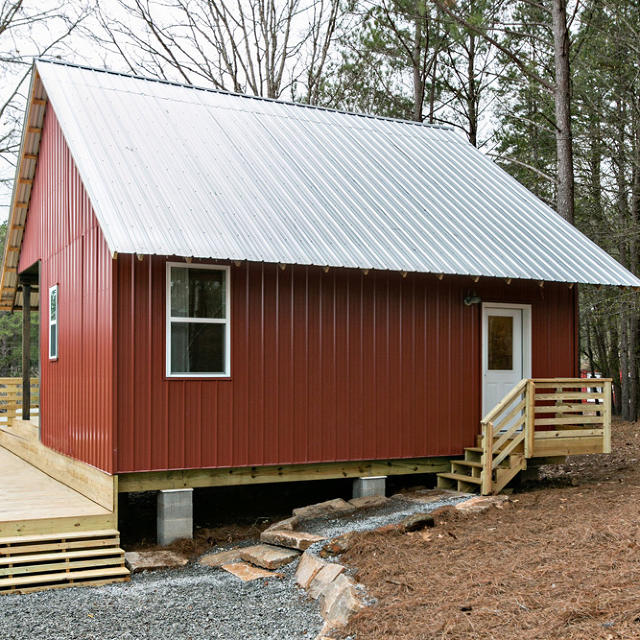
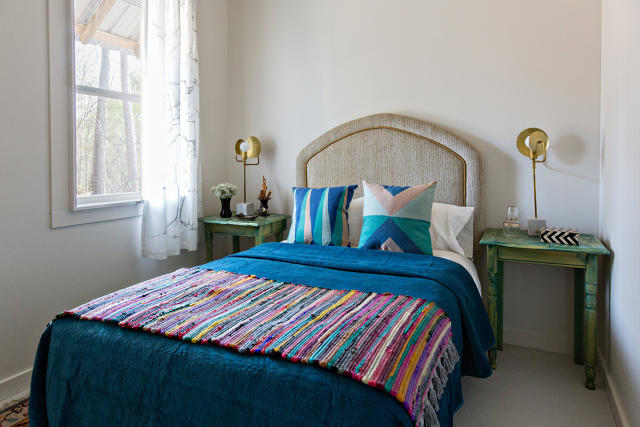
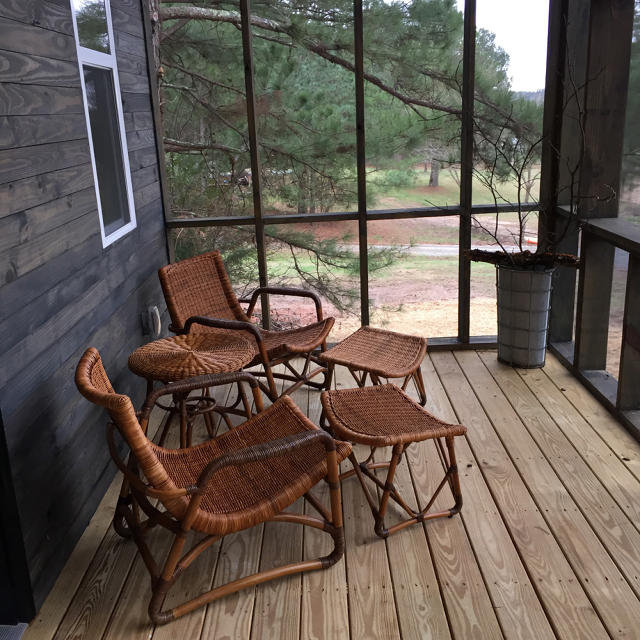
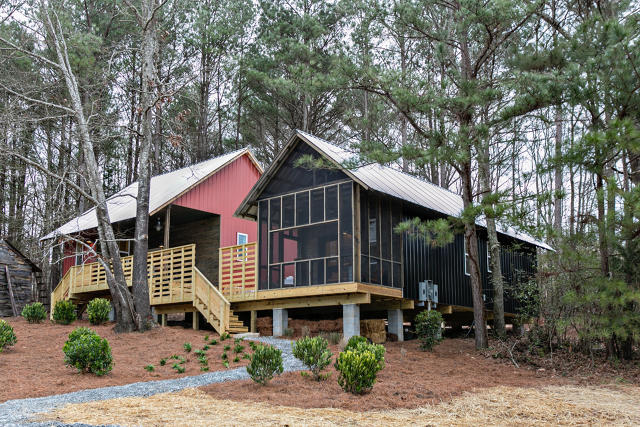
In January, after years of building prototypes, the team finished their first pilot project in the real world. Partnering with a commercial developer outside Atlanta, in a tiny community called Serenbe, they built two one-bedroom houses, with materials that cost just $14,000 each.
The goal: To figure out how to bring the ultra-low-cost homes, called the 20K Home, to the broader market. “We’re in a kind of experimental stage of the program, where we’re really trying to find out the best practice of getting this house out into the public’s hands,” says Rusty Smith, associate director of Rural Studio. “Really this first field test was to find out all the things that we didn’t know, and to find out all of the kind of wrong assumptions that we had made, and really find out how we had screwed up, honestly.”
Years of architecture students, and their advisors, have spent more than a hundred thousand hours tweaking each detail of the house to optimize both the function and the price. But the bigger challenge is fitting a house that’s completely different than normal into the existing system of zoning, and codes, how contractors do their jobs, and even mortgages.
“The houses are designed to appear to be sort of normative, but they’re really high-performance little machines in every way,” says Smith. “They’re built more like airplanes than houses, which allows us to have them far exceed structural requirements. … We’re using material much more efficiently. But the problem is your local code official doesn’t understand that. They look at the documents, and the house is immediately denied a permit simply because the code officials didn’t understand it.”
The foundation of the house, for example, uses cantilevers, seesaw-like joists that help save wood and concrete and actually make the house stronger than a typical foundation would. But the design isn’t in the usual guides that code officials consult, so the architects had to go back and explain how it worked.
“There’s a thousand and one things in the houses that are like that,” he says. “You’d never see them, the construction techniques, but the house is filled with them. Construction techniques that make the house not just less expensive, but actually makes it perform better than they normally would.”
To bring the house to everyone else who wants to build it, the team realized they would have to create a detailed guide that explained everything from how to build each piece—with Ikea-like instructions—to how to educate local officials.
“A traditional construction set basically tells a builder what to build,” says Smith. “And what we learned that we really need is what we’ve come to refer to as not a construction set, really an instruction set. That not just tells what to build, but specifically how to build it and even more important, why it should be built that way.”
In Serenbe, their first problem was a zoning issue: The houses were too small. (It’s a common problem for anyone trying to build a tiny home.) But they also realized there were numerous other issues, from dealing with insurance, to the bank. In the pilot project, the homes will be owned by the community and shared with artists as part of a residency program. But in a typical case, when someone is buying the house on a limited income and can’t afford the $20,000, banks won’t finance a mortgage for such a small amount of money.
Regions Bank, which works with Rural Studio, told Smith that a mortgage for a $100,000 house costs the bank about $2,300. But a mortgage for a $20,000 house also costs $2,300. “There’s a lack of scalability,” Smith says. “There are these structural things you can only scale down so far.” Now the bank has worked on their own design problem: a new mortgage product made for the poorest people to afford.
The team is trying to address all of the issues the house faces at once. “The most daunting problems aren’t brick and mortar problems, they’re these network and system problems that are threaded together and all intersect in the built environment,” he says. “We’re able to attack all these problems simultaneously—when we see a lever over here and wiggle it, we can very clearly see the implication it has on other systems down the road.”
The houses also had to look good, despite the tiny budget. The development near Atlanta might at first seem like an unlikely place to build the pilot homes—it’s a lush planned community that includes million-dollar houses. The architects partnered with the developer for several reasons, including their ability to keep going through seemingly impossible problems. But they also liked the idea of showcasing the homes in such a desirable area.
“When was the last time you were driving down the street by an affordable housing project and you thought, ‘Boy, I really wish I lived in one of those for myself,'” Smith says. “The goal of 20K House is really to design a house that’s affordable, that anybody could have—and that anybody would want.”
Once they have the full “instruction set” ready, the team wants to share it with anyone who wants to use it “The ultimate goal of the project is to give it away,” he says.
Originally, the project aimed for a house that would cost $20,000 in total, including construction, though they now believe that more money may be needed to provide a living wage for builders. They’ve rejected the idea of using factory-made prefab parts (something that a related project in the area does), because one of the main goals is to also provide jobs. Still, whatever the final cost, it will be cheap. And if someone wants to put it together themselves, it would cost less than $20,000.
“We provide the information to you, so that if you wanted to sort of self-service the house yourself, it is a house that with the right set of instructions, anybody who wanted to could build it,” Smith says.
He’s impatient to share the plans with the world. “We’re behind schedule, quite honestly,” he says. “So many people need it now.”
The Mansfield Chamber of Commerce will meet tomorrow for their monthly meeting. The focus of this meeting will be the two pharmacies coming into Mansfield, and the questions that surround the businesses, their location, opening dates, as well as a “Q&A” with the pharmacists.
Alllsion Clem, representing Cornerstone is familiar face with both Don’s Drug, and Walmart, and Richard Parks, who some have known from his pharmacies in Greenwood, and Lavaca.
Meeting starts 12:00pm (noon) at the City Hall in Mansfield.
Mansfield Parent Involvement Committee (MPIC) was formed to support the teachers, and students of the Mansfield School District. Headed by Amanda Wilson, they’ve been able to supply many needs for the district, including some of those which involved the relationship between parents, and the school district itself.
Recently, MPIC donated a greenhouse for Mrs. Bullard’s 7th/8th grade class where it will be used internally for education purposes. Mrs. Bullard said, “I just wanted to thank the MPIC for purchasing the greenhouse for my classroom! We are getting good use out of it!! We really appreciate their support!”
Wilson added, “It’s always rewarding to see the enthusiasm from the staff, and students, when we are able to do something like this. That’s exactly why MPIC was formed. Thank you parents!”
The greenhouse is already at work in Mrs. Bullard’s classroom.
My Italian grandmother always had good advice. One of them being, “You can never have too many tomato plants, but what happens when you run out of room in the garden. Tomatoes are probably the most versatile plant you can grow; They are used in everything from Tomato Sauce to Ketchup, Espagnole Sauce to Bloody Marys’ (Yum!).
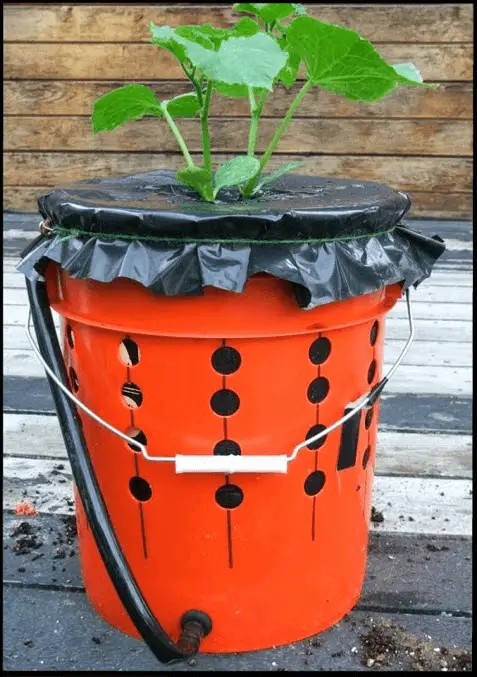
Growing tomato plants in 5 gallon buckets is nothing new, my relatives would grow them on their front porches for decades. What is kinda new and unique is having self watering tomato buckets that are practically maintenance free. Imagine growing beautiful, full tomato plants and only having to refill a reservoir may once a week. I don’t know about you, but my wife hates when we go away for a week and all I can say is “I wonder how my plants are doing”.
Here on the homestead, we try to maximize as much space as we can. About a year ago I was just fiddling around when I came across an obscure website call Alaska Grow Buckets. What they offered was an ingenious and SIMPLE way to make your own self watering buckets from stuff you probably have hanging around the house or garage. The concept so straightforward, it borders on genius.
How It Works
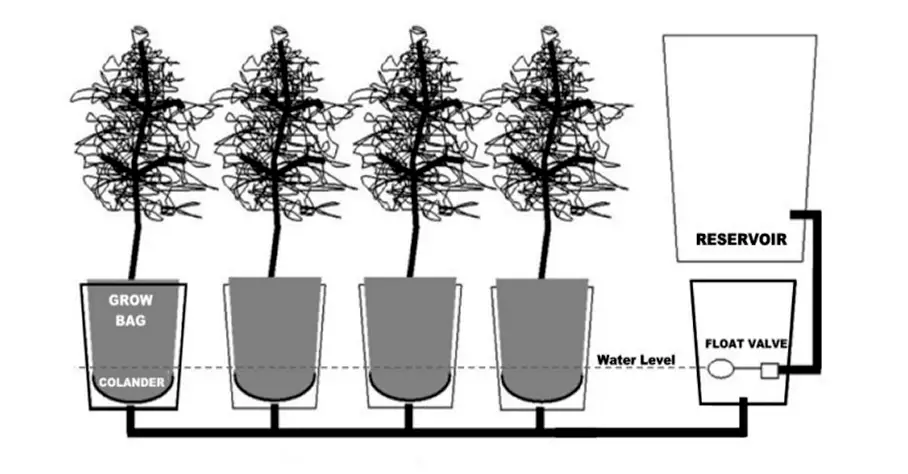
The process is quite simple. The tomatoes are planted in a wicking medium that draws water from below and sends it to the roots of the plant. The water is drawn from another drum or garbage can and is released by a float valve. When the water level drops, it activates the valve instantly irrigating your plants.
You can build this system as small or as large as you wish. Another nice thing is that you are not only limited to tomatoes. You can grow peppers, okra, cucumbers and more. Think of the possibilities.
The second key to this design is the fabric grow bag. The bags I use can be found at most supermarkets and are very inexpensive or free. The bags are made from spun polypropylene and should last for several years. Similar grow bags are available from nursery and garden suppliers. Canvas or burlap bags may also work – but they will eventually rot and fall apart. The porous fabric allows excess water drainage and aeration of the root zone which is necessary for optimal growing conditions.
The system is also based on the principle of “air root pruning”. As roots grow out to the porous fabric they become exposed to air, dry out and die. This causes the plant to produce dense fine feeder roots and prevents root circling. The increase in fine feeder roots leads to better nutrient and water absorption and promotes accelerated plant growth.
The third key to this system is a plastic kitchen colander, that will hold the fabric shopping bag off of the bottom of the bucket and create a shallow water reservoir in each grow bucket. Almost any large plastic colander can be trimmed to fit inside a 5 gallon bucket with a strong pair of shears. The colander included in all Alaska Grow Buckets kits fit perfectly without trimming.
The fourth key to this system is the 5 gallon support bucket with plenty of ventilation holes around the sides. The bucket helps support the fabric bag and the ventilation holes allow adequate air movement. This allows oxygen to reach the root zone which is essential for optimal plant growth. The bucket also acts as a water reservoir below the bag providing a water source for the wicking grow medium. By maintaining the proper water level with the float valve regulator the medium will never dry out and will continuously wick moisture up to the root-zone.
I strongly encourage that gardeners find and re-purpose used buckets whenever possible and help us to keep plastic containers out of our landfills. Look for the Type 2 HDPE symbol on the bottom to indicate the plastic is safe to use for growing vegetables.
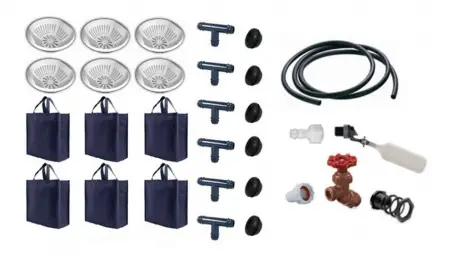
Many bakeries and restaurants have free or very low cost buckets available. Free used buckets are a great way to save. I get new 5 Gallon buckets from Home Depot at a very low price. You can find the rubber grommets, barbed fittings, vinyl tubing, and other parts from many online or local garden suppliers. The fabric grow bags that I use are available at many supermarkets.
Material Kit Includes Most large plastic colanders can be trimmed to fit in a bucket. All Alaska Grow Buckets kits come with special colanders that fit inside a 5 Gallon bucket without trimming. Complete Alaska Grow Bucket material kits are available here.
Tools
1. 3⁄4” Step Drill bit
2. Electric drill
3. Heavy shears or snips if you need to trim a plastic colander.
Construction
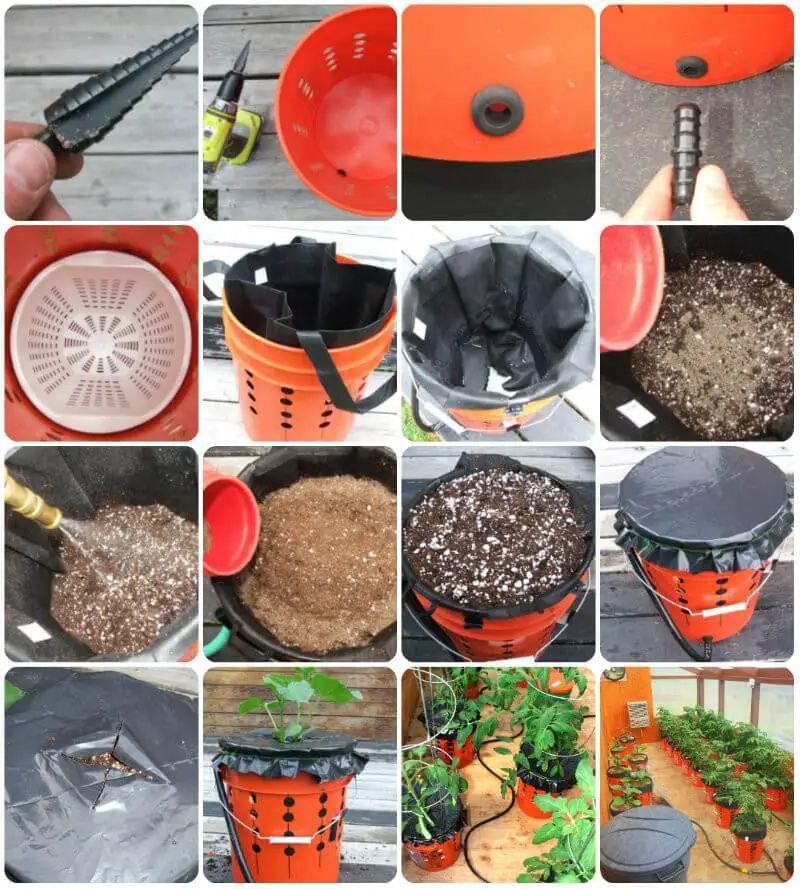
1. Drill a series of 3/4 inch holes in the bucket as illustrated. Drill as many holes as you like starting 6 inches from the bottom of the bucket. These holes along with the porous fabric bag provide air to the root system and that is the key to this design.
2. The lower portion of the bucket has only one opening. This is the water reservoir. You will drill one hole at the very bottom, with your step drill bit for your fill hose fitting.
3. Add a 1⁄2 inch barbed hose fitting to the grommet. This should provide a snug watertight fitting. Your fitting may differ depending on how you connect your buckets – 1⁄2 inch barbed fittings are available from hydroponic suppliers.
4. Place the special Alaska Grow Buckets plastic colander inside your bucket or trim other colanders to fit.
5. Place the fabric bag inside the bucket. I trimmed off the shopping bag handles.
6. Plug the fill hole and add water to the bottom of your bucket and begin adding your growing mix.
7. Fill the bucket in layers and soak each layer well to activate the wicking property of your soilless mix. Dry mix will not work.
8. Add a layer of slow release natural fertilizer to the bottom layer of grow mix.
9. An additional ring of fertilizer should be added near the top.
10. Continue adding layers of grow mix and wetting down with water.
11.A plastic sheet is added to reduce water loss through evaporation.
12. Cut slits in the plastic for planting.
13. I chose a nice looking Alaska grown cucumber that I purchased from a local garden center to test my design.
14. The bucket was attached to my greenhouse auto-fill reservoir system.
The key to setting up an Alaska Grow Bucket multi container system depends on a simple float valve regulator and a bulk reservoir for automatic watering.
Float system
You can add as many Grow Buckets in your system as space allows, but remember to leave enough space for the plants to grow with adequate air movement for ventilation and to remove excess humidity. Overcrowding impedes ventilation and promotes the spread of fungal disease and blocks light transmission within the plants.
Nutrients can be added in the form of a dry natural slow release fertilizer added to the growing mix or as a water soluble nutrient added to the water reservoir. Any hydroponic reference guide will give nutrient requirements for specific plants.