

“Just Roll with It” Serving up Recipes and Humor

Hello everyone! Hot, hot, hot!!! I love summer. I know it gets hot, but I am not a winter person.
I forgot to tell ya’ll about going to Buc-ee’s. They put the address in the GPS in the car for directions, and lo and behold, it took us to some church. We are in this church parking lot looking around, and there is no Buc-ee’s. We had to reroute, but we finally found it. We sure had a nice tour of Springfield and a few residential areas.
I also forgot to tell ya’ll about our ordeal with the Dolly Parton Stampede. We had been to eat at Lambert’s Café, and we had been shopping. We didn’t have to be at the Stampede until 8:30, so we decided to go back to the hotel and rest until then.
Well, 8:30 is what we thought. We are piled up lounging, and my brother decided to look at his phone. He yells, “Peggy, this says we are supposed to be at the Stampede at 5:30!” We start slinging and grabbing and getting our shoes on, and keep in mind it’s already almost quarter to six. We head out, and can you believe they called us because we weren’t there? They rescheduled us to the 8:30 show. Wasn’t that nice of them?
We shopped some more and headed to the Stampede. It was a great show, and the food was delicious. I bought two bags of the soup mix, and I have made a batch since I’ve been home. It tastes exactly the same as the one at the Stampede.
Now the nephew, ya’ll know the one, is on vacation. I’m telling you, crazy follows us wherever we go, so if you go on a trip with any of us Wags, expect the unexpected.
The last time they went to the beach, they had pictures taken. His beautiful wife was all pretty and fancy looking, and he’s got on a Garfield T-shirt.
This story is a prime example of the things that happen to us. They are at Navarre Beach, and they were shopping in a little gift shop. They took one of their nieces with them so their daughter would have someone to pal around with. These girls are teenagers.
They were in a little gift shop, and she went to the bathroom. When she stood up, there was a sign that read, “Per management, no pooping in this bathroom.” They took off out of there like a scalded dog.
See what I mean?? If you go anywhere with us, you better slip that rabbit’s foot in your purse or pocket.
I’m sure when they get back, I will have more stories to tell about their trip.
Ya’ll try to stay where it’s cool and be safe out and about.
Hug your loved ones, and always tell them you love them.
ALMOND JOY CAKE
1 chocolate cake mix (I use devil’s food) bake according to package directions
1 cup evaporated milk
1 cup sugar
26 large marshmallows
14 oz. shredded coconut
1/2 cup evaporated milk
1/2 cup butter
1/2 cup white sugar
1 cup chocolate chips
1/2 cup of almonds
Bake cake according to package directions. Beat with electric mixer on medium speed until smooth. Pour batter into the cake pan sprayed with non-stick spray.
Bake in 350-degree preheated oven for 26-31 minutes or until a toothpick comes out clean.
Mix 1 cup of evaporated milk, 1 cup sugar and marshmallows together in a large pot. Stir over medium heat until marshmallows are melted. Stir in coconut and pour over hot cake.
Combine 1/2 cup of evaporated milk, butter and 1/2 cup sugar in a saucepan. Bring it to a boil, stirring constantly. Fold in chocolate chips, and almonds. Spread over the coconut layer. Cool cake until set, about 30 minutes. Enjoy.

Obituary: Justen David Lee Lane (2007-2026)

Justen David Lee Lane of Harvey, Arkansas, passed from this life far too soon, leaving behind a family and community whose lives were made brighter by his adventurous spirit, warm smile, and genuine love for those around him.
Justen was born June 5, 2007, in Mena, Arkansas, to Clifford David Lane and Catherine Renee “Cathy” Austin Lane. He grew up in the Harvey and Waldron communities and graduated from Waldron High School with the Class of 2025. Following graduation, Justen began working at Wayne Farms, where he had been employed as a production worker for nearly a year. He was a hardworking young man who took pride in what he did and was beginning to build a life filled with promise and possibility.
During high school, Justen especially enjoyed Mr. B’s Auto Mechanics class and Mr. Allen’s Construction class. His natural ability, determination, and willingness to learn were evident when he became one of only two students, alongside his friend Keegan, to earn both electrical and plumbing certifications. These accomplishments reflected Justen’sintelligence, talent, and ability to work with his hands.
Justen lived life with excitement and enthusiasm. He loved anything with wheels, an engine, or the ability to go fast. Whether he was riding four-wheelers, driving four-wheel-drive vehicles, racing around on dirt bikes and motorcycles, or enjoying time on a jet ski, Justen was happiest when he was outdoors and on the move. He also enjoyed playing airsoft, practicing archery, and spending time around horses.
Among the many things Justen loved, his little dog, Little-Bit, held a special place in his heart. Little-Bit was more than a pet; she was Justen’sloyal companion and beloved friend.
Justen also enjoyed visiting the Rolling Kitchen, where he was always greeted with kindness. Dan fondly remembered him, writing, “Whether you were ordering a fiery Crazy Burrito or sticking with your classic cheeseburger, you always brought a smile.” That simple memory speaks beautifully of the joy Justen carried with him and the way his presence could brighten an ordinary day.
Justen attended Mulberry Free Will Baptist Church in Gravelly, Arkansas. His life, though much too brief, was filled with adventure, accomplishment, friendship, and love. He will be remembered for his fearless spirit, his ability to make others smile, and the special bond he shared with his family. The memories he created will forever be treasured by those who knew and loved him.
Justen leaves behind to cherish his memory his loving parents, Clifford and Catherine “Cathy” Lane; his sisters, Alexis Lane, Daisy Lane, and Paige Lane; his unborn niece, Braylee May, and unborn nephew, Everett Cash; his maternal grandparents, Chester Jr. and Monette Austin; his paternal grandmother, Brenda Deere; and his paternal step-grandmother, Brenda Lee Lane.
Justen is also survived by his uncles, Buck Lane, Ben Deere, and Adam Austin and wife Sharmon; his aunt, Samantha Totten and husband Jake; along with a host of extended family members, classmates, coworkers, church family, and treasured friends whose lives were touched by his friendship.
Justen was preceded in death by his paternal grandfather and namesake, Justen Lane; his paternal great-grandfather, Clifford Lane; his great-uncle, Terry Lane; and his great-uncle, Jeff Lane.
A celebration of Justen’s life will be held Thursday, July 30, 2026, at 2:00 p.m. at Mulberry Free Will Baptist Church in Gravelly, Arkansas, with Reverend and close family friend Lane Cochran, officiating.
Interment will follow in Monroe Cemetery in Harvey, Arkansas.
Serving as pallbearers will be Damon Vaughn, Keegan Moad, Nick Thompson, Chris Allen, Nathan Settle, Daisy Lane, Buck Lane, and James Ritchie.
Visitation will be held Wednesday, July 29, 2026, from 4:00 p.m. until 6:00 p.m. at Heritage Memorial Funeral Home in Waldron, Arkansas.
Justen’s time on this earth was far shorter than anyone could have imagined, but the love he gave, the smiles he shared, and the memories he created will remain forever. His adventurous spirit will live on in every roaring engine, every winding trail, and every story shared by those who were blessed to know him. He was deeply loved, will be endlessly missed, and will never be forgotten.
Arrangements are being entrusted to Heritage Memorial Funeral Home.
Timepiece: River of Change
By Dr. Curtis Varnell
The Arkansas river once had a disposition that ranged from housecat to wildcat and whose moods could change in minutes. When first explored, the frontiersmen used keel and flat boats and could go far upstream without difficulty. Needing little water to operate, they easily could travel to Webber’s fall, and with a little help, on to what is now Tulsa. Beginning in the 1820’s, steamboats could follow the same route but found that the water was often too shallow for transport from early summer until late fall. If they could avoid the sandbars, stumps, and some shallow rapids, they could usually navigate as far west as Dardanelle; further west the steamboat captain could expect some real problems. On occasion, a boat loaded with cotton or other goods would high-center, stuck on the sand until the water rose or they could be extracted by ropes and pulleys connected to animals on shore.
In 1836, one of the military journals kept by those required to accompany natives on the Trail of Tears described the arduous journey from Little Rock west. On several occasions, people were offloaded to lighten the load and traveled along the river through the marsh and swamp until the boat again reached deeper water. Goods and merchandise, pulled on a smaller boat that was weighted down, had to be left behind. Nothing about the journey sounded fun. The boats were finally abandoned at Roseville and the journey to Oklahoma continued by wagon andon foot.
On September 27, 1863, General Jo Shelby described his cavalry crossing the river at Roseville. The river was described as deep as the horse’s chest, the bed of the river a soft sand and easy to cross. Contrast that to 1927 when half of Arkansas was covered with water. The raging river covered up all of the bottom land and hundreds of farms. People escaped by fleeing to the tops of levees and dikes, often staying for weeks waiting on the water to recede. People described watching entire houses float by, carried downstream by the swollen torrents of water. Holla Bend area near Dardanelle was inundated with water as far as you could see in the distance. When the water receded, sand several feet deep covered the region leaving the land worthless.
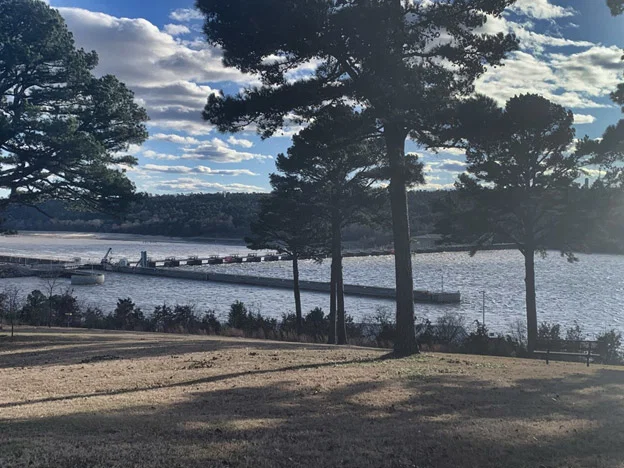
The federal government, in an effort to alleviate the problems, began to look at ways to develop a navigation system that would deepen the river, make it navigable to Tulsa year-round, and create recreational areas as well as produce electricity. A grand plan, all that was lacking was the money to complete it and a method to keep the river from clogging up sediment and filling in the various lakes as quickly as they developed. A little-known fact, Hans Albert Einstein, son of Albert Einstein, developed the flow method for the Arkansas river that would prevent much of the sedimentation and made it possible to construct the system.
Governor Robert Kerr of Oklahoma and Senator John McClellan were able to get the federal government to authorize the funding on a dam-by-dam basis, thus ensuring the eventuality of completing the project.
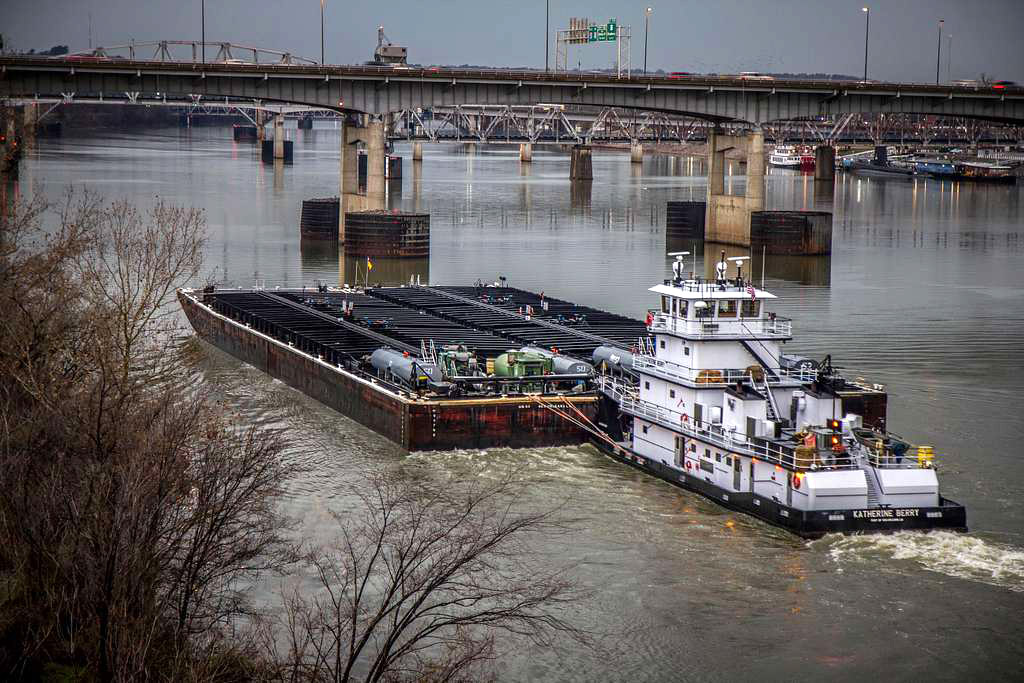
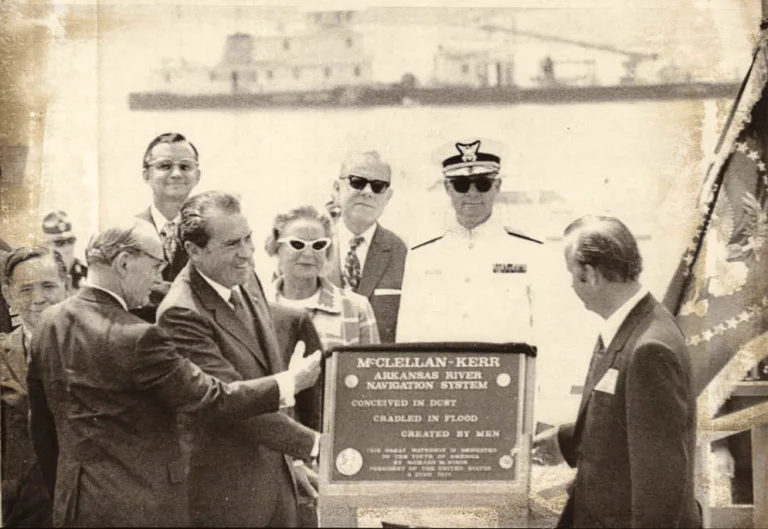
Eufala, Oologah, and Keystone reservoirs in Oklahoma were the first constructed, creating a body of water that could be used to maintain channel flow. The lake Dardanelle reservoir began in 1958, eventually followed by Little Rock and downstream. By 1971, The Arkansas River Navigation Project provided a minimum nine-foot-deep channel with a total lift of 420 feet, 450 miles long from the Mississippi River to the head of navigation at Catoosa, near Tulsa. On January 3, 1971, the first commercial barge pulled into the Port of Muskogee, containing steel pipe manufactured by Republic Steel. On June 5, 1971, President Richard Nixon dedicated the McClellan-Kerr Navigation system and the Arkansas River, although never completely tamed, was brought under control and open for use.
Cyclosporiasis outbreak: Keeping your family safe

By Sarah Cato
University of Arkansas Division of Agriculture
The Cyclosporiasis outbreaks happening across the U.S. may sound scary, but there are simple steps families can take to minimize risk of infection.
Cyclosporiasis is an intestinal illness caused by the microscopic parasite Cyclospora cayetanensis, also known as Cyclospora. As of July 13, 2026, CDC had received reports of 1,645 laboratory-confirmed, domestically acquired cases from 34 states, including Arkansas. Although cases of cyclosporiasis have been reported in Arkansas, health officials have not confirmed whether they are connected to the current multistate outbreak.
“We know in the past that cyclosporiasis outbreaks have come from raspberries, herbs like basil and cilantro, snow peas and bagged lettuce,” said Lida Araghi, extension nutrition and food safety specialist for the University of Arkansas Division of Agriculture. “However, it’s important for consumers to properly clean all fresh fruits, vegetables and other produce.”
Best practices for produce safety include washing hands before and after preparing food, rinsing fruits and vegetables under running water, scrubbing firm produce with a clean produce brush, and refrigerating cut or peeled produce within two hours.
While safely handling produce is important, Araghi warns that some misinformation may be giving people false confidence.
“Washing produce can reduce contamination, but it may not remove all Cyclospora,” Araghi said. “For produce that can be cooked, heating it to at least 158 degrees Fahrenheit or 70 degrees Celsius is the safest option because Cyclospora cannot survive at that temperature.”
Araghi said ‘vinegar soaks’ have been circulating on social media as a method of controlling Cyclospora, but that has not been proven to be effective. She also stressed that soap, bleach or household cleaners should never be used to wash produce.
Know the symptoms and when to seek medical care
Symptoms of cyclosporiasis may include:
- Frequent, watery diarrhea
- Loss of appetite
- Stomach cramps or bloating
- Nausea
- Fatigue
Araghi said symptoms usually begin about one week after exposure but may appear anywhere from two days to two weeks or more after exposure.
“Cyclospora may require specific stool testing and can be treated with prescription medication,” Araghi said. “Contact your healthcare provider if you develop frequent or persistent watery diarrhea, particularly if symptoms improve and then return.”
Araghi recommends following the U.S. Centers for Disease Control and Prevention, the U.S. Food and Drug Administration, and the Arkansas Department of Health for updates on the current outbreak.
To learn about extension programs in Arkansas, contact your local Cooperative Extension Service agent or visit uaex.uada.edu. Follow us on Facebook and Instagram. To learn more about the Division of Agriculture, visit uada.edu. To learn more about ag and food research in Arkansas, visit the Arkansas Agricultural Experiment Station at aaes.uada.edu.
About the Division of Agriculture
The University of Arkansas Division of Agriculture’s mission is to strengthen agriculture, communities, and families by connecting trusted research to the adoption of best practices. Through the Agricultural Experiment Station and the Cooperative Extension Service, the Division of Agriculture conducts research and extension work within the nation’s historic land grant education system.
The Division of Agriculture is one of 22 entities within the University of Arkansas System. It has offices in all 75 counties in Arkansas and faculty on three campuses.
Pursuant to 7 CFR § 15.3, the University of Arkansas Division of Agriculture offers all its Extension and Research programs and services (including employment) without regard to race, color, sex, national origin, religion, age, disability, marital or veteran status, genetic information, sexual preference, pregnancy or any other legally protected status, and is an equal opportunity institution.