


Arkansas Sales Tax Holiday Set for August 1–2

Arkansas families preparing for the upcoming school year will once again benefit from the state’s annual sales tax holiday, scheduled as always for the first weekend in August. State lawmakers set the event in early August specifically to ease the financial burden on families with children headed back to school.
This year’s tax‑free weekend begins at 12:01 a.m. on Saturday, August 1, and runs through 11:59 p.m. on Sunday, August 2. For the full 48 hours, both state and local sales taxes will be waived on a wide range of qualifying clothing, school supplies, and electronics.
The rules for eligible items remain familiar. Clothing and footwear priced under $100 per item qualify for the exemption. This category includes everyday items such as shirts, pants, dresses, and shoes, but also extends to baby blankets, raincoats, uniforms, hats, aprons, neckties, scarves, and steel‑toed boots. Diapers, including disposable diapers, are also tax‑exempt.
Accessories costing less than $50 per item are included as well. The list is lengthy, covering purses, handbags, sunglasses, wallets, watches, jewelry, hair accessories, and wigs. Additionally, more than 65 types of cosmetics, such as mascara, various hair products, fingernail polish and remover, bath salts, artificial eyelashes, perfume, and stretch‑mark cream, are exempt from sales tax during the holiday.
School supplies of all kinds qualify with no price limit. Families can purchase pens, pencils, paper, binders, crayons, markers, and art supplies without paying sales tax. Instructional materials used in the classroom, such as textbooks and reference books, are also eligible.
Electronics commonly used by students can be purchased tax‑free regardless of cost. That includes laptops, desktops, tablets, printers, keyboards, calculators, cell phones, e‑readers, and computer monitors. However, entertainment devices, including video game systems, stereos, and televisions, are not included in the exemption.
The tax break applies to each individual article rather than to the total amount spent. For example, if a shopper buys three shirts at $25 each and a pair of pants for $50, no sales tax will be charged on those items even though the total exceeds $100. Because each individual item falls below the allowable threshold, all qualify. On the other hand, a single pair of shoes priced at $120 would be fully taxable.
There is also no limit to the number of eligible items shoppers can buy, so long as each article meets its respective price restriction. Clothing must be under $100 per item, accessories under $50 per item, while electronics and school supplies have no price cap at all.
All retailers in Arkansas are required to participate in the tax‑free weekend. The exemption applies to in‑person purchases as well as qualifying online orders. Retailers are prohibited from splitting normally bundled items, such as men’s suits or pairs of shoes, into separate pieces in an effort to bring individual prices under the exemption threshold.
For complete definitions of eligible products and additional guidance, shoppers can consult the Arkansas Department of Finance and Administration website or download the state’s Sales Tax Holiday Instructions.

Obituary: David Wayne Cecil (1969-2026)

David Wayne Cecil, age 56, of Waldron, Arkansas, passed from this life on Tuesday, July 21, 2026, in Waldron. He was born on August 7, 1969, in Lexington, Kentucky.
David spent most of his life in and around the Waldron community, where he built lifelong friendships and left a lasting impression on everyone who knew him. A proud member of the Waldron High School Class of 1988, he later attended cosmetology school and discovered the career that perfectly suited his outgoing personality and caring heart. As a hairstylist, David found great joy in helping others look and feel their best. He worked in Waldron for many years before continuing his career in Fort Smith, eventually returning home to the community he always loved.
David was known for his quick wit, infectious sense of humor, and the ability to make people laugh no matter the circumstances. He had a deep love for motorcycles, enjoyed watching scary movies, and treasured the time he spent with family and friends. More than anything, David will be remembered for his kind heart, his gift for conversation, and the smiles he brought to so many lives.
Left to cherish his memory are his beloved daughter, Audra Blanton (Larry Adams) of Waldron, Arkansas; his son, Tyler Hutchens (Kristin Hutchens) of Booneville, Arkansas; his treasured grandchildren, Allie Blanton, Serenity Adams, Maverick Adams, Brianna Hutchens, and Samuel Hutchens; his nephew, Trey Parker III (Nakira Hot) of Hot Springs, Arkansas; his niece, Katelyn Ward (Brandon White) of Hall, Arkansas; along with a host of extended family members and dear friends who will forever hold his memory close to their hearts.
David was preceded in death by his parents, Earl Blanton and Brenda June (Jones) Blanton; his brother, Richard Blanton; and his sister, Lasha Johnson.
A memorial celebration of David’s life will be held at 2:00 p.m. on Saturday, July 25, 2026, at Waldron Pentecostal Church of God with Rev. Konnor McKay and Bro. Travis May officiating.
Though his time on earth was far too short, David’s laughter, kindness, and loving spirit will continue to live on in the hearts of all who knew and loved him. His memory will forever be a source of comfort, smiles, and cherished stories shared among family and friends.
Arrangements are being entrusted to Heritage Memorial Funeral Home.


Timepiece: Bomber Crashes on Mt. Magazine

By Dr. Curtis Varnell
(Below is a historical account of the bomber crash on Mt. Magazine as published in a local newspaper)
Authorities climbed high on Mt. Magazine, the highest point in Arkansas, near here today to remove the bodies of five Army airmen who were killed when their B-25, enroute from Chicago to its base at Barksdale Field, La., crashed into the mountain top and burned last night.
Searchers who went to the scene of the crash said they found five bodies and reported that a sixth passenger might had been aboard the plane.
Driving sleet and a heavy fog — probably the cause of the crash — made it impossible to bring the bodies down the mountain or to resume the search until daylight.
Logan County Sheriff Earl Ladd, who headed a search party, said the plane was “pretty badly burned up” and that two of the five bodies were badly burned. The other three were identifiable, he said.
Ladd reported that a copy of travel orders was found near the plane, bearing six names, but no trace of a sixth body had yet been found.
Searchers declined to reveal the names on the orders, in accord with army practice, and at Barksdale Field army authorities withheld identification of the dead pending notification of next of kin. They said the bomber had taken off from Orchard Place airport, an Army field near Chicago, on a routine training flight.
Havana residents said they heard a low-flying plane, its motors loud and labored, and then saw the crash and a burst of flames on the mountain.
Sheriff Ladd said the scene of the crash is some 2,800 feet high and described Mt. Magazine as
“the highest mountain between the Alleghenies and Rockies.”
AIRMEN KILLED IN B-25 CRASH on November 17, 1947:
Havana, Ark., Nov. 19. — (UP) — Six army airmen killed when their B-25 bomber crashed into nearby Mt. Magazine Monday night were identified today by Army authorities.
They were:
Capt. WILLIAM F. WILSON, 29, Strong City, Kan.
Lt. ALBERT G. FRESE, JR., 27, Brunswick, Ga.
1st Lt. ROBERT H. PABST, 24, Milwaukee, Wis.
2nd Lt. ED D. WARD, 27, Chicago.
Pfc. JAMES H. MIERSMA, 20, Grand Rapids, Mich.
Pfc. WILLIAM E. WESLEY, 21, Muskegon, Mich.
The plane was en route from Chicago to its base at Barksdale Field when it rammed into the mountain in a heavy fog.

As fall approaches, UADA experts urge cattle farmers to consider cool-season grasses
By Ryan McGeeney
University of Arkansas Division of Agriculture
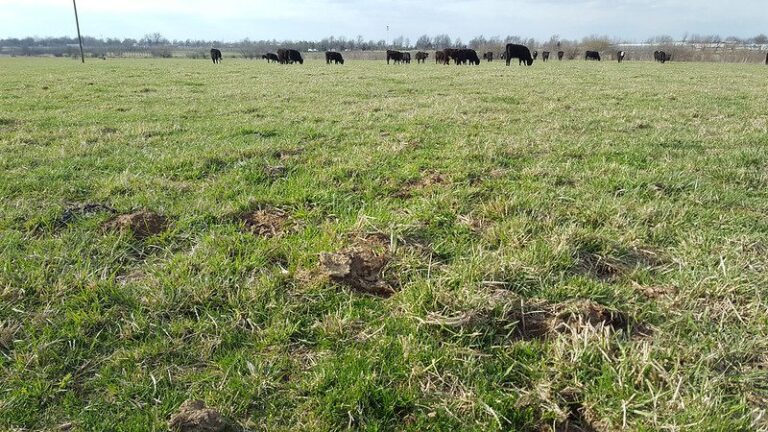
University of Arkansas Division of Agriculture experts are urging the state’s pasture managers to gear up for winter by planting cool-season grasses in the fall.
Jonathan Kubesch, extension forage specialist for the Division of Agriculture, said that Arkansas offers some unique challenges to farmers, being in a geographical transition zone between North and South.
“If we were further south, we’d only be growing warm-season grasses and using annuals to complement them,” Kubesch said. “If we were further north, we’d just have cool-season perennial grasses. Here in the middle, we really have to use any and all tools we can to extend the grazing period.”
Kubesch and Flint Harrelson, director of the Livestock and Forestry Research Station and associate professor of animal science for the Division of Agriculture, recently revamped the widely used fact sheet, “Using Cool-Season Annual Grasses for Grazing Livestock.”
The fact sheet focuses on winter annual grasses, such as small grains and ryegrass, which are typically planted in early fall. With a 60-day growth cycle, the grasses provide an option for farmers with bermudagrass or bahiagrass to extend their grazing season through the winter and into the spring, Kubesch said.
With a ready supply of ryegrass and other winter annual seeds, the lower cost offers an attractive avenue to farmers looking to introduce something new to their grazing systems.
“Annual ryegrass is a great species with which to learn how to manage forage well,” he said. “If nothing else, throwing some annual ryegrass out in the field can get people started down this path.”
The addition of winter annuals, including ryegrass, to a grazing program ties in nicely with the Division of Agriculture’s 300 Days of Grazing program. Established in 2008, the program encourages Arkansas farmers to extend their grazing program for cattle and other livestock as long as possible, relying less on hay and other forages, which are both more expensive and less nutrient-dense than grazing live grass. Kubesch, who joined the Division of Agriculture in 2024, also helps support that program.
Additionally, cool-season grasses help support the overall soil health of a farming operation, Kubesch said.
“Having something actively growing in the winter is good for keeping the ground in place,” he said. Ryegrass can also help bolster “sacrifice areas,” where cattle managers might normally allow herds to graze grasses down to stubble, and help absorb excess nutrients from agricultural runoff, when more fertilizer is present than can be absorbed by the soil alone.
While Kubesch said that adopting cool-season grasses is a good plan for Arkansas farmers in any year, weather conditions in 2026 are trending in a good direction for planting ryegrass and more. According to the U.S. Drought Monitor, the band of exceptional to extreme drought that has plagued several counties in central Arkansas appears to be shrinking, and the El Niño weather pattern in the Pacific Ocean could provide elevated moisture through the fall, Kubesch said.
“We have a really good seasonal outlook that tells us we’re probably going to have enough moisture to plant these grasses,” he said. “If you’re not planting these annuals, this would also be a good year to consider planting fescue or orchardgrass, because those are also in the same planting window.”
Too much of a good thing?
Kubesch said that farmers new to planting winter annuals are sometimes unsure about how much acreage to lend to the new grass. It depends on one’s goals, he said.
“If you’re doing soil conservation, cover the whole darn thing if you don’t have fescue or orchardgrass,” he said. “If you’re just trying to grow this specifically for grazing, we advise growing it on about a quarter of the farm’s acreage, so you don’t end up with too much, and it doesn’t get ahead of you. Concentrate your efforts on just a portion of your acreage and try to do the best job possible.”
Kubesch also encourages farmers to ease their herds into a diet of ryegrass and other cool-season grasses, which tend to be more nutrient dense than bermudagrass, bahiagrass and other common warm-season grasses.
“Allow the cow to build up a tolerance to this level of nutrition by limiting their access,” he said. “They can become bloated, and there’s an actual risk of the cow dying. Their rumen fills with gas, and they can’t get it out.”
Kubesch said cattle farmers can let the grass become “stemmier,” or more mature, to allow it to lose some nutrient density before giving their herds grazing access. Supplements are also available to help the animals break down the nutrients more efficiently.
To learn about extension programs in Arkansas, contact your local Cooperative Extension Service agent or visit uaex.uada.edu. Follow us on Facebook and Instagram. To learn more about the Division of Agriculture, visit uada.edu. To learn more about ag and food research in Arkansas, visit the Arkansas Agricultural Experiment Station at aaes.uada.edu.