91.5 F
Fort Smith
Friday, July 3, 2026
Home Blog Page 436

Obituary – Daniel S. Allen (1938-2022)

Daniel Stuart Allen of Harvey, Arkansas went to be with his Lord and Savior, Sunday, March 13, 2022 surrounded by his loving family. Dan was born September 15, 1938 in Harvey, Arkansas to Stewart Wayne and Myrtle (Lewis) Allen. He was 83 years old.

As a young man Dan loved to play baseball and was good enough to pitch a no hitter against Mena. He went to St Louis to try out for the St. Louis Cardinals but found out he wasn’t quite that good. He joined the National Guard and then married the love of his life, Margie Slater in 1961. Together they made their life in Harvey, Arkansas. “Boone” was very outgoing and made many life long friends while working at the Waldron Furniture Factory and then as an ironworker. He loved being up on the high beams towering above everything. Together, he and Margie raised two children and became grandparents and great grandparents and enjoyed spending time with family. Dan was a Christian and a strong leader of his family. Dan was a big story teller and prankster as his friends and family can tell you. There was no bigger Razorback fan and many weekends were spent watching the games with family. He loved to hunt and fish and passed that love along to his son, grandsons and great-grandsons.

Dan leaves behind to cherish his memory, his devoted wife, Margie of the home, two children: Tammy Slagle and husband Robert of Y-City, Arkansas and Lenny Allen of Harvey, Arkansas. “Pa” will forever remain in the hearts of his grandchildren: Chance Slagle, Chelsea Ridenhour and Gunner Allen as well as his great grandchildren: Evan, Carson, Hadlee, Dorian, Chloe, Reed and Madi. Dan will be missed by all that knew him and the many whose lives he impacted including a host of nieces, nephews, extended family and friends he considered family.

Dan was preceded in death by his parents: Stewart and Myrtle Allen and siblings: Madge Blair, Norman Allen, Dean Allen, Kenneth Allen and Frank Allen.

Dan’s celebration of life service will be 3:00 p.m., Wednesday, March 16, 2022 at the Heritage Memorial Funeral Home Chapel in Waldron, Arkansas with Rev. Ralph Peery officiating. Interment will follow in the Lamb Cemetery near Waldron, Arkansas. Arrangements are being entrusted to the Heritage Memorial Funeral Home in Waldron, Arkansas.

Dan’s pallbearers will be Chance Slagle, Robert Slagle, Gunner Allen, Sean Allen, Ronald Blair and Wade Ridenhour.

Dan’s visitation will be Wednesday, March 16, 2022 from 1:30 p.m. until 3:00 p.m. at the Heritage Memorial Funeral Home Chapel in Waldron, Arkansas.

If You’re Going to Drink to St. Paddy; Plan a Safe Ride Home

The boisterous celebrations of St. Patrick’s Day are expected to return this year. Regardless to what extent the celebrations may trend toward in local communities, drivers who may participate are encouraged to make plans for a safe return home.

The Arkansas State Police Highway Safety Office is offering advice to the celebratory crowd, Drive Sober or Get Pulled Over.

A sober driver is one who hasn’t consumed any alcohol, and to help keep local communities safe, Arkansas law enforcement officers are teaming up with the U.S. Department of Transportation’s National Highway Traffic Safety Administration (NHTSA) to spread the message about the dangers of drunk driving. Even one drink can be one too many.

According to NHTSA officials, 10,142 people were killed in drunk driving related crashes during 2019, accounting for nearly one-third of traffic crash fatalities. On average, more than 10,000 people died annually between 2015 through 2019 in motor vehicle crashes involving a driver who was drunk. That’s one person killed in drunk driving crashes every 52 minutes.

“Everyone has their own particular reason to celebrate at one time or another, but when they do, we want Arkansans to realize the importance of safe driving,” said Colonel Bill Bryant, Director of the Arkansas State Police, and the Governor’s Highway Safety Representative. “If you’ve been drinking, make the right choice to find a sober driver to get you and your friends home safely. Before you put your keys in the ignition, remind yourself: Drive Sober or Get Pulled Over.”

During the 2019 St. Patrick’s Day period (March 16th, 6 PM to March 18th, 5:59 AM), almost half (46%) of crash fatalities involved a drunk driver. Additionally, from 2015 to 2019, a total of 280 lives were lost in drunk driving crashes during the St. Patrick’s Day period. Drivers should also keep an eye out for pedestrians who have had too much to drink. Walking while intoxicated can also be deadly, as lack of attention to their surroundings could put pedestrians at risk of getting hit by a vehicle.

If you’re the designated driver, make sure you don’t drink so you can keep that promise of safety to yourself and your passengers. It can be a long night, but people are counting on you, not to mention the other drivers, passengers, and pedestrians on the streets. Take the role of designated driver seriously — people are relying on you.

Before heading out for a celebration, it’s vital to plan before anyone drives. Be honest with yourself; acknowledge whether you’ll be drinking or not. Don’t depend on the luck of the Irish, follow these ideas to ensure you and your fellow partygoers live another day.

• It’s never okay to drink and drive. Even if you’ve had one alcoholic beverage, designate a sober driver or plan to use public transportation to get to your destination safely. Plan a safe way home before you leave.
• If you see a drunk driver on the road, call 9-1-1.
• Do you have a friend who has been drinking and is about to drive? Take away their keys, then make arrangements to get your friend home safely.
• Buckle up, always. Your seat belt is your best defense against the drunk driver.

For more information on impaired driving, visit https://www.nhtsa.gov/risky-driving/drunk-driving or call the Arkansas Highway Safety Office at (501) 618-8136, and go to www.TZDArkansas.org to learn about Arkansas’ Toward Zero Deaths campaign to eliminate preventable traffic fatalities.

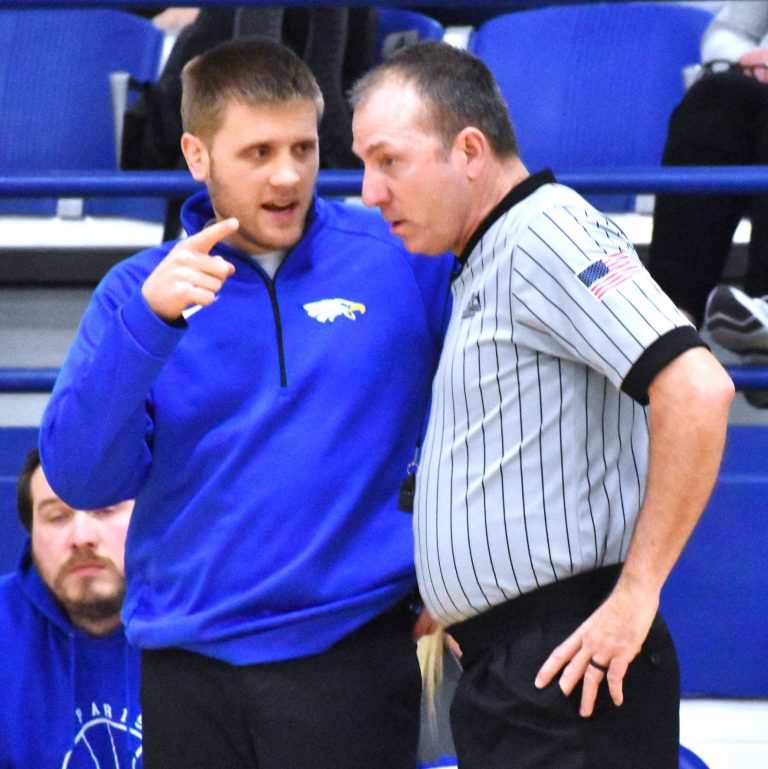
New Eagles Coach Leads Paris Back to the 3A State Basketball Tournament

The 2021-22 Arkansas high school basketball season has now come to an end, and fans everywhere are reflecting on their teams’ seasons. Many experienced success at different levels, and for the Paris boys basketball program, new Eagles coach Josh Ferrell led his program back to the state tournament for the first time in several seasons.

And even though the Eagles were eliminated in a highly-contested first round loss to Osceola, the Paris boys have much to be proud of. In fact, the Eagles will return three starters next year off of this year’s team, and coach Josh Ferrell will have his first chance to develop his team during the off-season as he and Eagles fans turn their sights to next season.

The 2021-22 season was full of ups and downs throughout the early months, but as post-season play approached, Ferrell had his Eagles playing their best basketball just in time to compete for a district tournament, regional, and state championship run. The Eagles played an inspiring district tournament that saw them play four games in five days at Cedarville. The Eagles finished as district tournament runner-ups to the home standing Pirates, but played their way into a two seed in the following week’s regional tournament at Booneville. In the regional tournament, it was the Eagles again playing inspiring basketball to defeat Valley Springs in the first round to secure a berth in the state tournament for the first time in many seasons. The defeat knocked Valley Springs out of the state tournament, just one week prior to when they would have been the host team in the first three rounds of the Class 3A state tournament. Paris went on to play in the state tournament as a four seed and gave the Osceola Seminoles all they wanted in a narrow loss in the state first rounds. A disappointing loss for Paris, but one that Eagles fans everywhere were proud of the team’s effort and the progress they had made in the last month of the season.

I asked Coach Ferrell for his comments regarding his team’s performance and progress that was made in his first year as the Eagles boys basketball coach. He replied by saying, “This season was a success for our senior high boys team. I could not be prouder of this group. We overcame a lot of challenges and adversity, and we handled it well. We had ups and downs throughout the year, but we grew as individuals and as a team. I believe we started playing our best basketball later as the season went on, which is what you want to do. There was a lot of accomplishments this team achieved; from having a tough road to the finals of the district tournament which took beating a tough Hackett team and then beating the number one seed Waldron Bulldogs to getting to the semi finals of the regional tournament. This team got to the state tournament which hadn’t been done in a while and we had a 20-win season which also has not happened in a while. Everyone on our roster contributed to the success of this team. Everyone of them bought in to what I had asked them to do daily and they worked hard and were very coachable all year. I am very proud to be able to coach these guys.”

From a fans’ perspective, it was obvious that the Eagles did buy-in to Coach Ferrell’s expectations and coaching, and for that reason, it appears that the boys basketball program at Paris is on solid ground and will have high expectations going into next season.

Congratulations to the 2021-22 Eagles basketball team on a great season, and best of luck next year!

Obituary – Elizabeth Soisouvanh (2000-2022)

Elizabeth Soisouvanh, who may be better known as Lizzie to her friends and family, passed from this life and went to be with her Lord and Savior, Wednesday, March 9, 2022 near Hartington, Nebraska. Elizabeth was born July 19, 2000 to Ouphavanh Soisouvanh and Victor Soisouvanh. She was 21 years old.

Elizabeth leaves behind to cherish her memory, her two sisters, their husbands, and a brother: Alice Price and her husband Cody Price, Olivia Wood and her husband Jake Wood, and Archibald Soisouvanh. She is also survived by her parents: Ouphavanh Soisouvanh and Victor Soisouvanh. Elizabeth will forever remain in the hearts of her family, friends, and boyfriend Kyle Young.

Elizabeth grew up and graduated high school in Waldron, Arkansas. Being the youngest of 4, it was only natural how loved she was by her family and friends. She was a big help to her parents on the chicken farm. She regularly went with her mother to Fort Smith, Arkansas to go shopping. Elizabeth was very active and involved in school. She was a member of the Waldron High School Color Guard, Future Farmers of America, Future Business Leaders of America, BETA club, and STEM club. She was also a member of the floriculture team. After graduating high school, she started her college career taking prerequisites at Arkansas Tech in Russellville, Arkansas before finding her new home at Harding University, a private Christian institution, located in Searcy, Arkansas. Elizabeth was a Christian and committed to Christ and the Bible as the Word of God. She attended church and bible studies regularly. She was a Junior Nursing Major at Harding University. She was a member of the Air Force Reserves and proud to serve her country. She planned to commission as an officer and become an Air Force nurse upon graduation.

Elizabeth loved to make coffee, put together puzzles, read, watch Netflix, exercise, travel, and try new foods. She was also a big lover of animals, especially cats and Corgis.

Elizabeth was a positive light in this world. She will be sorely missed by all that knew her. She had a kind soul and was very compassionate. She had the biggest heart and impacted many.

Elizabeth’s funeral ceremony will be 1:00 p.m., Sunday, March 13th, 2022 at the Heritage Memorial Funeral Home Chapel in Waldron, Arkansas. Arrangements and cremation are being entrusted to the Heritage Memorial Funeral Home & Crematory in Waldron, Arkansas.

Elizabeth’s Celebration of Life will be 2:00 p.m., Sunday, March 20, 2022 at East Side Baptist Church in Fort Smith, Arkansas. There will be a reception after the ceremony, the location is to be determined.

To send flowers to the family or plant a tree in memory of Elizabeth Soisouvanh, please visit our floral store.

Attorney General Alert: Scam Artists are Phishing for Information

Attorney General Leslie Rutledge is warning Arkansans of a prevalent scam taking place across the State. The method is called “phishing,” (pronounced the same as, ‘fishing’) and it is when scam artists email messages to consumers that appear to pitch products or services, when in actuality, these emails are specifically set up to gain information. Often times, the message will alert the individual to a potential problem with their account and request the consumer provide private information like an account number, date of birth or Social Security number in order to remedy the issue. Phishing emails contain software that can harm your computer or track your activities on the internet without your knowledge. They are not only illegal, but they are dangerous to unsuspecting consumers.

“I urge all Arkansans to be cautious if you receive an email asking for your information, it could be scam artists trying to phish for your information,” said Attorney General Rutledge. “Even with online protection software, scammers and con artists will continue to try to take your information; don’t fall prey to the trap.”

Remember these tips when safely navigating online:

  • No legitimate company will ever send you an unsolicited email asking for your personal information.
  • If you get an email or pop-up message that asks for personal or financial information, do not reply.
  • Contact the business identified in the original email directly. Using the customer service number provided to you on a reliable statement to verify that the issue in the original email is legitimate.
  • Do not give sensitive information in response to an unsolicited request.
  • Immediately delete all suspicious emails, and never open email attachments or click on links from unknown sources.
  • Use anti-virus and anti-spyware software, as well as a firewall, and update them regularly.

The Attorney General’s Office provides a tip card for consumers, how to spot phishing scams, information for parents to spot cyberbullying and tips on internet safety.

For more information and tips to avoid scams and other consumer-related issues, contact the Attorney General’s office by calling (800) 482-8982, emailing consumer@arkansasag.gov, or visiting ArkansasAG.gov.

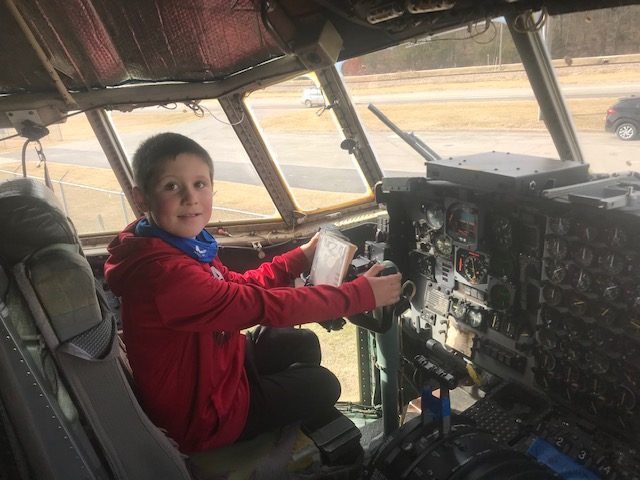
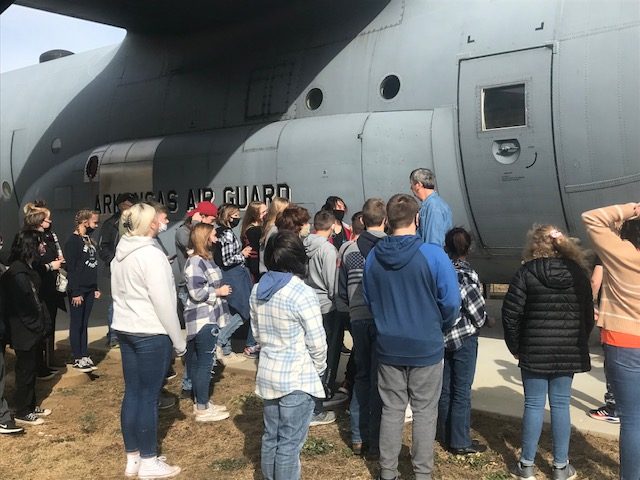
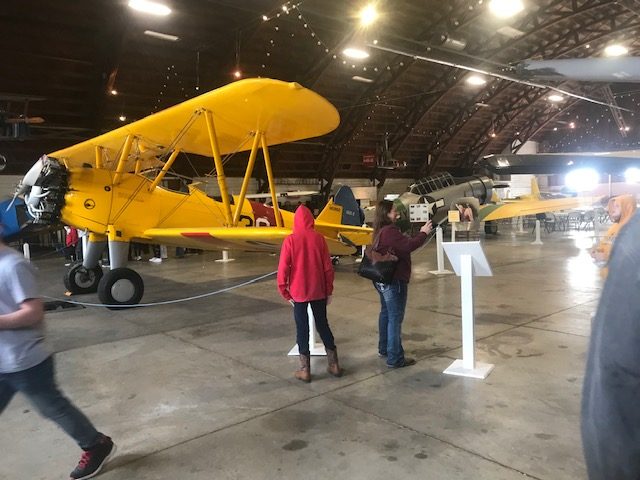
Area Students Learn Outside the Classroom

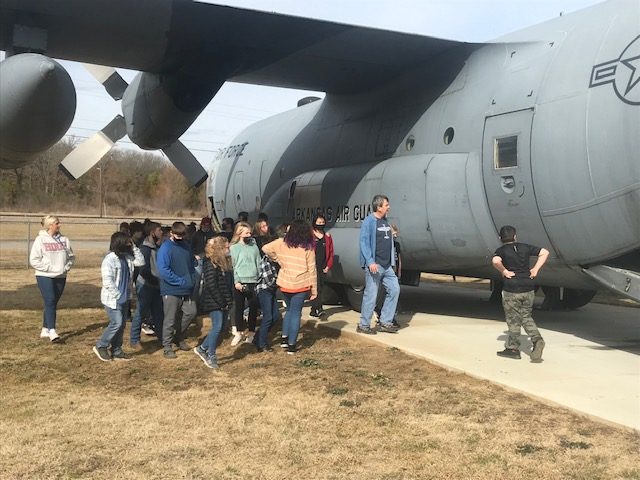
Area teachers have discovered that student learning and retention of information is greatly boosted by active student involvement through active participation through field trips and outdoor activities. In the past, such activities have been viewed as rewards for classroom work. Teachers now know that the activities themselves contribute greatly to student knowledge and greatly increase student scores on achievement tests.  A student that observes nature on Magazine Mountain, visits history at Fort Smith National park or writes a poem about visits to the city park develop memory pathways in the brain that stick with them forever.

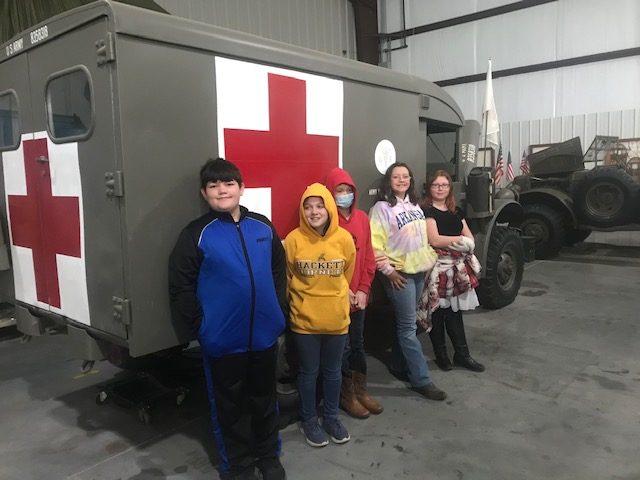
Magazine Mountain is one of the most popular locals for student visits during the fall months.  In the last year, Guy Fenter Education Cooperative, in collaboration with Arkansas State Parks and local schools have organized field-trips for groups from Waldron, Booneville, Lavaca, Hackett, Magazine, Scranton, County Line, Clarksville, and Paris.  Many of the younger students began the day at the visitors center where one of the local park interpreters provide local history or present programs on subjects ranging from local plants and trees to bears.  Dr. Curtis Varnell of the coop generally organizes history and science tours which take students to the high point of the mountain or on a loop into bear hollow, a little-used trail on the western slope of the mountain.  

Paris middle school annually conducts a two-day field trip on the mountain for all eighth grade students.  Using a unit developed by June Gilbreath, the students work math problems associated with the mountain trail, learn history as they visit the old home and hotel sites, and write poems about what they observe.  

Students from Hackett, Paris, and Magazine have visited the Old Fort and Judge Parker Courtroom in Fort Smith.  The trip usually involves a visit to Judge Parker’s court and a reenactment of a famous court case, visit to the old jail, a ride on the trolley, and often a visit for an ice cream in the museum soda shop.  

Other area students have visited Petit Jean Mountain, conducted an eagle watch and count on the Arkansas River, visited the coal mine museums, or gone through a lock and dam.  Eight local schools will participate in Student Assistant Day at the Huckabee Nature Center later this fall.  The day is organized around developing student and teacher relationships by actively participating together in activities ranging from kayaking, archery, to outdoor science.

Whatever the choice of activity, students realize real benefits from getting outside, getting physical and mental exercise, and learning from “real world” experience.

Are You “A Little Bit Country” Or “A Little Bit Rock & Roll”? Donate Blood And Choose Your Style With Free-T-Shirt And More!

Arkansas Blood Institute is encouraging donors to “turn up the volume” of blood and donate!

All successful blood donors will receive a free, limited-edition Country or Rock & Roll t-shirt, a free ticket to the National Cowboy Western Heritage Museum and an IHOP coupon for free pancakes.

Individuals ages 16 and up* are urged to give blood at one of these locations:

Arkansas Blood Institute is hosting a blood drive with County Line High School on Thursday, March 17, from 8:30 to 2 p.m. on the Bloodmobile. Individuals ages sixteen and up are urged to give blood.

Arkansas Blood Institute is the local, non-profit blood supplier, supporting the inventory for patients in more than 40 hospitals, medical facilities and air ambulances statewide.

Blood donation typically takes only about an hour, and one donation saves up to three lives. Blood drives will be managed according to CDC safety recommendations. Appointments can be made by calling 1-877-340-8777 or visiting arkbi.org. More information on Arkansas Blood Institute can be found at arkbi.org.

*16-year-olds must weigh at least 125 pounds and provide signed parental permission; 17-year-olds must weigh at least 125 pounds; 18+ year olds must weigh at least 110 pounds. Photo ID required.

“Just Roll with It” Serving Up Recipes and Humor

By Sheri Hopkins
Lifestyle Contributor

Hello everyone! As I write this it is snowing and it is so beautiful! Doesn’t God give us such beautiful artwork to look at? We are a blessed people.

I have laughed out loud thinking of something to write about this week. The things I’ve done and experienced crack me up sometimes. I was dumb or naive. Whichever you want to call it. This is the story that made me laugh thinking about it.

Once upon a time long ago I went out with a guy named Johnny. For the life of me, I cannot remember his last name. We were going on a date one Saturday night and he picks me up in his Buick a.k.a. land yacht with a white hardtop. I go to get in his car and he wants me to sit by him. Young folks did that back then. Couldn’t so much as get a piece of tissue paper between us. That’s a line from the Andy Griffith show.

It’s hot, summertime and the seat was tearing up and Johnny had silver duct tape on the seat. I get in and have to sit on the duct tape. I didn’t think too much about it at the time. I say “Where are we going?” He says the Skyvue Drive Inn.” Back then if you didn’t get a newspaper, you had no clue what was playing. We get to the Skyvue and it is horror movie night. Double feature, Night of the Living Dead and Walking Dead. Not some of your best horror movies, but who cares. We get all parked and Johnny says, “here is some money, go to the concession stand and get us some popcorn and cokes.” That sounds good, but remember the duct tape and summer in Arkansas.

I’m stuck to the seat. I finally get out with duct tape residue all over the back of my jeans. That made for a good laugh. I head to the concession stand, get our snacks and turn to go back to the big land yacht. Low and behold there were cars everywhere and I have no clue where we parked. I’m lost at the Skyvue Drive Inn. I mean wouldn’t someone kind of remember where they parked? Not me, I walked and walked and finally found the big old car. No cell phones back then. I couldn’t call and ask what row we were parked on. He says “What took you so long?” I got lost, yes, I forgot where we parked. It was so funny and the movies were boring but who cares, we had a good time.

Johnny wasn’t as bad as the guy Lisa Favela used to go out with. When they would go to the Skyvue he would get out of the car with his Windex bottle and paper towels and clean off the windshield. To a teenage girl, that was big-time embarrassing. Now that I am old, that was such a good idea. Fun times back in the old days.

Just a little advice, if your car seat has a rip, don’t use duct tape, especially in Arkansas summer heat.

This week’s recipe comes from my good friend, Donna Tafoya. It is a poke cake and it is easy and delicious. I promise you it is not low-calorie.

HEATH BAR POKE CAKE
1 Devil’s Food cake mix
1 can Eagle Brand Milk
1 jar of caramel sauce (I use caramel syrup)
1 jar of chocolate sauce (I use chocolate syrup)
1 Cool Whip container
1 package of Heath Bits O Brickle (they come in a bag by the chocolate chips)
Bake the Devil’s Food cake according to box directions. When it is done, poke holes in the cake with a wooden spoon end. While the cake is still hot, pour the can of Eagle Brand Milk on the top then the caramel and chocolate syrup (I don’t measure, I just use what I want). Save a little to decorate the top. Put the cake in the fridge till cool. When cool, sprinkle the top with half of the Heath Bar pieces and top with Cool Whip. Then drizzle some caramel and chocolate syrup on top and sprinkle some more Heath Bar pieces on top. This cake needs to be kept in the refrigerator. It is wonderful. Have a blessed week, and don’t forget to count your blessings

Researchers investigate health impacts of residual pesticides on wild bees

Farmers know not to apply pesticides on their fields during flowering season when bees are present. But wild bees can come into contact with pesticide residues, in some cases, for months after spraying.

Neelendra Joshi, associate professor of entomology for the Arkansas Agricultural Experiment Station, the research arm of the University of Arkansas System Division of Agriculture, said wild bees provide important pollination services for crops and native flowering plants.

Managed western honeybees, long the go-to pollinator for fruit and vegetable producers, are experiencing population declines in recent years. An Environmental Protection Agency report says about 30 percent of honeybees die off each year from colony collapse disorder (https://bit.ly/EPA-honeybeesCCD).

Joshi said the decline of managed honeybee colonies makes native bees more important for agricultural production.

Rich diversity

Joshi said there are about 4,000 documented species of native bees in North America. His lab and other entomology labs in the state have documented more than 200 native species in Arkansas. He plans to conduct another survey to find as yet undocumented species.

“We may have more than 400 native bee species in Arkansas,” he said.

Most people are familiar with honeybees, Joshi said, which are a European species commonly used for pollination services. “They are an excellent managed species,” he said.

People tend to think of social bees, like honeybees and various species of bumblebees, that live in colonies, Joshi said. But most bees in Arkansas are ground-nesting and tunnel-nesting species, and they are solitary bees. These include carpenter bees, leafcutting bees and mason bees. Some, like carpenter bees, dig their own tunnels for nests. Mason bees, like blue orchard bees, use existing tunnels cut into trees or structures by other insect species.

The Arkansas Cooperative Extension Service maintains information about native bees in the state: https://bit.ly/ArkNativeBees

Joshi said mason bees use soil and leaf particles to divide a tunnel into multiple chambers in which they lay eggs. Female eggs are placed in the deepest chambers and males in the chambers closest to the entrance because they hatch and emerge first. The chambers are stocked with pollen collected from flowers that the newly hatched bee larvae feed on before they pupate over winter. In the spring, they emerge as adults and dig their way through the chamber walls to leave the nest.

The males of tunneling species are usually smaller and hang around the tunnel exits after hatching, waiting for the females to emerge so they can mate. After emerging and mating, the females do the labor of collecting pollen, building chambers and laying eggs.

The pollen-collecting habits of these wild bees makes them valuable to fruit, vegetable and ornamental plant growers, Joshi said. It’s also what makes them susceptible to residual pesticides.

Like solitary bees, Joshi said, honeybees are also exposed to pesticide residues, and the exposure level may vary depending on the crop and on how the pesticides are applied. Jon Zawislak, assistant professor and Arkansas Cooperative Extension Service apiculture specialist, examined pesticide risks to honeybee pollinators foraging in agricultural landscapes in Arkansas.

“Extensive sampling of bee-collected pollen throughout the growing season revealed that some insecticides were present, but at very low levels for most of the season,” Zawislak said. “We were particularly interested in neonicotinoid chemicals, which have been widely blamed for honeybee losses, but found only traces of these early in the season, associated with planting, and none at all when crops were actually blooming.

“We did find residues of herbicides throughout the season in wildflower pollens, in every sample, and sometimes at very high concentrations,” Zawislak said. “This can potentially have significant ecological effects on many pollinator species.”

Native solution

Entomologists and beekeepers have documented declines in honeybee populations. The reasons for these declines are poorly understood and the declines are thought to be a result of a combination of several interacting stressors affecting bee health, Joshi said. What is better understood is that the loss of honeybees threatens fruit and vegetable food sources that depend on insect pollination.

The good news, Joshi said, is that America’s native bees can pick up the mantle of food pollinators. And some of them are easily managed, though with different methods than for honeybees.

Joshi said honeybees can easily be moved from site to site because when you move the queen, the colony goes with her. The hive boxes are carried from site to site as pollination season migrates from one agricultural region to another. Depending on the crop and the availability of honeybees, growers may pay as much as $200 per hive that is placed in their fields typically from one to two weeks.

As an alternative to recurring honeybee rentals, growers can place pre-cut tunnel habitats in their fields to encourage permanent native bee nesting. Farms can purchase unhatched native bees from breeders for 30 cents to $1 each and establish a permanent population on their property.

Once established, a native bee population becomes a permanent, self-sustaining presence on the farm or orchard, Joshi said.

It’s unlikely that migrating honeybee pollination services will cease altogether, Joshi said. But this change in pollination practice can prove an economical alternative for growers who find honeybee pollination increasingly difficult or too expensive to obtain.

The minefield

Pesticides are an important tool for farmers who need to protect their crops from insect pests that can inflict severe damage on fruit and vegetables, Joshi said. Although growers time applications to miss flowering season when bees are present, pesticide residues present hidden dangers to bees, Joshi said.

Some pesticide residues can remain toxic in soils and organic ground covers for months after spraying, Joshi said. After application, systemic pesticides translocate from different parts of trees or other plants to blooms, where they contaminate pollen by the time bees are in the field. Bees pick up that contaminated pollen and carry it back to their nests, where they store it to feed their young upon hatching.

Pesticide residues in the soil and leaf litter can also be carried back to the nests by mason bees that are building chambers within the tunnels. Emerging adult bees are exposed to those toxins while digging out of the chambers.

Joshi said bees may also be exposed to toxic residues accumulated in water sources or while flying through adjacent fields that are being sprayed.

Health impacts

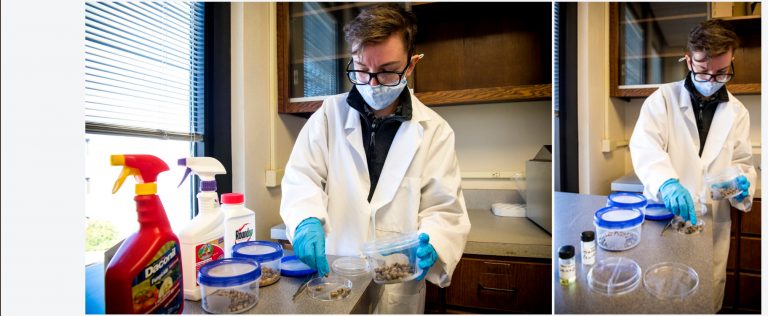
Even when the residual pesticides are too diminished to kill bees, they may have debilitating health effects. In research conducted in 2021, Joshi said some bees were reduced to crawling on the ground because they could not fly.

At a lower concentration of a systemic pesticide exposure, some bees were able to fly, but unable to locate the right flowers. Others that found their target flowers were unable to collect pollen. “They just crawled around on the bloom,” Joshi said.

And still others, after collecting pollen, were unable to fly or navigate to other flowers.

Joshi’s team is continuing research to determine how varying levels of exposure to residual pesticides affect wild bees. They are also studying ways to reduce or avoid exposure and how exposed bees can recover from the effects.

“A lot of research has been done for honeybees,” he said. “And some has been done for bumblebees. But there has been almost no research on field-realistic residual pesticide effects on solitary bees.”

The research

Ngoc Phan, a post-doctoral researcher and toxicologist in Joshi’s lab, investigated the effects of pesticide exposure as a graduate student at Pennsylvania State University. There she established research protocols for conducting the research, with an eye toward changing pesticide management systems to protect bees.

“Risk is a product of exposure and hazard,” Phan said. “The hazard (of pesticides) is the intrinsic toxicity, so it is unchangeable. But we can change the exposure by changing the spray program in terms of pesticide selection and spray timing.”

At the Arkansas Agricultural Experiment Station, Phan is using those research protocols to expand her research to more native bee species under field-realistic conditions.

Phan looks not only at exposure to mature bees during pollination activity, but also to bee larvae exposed to pesticide residues in stored pollen and in the soil particles used to build the nest chambers. This is important for the native solitary bees because they only reproduce once during a year, and if one generation is lost, that line dies out.

For those larval bees, Phan will track the health effects of exposure through their entire life cycle, including its impact on their ability to procreate.

Phan’s research has shown that larvae exposed to non-lethal levels of pesticides have shorter lifespans and are smaller than normal. “Body size matters,” she said. “It is related to foraging efficiency, homing ability, dispersal and, most importantly, the ability to produce an abundance of offspring. Smaller female bees lay fewer eggs or may not be able to lay eggs at all.”

Olivia Kline, a Ph.D. student in Joshi’s lab, is also investigating how the bees’ physiology may help them survive exposure, including how they detoxify the pesticides in their systems.

“I’m looking at how they might use enzymes or even their gut microbiome to help detoxify these pesticides,” Kline said, “and then looking at how different diets might affect their health as well.”

Kline said the gut microbiome refers to the communities of microorganisms, including bacteria, that exist in the intestinal systems of animals, including humans. Many of those microorganisms provide beneficial services to the gastro-intestinal system that have beneficial health effects for their hosts. These benefits include help with digestion, the immune system and with detoxification of poisons.

Scientists have investigated the gut microbiomes of honeybees and other social bee species, Kline said. But little is known about these microorganism communities in native solitary bees.

“We’re doing some additional studies to look at if there are certain bacteria species found at times in solitary bees that can help them survive certain pesticides, and whether these pesticides might be affecting those gut microbes.”

Kline said that if they could identify bacteria that are particularly effective at detoxifying pesticides, they might be incorporated into foods that can be fed to managed bee populations.

“Especially with managed bees that are used in agriculture so that they’re being used in fields that have been treated with pesticides, if they could be given a sort of probiotic treatment that could help them be more tolerant of that pesticide, and then keep up their pollination service even if they are being exposed to some potentially harmful insecticide.”

Joshi said he plans to develop a solitary bee nesting system with radio frequency identification technology for his research on native bees. Micro-RFID tags will be glued to the bees to monitor how often they leave their nests, how long they stay out before returning, or if they do not return, or even if they do not leave the nest to collect pollen after exposure to different agricultural pesticides.

Education

Joshi also plans to conduct public education programs about Arkansas’ native bees.

“The public knows about honeybees and bumblebees and carpenter bees,” Joshi said. “But awareness about solitary wild and native bees is low.”

In addition to live programs, Joshi wants to produce publications based on his ongoing surveys of native bee species in the state. “We want to raise awareness of the existence and importance of Arkansas’ native bees.”

To learn more about Division of Agriculture research, visit the Arkansas Agricultural Experiment Station website: https://aaes.uada.edu/. Follow us on Twitter at @ArkAgResearch. To learn more about the Division of Agriculture, visit https://uada.edu/. Follow us on Twitter at @AgInArk.

About the Division of Agriculture

The University of Arkansas System Division of Agriculture’s mission is to strengthen agriculture, communities, and families by connecting trusted research to the adoption of best practices. Through the Agricultural Experiment Station and the Cooperative Extension Service, the Division of Agriculture conducts research and extension work within the nation’s historic land grant education system.

The Division of Agriculture is one of 20 entities within the University of Arkansas System. It has offices in all 75 counties in Arkansas and faculty on five system campuses.

The University of Arkansas System Division of Agriculture offers all its Extension and Research programs and services without regard to race, color, sex, gender identity, sexual orientation, national origin, religion, age, disability, marital or veteran status, genetic information, or any other legally protected status, and is an Affirmative Action/Equal Opportunity Employer.


Arrest Reports 2/27

Arresting agency – Hackett Police Department:
Tori Rae Cantrell of Hackett was booked into the Sebastian County Detention Center on March 3 at 2:50 a.m. and remains at the SCADC. Cantrell was charged with possession of drug paraphernalia – ingest, possession of drug paraphernalia – ingest meth/cocaine, possession of controlled substance – schedule VI misdemeanor <4 oz., possession of controlled substance – schedule III 28 – 200g felony, possession of schedule I/II controlled substance with the purposed to deliver >2g.

Perla Via of Hackett was booked into the Sebastian County Detention Center on March 3 at 2:50 a.m. and remains at the SCADC. Via was charged with possession of drug paraphernalia – ingest, possession of drug paraphernalia – ingest meth/cocaine, possession of controlled substance – schedule VI misdemeanor <4 oz., possession of controlled substance – schedule III 28 – 200g felony and possession of schedule I/II controlled substance with the purpose to deliver >2g.

Arresting agency – Fort Smith Police Department:
Matthew Carl Guess of Hartford was booked into the Sebastian County Detention Center on March 3 at 6:35 p.m. and remains at the SCADC. Guess was charged with obstructing governmental operations-ID.

Arresting agency – Sebastian County Sheriff’s Department:
Brandon Neal Reeves of Greenwood was booked into the Sebastian County Detention Center on March 2 at 12:22 p.m. and remains at the SCADC as a commitment hold for the Arkansas Department of Corrections. Reeves was charged with parole violation, contempt – willful disobedience (failure to pay fine) and possession of firearms by certain persons – 2nd offense.

**The charges against those arrested are allegations and the cases are still pending in the courts.**