89 F
Fort Smith
Saturday, July 4, 2026
Home Blog Page 437

Arrest Reports 2/27

Arresting agency – Hackett Police Department:
Tori Rae Cantrell of Hackett was booked into the Sebastian County Detention Center on March 3 at 2:50 a.m. and remains at the SCADC. Cantrell was charged with possession of drug paraphernalia – ingest, possession of drug paraphernalia – ingest meth/cocaine, possession of controlled substance – schedule VI misdemeanor <4 oz., possession of controlled substance – schedule III 28 – 200g felony, possession of schedule I/II controlled substance with the purposed to deliver >2g.

Perla Via of Hackett was booked into the Sebastian County Detention Center on March 3 at 2:50 a.m. and remains at the SCADC. Via was charged with possession of drug paraphernalia – ingest, possession of drug paraphernalia – ingest meth/cocaine, possession of controlled substance – schedule VI misdemeanor <4 oz., possession of controlled substance – schedule III 28 – 200g felony and possession of schedule I/II controlled substance with the purpose to deliver >2g.

Arresting agency – Fort Smith Police Department:
Matthew Carl Guess of Hartford was booked into the Sebastian County Detention Center on March 3 at 6:35 p.m. and remains at the SCADC. Guess was charged with obstructing governmental operations-ID.

Arresting agency – Sebastian County Sheriff’s Department:
Brandon Neal Reeves of Greenwood was booked into the Sebastian County Detention Center on March 2 at 12:22 p.m. and remains at the SCADC as a commitment hold for the Arkansas Department of Corrections. Reeves was charged with parole violation, contempt – willful disobedience (failure to pay fine) and possession of firearms by certain persons – 2nd offense.

**The charges against those arrested are allegations and the cases are still pending in the courts.**

APHIS confirms avian flu in wild birds in Mississippi flyway

By Mary Hightower  
U of A System Division of Agriculture 

The highly pathogenic H5N1 avian influenza has been found in all four of the flyways of North America, according to the Animal and Plant Health Inspection Service of the U.S. Agriculture Department.  

The infection reported by APHIS, a mixed-species commercial flock in South Dakota, was the first reported in the Central Flyway. 

The disease already has been found in commercial and backyard flocks in Maryland, Maine, Missouri, New York, Kentucky, Virginia, Indiana, Delaware, Michigan, Connecticut and Iowa. 

“No cases have yet been found Arkansas,” said Dustan Clark, extension veterinarian for the University of Arkansas System Division of Agriculture. “And I cannot say this enough — whether you have a backyard flock or a commercial flock — review your biosecurity plans.” 

Clark said wild birds are a significant means for the virus to move across large areas. The avian flu can be transmitted between birds through feces and bodily fluids. The highly pathogenic strains, known as H5 and H7, can kill 90 to 100 percent of poultry quickly; often within 48 hours of infection.  

Flocks in which the disease is found are depopulated, preventing any poultry from entering the food supply.  

Wildfowl highways 

Flyways are north-south paths taken by migratory ducks, geese and other birds between wintering and nesting grounds. From east to west, North America has the Atlantic Flyway, Mississippi Flyway, Central Flyway and the Pacific Flyway. The Mississippi Flyway includes Arkansas, Alabama, Illinois, Indiana, Iowa, Kentucky, Louisiana, Michigan, Minnesota, Missouri, Mississippi, Ohio, Tennessee and Wisconsin.  

The Audubon Society reports 325 species of birds move between the Gulf of Mexico and Canada along the Mississippi Flyway. 

States in the Mississippi Flyway in which infections have been found in sampled birds are: 

  • Alabama — A single case with an American wigeon. 
  • Kentucky — 10 cases including gadwalls, mallards and snow geese. 
  • Tennessee — Two cases, both wood ducks. 

APHIS works with state agencies as part of its disease surveillance. 

Resources to protect birds 

The Cooperative Extension Service has three public webinars to help small flock poultry owners protect their birds. Find extension biosecurity resources on its website. Visit https://bit.ly/UAEX-Avian-Influenza

Timepiece: Indian Factory

One often touches history without realizing it.  Recently, while hiking at Spadra Bluff near Clarksville, I ran across a historical marker designating the location of an Indian factory.  What the heck?  Looking it up lead to the discovery that Indian factories were set up by Thomas Jefferson as trade stores to induce the natives to dependency on modern trade goods and to get them “civilized.”  The stores sold farm equipment and seed in addition to the usual Indian trade which included guns, powder, blankets, calico, mirrors, sugar, and spices.  In return, the Indian would trade hides, wild honey, bear bacon, and buffalo meat to the trader.  The hides were doused in turpentine and the food preserved and then shipped to the New Orleans market.

The Spadra factory was established in 1819, primarily to trade with the many Cherokee who had settled along the Arkansas River from Conway into Fort Smith.  Hunting and trading hides was the primary means of income for Indian tribes and, the increasing numbers of natives moving in from the east caused conflict between the Cherokee and the Osage who were native to the region.

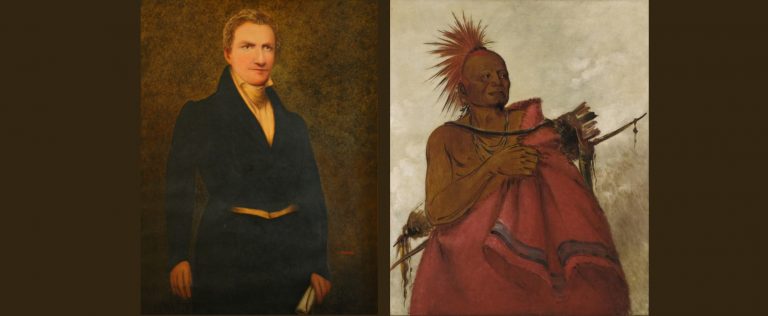
Spadra carried out a thriving business under director Matthew Lyon, catering to the local Cherokee trade from 1819-22.  Being seen as a friend to the Cherokee was not always a positive thing.  The Osage were determined that no one was going to take their hunting grounds and that the soldiers in Fort Smith were not going to prevent them from fighting.  Hundreds of Osage, led by Chief Mad Buffalo, threatened to overrun Fort Smith and its small contingent of men, that is until the commander rolled out his six-pound cannons full of canister and threatened to open fire.  Circling the fort, they began to raid the Cherokee villages along the Arkansas River.  Lyon was informed that over 800 Osage were on the way to Spadra.  Alarmed, he removed 113 kegs of gunpowder, fifty rifles, and other goods and headed downriver.  The raid eventually ground to a halt and things returned to normal.

The Indian Factory closed and moved west in 1822 but that was not the end of historic Spadra.  Located on the Arkansas River, both it and Morrison Bluff were prime stops on the steamboat lines running into Oklahoma.  It was the first county seat for Johnson County and a prime port for the region.  As such, it is presumed that visitors as famous as Jim Bowie, Sam Houston, John Drennan, Zachary Taylor, Jefferson Davis, and others walked the main streets and perhaps spent the night there or at New Spadra, located just across Spadra Creek.  In 1832, Washington Irving and perhaps artist George Catlin stopped along the bluff; they certainly traveled west along the Arkansas River.

After the Civil War, controversy ensued between the northern and southern regions of extensive Johnson county which, at that time extended south of the Arkansas River.  Spadra once again sought to become the county seat, only to be excluded when an agreement was reached to form a new county south of the river and leave Clarksville as the county seat.

Today, one can walk along the bluff above the Arkansas River and enjoy the sound of the geese and see the beauty of the surrounding countryside.  Little is left to remind us of the rich history and heritage of our past.

River Valley Regional Food Bank Provides More Than 1,200 Pounds of Dog Food to Animal Rescue Agency Artemis Project

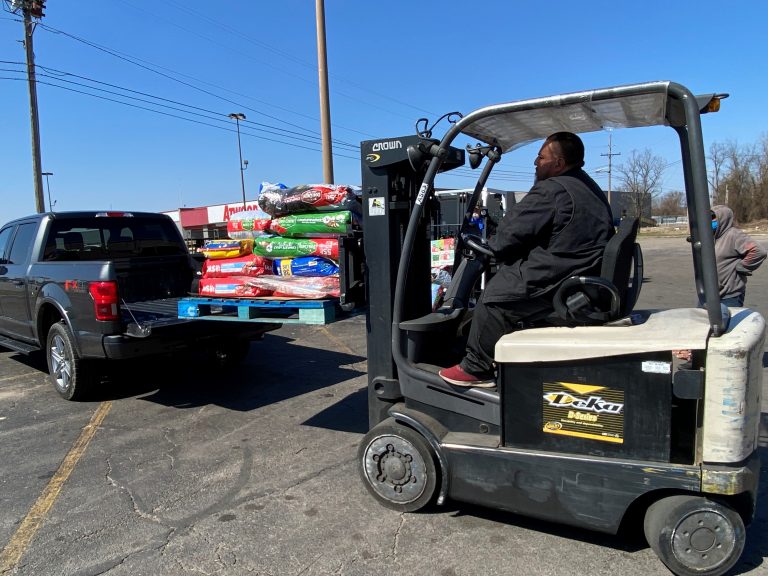
The River Valley Regional Food Bank on Wednesday provided more than 1,200 pounds of dog food to the food bank’s newest partner agency the Artemis Project.

The food bank provided the 1,221 pounds of dog food to the Artemis Project through its partnership with Feeding America, and the Caplan-Bensley Foundation’s Jazzy’s Place Dog Food Initiative.

The Artemis Project is a nonprofit that provides shelter, rescue and adoption services to more than 200 dogs, according to agency volunteer Dana Falleur, who said the agency is grateful to receive the food to help feed the animals.
River Valley Regional Food Bank Director Tracy Engel said not only is it the goal of the food bank to feed the community’s hungry families, but to make sure that our furry friends have shelter and food, as well.

The food bank is proud to work with and support the Artemis Project and its mission, and thanks Feeding America and the Caplan-Bensley Foundation’s Jazzy’s Place Dog Food Initiative for the opportunity to feed hungry animals in need

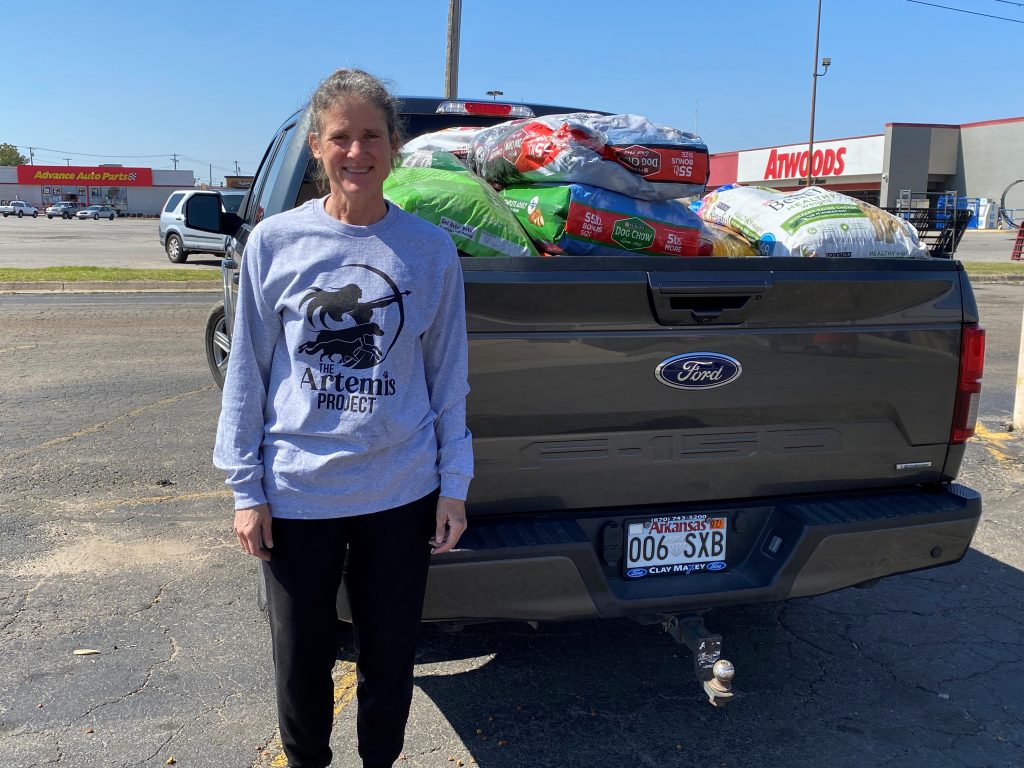
Dana Falleur with the Artemis Project poses with a load of dog food on Wednesday, March 9, 2022.

About the River Valley Regional Food Bank:
The RVRFB, a charitable organization, is based in Fort Smith, Ark., and works to alleviate hunger by acquiring and distributing food to people in need. The RVRFB distributes food to approximately 179 nonprofit food pantries and other nonprofit agencies throughout an eight-county region in West Central Arkansas. The food bank distributes more than 20 million pounds of food each year.

The RVRFB is one of 200 national food banks that make up the Feeding America network, and one of Arkansas’s six food banks that are connected through the Arkansas Hunger Relief Alliance. The food bank is a program of the C-SCDC.
Learn more at www.rvrfoodbank.org.

About the Artemis Project: The Artemis Project Inc 501c3 is dedicated to the rescue and rehab of all homeless animals in the River Valley. Our community’s support has inspired our mission and we are excited to serve the River Valley and its animals!
Learn more at www.theartemisprojectrescue.org.

About the Caplan-Bensley Foundation’s Jazzy’s Place Dog Food Initiative: The Caplan-Bensley Foundation provides dog food to families who are struggling, and thereby saving the life of a dog in need. We understand that when people experience hardships, they may be forced to choose between providing for themselves, their loved ones, or their pet. By giving dog food to those in need, Jazzy’s Place provides an immediate solution to people facing this dilemma.
Learn more at www.caplanbensley.org.

AG Rutledge Top Ten Consumer Complaints for 2021: National Consumer Protection Week: March 6-12, 2022

Of the more than 110,000 calls and emails received by the Attorney General’s Office in 2021, Arkansas Attorney General Leslie Rutledge today announced the top 10 most common consumer complaints. The announcement comes during the National Consumer Protection Week which is from March 6-12, 2022. In 2021, the Attorney General’s Office resolved 6,192 formal complaints. On behalf of consumers, the Attorney General’s Office recovered more than $3.5 million in 2021 compared to $2.8 million in 2020. To file a consumer complaint online, visit ArkansasAG.gov.

“I have continued to do the fighting for you as Attorney General and my office must keep hearing from you to better serve you and your families,” said Attorney General Rutledge. “Every consumer complaint is reviewed and addressed by my team to best determine how we can protect impacted Arkansans.”

National Consumer Protection Week is a partnership with attorneys general from across the country, along with many national organizations including the Better Business Bureau, Federal Trade Commission and AARP, to encourage consumers to understand their rights and make educated consumer decisions.

The 10 most common complaint categories from 2021 were:

  • Auto
  • Consumer goods
  • Scam
  • Home construction, maintenance & repair
  • Satellite, cable and internet services
  • Utilities
  • Consumer services
  • Health care
  • Banking, credit and other financial services
  • Landlord/tenant

Automobile-related complaints were one of the top issues reported to the Attorney General’s Office with 1160 complaints from consumers in 2021. These types of complaints often involve consumers reporting financing errors and high-pressure tactics to buy add-on services at the time of purchase, such as gap insurance, extended warranties and sales misrepresentations.

For more information and tips to avoid scams and other consumer-related issues, visit ArkansasAG.gov or facebook.com/AGLeslieRutledge or contact the Arkansas Attorney General’s Office at (800) 482-8982 or consumer@arkansasag.gov.

Huntington PD Releases Incident Report in Scott County Probe

In a follow-up to the story we brought to you this week regarding an investigation underway in Scott County, the incident report made by the Huntington Police Department, the arresting agency in the case of Robert Lee Deer, Jr., has been released.

The investigation has reportedly been ongoing since the arrest of Deer,49, of Van Buren. Deer was booked into the Sebastian County Detention Center on February 17, 2022, at 1:36 a.m. and charged with assault on a certified law enforcement officer and fleeing.

Deer was granted a signature bond, and released on February 23 at 8:45 a.m.

Deer was traveling through Huntington when Officer Mark Harris attempted to make a traffic stop. Deer failed to stop and the Mansfield Police Department joined in pursuing Deer. That chase continued into Scott County. Officer Harris alerted Scott County of the chase and was informed that the Scott County Sheriff’s Office had set up spike strips in the area near Packsaddle Church. “As we passed the position of the spike strip, a Waldron Police unit driven by Officer Omar Gonzalez got behind the van, taking over the pursuit…I was advised that the van missed the spike strip as we continued to head south coming into the Waldron City Limits.”

According to Harris’ report, Deer made several turns in the city limits but eventually returned to Highway 71. A Scott County Deputy joined in the pursuit. Deputy Spearman attempted to pass and slow Deer, who was driving a 1999 Ford F350 van. As the pursuit neared Echo Road, Stearman again attempted to get ahead of, and slow Deer. The chase would end after Deer collided with a dirt embankment.

“I exited my unit and approached the rear driver’s side of the van and pulled a less than lethal pepper ball gun. The driver had opened the door and I ordered him to get out of the vehicle and go onto his stomach down on the ground. The driver came out of the driver’s side door and laid on his back not listening to my commands. As I instructed the driver to turn to his stomach and show me his hands, he reached for his waistband, in what seemed like an attempt to get something out of his waistband. I concentrated on his hands as he rolled to his stomach and put his hands underneath him. The driver continued to disobey orders to show us his hands and I deployed my JPX Pepperball to the subject’s face, also striking Officer Gonzales with some of the pepper. The driver then placed his hands to his back as all officers were affected by the pepper deployed. At this time, other officers had arrived on scene. I had observed that the driver had placed his hands behind his back after the pepper had been deployed. So, I placed my one free hand on his back to ensure that he did not attempt to get up and escalate the situation and was waiting for another officer to produce handcuffs and place on the subject. At that time, I was still under the effects of the pepper off-spray and when other officers moved in to place handcuffs on the subject, I moved from the area to clear my airway. I turned back to the subject and saw three officers trying to place handcuffs on the driver as he once again refused to place his hands to his back. Once the subject had handcuffs placed on him…Officer Fletcher and I walked the male to my unit and checked him for weapons and placed him in the backseat of my unit. I identified the driver as Mr. Robert Deer by his ID that was located on his person during the weapons search. I then asked Mr. Deer if he knew why I was attempting to stop him, he stated ‘no’. I told Mr. Deer that he had a tailpipe dragging casing sparks and he replied yes, he knew that because it was broken. When asked why he did not stop in Mansfield, Mr. Deer replied that he had broken up with his girlfriend and when I turned on my lights he got depressed and didn’t want to stop. I then assisted Officer Fletcher in searching the van and did not find anything that seemed to cause Mr. Deer not to want to stop. Once the vehicle search was completed, I then transported Mr. Deer to the Sebastian County Detention Center where he was decontaminated from the pepper ball. As I was doing my booking paperwork, I noticed Mr. Deer’s right eye was swollen and there was blood around the area of his face. The following day, Officer Fletcher contacted me and advised that she and her chief had reviewed her video footage of the pursuit and found what appeared to be misconduct that could have led to the injuries sustained by Mr. Deer. I was asked by Chief Robb of the Mansfield Police Department to burn him a copy of my camera footage of the incident so that he could see a different perspective of his officer’s conduct in the event that occurred. A copy of the incident was given to the Mansfield Police Department as well as my City Attorney.”

Freedom of Information Act requests were made to all of the departments involved. Both the Mansfield Police Department and the Scott County Sheriff’s Office stated that because their department was not the arresting agency, no incident reports were made. The City Attorney for Waldron, Mark Johnson, responded and denied the FOIA request on the basis that the information requested was part of an ongoing investigation.

Resident News is monitoring this story and will continue to follow it and bring you updates.

Valley Springs takes Arkansas high school archery championship; Charleston dominates elementary and middle school divisions

Randy Zellers Assistant Chief of Communications

HOT SPRINGS — Valley Springs High School took the top spot in the High School Division of the Arkansas Game and Fish Commission’s Archery in the Schools State Championship held Saturday at Bank OZK Arena. Charleston claimed first place in both the Elementary and Middle School divisions, which were held Friday at the same location.

A single errant arrow separated the scores between Valley Springs and second-place finisher Bergman High School, with the two juggernauts posting final scores of 3,260 and 3,258, respectively. Alpena High School posted a score of 3,250 to round out third place in the High School Division.

Valley Spring High School’s first-place showing was anchored by standout performances by Luke Vail and Trent Mudgett, who ranked second and third, respectively, in the overall individual male archer scores, but all members of the team performed admirably during the competition. Bergman’s archers included the top-ranked female archer, Emilee Evers.

Charleston’s elementary and middle schools took control of their divisions, outpacing the competition by fairly large margins. In the Middle School Division, Charleston posted a score of 3,218 points to drive home the win over second-place Washington Middle School of El Dorado, which finished with a still-impressive 3,154 points. El Dorado Barton Junior High came a few arrows short of second, taking home a third-place trophy with a score of 3,127.

Charleston Elementary’s final score of 3,038 was enough for the win over Hill Farm Elementary’s second-place posting of 2,878 points.

In addition to team rankings, each archer’s score was tallied individually and the top archers in each division were awarded special prizes for their outstanding achievements. In the High School Boys Division, Landon Jackson of Greene County Tech High School took first place with a score of 289. Vail and Mudgett from Valley Springs both shot 284, with Vail taking the second-place spot based on more total hits to the bull’s-eye during the competition. Dylan Brown of Waldron High School took fourth and Ben Paxson of Southside High School placed fifth.

Evers of Bergman High School claimed the top spot among female archers at the high school level with the high school tournament’s top overall score of 290. Peyton Williams of Cabot Freshman Academy scored a 285 to capture second place, while August Alvis of Acorn High School, Alyssa Murray of Cabot Freshman Academy and Emmalee Rogers of Bergman High School rounded out the top five.

The Middle School division actually had the two most accurate archers of the entire tournament with Charleston Middle School’s Maddison Johnson and Ryan Polk of Washington Middle School both scoring a 291, higher than even the high school archers. These two will definitely be ones to watch in future years as favorites for the title. In elementary schools, Amber Bergen of Hill Farm Elementary in Bryant took top honors with a score of 276 and Jaxon Hutchins of Collegeville Elementary in Bryant placed at the top of the boys division with a score of 274.

All archers who won their division in individual competition were awarded a competition Genesis bow, similar to those shot during competition, and a field archery target. The top five individual archers in the High School Boys and High School Girls divisions also received scholarships ranging from $2,500 for first place to $500 for fifth.

Students from 94 schools competed in this year’s tournament based upon their performance at regional tournaments held in early February. The top two teams in each division from each region received bids for the title, as did the 10 next highest scoring teams in each division, regardless of region. Additionally, top individual archers were able to attend and compete on an individual basis even if their teams did not have a strong showing at regional tournaments.

“We choose participants for the state championship this way so archers competing in strong regions are represented as well as archers from across the state,” Curtis Gray, Archery in the Schools Program coordinator, said. “This tournament had the best young archers in Arkansas shooting it out for the top prize.”

Salem Elementary in Bryant and Cabot High School each earned the Joe Morgan Award, a special award of $1,000 for bringing the most food to the Arkansas Hunters Feeding the Hungry food drive held in conjunction with the tournament for Project Hope Food Bank in Hot Springs. The money from this award was derived directly from donations from each sitting Arkansas Game and Fish Commissioner and AHFH and can be used to help the team with any expenses associated with participating in the program, such as equipment and travel costs. According to Ronnie Ritter, AHFH executive director, 5,520 pounds of food were delivered to Project Hope as a result of this year’s effort.

Gray said he was very appreciative of all the coaches, school administrators and families who supported the kids and made the event a success. Last year’s event had to be staged virtually because of Covid-19 protocols at the time.

“We had great attendance this year and you could tell a lot of people really wanted to be there,” Gray said. “When we looked around on the first day and took a look, it was really amazing to see everyone show up to have a good time cheering these kids on.”

Tabbi Kinion, AGFC chief of education, said parents and students commented throughout the weekend about how appreciative they were of the in-person state championship being available this year.

“Every student and parent left the convention center more connected to our agency and our staff,” Kinion said. “For these students, this leaves a lifelong positive impression of our agency and they walk away with skills that will help them enjoy the outdoors.”

The Arkansas Game and Fish Commission’s Archery in the Schools Program teaches students the sport of archery using modern compound bows that will fit a wide range of users. Teachers and other school staff learn from the AGFC’s archery instructors how to bring this sport back to their students and offer them an alternative sport that children of nearly any size and ability are able to enjoy.

Visit www.agfc.com/anasp for more information about Archery in the Schools and a complete list of team and individual scores. More pictures from the event are available at the AGFC’s Facebook page, https://www.facebook.com/ARGameandFish.

Obituary – Cheryl Dianne (Murphrey) Evans (1948-2022)

Cheryl Dianne Woodrum Evans went to her Heavenly home on Friday, March 4, 2022 in Roanoke, AL. Dianne was born December 21, 1948 in Dallas, TX to Hubert Murphrey and Pauline Davis Murphrey. She was 73 years old.

Dianne was of the Baptist faith and a homemaker. She was one of the most selfless people you could ever meet. Being a devoted mother and grandmother, she cherished time spent with her family and friends more than anything.

Dianne is survived by her children, Shane Woodrum and wife Cheryl of Waldron, AR, Dana Adamson and husband Willis of Roanoke, AL, Beth Milligan of Waldron, AR, and Jimmy D. Woodrum of Waldron, AR. Nana will be dearly missed by her grandchildren, Cody and Julie Woodrum, Tayler and Dylan Staggs, Whitney Woodrum, Devin and Tess Sims, Hunter and Kelly Sims, Dustin and Denora Milligan, Cory and Jordan Milligan. Nana will forever remain in the hearts of her 13 great-grandchildren. Dianne is also survived by a sister of the heart Cheryl Lee.

Dianne is preceded in death by her parents, husband, Jimmy Woodrum, husband, Tom Evans, and nephew, Wade Martin.

Dianne’s life celebration will be 2:00 p.m., Saturday, March 12, 2022 at the Heritage Memorial Funeral Home Chapel in Waldron, Arkansas. 

Police Investigation Underway in Scott County

An investigation is underway in Scott County involving multiple law enforcement agencies.

The investigation has reportedly been ongoing since the arrest of Robert Lee Deer Jr.,49, of Van Buren. Deer was booked into the Sebastian County Detention Center on February 17, 2022 at 1:36 a.m. and charged with assault on a certified law enforcement officer and fleeing.

Deer was granted a signature bond. He was released on February 23 at 8:45 a.m.

Deer was traveling through Huntington when Officer Mark Harris attempted to make a traffic stop. Deer failed to stop and the Mansfield Police Department joined in pursuing Deer. That chase continued into Scott County.

Deer was reportedly apprehended near the Scott and Logan County line. Additional agencies involved include the Waldron Police Department, and the Scott County Sheriff’s office.

Officer Harris transported Deer to the Sebastian County Detention Center, where he was booked into custody. According to Huntington Mayor Gary Lawrence, charges against Deer have since been dropped.

As of press time, no police incident report has been made available. Requests were made to all of the departments involved. Both the Mansfield Police Department and the Scott County Sheriff’s Office stated that because their department was not the arresting agency, no incident reports were made. The attorney for the City of Waldron, Mark Johnson, responded and denied the FOIA request on the basis that the information requested was part of an ongoing investigation.

Huntington’s City Attorney John Verkamp denied the Freedom of Information Act request to provide an incident report, stating “the matters involving Robert Lee Deer and the police officers of various law enforcement agencies are currently the subject of investigation. It is my understanding that the Arkansas State Police is investigating the incident. The local law enforcement offices, including the City of Huntington, are investigating the incident.”

Resident News is monitoring this story and will continue to follow it and bring you updates.

Castile Soap- the Everything Soap

What if you could buy one thing for your entire house’s soap? Well you can! Castile soap is the answer for your soap needs and best of all it’s natural!

Castile soap is a vegetable-based soap, it is naturally nontoxic and biodegradable. Castile soap was traditionally made out of olive oil, and gets its name from where it originated in the Castile region of Spain.

Nowadays Castile soap is made from coconut, castor, hemp, avocado, walnut, or almond oils. The oils are what cause the soap to lather and moisturize.

One bottle or bar of Castile soap can replace a variety of products in your house that may be comprised of more harmful chemicals.

Castile soap can be used for a multitude things depending on how you dilute it and what you add with it.

  1. Dish soap- for liquid dish soap add 1 part Castile soap to 10 parts water. 
  2. Window cleaner- skip the stinky Windex and use 1 tablespoon of Castile soap in a quart of water.
  3. Face wash- gentle enough for your sensitive skin on your face, rub a couple drops of neat Castile soap and rinse with water
  4. All-purpose household cleaner- use 1 to 2 cups of soap in one quart of water, add to spray bottle and use for cleaning.
  5. Laundry soap- add 1/4-1/2 cup of Castile soap in the washer, high efficiency washers using less.

When using Castile soap it’s best to make sure you aren’t using hard water as it can use a white film. Distilled water is perfect, or water that’s not hard from the tap works well.

Do not use Castile soap with vinegar, the substances cancel each other out and cause the soap to turn back to just oils. Avoid combining it with lemon juice also.

If your family has allergies to scents or is just looking to find more natural options for your home Castile soap is something to look into!