We would like to take a few minutes and recognize our 5th grade January students of the month. Teachers nominated a male and female student for their hard work and positive attitude that they have displayed throughout this current school year. Our young man that has been selected as the 5th grade student of the month for January for many different reasons, Joseph Carter is a hard working student that is beginning to flourish at the middle school. He has been chosen by his teachers for his great attitude and leadership skills he personifies throughout the school day. Shyla Byers is the 5th Grade January female student of the month. Shyla continues to work hard every day and sets a good example for all of her peers to follow.
We are extremely proud to have such great students at Mansfield Middle School and we are even more encouraged by the presence their parents are making in their life. Each student continues to lead their peers by positive examples and we will be saddened by the day these two young people move to the high school. Congratulations Joseph and Shyla!
5th Grade Shyla Byers
Favorite Food: Pizza
Favorite Subject: Math
Hobbies: Riding my
bike
Favorite Movie: Nutcracker
Favorite Book:
Charlotte’s Web
Embarrassing
Moment: Way to embarrassed to say.
Happiest Moment: When
my baby sister was born
Future Aspirations: A
police officer
Favorite Color:
Purple
Funniest School Memory: When people fall out their chair
5th Grade Joseph Carter
Favorite Food: Pizza
Favorite Subject: Keyboarding
Hobbies: Playing
Fornite
Favorite Movie: The Notebook
Favorite Book: Stick
Dog
Embarrassing
Moment: When I got a bad grade.
Happiest Moment: When
I scored a buzzer beater.
Future Aspirations:
To play in the NBA
Favorite Color: Gray
Funniest School Memory:
I tripped into an endless roll
Lavaca School District was pleased to announce that Lavaca Middle School has been Nationally recognized as an ESEA Distinguished School. Lavaca Middle School posted the following on their Facebook account.
Steve Rose (Lavaca Schools Superintendent), Kenny Holland (Lavaca Middle School Principal), Krysta Winchester (Lavaca Middle School Teacher), and Brooka Meredith (Lavaca Middle School Teacher), pictured here with Arkansas Department of Education representative Otistene Smith, were in Kansas City, MO today to accept an award for closing the achievement gap between student populations.
See the original press release below.
The National Association of ESEA ( Ensuring Student Equity and Access) State Program Administrators (NAESPA) is pleased to announce that Lavaca Middle School from Lavaca, Arkansas has been named a National ESEA Distinguished School by the state education agency in Arkansas. Lavaca Middle School is one of up to 100 schools throughout the country that is being nationally recognized for exceptional student achievement in 2018.
A project of the NAESPA, the National ESEA Distinguished Schools Program publicly recognizes qualifying federally funded schools for the outstanding academic achievements of their students. It highlights the efforts of schools across the country making significant improvements for their students. The program has been in place since 1996, showcasing the success of hundreds of schools in one of three categories:
Category 1: Exceptional student performance for two consecutive years Category 2: Closing the achievement gap between student groups Category 3: Excellence in serving special populations of students The Elementary and Secondary Education Act (ESEA) provides additional resources for vulnerable students and federal grants to state educational agencies to improve the quality of public elementary and secondary education.
The Association is a membership organization made up of State ESEA Program Administrators, and their staff from each of the states and territories, charged with managing their state-federal education program. They ensure compliance with federal regulations, but more importantly, work to see that all children — especially those living in economically disadvantaged conditions — have the opportunity to receive a high-quality education.
NAESPA implements the National ESEA Distinguished Schools Program to highlight selected schools that have successfully used their ESEA federal funds to improve the education for all students–including economically disadvantaged students. More information about all National ESEA Distinguished Schools is available on the ESEA Network website: www.ESEAnetwork.org
As reported this morning, the Mansfield School District has been hit heavily by the flu virus. The district sent out messages to parents advising them to take precautions at home to prevent its spread. On Wednesday, Superintendent Robert Ross said the school is doing its part to combat the virus.
“We’ve started spraying the school campuses, especially the middle school,” said Ross. The middle school has been reportedly hit the hardest, specifically the seventh and eighth grades.
Ross added that they have also added multiple hand sanitizing stations at all three campuses and are planning to spray the buses.
The machine the school purchased last year disinfects all hard surfaces, and has been a great asset for combating the virus’ spread.
Ross also noted that the school will bus sick students to Mercy Clinic, which is located at the elementary school, with the parents permission. “It’s a good service, working parents don’t have to leave their job and we keep them informed about the student,” Ross concluded.
Former Mansfield Elementary teacher, Kristen Wheeler, is battling for her life due to cancer. As a community, we can help! An account has been set up at Farmer’s Bank called, “Kristen Wheeler Benefit Account.” If you would like to donate and help this loving family, you may give at any Farmer’s Bank location.
Almost two years ago, Kristen Wheeler, former Mansfield Elementary teacher, received the news that no one ever wants to be told. She had thought she had a stomach bug and had been instructed to go home and get rest and fluids. Time passed by, and Kristen again thought she was battling mastitis. As a young woman in her twenties, she never had thoughts that these were signs of breast cancer. More time passed, and in May she felt like she had injured her back in some way. They made a trip to their local family doctor in Fort Smith, and that is where Kristen’s life changed forever.
After tests were run, she was diagnosed with stage IV breast cancer and a collapsed vertebra. The back pain was due to the crushed C7 where a lesion had eaten on Kristen’s spine from the breast cancer. The calcium from the C7 dissolving was literally killing her kidneys. Kristen was immediately life flighted to UAMS, and it is there the doctors began to work to help bring back some normalcy to Kristen. She underwent surgery and received plates and rods in her neck to repair the damage from the cancer and a cancer treatment plan went into place.
Kristen didn’t give up fighting. However, the cancer continued to attack. Some time later, spots of cancer appeared on the fluid outside of her brain, and Kristen once again underwent surgery.
Then, a week after Christmas, Kristen developed a cough, and she was hospitalized. She was delivered the news that now, spots of cancer are showing on her lungs and liver. She fought hard that week to return home on oxygen and after a week stay in the hospital, she was finally home once again. She then began chemo treatments.
Right before Kristen went in for her 3rd chemo treatment, she began to struggle breathing and was rushed to the hospital again. Kristen is now in ICU and fighting for her life.
Kristen and her husband, JR, have been through so much, yet in the past two years have gave to our surrounding communities while in the midst of their own battles. The Wheelers had just began building Roo Doo’s Wildlife Park when Kristen was diagnosed with breast cancer, and although it has slowed down the process, the Wheelers still want to continue building the zoo. However, their first priority is getting Kristen well, so she can return home to be with their two beautiful daughters and family.
Kristen has personally touched the lives of so many she has came in contact. A former student’s father recently said, “Mrs. Wheeler made the difference in my son’s life while she was at Mansfield. If it wasn’t for her, I don’t know where we would be with our son.”
Another teacher at Mansfield said, “Kristen was always going above and beyond to reach students and have fun learning.”
It’s no secret, when you talk with Kristen that teaching and helping students learn to read is her passion. Kristen is also a certified Dyslexia coordinator and was just teaching for Arkansas Virtual Academy this past semester, until she had to quit due to the cancer. The Wheelers just recently made a trip to Mansfield and Hackett schools to introduce their “Wild About Reading Program” where they passed out free books to the entire elementary schools.
Even though cancer has been attacking, Kristen has not given up fighting. As a community, we need to give back to those who have gave to us. If you are interested in helping, a benefit account is set up at Farmer’s Bank called, “Kristen Wheeler’s Benefit Account.” You may give at any Farmer’s Bank location. Most of all, we ask for you to pray for Kristen and her family as they continue to fight for healing and a miracle for Kristen’s life.
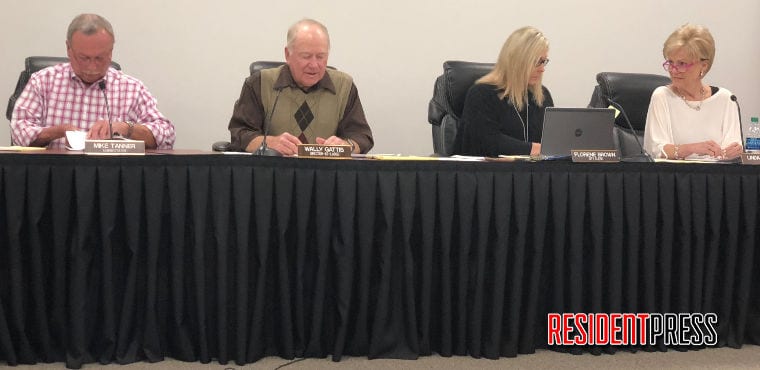
Barling City Administrator, Mike Tanner, has been suspended with pay following an incident that took place on Thursday, January 24.
Barling Police Chief Jerry Foley said Tanner reportedly lost his temper, and “went off on a city worker.” The police department responded, but upon investigation found that there was no criminal action that had taken place.
The Barling Board of Directors were contacted and held a special meeting to discuss further actions. After meeting in executive session, the board voted to suspend Tanner with pay until February 12.
Following that meeting, officers with the Barling Police Department accompanied several city employees home as a “precautionary measure.” Foley said, “There was no direct threat, but I feel strongly about making sure my officers and the citizens are safe.”
Currently, an internal investigation is underway. “They are talking with those employees that were here that day and those who heard what went on,” Foley added.
The Barling Board of Directors will meet on February 12, and make a determination on whether or not to extend Tanner’s suspension.
One of the things the students have done is hand knit warm beanie hats to donate to the homeless shelter.
They spent several weeks in advance preparing the hats on their own time. In addition, these students served breakfast to all of our staff for a Staff Kindness Breakfast.
During my career as a police officer, I’ve seen the era of community policing evolve. How many of us can recall the D.A.R.E. car visiting your local school and having an officer speak about the dangers of drugs? This was an early program to get officers invested in the schools and speak on the dangers of drugs. Unfortunately, the program was somewhat unsuccessful until it was modified in 2009 and geared to middle school students across the country. Long lectures were replaced with more interactive exercises. Just as this program was modified, so has moving to a community policing form of operation. Community policing dynamics involves getting officers invested into the neighborhoods. Community policing is built on one central theme. Trust.
Community Policing is defined as a philosophy that promotes organizational strategies, which support the systematic use of partnerships and problem-solving techniques, to proactively address the immediate conditions that give rise to public safety issues such as crime, social disorder, and fear of crime.” While this definition may seem complex, the use of community policing is more than just a tool for law enforcement, it has become the norm.
Community policing involves embedding officers into the neighborhood not just in a law enforcement role but as an active member of the community. Studies show that community policing improves confidence and builds trust within the neighborhood. As officers become fixtures in the neighborhood, it helps establish a relationship with the residents.
After I became Chief of Police of Hackett in 2013, I decided to implement this form of policing in our department. It takes the support of not only the community but the city administration to function properly. The administration must be willing to trust the officers within the department and judge performance not just on ticket numbers and arrests but positive response from the community.
What I found after moving to the community policing model is that the community learns to trust your department. They see you interacting with the school and in the neighborhood. Your officers become not just ticket writers but a resource for the community and someone they can come to in a time of need. The officers are reflections of the community. Community policing does not mean soft on crime. In fact, it’s just the opposite.
Community policing has also resulted in the community feeling comfortable coming to you with information. The results of this information often lead to more arrests and safer communities. In five years, drug arrests in our department are up over 700% compared to the previous five years, DWI arrests over 100%, and overall crime down over 50%. It’s not by chance. It’s due to hard work by the officers in being proactive while also using information provided by the community to help make it safer. Will there ever be a community without crime? No. Mayberry doesn’t exist. We still have crime but with the valuable input we receive from our community our chances improve at helping solve those crimes. With a small department, members of our community provide us more eyes and ears. Community involvement is essential for the program to work.
Community policing involves being able to interact with the community. Often times this is through social media. Social media enables the department to provide information to the community in minutes. It also allows residents of the community to provide officers information such as security checks on their homes and businesses while they’re away or suspicious activity on their street. It also enables the department to show their sense of humor on occasion. See photo below.
Community policing makes officers more visible in the community. The more visible these men and women are, especially in the schools, the stronger the relationship becomes with the community.
The Mansfield School District have notified parents and guardians that it is flu season, and that several students are out or have been out with the flu.
Additionally, the district precautioned parents to remind youngsters to practice good hygiene in order to prevent its spread.
A Western Arkansas School District has already closed their campus until next week in an attempt to prevent further illness.
The number of flu related deaths, according to the Arkansas Department of Health, has risen to 17. However, the season has not yet peaked.
ADH is also reporting to the Centers for Disease Control and Prevention that the flu is widespread in the state with Sebastian County being among those counties with the majority of cases.
As recommended by the MSD, here are a few tips to follow to help prevent the flu virus and its spread.
By Jack James (original article published January 29, 2019)
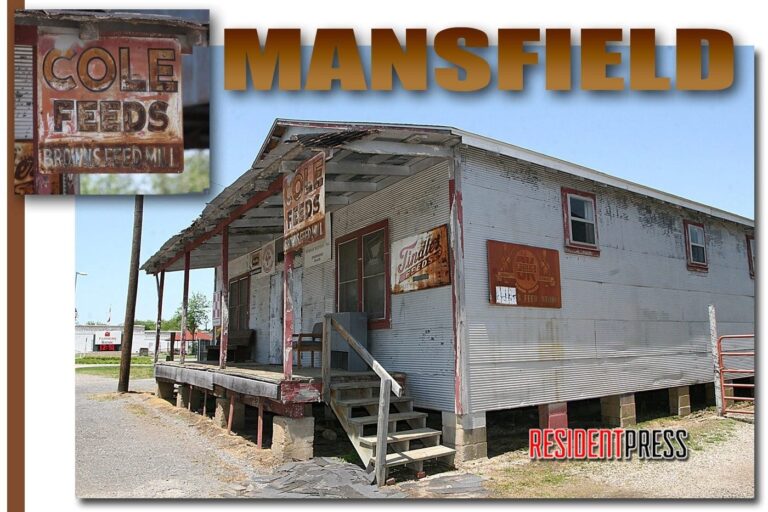
In every community, there is a meeting place; a spot where all the older men meet and greet each other to share the latest news, a recent coon hunt or reminisce about the past. In Mansfield, that was Johnny Brown’s Feed Store.
Johnny was born on January 31, 1921. His father, Grover Brown, was a Mansfield businessman, owning two cotton gins from 1890 to 1932. Johnny’s grandfather, John Calvin, came to America by stowing away on a ship from Switzerland at the age of sixteen.
Johnny Brown opened his first feed store in Mansfield in 1950 in a brick building across from the Roy Cross Lumber yard. (That building is gone). He ran a creamery in the store too, with people like Bobby Traylor’s family who were one of the families that brought cream to feed store. In 1964 the feed store was moved to the building it occupied until the business ended.
The Feed Store was an adventure to behold. As you drove up to the loading dock/front porch, you notice all the trucks that were parked around the store and in the parking lots of neighboring buildings. You’d think that something big was happening, and there was: it was Saturday morning and it was time to gather at Johnny Brown’s.
Walking up the heavy worn wooden steps led you to the loading dock of more worn wood and the corrugated sheet metal (tin) store front. All kinds of metal signs adorned the frontage, advertising major feed sellers like MFA, OK Feeds and Tindle Feed. From the moment you stepped out of your vehicle, men would call you by name and begin teasing with you about something.
There are two things I remember as I would enter the double doors into the store: the breeze that come completely through the warehouse would almost knock you down and the wonderful smell of animal feed. A long and wide path went from front to back and all sorts of feed for any animal that was being raised in the county was stacked in neat rows from the path to the outside walls. On the right of the entry was a collection of anything a farmer may need hanging from hooks, nails or from the rafters that exposed the unfinished ceiling to the sheet metal roof above. A wooden cabinet with open bins held some of the feed as well. If you needed a fifty-pound bag of chicken feed, Johnny or one of his employees would take it to your truck or to the loading dock. But if you needed just a pound or two of chops for your chickens, paper bags were there for you to fill with a metal scoop. A scale hung nearby for you to weigh your filled sack. Johnny took your word that it was what you said. Johnny would take off in his big red truck and go after special feeds from Joplin or Springfield, Missouri or over to Muskogee, Oklahoma.
On the left of the front entrance was Johnny’s office. A dated Coca-Cola machine guarded the door into the inner sanctum of Johnny’s business. Tall counters with slanted tops made it easy to write the tickets. An old cash register rang loud bells when Johnny pushed the appropriate key down and the cash drawer popped open. An old oak office chair was against the double windows that looked out toward the activity on the porch. The office was chaos. Nothing was organized yet he knew exactly where everything was. Johnny would tease his customers just like the men outside would and expected to be teased back. He called me “Little Jack” since my father was also named Jack. All girls were called “Little Ladies.”
He loved to be with people and loved kids. The big overalls he wore contained a big man with a big, compassionate heart. He was also a practical joker. He and a buddy Willis Harrison placed persimmons in a very large glass jug. They filled it with water and added some orange food coloring. Johnny made a sign for the jug that said, “DO NOT OPEN! Making persimmon beer!” Three of the town’s church ladies chastised him for making his “beer.” It wasn’t long before he got a call from two of the women wanting the recipe!
Johnny Brown was a Masonic Mason of Reid Lodge # 163 F&AM, a Fire Chief and of the Methodist faith. When he passed away on March 27, 1993, the heart of the feed store died with him. A couple of businesses have been in the building but it sits empty today on Mansfield’s main street, reminding us all of the wonderful times we had there.
(Photo courtesy of Duane Whitsett. Deborah Brown Musgrove interview.)
On Monday, January 28, the Arkansas House voted to cut concealed handgun license fees.
That measure was approved by a vote of 74-18. The house bill would cut the filing fee for a concealed handgun license from $100 to $50. The license renewal fee would also be cut in half, from $50 to $25. HB1036 now heads to the Senate.
Governor Asa Hutchinson has said he will back the bill and supports the cut. Arkansas collected $3.1 million in revenue from concealed carry licensing fees in 2018. The Arkansas State Police receives the majority of income from concealed carry licensing fees.
On the same day HB1036 passed in the house, House Resolution 1013 was introduced. Representative Brandt Smith of Jonesboro introduced the resolution, and is also a co-sponsor of HB1036.
HR1013 was filed to clarify gun rights and to recognize the Taff v. Arkansas ruling. In that ruling, the court of appeals affirmed that Arkansas is a constitutional carry state. -See related story.
Proponent of that resolution, Gary Epperson said, “The House may have voted to cut the fees for concealed carry, however, as the appeals court ruled on Taff v. Arkansas, we are a Constitutional Carry State and no permit is required in state. HR1013 will allow the House to officially recognize it.”