

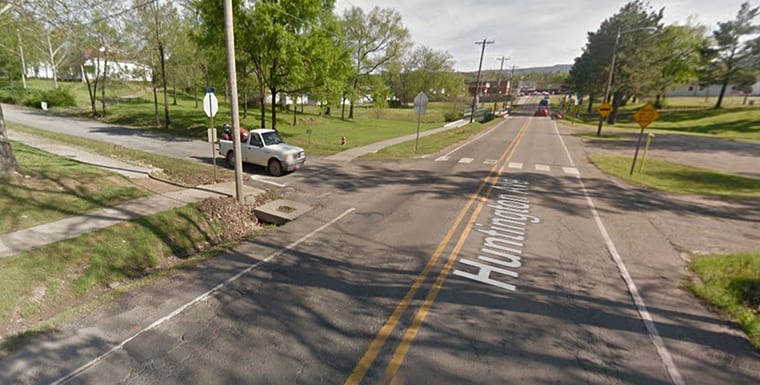
We’ve recently received two complaints over their concern of the crosswalks at the intersection of Huntington Avenue, and Grove Street in Mansfield, which is not only busy with kids using the crosswalk, but vehicles coming in and out of the School Zone, picking up, and dropping off children, plus normal traffic unrelated to accessing the school.
With one crosswalk crossing Huntington Ave. (Highway 96), which is always busy with traffic, and the other crossing Grove St. (East & West in front of Mansfield Middle School) which sees high traffic between 7:30am – 8:00am, and 2:45pm 3:30pm, each day. It’s fairly common to see at least 4-6 kids using both crosswalks before, and after school, and so is the travel paths of parents.
The RED ARROW in the below image points to the intersection of the crosswalk that’s mentioned above.

“I have seen numerous vehicles not stop for kids attempting to cross the street going to school at the intersection near the Dollar Store and the bridge. A child is going to end up getting hurt by a vehicle not paying attention. There are no cross walk guards, and people are too worried about getting in and out of there, not the safety of the kids in our community.”
“I am one of many parents who sit and watch cars rarely stop for kids in the crosswalk at Grove street and Huntington Ave before and after school. Cars go in and out very quickly, without any concern for the kids. Once car sped thru the crosswalk with two girls in the crosswalk. An SUV sits stopped in the crosswalk and kids have to walk around to make their way across the street. It’s only a matter of time before there’s a wreck or kid is hurt.”
Images provided by Google Earth, and Google Maps









A raised bed—essentially a large planting box—is the ultimate problem solver: It offers perfect drainage, protection from pests, and easy access to crops. And it’s just the thing to turn your backyard into the farm of your dreams. Follow our directions, and you’ll be able to build the 4- by 8-foot bed pictured here as a weekend project. Design: Sunset garden editors Johanna Silver and Lauren Dunec Hoang

- Four 16-inch-long 4-by-4s* ($15), to act as corner posts
- Two 4-foot-long 2-by-12s* ($35), for bed ends
- Two 8-foot-long 2-by-12s* ($65), for bed sides
- Twenty-four 3 1/2-inch #14 wood screws ($5)
- Twenty-four 1/2-inch #8 wood screws ($5); optional
- Six 12-inch-long pieces of 1/2-inch PVC pipes ($3); optional
- Three 10-foot-long pieces of 3/8-gauge rebar ($10); optional
- Three 3- by 5-foot rolls of 1/4-inch-mesh hardware cloth ($40), to deter burrowing animals; optional
- Twelve 1-inch galvanized tube straps ($5); optional
- 1 roll bird netting or floating row cover ($25); optional
- 16 cubic feet of planting soil ($55 if bought in bulk; $85 if bought in bags)
- 16 cubic feet of compost ($60 for bulk; $85 in bags)
- Drip-watering system; optional
Total cost: $235 for raised bed with soil (bought in bulk; $290 with soil bought in bags). Prices may vary.
Tools
- Drill
- 5/32-inch drill bit
- Pencil
- Ruler
- Shovel or trowel
- Level (optional)
- Gloves
- Staple gun
- Wire cutters
- 4 adjustable woodworking bar clamps: 2 short (12 inches) and 2 long (6 feet); optional
*A note on the lumber: For our side and end boards, we selected sustainably harvested “construction heart”—or con heart—redwood that we ordered at a lumberyard. Con heart is cut from the center of a log and is the most rot-resistant. We used boards that are 12 inches wide, giving us a full foot for plant roots to thrive. To save time, we asked the lumberyard to cut the wood to the lengths we needed. (You’ll need a table saw if you’re making the cuts yourself. Be sure to measure twice and cut once, as pieces of wood often vary slightly in their listed lengths, and you’ll need the sides and ends of your bed to be exact.)

You’ll build the bed upside down. Working on a flat surface (such as a patio), set a 4-foot 2-by-12 board on its narrow side edge on the pavement; at one end of the board, place a 16-inch 4-by-4 corner post upright and flush with the end of the board. Use two adjustable woodworking clamps—or a buddy—to keep both pieces of wood flush on the sides and bottom.

Before securing the post to the 4-foot board, help prevent the wood from splitting by predrilling three evenly spaced holes in the board with the 5/32-inch drill bit. Then secure the board to the post with three 3 1/2-inch screws. (Once the board is secured to the post, you can remove the woodworking clamps if using.)


With help from a friend, flip the bed right side up and move it into position. If you plan on growing vegetables, choose a spot in your garden that receives full sun—meaning at least 6 hours of sun per day. A north-south orientation of the bed will give you even sun exposure.

Once you’ve decided on a bed location, dig a 5- to 6-inch-deep hole for each of the corner posts. Then sink each post into the ground.

Make sure the bed is level on all sides (using a level if you have one); this will ensure that irrigation percolates evenly. Then backfill the corner holes with dirt to steady the posts.

To give your vegetables an edge on birds and frost, consider adding hoops to hold up bird netting or a floating row cover. If you want to add these three optional hoops, attach their PVC support tubes now (before you fill up the bed with dirt).
Here’s how: On the inside of each of the long (8-foot) sides of the raised bed, evenly space three of your 12-inch pieces of 1/2-inch PVC pipe. Set those pipes upright against the bed sides, making sure that each PVC pipe has a parallel pipe mirroring it across the bed (so each pair can act as support tubes for the hoops).
Secure each PVC pipe upright to the inside of the bed with two tube straps, using two 1/2-inch screws per strap.

You don’t want to share your vegetables with gophers and moles. If they’re a problem in your area, keep them out of your raised bed by adding a layer of hardware cloth before you pour in your planting soil.
Here’s what to do: Rake existing soil at the bottom of the bed to level it, then tamp it smooth. Wearing gloves, line the bed bottom with hardware cloth, making sure that the cloth is lying flat on the bottom and curving up to touch each side of the bed. Secure the cloth by stapling it to the sides of the bed. Use wire cutters to trim excess cloth and to help the cloth fit flush around the corner posts.

Fill the bed with a 50/50 mixture of planting soil and compost. (You can buy both in bags at a garden center, and you can typically save money by buying both in bulk at a local soil yard.) Once the bed is filled, rake the soil smooth and moisten it with a gentle spray from the hose.

If you’ve got a drip system, simply connect this bed to your existing irrigation line. To cover our 4- by 8-foot bed evenly, we added 1/4-inch emitter lines (spaced every 12 inches) to 1/2-inch tubing.
More: How to set up your own drip irrigation system

Your bed is ready to get growing with fruits, herbs, and vegetables. Learn where to start with our complete guide to growing edible crops.


